


Overview
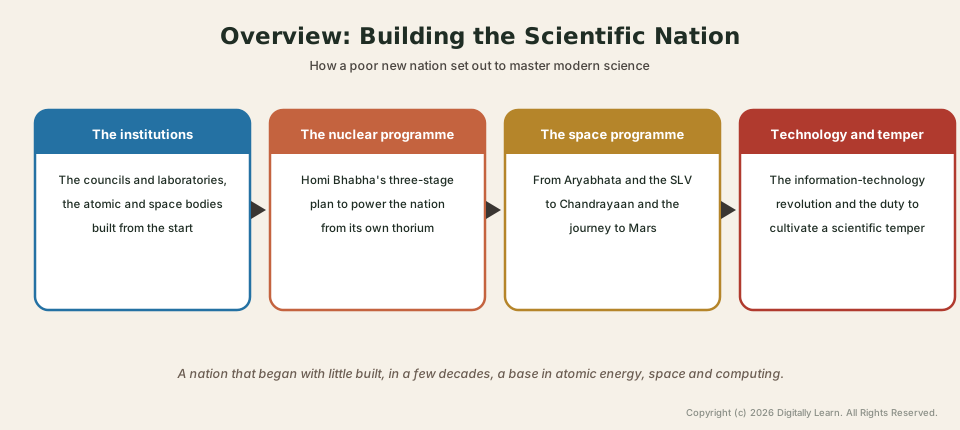
Science, technology and space were, for the founders of the republic, not a luxury but a necessity, the means by which a poor and newly free nation would lift itself and stand on its own. From almost nothing, the state built a network of institutions, an ambitious nuclear programme under Homi Bhabha, a space programme under Vikram Sarabhai that carried the country from its first satellite to the surface of the Moon and the orbit of Mars, and, later, an information-technology revolution. This part follows that long effort to master modern science in the service of development and self-reliance.
Science and the Building of a Modern Nation
Why a Poor New Nation Chose to Master Modern Science
Why this matters: A country as poor as India was in 1947 might have been expected to leave the costly sciences to the rich nations and buy what it needed. The founders chose otherwise, judging that real independence required scientific self-reliance, that a nation which could not build its own reactors, satellites and computers would remain dependent however free its flag. The decision to invest in science, against the pressure of immediate poverty, was one of the boldest of the early republic.
What is the significance of this effort: It built, in a few decades and from almost nothing, a base in atomic energy, space and later computing that few developing nations have matched. The science of the republic served both prestige and use, lifting India's standing in the world while turning its tools, the weather satellite, the high-yielding seed, the remote-sensing image, to the practical work of development. This part traces the institutions, the programmes and the milestones of that building.
The Institutions of Indian Science: From the AEC to the Policy of 1958
How the State Built the Bodies to Carry the Scientific Effort
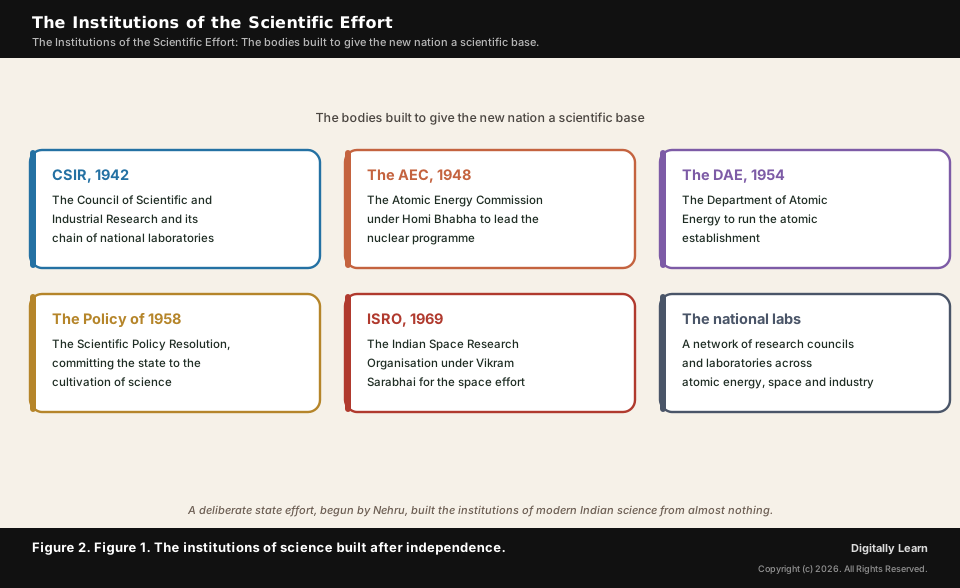
Distinguishing the institutional foundation: Indian science rested on a deliberate effort of the state, driven by Nehru, who saw the laboratory and the dam as the temples of a modern India. The Council of Scientific and Industrial Research, founded in 1942, built a chain of national laboratories; the Atomic Energy Commission of 1948 and the Department of Atomic Energy of 1954, under Homi Bhabha, led the nuclear effort; and a network of research councils came to cover agriculture, medicine and industry.
The effort was given a formal charter. In 1958 the government adopted the Scientific Policy Resolution, committing the state to foster, cultivate and sustain the pursuit of science, to develop scientific manpower and to ensure that the benefits of science reached the people. It expressed the conviction, central to the Nehruvian vision, that science and technology were the key to the country's progress, and it gave the scientific establishment a place at the heart of national policy. The figure below sets out these bodies.
Observable outcome: By the 1960s India possessed a dense framework of scientific institutions, public and well-funded, that few nations of its income had built. The framework had its critics, who charged it with elitism and a distance from the everyday needs of the poor, but it gave the country a capacity in the advanced sciences that became the platform for the nuclear, space and technological achievements that followed.
Homi Bhabha and the Three-Stage Nuclear Programme
How India Designed a Nuclear Path Built on Its Own Thorium
Distinguishing the nuclear vision: India's nuclear programme, the work above all of Homi Bhabha, was shaped by a single strategic fact: the country was poor in uranium but rich in thorium, holding some of the world's largest reserves in the sands of its southern coasts. Bhabha therefore designed a three-stage programme meant to lead, in time, to a nuclear power base founded on thorium, freeing the country from dependence on imported fuel.
The three stages built upon one another. The first stage used natural uranium in pressurised heavy-water reactors; the second would use the plutonium they bred in fast breeder reactors, multiplying the usable fuel; and the third would at last burn the country's abundant thorium. The advantage of the fast breeder, the heart of the design, is that it produces more fissile material than it consumes, so that a modest uranium start could unlock the vast energy of the thorium reserves. India's first research reactor, Apsara, went critical in 1956, and the programme has moved, slowly and with difficulty, along the path that Bhabha laid out.
Observable outcome: The three-stage programme gave India a distinctive and self-reliant nuclear path, and a scientific capability that underlay both its civilian power effort and, as the part on the wars described, the tests at Pokhran. Progress has been slower than its founders hoped, and the thorium stage is not yet reached, but the design remains the framework of the country's nuclear ambition and a model of planning for long-term self-reliance.
From INCOSPAR to ISRO: The Birth of the Space Programme
How Vikram Sarabhai Founded a Space Programme for Development
Distinguishing the founding of the space effort: The Indian space programme was the creation of Vikram Sarabhai, who held a vision unusual for its time: that a developing nation should pursue space not for prestige or for the contest of the great powers, but as a practical tool for its own development. The Indian National Committee for Space Research, INCOSPAR, was set up in 1962, and a modest rocket-launching station was established at Thumba, near Thiruvananthapuram, on the magnetic equator, in 1963.
The effort was organised under a single body. In 1969 the Indian Space Research Organisation, ISRO, was formed to lead the programme, and it was guided throughout by Sarabhai's conviction that the proper use of space technology for a country like India lay in communication, education, weather forecasting and the survey of resources, the things that could touch the life of the ordinary citizen. The programme grew from this practical and frugal philosophy rather than from any race to the Moon.
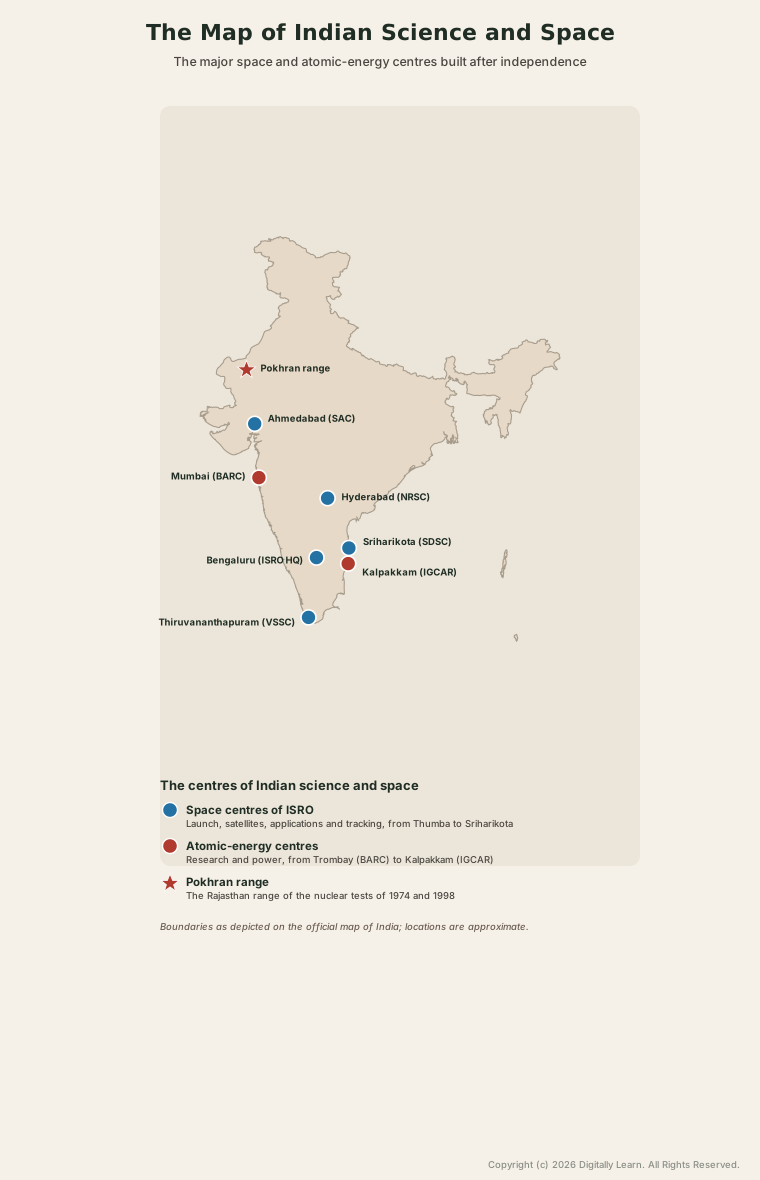
Observable outcome: The choice to build a space programme for use rather than for show shaped everything that followed, giving India a space effort known for its low cost and its developmental focus. It was a deliberate departure from the path of the superpowers, and it allowed a poor country to justify, and to sustain, an ambitious programme in space by tying it firmly to the needs of its own people. The map below sets out the centres of science and space from which the effort was run.
Milestones in Space: From Aryabhata to Mangalyaan
How the Programme Grew from the First Satellite to the Orbit of Mars
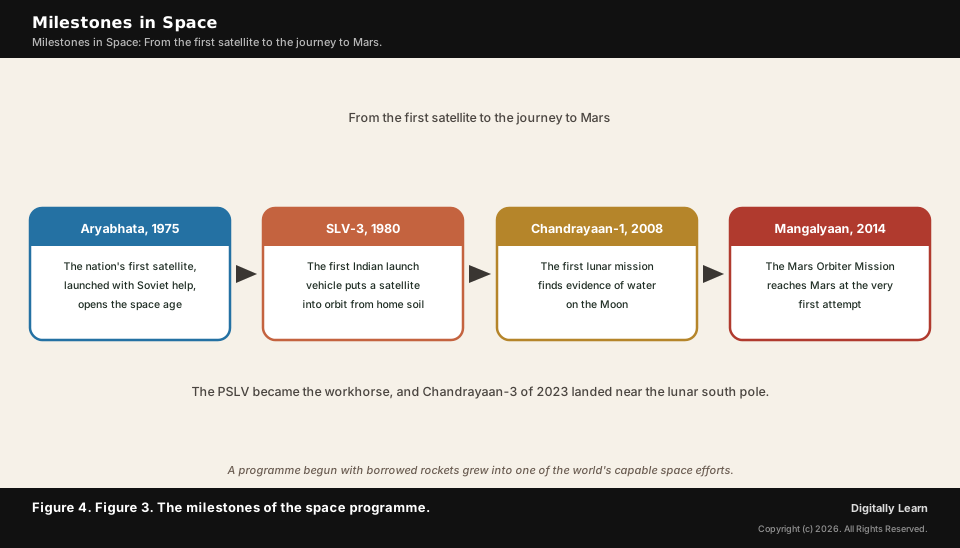
Distinguishing the arc of achievement: India's first satellite, Aryabhata, was launched with Soviet help in 1975, and the first Indian launch vehicle, the SLV-3, placed a satellite in orbit from home soil in 1980. From these beginnings the programme built the Polar Satellite Launch Vehicle, the reliable workhorse that has launched satellites for many nations, and the heavier Geosynchronous Satellite Launch Vehicle.
The programme reached into deep space. Chandrayaan-1 of 2008 found evidence of water on the Moon; the Mars Orbiter Mission, Mangalyaan, of 2014 reached the orbit of Mars at the very first attempt, a feat no other nation had achieved on its first try, and at a famously low cost; and Chandrayaan-3 of 2023 landed near the lunar south pole, a region no mission had reached before. The figure below traces these milestones.
Observable outcome: Within fifty years a programme begun with borrowed rockets had become one of the world's capable space efforts, launching its own and others' satellites and reaching the Moon and Mars. The achievements brought the country a new prestige, but, true to Sarabhai's vision, they rested on a base of communication and earth-observation satellites that served the practical needs of the nation below.
Science for Development: SITE, Satellites and the Green Revolution
How the Tools of Science Were Turned to the Work of Development
Distinguishing science put to use: The proof of Sarabhai's vision lay in the application of technology to development. In 1975 the Satellite Instructional Television Experiment, SITE, used a borrowed satellite to beam educational and development programmes to thousands of villages, a pioneering use of space for mass education; and the later INSAT communication satellites and the Indian Remote Sensing satellites carried this work forward, serving telecommunication, broadcasting, weather forecasting and the survey of land, water and crops.
The same conviction had transformed agriculture. The Green Revolution, treated in the earlier part on agrarian change, was science applied to the field, the high-yielding seed, the fertiliser and the irrigation that turned a food-deficit country into a food-surplus one. Together the satellite and the seed showed how the abstract capacity built in the laboratory could be turned to the concrete relief of hunger, ignorance and want, the test by which Sarabhai had asked that the whole effort be judged.
Observable outcome: The application of science to development justified the investment in research to a nation that could ill afford waste. Remote sensing guided the planning of crops and the search for water, communication satellites carried schooling and weather warnings to remote regions, and the technologies of the Green Revolution fed a growing population, binding the advanced sciences to the daily welfare of the people.
The Nuclear Tests: Pokhran I and II
How the Nuclear Programme Demonstrated Its Scientific Reach
Distinguishing the scientific dimension of the tests: The nuclear programme's capability was demonstrated to the world in the tests at Pokhran, treated in their strategic aspect in the earlier part on the wars and the bomb. Pokhran-I of 1974, described at the time as a peaceful nuclear explosion, showed that the country's scientists could design and detonate a nuclear device, the fruit of the establishment that Bhabha had built; and Pokhran-II of 1998, a series of tests, demonstrated a developed weapons capability.
The tests were, in scientific terms, a proof of mastery. They showed that the long investment in atomic science, the reactors, the laboratories and the trained physicists, had given the country a command of the most demanding of technologies, achieved under conditions of secrecy and against the denial of foreign help. Whatever their strategic meaning, treated elsewhere, they marked the arrival of India as a nation able to work at the frontier of nuclear science.
Observable outcome: The Pokhran tests confirmed, in the most dramatic way, the self-reliance in advanced science that the founders had sought. They are narrated in their strategic and diplomatic dimension in the part on the wars and the bomb; their place in this account is as the demonstration of how far the scientific capability of the republic, patiently built from 1948, had come.
The Information Technology Revolution
How India Became a Power in Software and Information Technology
Distinguishing the technological turn: A different and less planned achievement was India's rise as a power in information technology. From small beginnings in the 1970s and 1980s, a software industry grew, helped by the country's large pool of English-speaking, technically trained graduates and by a gradual loosening of the controls that had hampered the import of computers. The state set up bodies such as the Centre for Development of Advanced Computing, which built indigenous supercomputers after foreign ones were denied.
The industry was transformed by liberalisation. The Software Technology Parks of India, established in 1991, and the reforms of that year opened the way for an export boom, and through the 1990s and after, Indian firms became a global force in software services and business processing. The information-technology sector grew into one of the largest in the economy and the country's best-known export, carrying the name of Indian skill across the world and drawing millions into a new middle class.
Observable outcome: The information-technology revolution showed a face of Indian science different from the state-led programmes in atoms and space, one driven by private enterprise and the global market, yet resting on the same human capital, the trained graduates, that the early investment in scientific and technical education had produced. It became, by the turn of the century, a pillar of the economy and a symbol of a confident, capable India.
Scientific Temper: A Constitutional Ideal
How the Cultivation of a Scientific Outlook Became a Public Duty
Distinguishing the idea of scientific temper: Beyond the building of reactors and rockets lay a deeper ambition, to spread a scientific temper through society. The phrase was Nehru's, by which he meant a habit of reason, of evidence and of questioning, set against superstition and blind custom, and he held it to be as important to the making of a modern nation as any laboratory. The cultivation of this outlook was, in his view, the true measure of whether a people had embraced the modern age.
The ideal was written into the Constitution. The 42nd Amendment of 1976 added to the Fundamental Duties, under Article 51A, the duty of every citizen to develop the scientific temper, humanism and the spirit of inquiry and reform, the only constitution in the world to place such a duty upon its citizens. It was a recognition that the building of a scientific nation required not only institutions and programmes but a change in the public mind.
Observable outcome: The duty to cultivate a scientific temper remains an aspiration imperfectly realised, for superstition and unreason have not vanished from public life, and the tension between the scientific outlook and older beliefs is a continuing one. Yet the ideal endures as a standard against which the public culture is measured, and as a reminder that the founders saw the spread of reason, not merely the mastery of machines, as the deepest purpose of the scientific effort.
Significance: Self-Reliance in Science as the Foundation of a Modern Power
How the Investment in Science Built the Base of the Contemporary Nation
The larger significance of this effort is that the republic, by a deliberate and sustained investment against the pressure of immediate poverty, built for itself a base in the advanced sciences that became a foundation of its later strength. The atomic and space establishments, the research councils and the technically trained workforce gave India a capacity that few developing nations possess, and a measure of self-reliance in the technologies that decide a modern nation's standing.
| Milestone | What it marked | Year |
|---|---|---|
| The Atomic Energy Commission | The start of the organised nuclear effort | 1948 |
| The Scientific Policy Resolution | The state's charter for the pursuit of science | 1958 |
| The Indian Space Research Organisation | The single body for the space programme | 1969 |
| Aryabhata | India's first satellite | 1975 |
| The SLV-3 | The first Indian launch vehicle to reach orbit | 1980 |
| The Mars Orbiter Mission | India reaches Mars at the first attempt | 2014 |
Contemporary linkages carry this story into the present. The newer missions to the Moon and the Sun, the rise of a private space sector, the missions in semiconductors, supercomputing and artificial intelligence, and the continuing debate over the place of basic research are all the descendants of the scientific effort begun in these decades.
The deeper lesson is that a nation's future is shaped by the long, patient investments it is willing to make when they are least affordable, and that the choice of the founders to build science when the country was poorest was vindicated by all that followed. The next part turns from the building of capacity to its costs, the rise of the environmental movement and the conflict between development and ecology.
- Nehru’s faith in science built the CSIR, the Atomic Energy Commission and the Scientific Policy Resolution of 1958.
- Homi Bhabha’s three-stage nuclear programme aimed at self-reliance through the country’s thorium reserves.
- Vikram Sarabhai built ISRO in 1969 as a space programme for development rather than prestige.
- From Aryabhata in 1975 to the Mars Orbiter Mission of 2014, India built a capable and low-cost space programme.
- The 42nd Amendment made the development of a scientific temper a Fundamental Duty under Article 51A.
Previous Year UPSC-CSE Questions
Previous Year UPSC-CSE Questions By the end you will be able to draft model answers for the following UPSC questions. Each question carries a collapsible framework showing how to approach it in the exam.
- UPSC Mains 2016 GS-IIIDiscuss India’s achievements in the field of Space Science and Technology. How the application of this technology has helped India in its socio- economic development?
How to structure the answer in the exam
Introduction: Open with Sarabhai's vision of space technology as a tool for development.
Body (sub-themes to develop):
- Achievements: Aryabhata, the SLV-3, the PSLV and GSLV, Chandrayaan and the Mars Orbiter Mission.
- Communication: INSAT for broadcasting, telephony and the SITE experiment in education.
- Earth observation: Indian Remote Sensing for crops, water, minerals and disaster management.
- Weather and navigation: meteorology and the regional navigation system.
Conclusion: Conclude that India's space programme is distinctive for tying world-class achievement to the practical service of development.
- UPSC Mains 2017 GS-IIIGive an account of the growth and development of nuclear science and technology in India. What is the advantage of fast breeder reactor programme in India?
How to structure the answer in the exam
Introduction: Open with the Atomic Energy Commission of 1948 and Bhabha's vision of self-reliance.
Body (sub-themes to develop):
- Institutions: the AEC, the DAE, BARC and the chain of atomic establishments.
- The three-stage programme: uranium, plutonium in fast breeders, then thorium.
- The fast breeder advantage: it breeds more fuel than it uses, unlocking the thorium reserves.
- Progress and challenges: Apsara, the slow movement to the later stages, technology denial.
Conclusion: Conclude that the fast breeder is the key to India's thorium-based, self-reliant nuclear future, though progress has been slow.
- UPSC Prelims 2016 GS Paper IConsider the following statements: The Mangalyaan launched by ISRO
- Is also called the Mars Orbiter Mission
- Made India the second country to have a spacecraft orbit the Mars after USA
- Made India the only country to be successful in making its spacecraft orbit the Mars in its very first attempt
Which of the statements given above is/are correct?
How to approach this Prelims question
Approach: Test each statement about the Mars Orbiter Mission.
Trap to watch: India was not the second country to reach Mars; others had done so earlier. India was the first to succeed at its very first attempt.
Key facts to recall:
- Mangalyaan is the Mars Orbiter Mission, launched 2013, reached Mars 2014
- India was the first to succeed on its first attempt
- It was not the second nation to reach Mars
Answer signal: Statements 1 and 3 only, so option (c).
Sources and Further Reading
- NCERT, Politics in India since Independence (Class 12)
- Indian Space Research Organisation (ISRO)
- Department of Atomic Energy, Government of India
- Wikipedia: Indian Space Research Organisation
- Wikipedia: India's three-stage nuclear power programme
- Wikipedia: Mars Orbiter Mission
- Press Information Bureau, Government of India
- National Portal of India
Editorial Disclaimer
This article is prepared for civil services preparation. Verify key facts and interpretations against standard reference works before relying on them.