
Overview
Previous Year UPSC-CSE Questions By the end you will be able to draft model answers for the following UPSC questions. Each question carries a collapsible framework showing how to approach it in the exam.
- UPSC Mains 2020 GS-IV“The will to power exists, but it can be tamed and be guided by rationality and principles of moral duty”. Examine this statement in the context of international relations.
How to structure the answer in the exam
Introduction: Open with the tension in the quote: power politics is real, yet the statement claims principle and reason can temper it.
Body (sub-themes to develop):
- The will to power in international relations: the Cold War's bloc rivalry as raw power politics.
- Taming by rationality: non-alignment as strategic autonomy, serving interest by refusing a permanent camp and balancing both blocs.
- Guiding by moral duty: Panchsheel, anti-colonialism, anti-apartheid and disarmament as principles in foreign policy.
- The realist counter: critics held such moralism naive, citing the uneven balance of 1956 and later strategic costs.
Conclusion: Conclude that principle and reason can temper power without abolishing it, and that India's non-alignment shows both the promise and the limits of a values-guided foreign policy.
- UPSC Prelims 1997 GS Paper IWhich one of the following is NOT a principle of “Panchsheel”?
How to approach this Prelims question
Approach: Recall the five principles of Panchsheel and find the option that is not among them.
Trap to watch: Non-alignment and Panchsheel are linked but distinct: non-alignment is the posture, Panchsheel is the five-point code of conduct between states.
Key facts to recall:
- The five principles include peaceful coexistence and mutual respect for sovereignty
- Non-alignment is the wider foreign-policy doctrine, not a Panchsheel principle
- Panchsheel was enunciated by Nehru and Zhou Enlai in 1954
Answer signal: Non-alignment is not a Panchsheel principle, so option (a).
- UPSC Prelims 2005 GS Paper IIn which country is Bandung, where the Conference of African and Asian nations was held which led to establishing Non-Aligned Movement (NAM), situated?
How to approach this Prelims question
Approach: Anchor Bandung to Indonesia, the host of the 1955 Afro-Asian Conference.
Trap to watch: Egypt and the others were associated with non-alignment through their leaders, but the conference city Bandung is in Indonesia.
Key facts to recall:
- The Bandung Conference was held in 1955 in Bandung, Indonesia
- It brought together twenty-nine Asian and African nations
- It led to the founding of the Non-Aligned Movement
Answer signal: Indonesia, so option (c).
Non-alignment was independent India's founding choice in foreign affairs: a decision not to join either of the two armed camps into which the Cold War had divided the world. Shaped by the ideals of the freedom struggle and guided for nearly two decades by Jawaharlal Nehru, it grew from the principles of Panchsheel and the solidarity of Bandung into the Non-Aligned Movement, a grouping of newly free nations that refused to be drawn into great-power rivalry. This part follows that doctrine from its anti-colonial roots to its critiques.
India in the World of 1947: Why a New Nation Needed a Policy of Its Own
Foreign Policy as the True Test of Independence
Why this matters: Nehru told the Constituent Assembly that independence consists fundamentally of foreign relations, and that once those pass into another's charge a nation is independent only in name. A country that had just won its freedom had therefore to decide, at once, how it would carry itself among the great powers.
What is the significance of non-alignment: It was the answer India gave to that question, and it set the country's course in the world for a generation. To understand India's place among nations, it is worth grasping why a poor and newly free state chose to stand apart from both Cold War blocs, and at what cost and gain.
The Anti-Colonial Roots of India's Foreign Policy
From the Freedom Struggle to a Worldview, and Article 51
Distinguishing the roots: India's foreign policy did not begin in 1947; it grew out of the national movement, which was never an isolated affair but part of a worldwide struggle against colonialism and imperialism. Indian leaders had long been in contact with the nationalists of other colonies, and the ideals that inspired the fight for freedom, anti-racism, anti-colonialism and the sovereign equality of nations, shaped the policy that followed.
The Constitution carried these ideals forward. Article 51, a Directive Principle, directs the state to promote international peace and security, maintain just and honourable relations between nations, foster respect for international law and treaty obligations, and encourage the settlement of disputes by arbitration. The policy of non-alignment was the practical expression of that constitutional instinct.
The Cold War Context: A Bipolar World and the Pressure to Choose
NATO, the Warsaw Pact and Why the Superpowers Courted Small States
Distinguishing the setting: India was born into a world freshly split in two. On one side stood the United States and its western allies, who built the North Atlantic Treaty Organisation in 1949; on the other stood the Soviet Union and its allies, who answered with the Warsaw Pact in 1955. Regional alliances such as SEATO and the Baghdad Pact extended the contest into Asia and West Asia.
The superpowers needed the smaller states despite their own vast power, for access to oil and minerals, for territory and bases, for listening posts, and for the appearance of winning the contest of ideas. Newly free nations were therefore pressed hard to pick a side, and many, in need of aid, did. India's refusal to be drawn in was the deliberate exception this part explains.
Panchsheel: The Five Principles of Peaceful Coexistence
The 1954 Enunciation and the Content of the Five Principles
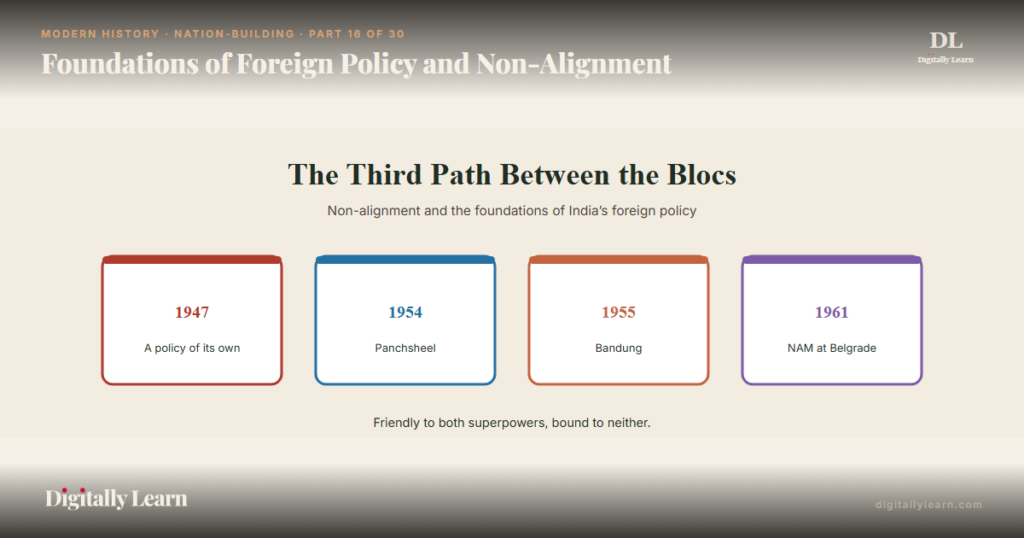
Distinguishing the doctrine: If non-alignment was India's posture, Panchsheel was its stated code of conduct between nations. The Five Principles of Peaceful Coexistence were jointly enunciated by Prime Minister Nehru and the Chinese Premier Zhou Enlai on 29 April 1954, and they offered a moral grammar for relations between states of unequal power.
- Mutual respect for each other’s territorial integrity and sovereignty.
- Mutual non-aggression.
- Mutual non-interference in each other’s internal affairs.
- Equality and mutual benefit.
- Peaceful coexistence.
Observable reach: Panchsheel travelled far beyond the agreement that named it. It became the language in which India proposed to deal with all states, and its principles were woven into the declarations of the wider non-aligned world; the relationship with China that gave the principles their occasion is taken up in the next part.
Non-Alignment as Strategic Autonomy, Not Isolationism
The Three Objectives and the Independent Stand Between the Blocs
Distinguishing the strategy: Nehru, who was his own Foreign Minister and shaped the policy from 1946 to 1964, pursued three plain objectives through non-alignment, set out below. The doctrine was a means, not a sentiment: a way for a weak state to keep its choices in its own hands.
- Preserve the hard-won sovereignty of the new nation.
- Protect its territorial integrity.
- Promote rapid economic development.
The independent stand had to be lived, not just declared. In 1956, when Britain attacked Egypt over the Suez Canal, India led the world's protest against the invasion; in the same year, when the Soviet Union moved into Hungary, India did not join the public condemnation. The balance was not always even, yet by and large India took its own line on the great questions and drew aid and assistance from members of both blocs.
Neither Isolationism Nor Neutrality: What Non-Alignment Was Not
Distinguishing the term from its lookalikes: Non-alignment was often misread, so its founders defined it as much by what it was not. It was not isolationism, the policy of holding aloof from world affairs, which had described the United States from its founding to the First World War. Nor was it neutrality, the narrow practice of staying out of wars and taking no position on their rights and wrongs.
Observable outcomes followed from this active posture. Non-alignment served India's interests directly: it let the country take stances that suited its own needs rather than a superpower's, and it allowed India to balance one bloc against the other, winning aid from both Washington and Moscow at a time when it could spare neither.
| Test | Isolationism | Neutrality | Non-Alignment |
|---|---|---|---|
| Stance to world affairs | Stay aloof | Engaged, but silent on wars | Actively engaged |
| Position on a war's merits | None | None | Takes a side on principle |
| Tie to a bloc | None | None | None, but friendly to both |
| Purpose | Avoidance | Staying out of war | Strategic autonomy |
The Bandung Conference of 1955 and Afro-Asian Solidarity
From the Asian Relations Conference of 1947 to the Zenith at Bandung
Distinguishing the solidarity strand: Non-alignment was never only about the superpowers; it was also about the newly free world finding its own voice. Nehru was an early champion of Asian unity: India convened the Asian Relations Conference in March 1947, months before its own independence, called an international conference in 1949 to support Indonesia's freedom from Dutch rule, and stood firmly against racism and the apartheid of South Africa.
This strand reached its zenith at Bandung. The Afro-Asian Conference held in the Indonesian city of Bandung from 18 to 24 April 1955, attended by twenty-nine Asian and African nations, marked the high point of India's engagement with the decolonising world. Bandung's call for cooperation and against colonialism became the seedbed from which the Non-Aligned Movement grew.
The Birth of the Non-Aligned Movement: Belgrade 1961
The Five Founders and the First Summit at Belgrade
Distinguishing the movement from the mood: Bandung gave the spirit; Belgrade gave the institution. The roots of the Non-Aligned Movement lay in the friendship of three leaders who met in 1956, Yugoslavia's Tito, India's Nehru and Egypt's Nasser, joined by Indonesia's Sukarno and Ghana's Nkrumah, the five who came to be known as the founders of NAM.
The first summit met at Belgrade in September 1961 and was attended by twenty-five member states. Three forces brought it together: the cooperation of the five founders, the deepening tensions and widening arenas of the Cold War, and the dramatic arrival of newly decolonised African nations on the world stage. From those twenty-five states the movement grew over the decades into one of the largest groupings of nations on earth.
Nehru as Mediator: Korea, the UN and the Active Pursuit of Peace
Non-Alignment as Engagement, Not Fleeing Away
Distinguishing the mediating role: Nehru insisted that non-alignment was not a policy of fleeing away, and India lived that claim by working actively to soften Cold War rivalries. Indian diplomats were repeatedly used to communicate and mediate between the rival camps, most notably in the Korean War of the early 1950s, where India played a part in mediating between the two Koreas.
Observable contributions followed from this stance. India contributed personnel to United Nations peacekeeping operations, sought to activate the regional and international bodies that lay outside the two alliances, and reposed faith in a commonwealth of free and cooperating nations that might soften, if not end, the great rivalry. Non-alignment, in practice, meant doing more in the world, not less.
From Political Movement to Economic Bloc: The New International Economic Order
NIEO, UNCTAD 1972 and NAM as an Economic Pressure Group
Distinguishing the economic turn: As the movement grew it changed character. Most of its members were among the world's poorest, and they came to see that political freedom without economic development was hollow, for a nation that depended on the rich for its bread could not be truly free. Out of that realisation came the demand for a New International Economic Order.
The demand took shape through the United Nations. A 1972 report of the UN Conference on Trade and Development, titled Towards a New Trade Policy for Development, proposed a reform of world trade in favour of the poorer countries, listed below. By the mid-1970s these economic issues, marginal at Belgrade in 1961, had become the movement's central concern, turning NAM into an economic pressure group.
- Control for poorer countries over their own natural resources.
- Access to the markets of the developed world for their goods.
- Cheaper technology from the richer countries.
- A greater voice in the world’s economic institutions.
Observable limits set in by the late 1980s. The richer countries faced the demand as a united group while the non-aligned states struggled to hold their own unity, and the New International Economic Order initiative gradually faded; its underlying grievance, the unequal terms of the world economy, did not.
The Critiques of Non-Alignment and Its Balance Sheet
Idealism or Interest? The Debate Over India's Independent Stand
Distinguishing the critique: Non-alignment drew criticism from the first, at home and abroad. At home, leaders such as Ambedkar and parties like the Bharatiya Jan Sangh and the Swatantra Party argued that India should lean towards the democratic, pro-Western bloc. Abroad, realists charged that the policy was moralistic and naive, a posture of principle in a world ruled by power, and pointed to the uneven balance of 1956, loud over Suez but quiet over Hungary.
A second charge was a pro-Soviet tilt, sharpened when India signed a twenty-year Treaty of Peace and Friendship with the Soviet Union in 1971. The criticism had political weight: when the first non-Congress government took office in 1977, the Janata ministry announced that it would follow genuine non-alignment, a phrase that conceded the tilt it promised to correct.
The defence rests on results, not sentiment. Non-alignment was not a noble cause divorced from India's interests; it served them, as the strategic-autonomy section showed, by keeping decisions in Indian hands and letting a poor country draw aid from both superpowers at once. The honest balance sheet records both the imperfect even-handedness and the real strategic gains, and leaves the reader to weigh idealism against interest.
Significance: Non-Alignment as the Charter of India's Strategic Autonomy
Why the Doctrine Still Names India's View of the World
The larger significance of non-alignment is that it gave India a durable principle rather than a passing posture: the insistence on keeping its own counsel among the great powers. The blocs it balanced are gone and the Cold War is over, yet the instinct it expressed, to judge each question on its merits and to refuse a permanent camp, outlived the conditions that produced it.
Contemporary linkages keep the doctrine current under a new name. The phrase strategic autonomy that fills today's foreign-policy debate is non-alignment's direct heir, and India's habit of working with rival powers at once traces straight back to Nehru's third path. The next part turns from doctrine to the hardest test of it, India's relations with its own neighbours.
- India’s foreign policy grew from the anti-colonial ideals of the freedom struggle and Article 51.
- Panchsheel, enunciated with Zhou Enlai in 1954, gave non-alignment its five guiding principles.
- Bandung in 1955 and Belgrade in 1961 carried Afro-Asian solidarity into the Non-Aligned Movement.
- Non-alignment was strategic autonomy, not isolationism or neutrality; it drew aid from both blocs.
- Its critics charged idealism and a Soviet tilt; its defence is the strategic autonomy it secured.
Prelims MCQ practice
Each question below tests one specific concept on the topic. Click to reveal the answer and a full option-wise explanation.
Q1. The five principles of Panchsheel were jointly enunciated in 1954 by Jawaharlal Nehru and which of the following leaders?
- Mao Zedong
- Zhou Enlai
- Ho Chi Minh
- Sukarno
Show answer and explanation
Answer: Zhou Enlai
Explanation.
Option (b) is correct. The Five Principles of Peaceful Coexistence, or Panchsheel, were jointly enunciated by Prime Minister Nehru and the Chinese Premier Zhou Enlai on 29 April 1954. Hence option (b).
Q2. Consider the following leaders who are regarded as the five founders of the Non-Aligned Movement:
- Josip Broz Tito of Yugoslavia
- Gamal Abdel Nasser of Egypt
- Kwame Nkrumah of Ghana
Which of the leaders given above are correctly matched with their countries?
- 1 and 2 only
- 2 and 3 only
- 1 and 3 only
- 1, 2 and 3
Show answer and explanation
Answer: 1, 2 and 3
Explanation.
All three pairs are correct. Tito of Yugoslavia, Nasser of Egypt and Nkrumah of Ghana, together with Nehru of India and Sukarno of Indonesia, were the five founders of the Non-Aligned Movement. Hence option (d).
Q3. Consider the following statements about the first summit of the Non-Aligned Movement:
- It was held at Belgrade in 1961.
- It was attended by twenty-five member states.
- It was hosted in the same city as the Afro-Asian Conference.
Which of the statements given above is/are correct?
- 1 and 2 only
- 2 and 3 only
- 1 and 3 only
- 1, 2 and 3
Show answer and explanation
Answer: 1 and 2 only
Explanation.
Statements 1 and 2 are correct: the first NAM summit was held at Belgrade in 1961 and was attended by twenty-five member states. Statement 3 is wrong, since the Afro-Asian Conference was held at Bandung in Indonesia, not at Belgrade. Hence option (a).
Q4. With reference to the policy of non-alignment, consider the following statements:
- It meant isolationism, that is, remaining aloof from world affairs.
- It meant neutrality, that is, taking no position on the merits of a war.
- It allowed India to draw aid from both Cold War blocs.
Which of the statements given above is/are correct?
- 3 only
- 1 and 2 only
- 2 and 3 only
- 1, 2 and 3
Show answer and explanation
Answer: 3 only
Explanation.
Only statement 3 is correct. Non-alignment was neither isolationism nor neutrality; the non-aligned states were actively engaged in world affairs and took positions on the merits of issues. It did allow India to draw aid from both blocs, so statement 3 is right and statements 1 and 2 are wrong. Hence option (a).
Q5. Consider the following statements about the Bandung Conference:
- It was held in Indonesia in 1955.
- It was attended by twenty-nine Asian and African nations.
- It led to the establishment of the Non-Aligned Movement.
Which of the statements given above are correct?
- 1 and 2 only
- 2 and 3 only
- 1 and 3 only
- 1, 2 and 3
Show answer and explanation
Answer: 1, 2 and 3
Explanation.
All three statements are correct: the Bandung Conference of 1955 was held in Indonesia, was attended by twenty-nine Asian and African nations, and led to the founding of the Non-Aligned Movement. Hence option (d).
Q6. Consider the following statements about the making of India's foreign policy under Nehru:
- Article 51 of the Constitution directs the state to promote international peace and security.
- Nehru held the foreign affairs portfolio himself while serving as Prime Minister.
- The New International Economic Order was a demand raised through the United Nations.
Which of the statements given above are correct?
- 1 and 2 only
- 2 and 3 only
- 1 and 3 only
- 1, 2 and 3
Show answer and explanation
Answer: 1, 2 and 3
Explanation.
All three statements are correct. Article 51 is a Directive Principle on promoting international peace, Nehru was his own Foreign Minister from 1946 to 1964, and the New International Economic Order was pressed through the United Nations, notably a 1972 UNCTAD report. Hence option (d).
Sources and Further Reading
- NCERT, Politics in India since Independence (Class 12), India's External Relations
- NCERT, Contemporary World Politics (Class 12), The Cold War Era
- Wikipedia: Non-Aligned Movement
- Wikipedia: Bandung Conference
- Wikipedia: Five Principles of Peaceful Coexistence
- Ministry of External Affairs, Government of India
- United Nations: Decolonization
- Press Information Bureau, Government of India
- National Portal of India
Editorial Disclaimer
This article is prepared for UPSC examination preparation. Verify key facts and interpretations against standard reference histories before relying on them.