
Overview
Previous Year UPSC-CSE Questions By the end you will be able to draft model answers for the following UPSC questions. Each question carries a collapsible framework showing how to approach it in the exam.
- UPSC Mains 2013 GS-ICritically discuss the objectives of Bhoodan and Gramdan Movements initiated by Acharya Vinoba Bhave and their success.
How to structure the answer in the exam
Introduction: Open with Bhoodan's birth at Pochampally in April 1951, Vinoba Bhave's voluntary land-gift answer to the agrarian question.
Body (sub-themes to develop):
- Objectives: peaceful land redistribution by moral persuasion, supplementing stalled legislation; defusing agrarian conflict in the Telangana countryside; Gramdan's village-held land and Sarvodaya self-rule.
- Success: large areas pledged across the country; genuine moral mobilisation; over a thousand villages came over to Gramdan.
- Shortfall: much donated land was unfit, disputed or never distributed; momentum faded within a decade; the structure of landholding was not altered.
- Verdict: a moral supplement to land reform, not a substitute for it.
Conclusion: Conclude that Bhoodan softened the agrarian question without solving it, pushing the state towards the productivity route the Green Revolution took.
- UPSC Mains 2014 GS-IWhy did the Green Revolution in India virtually by-pass the eastern region despite fertile soil and good availability of water?
How to structure the answer in the exam
Introduction: Open with the paradox the question states: fertile alluvium and abundant water, yet the first wave passed the east by.
Body (sub-themes to develop):
- Water without control: monsoon flood and waterlogging are not the assured irrigation the HYV package demanded.
- Tenure: small, fragmented, sharecropped holdings and insecure tenancy, the residue of zamindari tenures, discouraged input investment.
- Infrastructure: weak rural credit, electrification, procurement and extension exactly where the package needed them.
- Crop choice: The early dwarf varieties were wheat-centred; suitable rice packages for the east matured later.
- Policy: the new strategy consciously concentrated resources on areas of assured irrigation and quick returns.
Conclusion: Conclude that the bypass was the package's own logic at work, and note the east's later entry once rice technology and procurement spread.
- UPSC Mains 2017 GS-IIIExplain various types of revolutions, took place in Agriculture after Independence in India. How have these revolutions helped in poverty alleviation and food security in India?
How to structure the answer in the exam
Introduction: Open with the Green Revolution in food grains and the White Revolution in milk as the two foundational transformations, noting the later commodity revolutions that followed them.
Body (sub-themes to develop):
- Green Revolution: HYV seeds, fertiliser, assured irrigation and guaranteed prices delivered self-sufficiency in food grains.
- Food security mechanism: FCI procurement and buffer stocks; the marketed surplus lowered the relative price of food, helping the poor most.
- White Revolution: Operation Flood on the Anand pattern built a national milk grid and the world's largest milk producer by 1998.
- Poverty mechanism: a regular year-round milk income for smallholder and landless households, with women drawn into the cooperatives.
Conclusion: Conclude that the revolutions attacked deprivation from both ends, cheaper food for consumers and steadier incomes for producers.
- UPSC Prelims 2007 GS Paper IWhich one of the following was associated with Acharya Vinoba Bhave's Bhoodan Movement at the beginning of the movement?
How to approach this Prelims question
Approach: Anchor the movement to its birthplace and date: Pochampally, Telangana, April 1951.
Trap to watch: All four options are toponyms from the same broad region; only Pochampally carries the founding event.
Key facts to recall:
- Bhoodan began on 18 April 1951 at Pochampally
- V. Ramachandra Reddy donated 100 acres on Vinoba Bhave's appeal
- Gramdan later extended the idea to whole villages
Answer signal: Pochampalli, so option (c).
- UPSC Prelims 2002 GS Paper IConsider the following high yielding varieties of crops in India:
- Arjun
- Jaya
- Padma
- Sonalika
Which of these are wheat?
How to approach this Prelims question
Approach: Sort the varieties by crop: the wheat names descend from the Mexican dwarf wheats, the rice names from the IR8 line.
Trap to watch: Jaya is the famous early HYV rice; placing it under wheat is the intended error.
Key facts to recall:
- Sonalika and Kalyan Sona: HYV wheat from the Borlaug dwarf lines
- Jaya and Padma: early Indian HYV rice
- Elimination: every option containing Jaya or Padma as wheat falls
Answer signal: Arjun and Sonalika, so option (c).
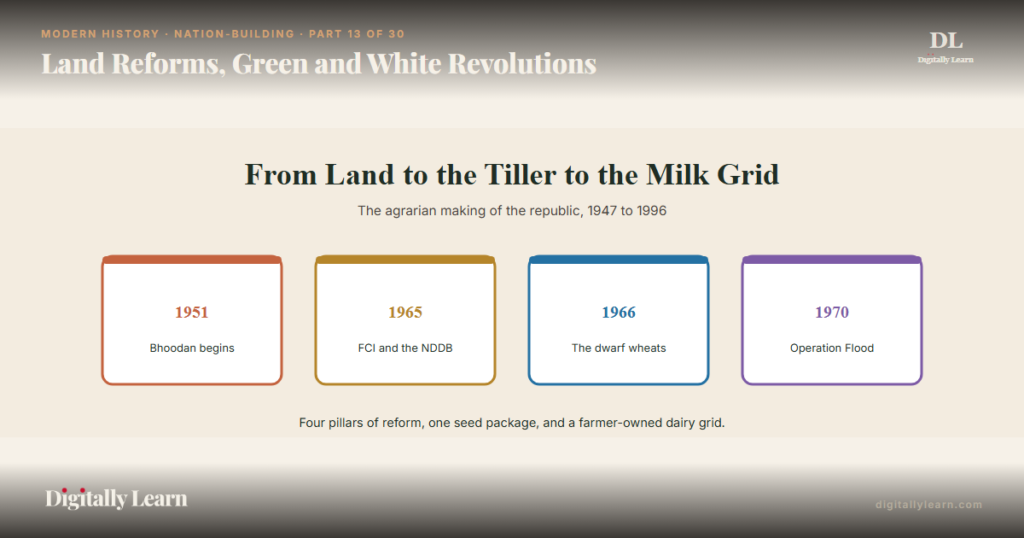
Land reforms were independent India's attempt to answer its oldest question: who owns the land, and on what terms is it tilled. Together with the Green Revolution in food grains and the White Revolution in milk, they form one connected story. The republic began by abolishing the zamindari system, walked with Vinoba Bhave through Bhoodan, bet on the high-yielding seed package when famine threatened in the mid-1960s, and built the world's largest dairy industry through the Anand pattern cooperatives. This part follows that agrarian remaking from 1947 to 1996.
The Agrarian Question at Independence: Tenure, Hunger and Imported Grain
Why Land and Food Decided the Fate of the New Republic
Why this matters: At independence roughly three quarters of the population lived off agriculture, yet the sector had seen neither growth nor equity under colonial rule. The land tenure system was dominated by intermediaries, the zamindars and jagirdars who collected rent from the actual tillers while contributing nothing to the farm, and productivity was so low that the country imported food from the United States.
What is the significance of the agrarian question: It framed the whole development project. The First Five-Year Plan identified the pattern of land distribution as the principal obstacle to agricultural growth and placed land reforms at the centre of the country's development, alongside large irrigation works such as Bhakra Nangal. Three distinct instruments would be tried over the next decades: reform by law, persuasion by movement, and transformation by technology and cooperation.
The Four Pillars of Land Reform: Abolition, Tenancy, Ceilings and Consolidation
What Each Pillar Promised and How the Record Diverged
Distinguishing the four pillars: Land reform was not one law but a family of measures. The abolition of intermediaries sought to make tillers the owners of their land; tenancy reform promised tenants security against eviction and regulated rents; land ceilings fixed a maximum holding so that surplus land could go to the landless; and consolidation of holdings combined scattered plots into farms of workable size.
Observable outcomes diverged sharply across the pillars. Abolition of intermediaries was the most significant and successful measure, and consolidation proved fairly successful, especially in the north-west. The ceiling laws were evaded by those they targeted, and tenancy protections, though written into law, were rarely implemented on the ground. That divergence, and its causes, are examined pillar by pillar below.
Zamindari Abolition and the First Amendment: Land to the Tiller
How the States Abolished Intermediaries and Parliament Shielded the Laws
Distinguishing the boldest pillar: Within a year of independence the states began legislating to abolish intermediaries and make the tiller the owner. The logic was incentive: an owner profits from improving the land, while a rent-paying tenant does not, so ownership itself was expected to raise investment and output. Millions of tenants were freed from the zamindar and brought into direct contact with the state.
The constitutional battle followed immediately. Landlords challenged the laws in court, and Parliament answered with the First Amendment of 1951, which inserted Articles 31A and 31B and created the Ninth Schedule, validating thirteen land reform laws against fundamental-rights challenges. The amendment turned agrarian reform from contested legislation into protected policy.
- The zamindari class lost both its rental income and much of its capacity to dominate rural politics.
- Some former zamindars kept large areas through loopholes, by evicting tenants and claiming to be self-cultivators.
- The poorest, the sharecroppers and landless labourers, gained least from the abolition settlement.
- Consolidation of holdings, the quietest pillar, made fragmented farms viable and was fairly successful.
Why the Land Ceiling Laws Failed: Litigation, Loopholes and Benami Transfers
The Evasion Playbook and the Two States That Bucked It
Distinguishing the failure: The ceiling laws capped how much land one holder could own, with the surplus meant for redistribution. Big landholders fought the legislation in the courts, and the delay itself became the loophole: while cases dragged on, land was registered in the names of relatives, the benami route, and generous exemptions in the laws let large estates survive on paper as several small ones.
Observable outcomes confirmed the pattern. Tenancy security, the companion promise, was rarely enforced, and many proposals for reform either never became law or remained law only on paper, because the landowning groups that lost from reform also held political power in the countryside.
The exceptions proved the rule: Kerala and West Bengal implemented land-to-the-tiller policies with sustained political commitment, and their record stands apart. West Bengal's Operation Barga, begun in 1978, registered sharecroppers and secured their tenure, and remains the model tenancy intervention.
| Pillar | Aim | Outcome |
|---|---|---|
| Abolition of intermediaries | End rent-collecting tenures; land to the tiller | The most successful pillar; millions of tenants dealt directly with the state |
| Tenancy reform | Security against eviction and regulated rents | Protections existed on paper but were rarely implemented |
| Land ceilings | Cap holdings and redistribute the surplus | Widely evaded through litigation, exemptions and benami transfers |
| Consolidation of holdings | Combine scattered plots into viable farms | Fairly successful, especially in the north-west |
Bhoodan and Gramdan: Vinoba Bhave's Walk for Voluntary Land Gifts
From Pochampally 1951 to the Gramdan Villages: The Honest Balance Sheet
Distinguishing the moral route: Where law had stalled, Vinoba Bhave tried persuasion. On 18 April 1951, at Pochampally in the Telangana region, the landowner V. Ramachandra Reddy answered Bhave's appeal for the landless by gifting 100 acres, and the Bhoodan movement was born. Bhave then walked village to village asking landowners to donate a share of their land, framing the gift as a moral duty rather than a legal demand.
The movement widened into Gramdan, the donation of entire villages, where land would be held by the village community; more than a thousand villages came over this way. The objectives ran deeper than acreage: to redistribute land peacefully where the Telangana countryside had just seen armed struggle, to supplement legislation with consent, and to build the Sarvodaya ideal of village self-rule from below.
The balance sheet is genuinely mixed, which is exactly what the examiner expects a student to argue. Large areas were pledged across the country and the movement mobilised real moral energy, yet much of the donated land proved unfit for cultivation, disputed in title, or was simply never distributed, and momentum faded within a decade. Bhoodan softened the agrarian question; it did not solve it, and the state's attention turned from ownership to productivity.
The Food Crisis of the Mid-1960s and the Green Revolution Bargain
Droughts, the Bihar Near-Famine and Dependence on American Grain
Why the strategy changed: Through the 1940s and 1950s food grain output barely stayed ahead of population growth, and between 1965 and 1967 severe back-to-back droughts struck, alongside two wars and a foreign exchange crisis. Bihar faced near-famine conditions, with food prices far above those in Punjab, while government zoning rules that barred grain trade across state lines deepened the scarcity.
Observable consequences were humbling for a proud planning state. India had to import wheat and accept food aid, mainly from the United States under its PL-480 programme, and the dependence exposed the country to external pressure. Self-sufficiency in food became the first priority of policy, and the planners' earlier instinct to support lagging regions gave way to a colder bet: concentrate resources where they would yield grain fastest.
The HYV Package: Dwarf Wheats, Fertiliser, Assured Water and a Guaranteed Price
Distinguishing the package: The new strategy, championed politically by food and agriculture minister C. Subramaniam and scientifically by M. S. Swaminathan, rested on the dwarf wheats bred by Norman Borlaug in Mexico. India imported the seed in bulk in 1966, around eighteen thousand tonnes, and Indian crosses such as Kalyan Sona and Sonalika followed; in rice, the new plant type arrived as IR8 and Indian selections such as Jaya.
The high-yielding varieties worked only as a package: The seeds demanded fertiliser and pesticide in correct proportion and a regular, controlled supply of water, which meant assured irrigation rather than rainfall alone. The state supplied the rest of the bargain, subsidised inputs and credit for farmers, and a guaranteed purchase price for the harvest, so that adopting the risky new technology became a rational bet for the cultivator.
The Procurement State: FCI, the Prices Commission and the Buffer Stock
How MSP, Procurement and Marketed Surplus Made the Revolution Stick
Distinguishing the institutional architecture: The seeds alone would not have changed India without the procurement state built around them. The Food Corporation of India was set up on 14 January 1965 under the Food Corporations Act of 1964, opening its first district office at Thanjavur, and the Agricultural Prices Commission was created the same month to recommend support prices; it is the ancestor of today's Commission for Agricultural Costs and Prices.
Observable outcomes flowed from the pairing of price and purchase. The minimum support price assured the farmer a floor, and FCI procurement turned surplus grain into a national buffer stock against lean years.
Because a good share of the new wheat and rice was sold rather than consumed on the farm, the marketed surplus pushed food prices down relative to other goods, a quiet gain that mattered most to the poor, who spend the largest share of income on food. The package also travelled through new institutions of science: the first agricultural university opened at Pantnagar in 1960, the model for the state agricultural universities that carried the seeds to the fields.
Where the Green Revolution Took Hold: The Core, the Pockets and the Bypassed East
Mapping the First Wave and Why the East Was Left Behind
Distinguishing the geography: The first wave, from the mid-1960s to the mid-1970s, concentrated in Punjab, Haryana and western Uttar Pradesh, the wheat country with canal and tubewell irrigation, with early rice pockets in coastal Andhra and the Kaveri delta. In the second phase, from the mid-1970s to the mid-1980s, the technology spread to more states and more crops, and only then did the east join in earnest.
Why did the revolution bypass the east despite fertile soil and abundant water? The answer lies in what the HYV package demanded, and the question is a Mains classic best answered point by point.
- Water without control: The east’s water arrives as monsoon flood and waterlogging, not as the assured, controlled irrigation the new seeds required.
- Tenure: Holdings were small, fragmented and often sharecropped, and the insecure tenancy left by the old intermediary tenures blunted investment in costly inputs.
- Infrastructure: Rural credit, electrification, procurement and extension networks were weakest exactly where the package needed them most.
- Crop choice: The early dwarf varieties were wheat-first, while the east is a rice region whose suitable packages matured later.
- Policy: The new strategy deliberately bet its resources on already-irrigated tracts that could deliver grain quickly, completing the bypass.
The Costs of the Green Revolution: Ecology, Inequality and the Middle Peasant
Water, Chemicals and Class: The Bill That Came Later
Observable ecological costs accumulated in the very core that the revolution built. Intensive wheat and rice cropping drew down the water table, sustained chemical use loaded the fields, and the narrowing of cultivation to a few high-yield varieties left crops more exposed to pests, a risk the state met with research institutes and plant protection services. The old core now lives with the groundwater bill of its early success.
The social ledger was equally mixed. The rich peasants and large landholders gained first, and polarisation between prosperous and lagging regions sharpened; in several areas the stark contrast between the poor peasantry and the landlords created conditions that left-wing movements organised, a thread this series picks up with Naxalbari.
The state's counter-moves softened the divide. Subsidised credit and inputs let small farmers adopt the package, so that in time output on small farms matched the large ones, and a new middle peasantry emerged that would soon matter in state politics. The subsidy debate born in those years has never closed: one side urges phasing subsidies out once a technology is established, the other holds that poor farmers cannot carry the input risk unaided.
- Falling water tables and chemical loads in the wheat-rice core, the long ecological bill.
- Sharper regional inequality between the irrigated core and the rainfed interior and east.
- Left-wing mobilisation of the rural poor where gains and deprivation sat side by side.
- The rise of the middle peasant, a new political force in the states of the core.
Operation Flood and the Anand Pattern: The White Revolution
From the Kaira Union to the NDDB: Kurien and the Cooperative Architecture
Distinguishing the cooperative route: The milk story began before the grain story, in Kaira district of Gujarat, where farmers organised the Kaira District Co-operative Milk Producers' Union in 1946 under Tribhuvandas Patel, the union the world knows as Amul.
The young engineer Verghese Kurien stayed on at Anand to manage it, and the model he refined became the Anand pattern: Village societies that collect milk daily, a district union that owns the processing plant, and a state federation that markets under one brand, every tier owned by the farmers themselves and run by professionals answerable to them.
What is the significance of this architecture: It solved the problem that had defeated land law, how to put the gains of growth directly into village hands. In 1965 Prime Minister Lal Bahadur Shastri asked Kurien to replicate Anand across the country, and the National Dairy Development Board was founded at Anand with Kurien at its head, the institutional bridge from one district's success to a national programme.
Operation Flood 1970-1996: The Milk Grid and the Largest Producer
Distinguishing the programme: Operation Flood, launched in 1970, was the world's largest dairy development programme, and it was never just about milk; it treated dairying as a path to rural employment, income and poverty relief.
Its first phase linked eighteen of the best milksheds to the big-city markets; the second, from 1981 to 1985, expanded the milksheds from 18 to 136 with commodity gifts and a World Bank loan; and the third, from 1985 to 1996, deepened feed, veterinary and insemination services and member education across the grid.
Observable outcomes justified the name. The national milk grid connected producer and consumer while squeezing out the middleman, assured the farmer a year-round income, drew growing numbers of women into the village societies, and by 1998 India had become the world's largest milk producer. Kurien earned his title, the Father of the White Revolution, and commentators later extended the metaphor to a whole family of commodity revolutions, catalogued in the geography section of this knowledge base.
| Dimension | Green Revolution | White Revolution |
|---|---|---|
| Commodity | Food grains, chiefly wheat and rice | Milk and dairy products |
| Engine | HYV seed package with fertiliser and assured irrigation | Farmer-owned Anand pattern cooperatives |
| State instruments | FCI procurement, support prices and input subsidies | The NDDB and Operation Flood, 1970 to 1996 |
| Geography | Began in the irrigated north-west and southern pockets | Spread from Anand to milksheds across the country |
| Outcome | Self-sufficiency in food grains | The world's largest milk producer by 1998 |
Significance: The Agrarian Foundations of Indian Self-Sufficiency
Why Land Reform, the HYV Decades and the Milk Grid Still Matter
Contemporary linkages run straight from these decades into today's headlines. The minimum support price and procurement system born in 1965 sits at the centre of every present farm-policy debate; the groundwater stress of the old core drives today's calls for crop diversification; and the cooperative route was given a Union ministry of its own, the Ministry of Cooperation, in 2021, with Amul still the working template.
The larger significance is the pairing the examiner loves: the Green and White Revolutions attacked poverty and food insecurity from opposite ends. Cheaper grain from the marketed surplus raised the real incomes of the poor and the buffer stock ended the ship-to-mouth years, while the milk grid put a daily cash income into smallholder and landless households.
Where the land laws redistributed assets with mixed success, technology and cooperation redistributed income streams, and together they carried the republic from famine fear to food security. The next part turns from the field to the factory, to industry and the licence raj.
- Land reform stood on four pillars; abolition of intermediaries succeeded, ceilings and tenancy were evaded.
- The First Amendment of 1951 shielded land laws through Articles 31A and 31B and the Ninth Schedule.
- Bhoodan and Gramdan traded coercion for persuasion and won pledges, but redistribution stayed limited.
- The HYV package plus FCI procurement and support prices ended the food crisis and the import dependence.
- Operation Flood scaled the Anand pattern into a national grid and the world’s largest milk producer by 1998.
Prelims MCQ practice
Each question below tests one specific concept on the topic. Click to reveal the answer and a full option-wise explanation.
Q1. The Constitution (First Amendment) Act, 1951 is associated with which of the following measures in the agrarian sphere?
- Nationalisation of the rural grain trade
- Protection of zamindari-abolition laws through the Ninth Schedule
- Introduction of the minimum support price for wheat
- Launch of a national programme of land consolidation
Show answer and explanation
Answer: Protection of zamindari-abolition laws through the Ninth Schedule
Explanation.
Option (b) is correct. The First Amendment inserted Articles 31A and 31B and created the Ninth Schedule, validating thirteen land reform laws against fundamental-rights challenges. The grain trade was not nationalised by it, MSP came with the Prices Commission in 1965, and consolidation was a separate state-level pillar. Hence option (b).
Q2. Consider the following statements about the four pillars of land reform in India:
- The abolition of intermediaries was the most successful of the land reform measures.
- The land ceiling laws were the most successful of the land reform measures.
- The consolidation of holdings was fairly successful.
Which of the statements given above is/are correct?
- 1 only
- 1 and 3 only
- 2 and 3 only
- 1, 2 and 3
Show answer and explanation
Answer: 1 and 3 only
Explanation.
Statements 1 and 3 are correct: abolition of intermediaries was the most significant and successful measure, and consolidation proved fairly successful. Statement 2 inverts the record, since the ceiling laws were widely evaded through litigation, exemptions and benami transfers. Hence option (b).
Q3. In which year were the Food Corporation of India and the Agricultural Prices Commission both established?
- 1955
- 1960
- 1965
- 1970
Show answer and explanation
Answer: 1965
Explanation.
Option (c) is correct. The Food Corporation of India was set up on 14 January 1965 under the Food Corporations Act, 1964, and the Agricultural Prices Commission was created in the same month to recommend support prices. Hence option (c).
Q4. Consider the following statements about the Bhoodan and Gramdan movements:
- The Bhoodan movement began at Pochampally in the Telangana region in 1951.
- Gramdan sought the donation of entire villages rather than individual plots of land.
Which of the statements given above is/are correct?
- 1 only
- 2 only
- Both 1 and 2
- Neither 1 nor 2
Show answer and explanation
Answer: Both 1 and 2
Explanation.
Both statements are correct. Vinoba Bhave received the first land gift at Pochampally on 18 April 1951, and Gramdan extended the idea from individual gifts to the donation of whole villages held by the community. Hence option (c).
Q5. Consider the following statements about the high-yielding varieties programme:
- The HYV seeds required fertiliser, pesticide and a regular supply of water in correct proportions.
- The first phase of the Green Revolution was concentrated in Punjab, Haryana and western Uttar Pradesh.
- The eastern region was among the earliest beneficiaries of the new seeds.
Which of the statements given above is/are correct?
- 1 and 2 only
- 2 and 3 only
- 1 and 3 only
- 1, 2 and 3
Show answer and explanation
Answer: 1 and 2 only
Explanation.
Statements 1 and 2 are correct: the package demanded inputs in correct proportion with assured water, and the first wave concentrated in the irrigated north-west. Statement 3 is wrong because the east was virtually bypassed in the first phase and joined only later. Hence option (a).
Q6. Consider the following statements about Operation Flood and the Anand pattern:
- The National Dairy Development Board was set up in 1965 with its headquarters at Anand.
- Operation Flood was launched in 1970.
- The Anand pattern rests on a three-tier structure of village societies, district unions and state federations.
Which of the statements given above are correct?
- 1 and 2 only
- 2 and 3 only
- 1 and 3 only
- 1, 2 and 3
Show answer and explanation
Answer: 1, 2 and 3
Explanation.
All three statements are correct. The NDDB was founded at Anand in 1965 after Shastri asked Kurien to replicate the Anand scheme nationally, Operation Flood was launched in 1970, and the Anand pattern is the three-tier farmer-owned architecture of village society, district union and state federation. Hence option (d).
Sources and Further Reading
- NCERT, Indian Economic Development (Class 11) and Politics in India since Independence (Class 12)
- Wikipedia: Bhoodan movement
- Wikipedia: Green Revolution in India
- Wikipedia: Operation Flood
- Food Corporation of India
- Commission for Agricultural Costs and Prices
- Press Information Bureau, Government of India
- National Portal of India
Editorial Disclaimer
This article is prepared for UPSC examination preparation. Verify key facts and interpretations against standard reference histories before relying on them.