


Overview
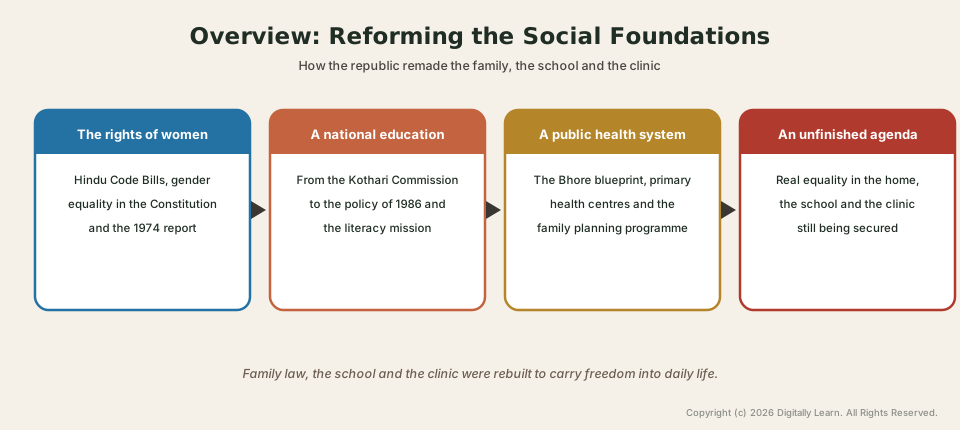
Women, education and health were the social foundations on which the new republic set out to build a life of equal citizenship. Political freedom in 1947 left untouched a society in which women were bound by an unreformed family law, most people were unlettered, and modern medicine reached only a few; the state therefore reformed the law of marriage and inheritance through the Hindu Code Bills, built a national system of schools and universities on the recommendations of the Kothari Commission, and founded a public-health and family planning service on the blueprint of the Bhore Committee. This part follows that long work of social reconstruction.
Women, Education and Health: The Social Foundations of the Republic
Why Political Freedom Had to Become Social Freedom
Why this matters: The Constitution promised equality, but a vote and a right mean little to a woman bound by an unreformed family law, to a child with no school, or to a village with no clinic. The republic understood that political freedom had to be carried into the home, the classroom and the dispensary, and the reform of women's rights, education and health was the labour of making citizenship real.
What is the significance of this social reform: It turned the abstract equality of the Constitution into institutions, the reformed marriage law, the national school system and the public dispensary, that touched ordinary lives. As Nehru held, to awaken a nation one must first awaken its women; the same conviction, that a people rises only when its weakest are lifted, ran through the building of schools and the founding of a health service.
The Hindu Code Bills: Reforming the Law of the Family
How the Law of Marriage and Inheritance Was Remade for Women
Distinguishing the great legal reform: The most far-reaching social reform of the early republic was the recasting of Hindu personal law. Ambedkar, as Law Minister, drafted a comprehensive Hindu Code to reform marriage, divorce, inheritance and the rights of women, but it met fierce resistance from conservatives who saw it as an assault on tradition, and when it stalled he resigned from the cabinet in 1951. Nehru persevered, and the code was passed in pieces over the following years.
The reform took the shape of four statutes. The Hindu Marriage Act of 1955 made monogamy the law, set a minimum age and, for the first time, allowed divorce; the Hindu Succession Act of 1956 gave daughters a right to inherit family property; and the Hindu Minority and Guardianship Act and the Hindu Adoptions and Maintenance Act, both of 1956, settled guardianship, adoption and maintenance on a modern footing. Together they transformed the legal position of Hindu women. The figure below sets out the reform.
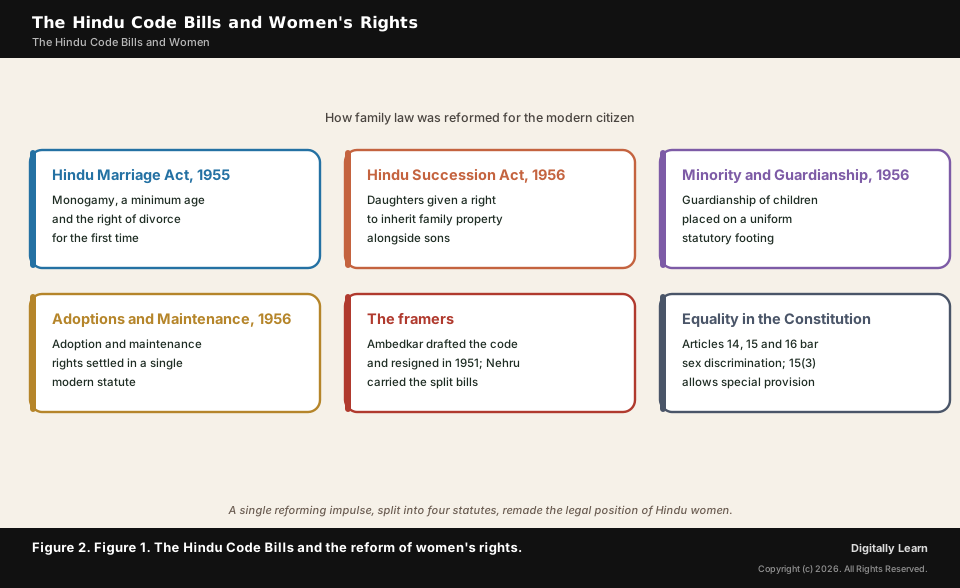
Observable outcome: A body of law that had bound women for centuries was, within a decade, replaced by statutes that recognised them as equal heirs and partners. The reform was incomplete, for it touched only Hindu law and left other personal laws untouched, and practice lagged behind the statute; but it established the principle that the state could reform the family in the name of equality, and it remains the foundation of women's legal rights today.
Constitutional Gender Equality: Articles 14, 15 and 16
How the Constitution Guaranteed and Advanced the Equality of Women
Distinguishing the constitutional guarantee: The reform of family law rested on a constitutional foundation of equality. Article 14 guarantees equality before the law, and Article 15 forbids discrimination on grounds of sex, yet Article 15(3) expressly allows the state to make special provision for women and children, recognising that formal equality alone could not undo an inherited disadvantage. Article 16 extends equality of opportunity in public employment to women on the same terms as men.
The directive principles carried the guarantee further. Article 39 directs the state to secure an adequate means of livelihood for men and women equally and equal pay for equal work, and Article 42 requires just and humane conditions of work and maternity relief. The Constitution thus combined a bar on discrimination with a positive duty to advance women, a design that later statutes on equal pay, maternity benefit and protection from harassment would build upon.
Observable outcome: Indian women began their citizenship with rights that women in many older democracies had won only after long struggle, the vote, equality before the law and a constitutional mandate for special protection. The gap between this formal equality and the reality of women's lives would drive the women's movement of the decades that followed, but the constitutional ground on which that movement stood was secure from the start.
The Women's Movement and the Towards Equality Report of 1974
How a Government Report Exposed the Gap Between Law and Life
Distinguishing the turning point: For two decades after independence it was assumed that legal equality would steadily improve women's condition. That assumption was shaken in 1974, when the Committee on the Status of Women in India published its report, titled Towards Equality, which found that the position of women had in many respects worsened, that the sex ratio was declining and that women's participation in work and politics remained low. The report was a landmark, exposing the gap between the promise of the Constitution and the reality of women's lives.
The report helped to launch a new women's movement. From the mid-1970s an autonomous women's movement, independent of political parties, took up issues that the state had neglected, campaigning against dowry, against violence and rape, and for the rights of working women. It built shelters and study centres, brought women's questions into public debate, and pressed for the laws on dowry, domestic violence and harassment that would follow in later years.
Observable outcome: The Towards Equality report and the movement it helped to inspire shifted the women's question from one of legal reform handed down by the state to one of assertion demanded from below. It established that equality could not be measured by statutes alone but by the lived condition of women, and it set the agenda of dowry, violence and work that the women's movement and the law would pursue for the rest of the century.
Women in Public Life: Political Participation and Representation
How Women Were Brought into the Institutions of Self-Government
Distinguishing participation from rights: Indian women had the vote from the first general election, on equal terms with men, but their presence in the legislatures remained small. The most decisive step towards their political participation came in 1992, when the 73rd and 74th Amendments reserved one-third of the seats in the panchayats and the municipalities for women, bringing more than a million women into local self-government and giving them, for the first time, a share of real political power.
A standing machinery was built alongside. The National Commission for Women, established in 1992, was given a statutory mandate to safeguard women's rights and recommend reform, and the question of reserving seats for women in Parliament and the state assemblies was debated for three decades before a women's reservation law was finally enacted. Women's representation in public life thus advanced furthest at the local level, where the reserved seat made the largest difference.
Observable outcome: The reservation in local bodies was the single largest expansion of women's political participation in independent India, and it changed the texture of village and town government. Yet representation at the higher levels remained limited, and the gap between the one-third reservation in the panchayats and the small presence of women in Parliament measured how much of the task of political equality was still unfinished.
Building a National Education System: From the Kothari Commission to the Policy of 1986
How a Sequence of Commissions Built a Common Framework for Schools
Distinguishing the building of a school system: Independent India inherited an education system that reached only a small, mostly urban minority, and the framers set out to build a national system. The University Education Commission of 1948, under Sarvepalli Radhakrishnan, reformed higher education, and the Mudaliar Commission of 1952 reorganised secondary schooling; but the decisive blueprint came from the Kothari Commission of 1964 to 1966, which proposed the 10+2+3 pattern, a common school system and a national outlay of six per cent of income on education.
The commissions were followed by national policies. The first National Policy on Education of 1968 adopted the Kothari framework, and the revised policy of 1986, with its Operation Blackboard for primary schools and its push for adult literacy, set the shape of Indian education for a generation. A constitutional change underpinned the effort: the 42nd Amendment of 1976 moved education from the State List to the Concurrent List, making it a shared charge of the Union and the states, and the right to free and compulsory education was later made a fundamental right by the 86th Amendment of 2002, not the 76th.
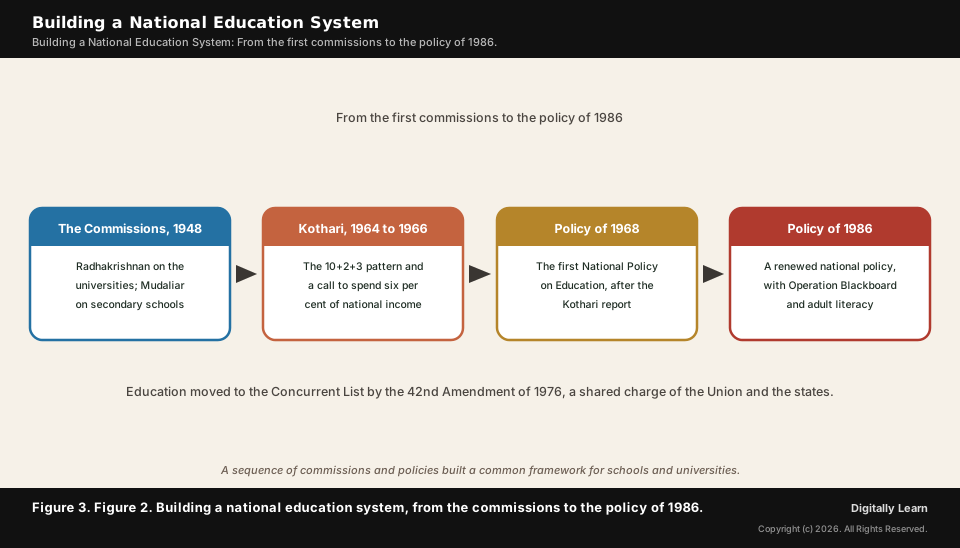
Observable outcome: Over four decades the republic built, from a thin colonial inheritance, a vast national system of schools, colleges and universities, and brought education within the reach of a steadily widening share of its people. Quality and access remained uneven, and the goal of six per cent of income was rarely met, but the framework of a common, state-directed education system, laid down by the commissions and the policies, endured.
Literacy for All: The National Literacy Mission of 1988
How the State Set Out to Teach an Unlettered Nation to Read
Distinguishing literacy from schooling: Building schools reached the young, but at independence the great majority of adults could neither read nor write, and a separate effort was needed for them. The National Adult Education Programme of 1978 made a first attempt, and the decisive step came with the National Literacy Mission, launched in 1988, which set out to make millions of adults functionally literate through time-bound, area-based campaigns run with the help of volunteers.
The mission worked through mass campaigns. The Total Literacy Campaigns, organised district by district and drawing on students, teachers and volunteers, became a model of social mobilisation, and districts such as Ernakulam in Kerala were declared fully literate. Alongside the mission, Operation Blackboard of 1987 equipped primary schools, so that the effort to teach adults and the effort to school children advanced together.
Observable outcome: The literacy rate, which had stood below a fifth of the population at independence, rose decade by decade to cross two-thirds by the turn of the century, one of the quieter achievements of the republic. Literacy remained uneven between the sexes and the regions, with women and the poorer states lagging, but the long campaign turned a largely unlettered nation into a substantially literate one.
Public Health and the Bhore Committee Blueprint
How a Welfare-State Vision of Health Reached from the Plan to the Village
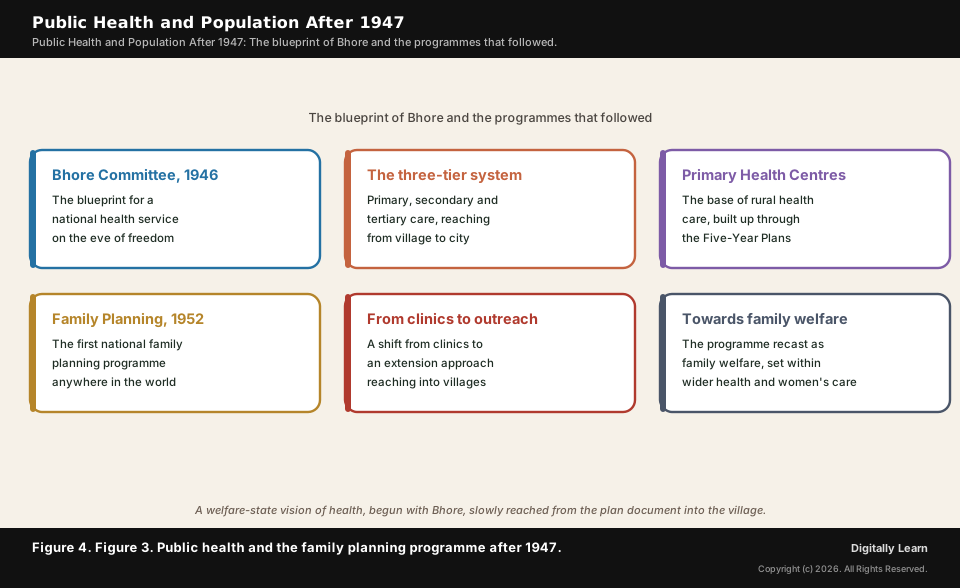
Distinguishing the health blueprint: India's public-health system rests on a plan drawn up before independence. The Bhore Committee, the Health Survey and Development Committee chaired by Joseph Bhore, reported in 1946 and recommended a national health service free at the point of use, organised in a three-tier structure of primary, secondary and tertiary care, with a network of primary health centres as its base. It was a welfare-state vision, treating health care as a duty of the state rather than a market service.
The blueprint was built through the plans. From the First Five-Year Plan the state established Primary Health Centres and sub-centres across the countryside, staffed them with doctors and health workers, and ran national programmes against malaria, tuberculosis, smallpox and other diseases. Smallpox was eradicated and malaria sharply reduced, and a structure of rural health care, however thinly resourced, reached into districts that modern medicine had never touched.
Observable outcome: A primary health structure is, as the framers grasped, both a moral duty of a welfare state and a condition of development, for a sick and short-lived people cannot prosper. The system that Bhore designed and the plans built remained underfunded and uneven, and the goal of free universal care was never fully met, but it carried modern medicine and a rising life expectancy to a population that had known little of either.
Population and the Family Planning Programme
How India Became the First Nation to Adopt a Population Policy
Distinguishing the population question: A rapidly growing population threatened to outrun the gains of development, and in 1952 India became the first country in the world to adopt a national family planning programme, treating population as a matter of public policy. The early programme worked through clinics, offering advice and contraception to those who came; it reached few, and in time it shifted to an extension approach that carried the message into the villages.
The programme passed through difficult years. During the Emergency of the mid-1970s the drive for sterilisation became coercive in places, and the reaction against that coercion set the programme back and made later governments cautious. It was afterwards recast as a programme of family welfare, voluntary and linked to women's health, education and child survival, on the understanding that smaller families follow from development and the education of women rather than from compulsion.
Observable outcome: The family planning programme, the first of its kind anywhere, slowly helped to lower the birth rate, though India's population continued to grow for decades through its young age structure. The lesson the programme taught, that the surest route to a stable population runs through the education and health of women, tied the population question back to the wider social reform of which it was a part.
Significance: Women, Education and Health as the Unfinished Social Agenda
How Social Reform Carried the Constitution into Daily Life
The larger significance of this reform is that it gave the republic's promise of equality an institutional body. The reformed family law, the national school system and the public-health service translated a constitutional ideal into arrangements that shaped how Indians married, learned and were cared for; without them, the equality of the Constitution would have remained a paper guarantee, untouched by the conditions of ordinary life.
Contemporary linkages keep this agenda at the centre of policy. Women's representation and safety, the quality and reach of schooling under later education policies, public health after the experience of recent epidemics, and the slow approach to a stable population are all live questions, each the descendant of the reforms begun in these decades.
The deeper lesson is that social reform is never finished, that each gain in the rights of women, in education and in health opens a further task, and that the awakening Nehru spoke of is the continuing work of a democracy. The next part turns from these social foundations to the question of language and culture in the building of the nation.
| Field | Landmark | Year |
|---|---|---|
| Public health | The Bhore Committee blueprint and the three-tier system | 1946 |
| Population | The family planning programme, the first in the world | 1952 |
| Women's rights | The Hindu Marriage and Hindu Succession Acts | 1955 and 1956 |
| Education | The Kothari Commission and the 10+2+3 pattern | 1964 to 1966 |
| Women's status | The Towards Equality report | 1974 |
| Education | Education moved to the Concurrent List | 1976 |
| Literacy | The National Literacy Mission | 1988 |
| Women in politics | One-third reservation in local bodies | 1992 |
- The Hindu Code Bills of 1955 and 1956 reformed marriage, divorce and inheritance for Hindu women.
- Articles 14, 15 and 16, with Article 15(3), guarantee equality and allow special provision for women.
- The Towards Equality report of 1974 exposed the gap between legal and real equality and spurred the women’s movement.
- The Kothari Commission shaped the 10+2+3 system; the 42nd Amendment of 1976 made education a Concurrent subject.
- The Bhore Committee of 1946 framed a three-tier health system, and the 1952 family planning programme was the world’s first.
Previous Year UPSC-CSE Questions
Previous Year UPSC-CSE Questions By the end you will be able to draft model answers for the following UPSC questions. Each question carries a collapsible framework showing how to approach it in the exam.
- UPSC Mains 2023 GS-IV“To awaken the people, it is the women who must be awakened. Once she is on the move, the family moves, the village moves, the nation moves.” – Jawaharlal Nehru
How to structure the answer in the exam
Introduction: Open with Nehru's idea that the awakening of women is the key to the awakening of the nation.
Body (sub-themes to develop):
- The chain in the quote: an awakened woman moves the family, the village and the nation.
- Legal awakening: the Hindu Code Bills and constitutional gender equality as the lever of reform.
- Social awakening: education and the women's movement after Towards Equality 1974.
- The development link: women's education and health as the route to a stable, prosperous society.
Conclusion: Conclude that the empowerment of women is both an end in itself and the most effective means of national advancement, as Nehru held.
- UPSC Mains 2021 GS-II“Besides being a moral imperative of a Welfare State, primary health structure is a necessary precondition for sustainable development.” Analyze.
How to structure the answer in the exam
Introduction: Open with the Bhore Committee's vision of health care as a duty of the welfare state.
Body (sub-themes to develop):
- The moral imperative: the Bhore blueprint of a free, three-tier service with primary health centres at the base.
- The developmental precondition: a healthy population as the basis of productivity, learning and demographic stability.
- The instruments: primary health centres, disease-control programmes and the family welfare approach.
- The shortfalls: underfunding, rural-urban gaps and the unfinished goal of universal care.
Conclusion: Conclude that a strong primary health structure serves both the welfare state's moral duty and the material conditions of sustainable development.
- UPSC Prelims 2006 GS Paper IConsider the following statements:
- Free and compulsory education to the children of 6-14 years age group by the State was made a Fundamental Right by the 76th Amendment to the Constitution of India.
- Sarva Shiksha Abhiyan seeks to provide computer education even in rural areas.
- Education was included in the Concurrent List by the 42nd Amendment, 1976 to the Constitution of India.
Which of the statements given above are correct?
How to approach this Prelims question
Approach: Test each statement against the constitutional amendments and the schemes.
Trap to watch: The right to education was the 86th Amendment of 2002, not the 76th; the 42nd Amendment of 1976 moved education to the Concurrent List.
Key facts to recall:
- The 42nd Amendment of 1976 moved education to the Concurrent List
- The right to education was the 86th Amendment of 2002 (Article 21A), not the 76th
- Sarva Shiksha Abhiyan extended schooling, including computer education, to rural areas
Answer signal: Statements 2 and 3 only, so option (c).
Sources and Further Reading
- NCERT, Politics in India since Independence (Class 12)
- NCERT, Indian Constitution at Work (Class 11)
- Wikipedia: Hindu Code Bills
- Wikipedia: Kothari Commission
- Wikipedia: Bhore Committee
- Wikipedia: Family planning in India
- Ministry of Health and Family Welfare, Government of India
- Ministry of Education, Government of India
- India Code: The Hindu Marriage Act, 1955
- Press Information Bureau, Government of India
- National Portal of India
Editorial Disclaimer
This article is prepared for civil services preparation. Verify key facts and interpretations against standard reference works before relying on them.