


Overview
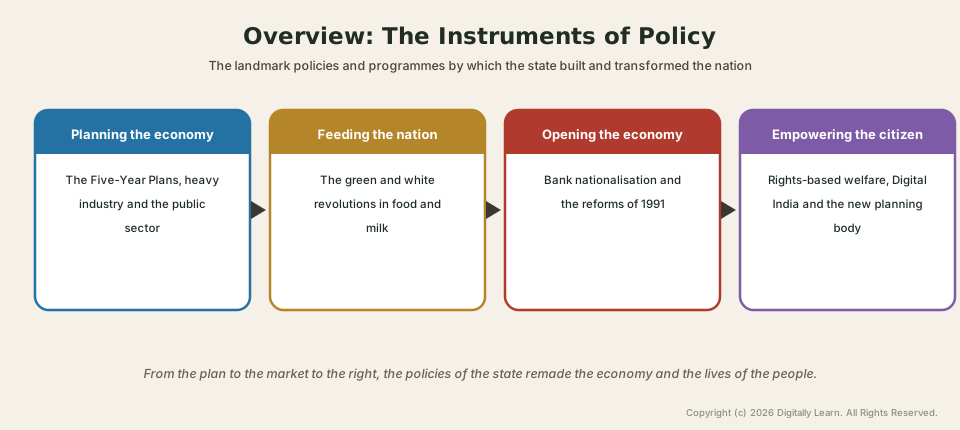
The landmark policies and programmes of independent India were the great instruments through which the state sought to build and transform the nation. If the architects gave the republic its vision, it was through these instruments that the vision was carried into the lives of the people: the Five-Year Plans that built the planned economy, the green and white revolutions that secured food and milk, the bank nationalisation and the 1991 reforms that turned the economy first to the state and then to the market, and the rights-based welfare laws and Digital India of the contemporary era. This part draws these instruments together, as a closing survey, and treats each as a tool of nation-building.
Landmark Policies and Programmes: The Instruments of Nation-Building
Why the Policies and Programmes Are the Tools of the Builder
Why this matters: A vision is realised through instruments. The democratic and secular ideals of the founders, traced through this series, were carried into the lives of the people through the great policies and programmes of the state. To understand how the nation was built, one must understand these tools, the plans, the revolutions, the reforms and the welfare laws through which policy reached the field, the factory and the home.
What is the significance of these instruments: They show the changing strategy of nation-building across the decades, from the planned economy of the early republic to the market reforms of 1991 and the rights-based welfare of the present. This part surveys the landmark instruments, treating each as a tool whose aims and effects are set down in balanced terms, with the detailed accounts cross-referenced to the earlier parts.
The Five-Year Plans and the Planned Economy
How the State Sought to Build the Economy by the Plan
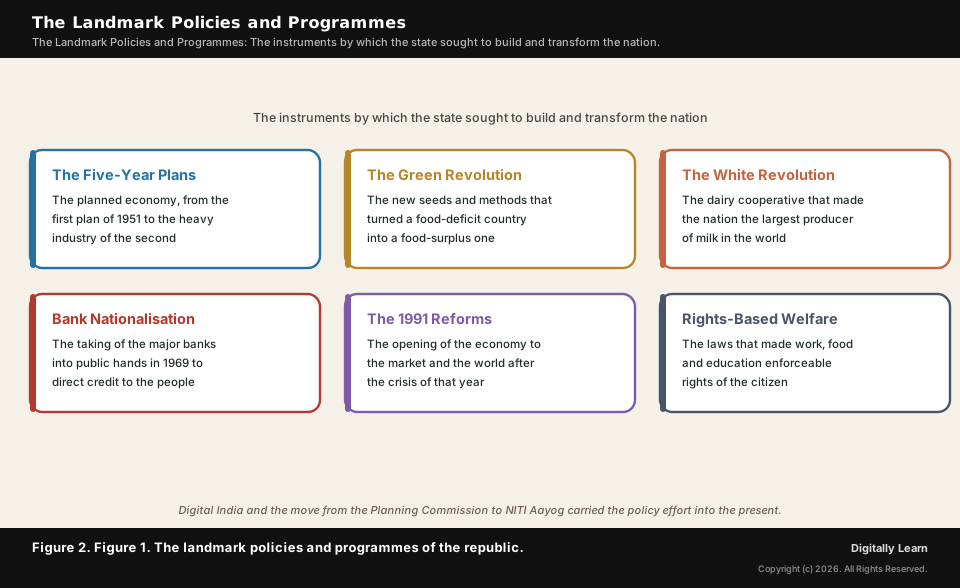
Distinguishing the Five-Year Plans: The first great instrument of the new republic was planning. Through the Planning Commission and a series of Five-Year Plans, beginning with the first in 1951, the state set out to direct the economy towards growth, industry and self-reliance, treated in full in the part on planning. The plans were the chosen means of building a modern economy in a poor and largely agricultural country.
The plans had distinct priorities. The first plan, of 1951, gave its weight to agriculture and to repairing the wounds of partition; the second plan, of 1956, emphasised the establishment of heavy industry, on the strategy associated with the statistician Mahalanobis, building the steel plants and the public sector that were to be the base of an industrial economy; and the later plans pursued self-reliance and, in time, the relief of poverty.
The table below sets out the early plans.
| Plan | Its chief emphasis | Period |
|---|---|---|
| The First Plan | Agriculture and recovery after partition | 1951 to 1956 |
| The Second Plan | Heavy industry, on the Mahalanobis strategy | 1956 to 1961 |
| The Third Plan | A self-reliant and self-generating economy | 1961 to 1966 |
Observable outcome: The planned economy built the heavy industry, the dams and the public-sector base on which later growth rested, the great achievement of the strategy. Its limits, the slow growth, the neglect of agriculture in the early plans and the inefficiency of the controls, were the criticisms that in time led to the reforms of 1991, and the balance of the plan's record is treated in the part on planning.
The Green Revolution and the Quest for Food
How the New Seeds Turned a Hungry Nation into a Food-Surplus One
Distinguishing the Green Revolution: In the middle of the 1960s, after the droughts and the dependence on food aid, the state turned to a new strategy in agriculture. The Green Revolution, treated in full in the part on the agrarian revolutions, brought the high-yielding seeds, the fertiliser and the assured irrigation that, in a few years, turned a food-deficit country into a food-surplus one and ended the spectre of famine.
Its gains were unevenly spread. The revolution took its fullest hold in Punjab, Haryana and western Uttar Pradesh, where assured irrigation and a responsive farmer made the new methods succeed, and it largely bypassed the eastern region despite its fertile soil and ample water, held back there by water-logging and floods, by small and fragmented holdings, and by weaker rural institutions.
It also brought its costs, the strain on the soil and the groundwater and the widening gap between the prospering and the lagging regions.
Observable outcome: The Green Revolution gave the nation food security, one of the great achievements of policy, freeing it from dependence on foreign grain. Its uneven spread and its ecological costs are the qualifications that an honest account records, and the detailed treatment, including the eastern region, is given in the part on the agrarian revolutions.
The White Revolution and the Cooperative Model
How the Dairy Cooperative Made the Nation the Largest Producer of Milk
Distinguishing the White Revolution: Alongside the green revolution in grain ran the white revolution in milk. Through the programme of Operation Flood, launched in 1970 and built on the cooperative of Anand, the dairy farmers' own cooperatives were linked into a national grid, the work of Verghese Kurien examined in the parts on the agrarian revolutions and the architects.
Its method was the farmer-owned cooperative. By placing the dairy in the hands of the producers themselves, who owned it and kept its profit, the white revolution lifted the incomes of millions of small farmers and made the nation the largest producer of milk in the world. It became a model, widely studied, of how a cooperative could transform a whole sector for the benefit of the small producer.
Observable outcome: The white revolution showed that a cooperative of small producers, well led and well organised, could achieve a transformation that neither the market nor the state alone had managed. Its success made it one of the most admired programmes of rural development the republic has produced, and its detail is given in the part on the agrarian revolutions.
Bank Nationalisation and the Social Control of Credit
How the Major Banks Were Taken into Public Hands
Distinguishing bank nationalisation: In 1969 the government took the major commercial banks into public ownership, nationalising fourteen of the largest, and added more in a second round in 1980. The stated aim was the social control of credit, to direct lending away from a narrow circle of industry towards agriculture, small enterprise and the neglected regions, and to spread banking to the countryside.
The measure is recorded here as a dated fact, in balanced terms. On one side, nationalisation greatly widened the reach of banking, opening branches across rural India and channelling credit to priority sectors and the poor; on the other, critics held that public ownership brought inefficiency, political direction of lending and the burden of bad loans. The two sides of the record are set down together, without a partisan verdict on the policy.
Observable outcome: Bank nationalisation deepened the reach of the financial system into rural and small-town India and remained a defining feature of the economy until the reforms of the 1990s loosened the state's grip. Its place here is as a landmark instrument by which the state sought to bend finance to the purposes of development.
The Reforms of 1991 and the Turn to the Market
How the Liberalising Reforms Remade the Strategy of Policy
Distinguishing the 1991 reforms: The most decisive change of policy in the contemporary era was the turn of 1991. Faced with a balance-of-payments crisis, the government dismantled much of the system of industrial licensing and opened the economy to private enterprise, to trade and to foreign investment, the reforms of liberalisation, privatisation and globalisation treated in full in the parts on the reforms of 1991 and on contemporary India.
The turn reversed the strategy of forty years. Where policy had sought to build the economy through the plan, the public sector and protection, it now turned to the market, to competition and to the world, a change as great in the field of policy as any since independence. The reforms are recorded here as the pivot between the two great strategies of nation-building, the planned and the market-led.
Observable outcome: The reforms of 1991 reshaped the economy for a generation and remain the most consequential policy turn of the contemporary republic. Their merits and their costs, the rapid growth and the questions of jobs and inequality, are debated in the part on contemporary India and are not weighed here.
Rights-Based Welfare: Work, Food, Education and Information
How Welfare Was Recast as the Enforceable Right of the Citizen
Distinguishing rights-based welfare: A striking feature of policy in the contemporary era was the recasting of welfare as the enforceable right of the citizen, rather than the discretionary favour of the state. A series of laws gave the citizen claims that could be enforced in the courts, marking a new and rights-based approach to the relief of poverty and the spread of opportunity.
The new rights covered work, food, education and information. The right to education was made a fundamental right by the eighty-sixth amendment of 2002 and given effect by the law of 2009, guaranteeing free and compulsory schooling to children from the age of six to fourteen.
The rural employment law of 2005 guaranteed a hundred days of wage work in the year to every rural household, the food security law gave a legal entitlement to subsidised grain, and the right to information opened the records of the state to the citizen. The figure below sets out these rights.
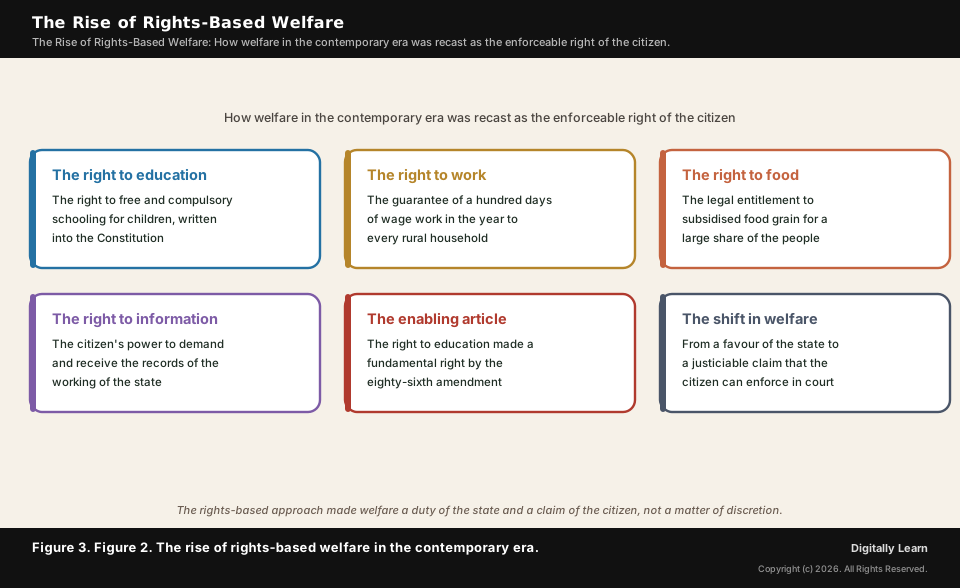
Observable outcome: The rights-based approach changed the relation between the citizen and the state, making welfare a duty enforceable in law rather than a matter of discretion. Its reach and its effectiveness are debated, as with any large programme, but the shift from favour to right was a genuine change in the idea of welfare, recorded here in balanced terms.
Digital India and the Technology of Governance
How Technology Was Turned to the Delivery of Public Services
Distinguishing Digital India: The most recent of the great policy efforts turned the tools of technology to the work of governance. The Digital India programme, launched in 2015, sought to build the digital infrastructure of the country, to deliver public services online and to make the state more accessible to the citizen, building on the spread of the mobile telephone and the internet described in the part on contemporary India.
Its aim was a more direct and accessible state. By placing services, records and payments on a digital platform, the effort sought to cut the distance between the citizen and the government, to reduce the leakages of welfare and to widen access to information and to markets. It is recorded here as a dated development, the latest instrument by which policy has sought to reach the citizen, with its effects still unfolding.
Observable outcome: Digital India marked the turn of policy towards the technological delivery of services, a change whose full consequences belong to a story still being written. Its place in this survey is as the contemporary face of the long effort to make the instruments of the state reach the ordinary citizen.
From the Planning Commission to NITI Aayog
How the Architecture of Planning Itself Was Remade
Distinguishing the change in planning: The very body that had directed the economy was itself remade. In 2015 the Planning Commission, which had drawn up the Five-Year Plans since 1950, was replaced by a new body, the National Institution for Transforming India, or NITI Aayog. The change marked the passing of the era of central planning that the reforms of 1991 had already undermined.
The new body differed in its principles. Where the Planning Commission had drawn up binding Five-Year Plans and allocated funds to the states from the centre, in a top-down manner, the new institution was conceived as a think-tank that advises rather than directs, that does not allocate funds, and that works through cooperative federalism, drawing the states into the making of policy from the bottom up. The difference in their principles is the subject of a recurring examination question.
Observable outcome: The move from the Planning Commission to NITI Aayog set down, in the architecture of the state itself, the larger turn from the planned economy to the market and to a stronger role for the states. It is recorded here as a dated institutional change, the framework of planning remade to suit a different economy.
Significance: Policy as the Instrument of a Changing Nation
How the Instruments of Policy Tell the Story of Nation-Building
The larger significance of these landmark policies and programmes is that they trace, in the instruments of the state, the whole changing strategy of nation-building. From the plan to the market and from the favour to the right, the great instruments of policy show how the republic understood, in each era, the task of building the nation and lifting its people, and the present rests on what they together achieved and attempted.
| Policy or programme | What it sought | Era |
|---|---|---|
| The Five-Year Plans | To build the economy by the plan | From 1951 |
| The Green and White Revolutions | To secure food and milk | From the 1960s |
| Bank Nationalisation | To direct credit to the people | 1969 |
| The 1991 Reforms | To open the economy to the market | 1991 |
| Rights-Based Welfare | To make welfare an enforceable right | The contemporary era |
Contemporary linkages carry their story to the present, where the debates over the role of the plan and the market, the spread and the effectiveness of welfare, and the digital delivery of services are all the living descendants of the instruments surveyed here.
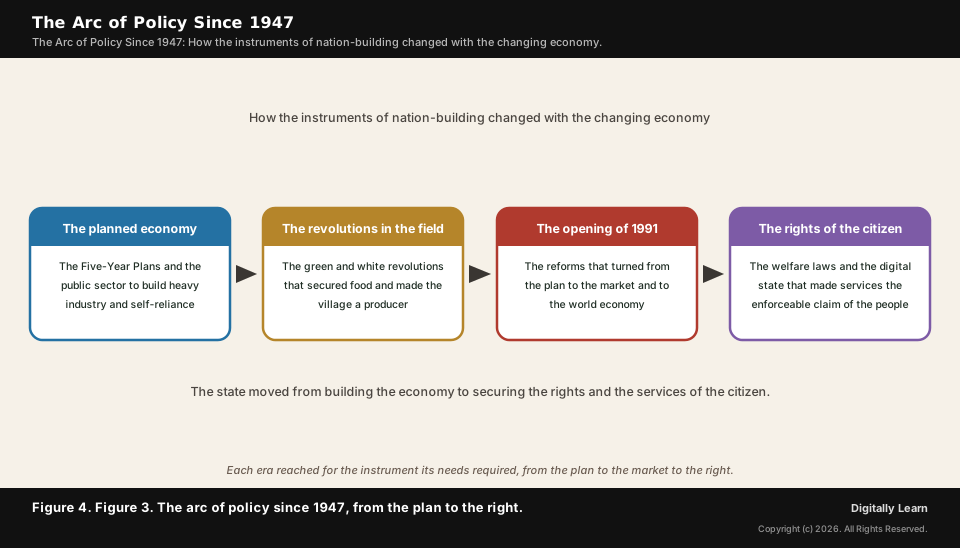
The deeper lesson is that a nation is built as much by its instruments as by its ideals, that the choice of the right tool for each task is itself a part of statecraft, and that the long endeavour of nation-building can be read in the changing policies of the state. The final part turns from the policies to the larger themes and the verdict on the whole endeavour.
- The Five-Year Plans and the public sector built heavy industry, the second plan emphasising it on the Mahalanobis strategy.
- The green and white revolutions secured food and milk, though the green revolution’s gains were unevenly spread across the regions.
- Bank nationalisation of 1969 and the reforms of 1991 turned the economy first to the state and then to the market.
- Rights-based welfare made work, food, education and information the enforceable claims of the citizen.
- Digital India and the move from the Planning Commission to NITI Aayog carried the policy effort into the present.
Previous Year UPSC-CSE Questions
Previous Year UPSC-CSE Questions By the end you will be able to draft model answers for the following UPSC questions. Each question carries a collapsible framework showing how to approach it in the exam.
- UPSC Mains 2018 GS-IIIHow are the principles followed by the NITI Aayog different from those followed by the erstwhile Planning Commission in India?
How to structure the answer in the exam
Introduction: Open with the replacement of the Planning Commission by NITI Aayog in 2015.
Body (sub-themes to develop):
- Top-down vs bottom-up: central direction against cooperative federalism.
- Binding plan vs advisory think-tank: NITI Aayog advises, it does not direct.
- Fund allocation: the Planning Commission allocated funds; NITI Aayog does not.
- Role of the states: a stronger and more participative role for the states in NITI Aayog.
Conclusion: Conclude that NITI Aayog reflects the shift from central planning to cooperative federalism and an advisory, market-aware role.
- UPSC Mains 2014 GS-IWhy did the Green Revolution in India virtually by-pass the eastern region despite fertile soil and good availability of water?
How to structure the answer in the exam
Introduction: Open with the concentration of the Green Revolution in the north-west.
Body (sub-themes to develop):
- Water management: water-logging and floods in the east despite ample water.
- Land holdings: small and fragmented holdings in the east, unlike the larger farms of Punjab.
- Institutions: weaker credit, extension and marketing institutions in the east.
- Other factors: tenancy, lower assured irrigation and a less responsive infrastructure.
Conclusion: Conclude that the absence of the enabling conditions of the north-west, not of soil or water, kept the east behind.
- UPSC Prelims 2009 GS Paper IConsider the following statements regarding Indian Planning :
- The Second Five-Year Plan emphasised on the establishment of heavy industries.
- The Third Five-Year Plan introduced the concept of import substitution as a strategy for industrialisation.
Which of the statements given above is/are correct ?
How to approach this Prelims question
Approach: Test each statement about the early Five-Year Plans.
Trap to watch: Heavy industry is the hallmark of the Second Plan (Mahalanobis); import substitution is not specifically the Third Plan's concept.
Key facts to recall:
- The Second Plan emphasised heavy industry on the Mahalanobis strategy
- The Third Plan aimed at a self-reliant and self-generating economy
Answer signal: Statement 1 only, so option (a).
Sources and Further Reading
- NCERT, Politics in India since Independence (Class 12)
- NITI Aayog, Government of India
- Wikipedia: Five-Year Plans of India
- Wikipedia: Green Revolution in India
- Wikipedia: Right of Children to Free and Compulsory Education Act, 2009
- India Code: the central Acts
- Press Information Bureau, Government of India
- National Portal of India
Editorial Disclaimer
This article is prepared for civil services preparation. Verify key facts and interpretations against standard reference works before relying on them.