
Overview
Previous Year UPSC-CSE Questions By the end you will be able to draft model answers for the following UPSC questions. Each question carries a collapsible framework showing how to approach it in the exam.
- UPSC Mains 2018 GS-IHow is the Indian concept of secularism different from the western model of secularism? Discuss.
How to structure the answer in the exam
Introduction: Open with secularism as a core feature, but one that India defines differently from the West.
Body (sub-themes to develop):
- The Western model: a strict wall of separation; the state keeps strictly out of religion.
- The Indian model: principled distance and equal respect for all faiths.
- The state's power to intervene to reform religion in the name of equality.
- The protection of religious minorities and the suitability to a plural society.
Conclusion: Conclude that Indian secularism is an engaged, equal-distance model rather than a strict separation.
- UPSC Prelims 2017 GS Paper IWhich one of the following objectives is not embodied in the Preamble to the Constitution of India?
How to approach this Prelims question
Approach: Recall the liberties the Preamble actually lists.
Trap to watch: The Preamble secures liberty of thought, expression, belief, faith and worship; economic liberty is not among its stated objectives.
Key facts to recall:
- The Preamble lists liberty of thought, expression, belief, faith and worship
- It does not list economic liberty
- Liberty in the Preamble is of conscience and expression
Answer signal: Economic liberty is not embodied in the Preamble, so option (b).
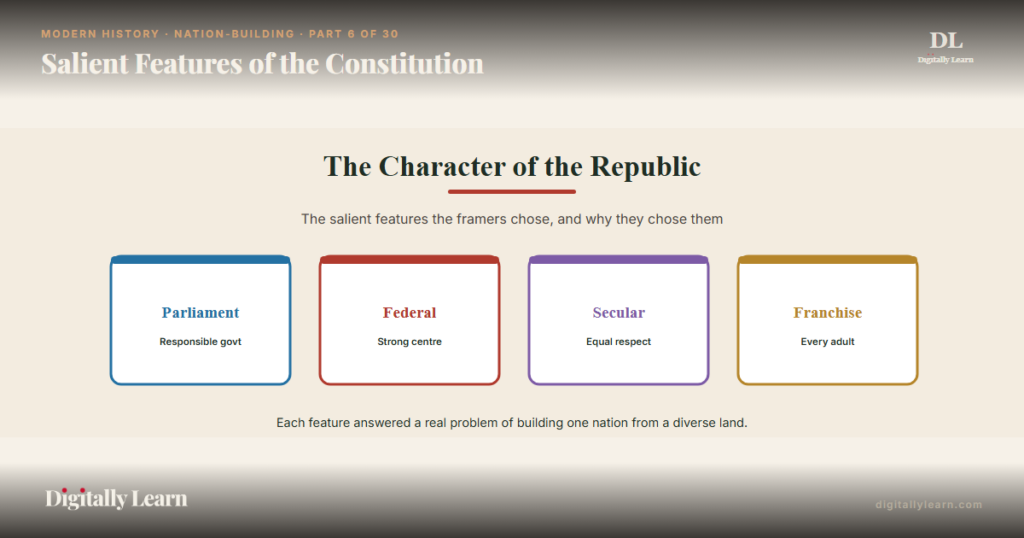
The salient features of the Indian Constitution are the defining choices the framers made about the kind of republic India would be. They built a parliamentary democracy and a federal union with a strong centre, guaranteed justiciable fundamental rights alongside non-justiciable directive principles, founded the state on a distinctive secularism of equal respect for all faiths, granted universal adult franchise, and set up an independent integrated judiciary. Each feature was chosen to answer a real problem of building one nation from a vast and diverse land, and together they gave nation-building its lasting democratic character.
Introduction: The Character the Framers Gave the Republic
Why the Salient Features Are Choices, Not Just Facts
Why this matters: the salient features of the Constitution are best understood not as a list to memorise but as choices the framers made. Each feature answered a real question about how a vast, diverse and newly free nation should be governed, and the reasons behind the choices are as important as the features themselves.
What is the significance of the features: together they gave the republic its enduring character, parliamentary, federal, rights-based, secular and democratic. They are the frame within which all the later working of nation-building, from elections to federalism to amendment, has taken place, as the features below set out.
Parliamentary Government and Federalism with a Unitary Bias
Why a Parliamentary System and a Strong Centre
What is the significance of the parliamentary choice: the framers chose a parliamentary rather than a presidential system. As Ambedkar argued, a parliamentary executive answerable day to day to the legislature offered more responsibility, even at some cost to stability, and the model was already familiar from the working of the 1935 Act.
Distinguishing the federal choice: India became a federation with a unitary bias, a union of states in which power tilts towards the centre. This was a deliberate design, shaped by the trauma of Partition and the fear of fragmentation, so that the union could hold a diverse country together in a crisis.
Fundamental Rights, Directive Principles and the Preamble
Rights to Limit the State and Directives to Guide It
What is the significance of rights and directives: the Constitution balances two kinds of provision. The justiciable fundamental rights limit the state and can be enforced in court, while the non-justiciable directive principles set goals of social and economic justice that the state is to pursue but that the courts will not enforce.
Distinguishing the Preamble: the Preamble declares India a sovereign, socialist, secular, democratic republic and secures to its citizens justice, and liberty of thought, expression, belief, faith and worship. It is the key to the Constitution's purposes, though it does not by itself confer a separate economic right.
Secularism in the Indian Constitution: Principled Distance, Not Separation
How the Indian Idea of Secularism Differs from the West
What is the significance of Indian secularism: it is a distinctive model. Where the Western idea builds a wall of strict separation between religion and the state, the Indian idea is one of principled distance, an equal respect for all faiths in which the state may even step in to reform a religion in the name of equality.
Distinguishing the engagement: Indian secularism is therefore a secularism of engagement rather than of avoidance. It protects religious minorities, allows the state to intervene against practices it deems unjust, and treats all religions alike, a model suited to a deeply plural society, as the contrast below sets out.
Universal Adult Franchise and an Independent Judiciary
A Democratic Wager and Its Guardian
Observable outcomes began with the very first election. The framers granted universal adult franchise at once, making every adult citizen a voter in a poor and largely illiterate society, a bold democratic wager that few new nations of the time were willing to make.
Distinguishing the judiciary: to guard the whole structure the Constitution set up a single integrated judiciary, with the Supreme Court at its head, independent of the executive and charged with upholding the rule of law and the Constitution. The franchise gave the people power; the judiciary guarded the rules.
Fundamental Duties and the Evolution of the Constitution's Values
How the Features Were Added to and Refined
What is the significance of the later changes: the salient features were not frozen in 1950. The Fundamental Duties were added by the 42nd Amendment of 1976 on the advice of the Swaran Singh Committee, and the same amendment inserted the words secular and socialist into the Preamble.
Distinguishing the further evolution: later amendments continued to shape the features. The voting age was lowered from twenty-one to eighteen, and the right to education was added as a fundamental right. The timeline below traces how the founding features were added to and refined over the decades.
Why the Framers Made These Choices
The Reasoning Behind the Great Constitutional Decisions
Distinguishing the logic behind the features shows the framers as problem-solvers. They chose a strong centre against the danger of fragmentation, rights to limit the state and directives to guide it, secularism to bind a plural society, and universal suffrage to root the republic in the consent of all, as the reasoning below sets out.
What is the significance of this reasoning: it explains why the Constitution has endured. Because each feature answered a real problem of nation-building rather than copying a foreign model blindly, the frame proved durable enough to carry a vast and diverse country through more than seventy years of self-government.
| Feature | What it means | Why it was chosen |
|---|---|---|
| Parliamentary government | An executive answerable to the legislature | More day-to-day responsibility, and familiarity from the 1935 Act |
| Federalism with a strong centre | A union of states with power tilted to the centre | To hold a diverse country together after Partition |
| Fundamental rights and directives | Enforceable rights and non-enforceable goals | To limit the state and to guide it towards social justice |
| Secularism | Equal, principled distance from all faiths | To bind a deeply plural society into one nation |
| Universal adult franchise | Every adult citizen a voter | To root the republic in the consent of all its people |
Significance: A Frame That Has Endured
Why the Features Anchor the Whole of Nation-Building
Contemporary linkages run from these features into every later part of the story. The parliamentary and federal choices shape the working of democracy and centre-state relations, the rights and the judiciary shape the long history of amendments and judicial review, and secularism remains a live question in Indian politics.
The larger significance is that the salient features gave nation-building its stable democratic frame. A diverse land bound itself by consent to parliamentary government, fundamental rights and a secular, federal republic. The points below gather the threads, and the next part turns to the reorganisation of the states within that frame.
- The Constitution gave the republic a parliamentary, federal, rights-based and secular character.
- Federalism with a unitary bias was a deliberate design shaped by the trauma of Partition.
- Indian secularism is a principled distance from all faiths, not a Western wall of separation.
- Fundamental Duties and the words secular and socialist were added by the 42nd Amendment of 1976.
- Each feature answered a real problem of building one nation from a vast and diverse land.
Prelims MCQ practice
Each question below tests one specific concept on the topic. Click to reveal the answer and a full option-wise explanation.
Q1. India is described as a federation with a 'unitary bias' chiefly because of which one of the following?
- The states are more powerful than the centre
- Power is tilted towards a strong centre
- There is no division of powers at all
- The centre has no role in state matters
Show answer and explanation
Answer: Power is tilted towards a strong centre
Explanation.
Option (b) is correct. Indian federalism tilts power towards a strong centre, a unitary bias shaped by the need to hold a diverse country together. Hence option (b).
Q2. The words 'Secular' and 'Socialist' were added to the Preamble of the Constitution by the:
- 42nd Amendment, 1976
- 44th Amendment, 1978
- First Amendment, 1951
- 61st Amendment, 1989
Show answer and explanation
Answer: 42nd Amendment, 1976
Explanation.
Option (a) is correct. The words 'Secular' and 'Socialist' were added to the Preamble by the 42nd Amendment of 1976. Hence option (a).
Q3. Consider the following statements about the Indian model of secularism:
- It maintains a principled distance and equal respect for all religions.
- It follows a strict wall of separation in which the state never intervenes in religion.
Which of the statements given above is/are correct?
- 1 only
- 2 only
- Both 1 and 2
- Neither 1 nor 2
Show answer and explanation
Answer: 1 only
Explanation.
Only statement 1 is correct. Indian secularism is a principled distance with equal respect; it is not the Western strict wall of separation, and the state may intervene to reform religion. Hence option (a).
Q4. The Fundamental Duties were added to the Constitution on the recommendation of the:
- Sarkaria Commission
- Swaran Singh Committee
- Balwantrai Mehta Committee
- Fazl Ali Commission
Show answer and explanation
Answer: Swaran Singh Committee
Explanation.
Option (b) is correct. The Fundamental Duties were added by the 42nd Amendment of 1976 on the recommendation of the Swaran Singh Committee. Hence option (b).
Q5. Consider the following statements about fundamental rights and directive principles:
- Fundamental rights are justiciable and can be enforced in court.
- Directive principles are non-justiciable and guide the policy of the state.
Which of the statements given above is/are correct?
- 1 only
- 2 only
- Both 1 and 2
- Neither 1 nor 2
Show answer and explanation
Answer: Both 1 and 2
Explanation.
Both statements are correct. Fundamental rights are justiciable and enforceable; directive principles are non-justiciable and guide state policy. Hence option (c).
Q6. The voting age in India was lowered from twenty-one to eighteen years by the:
- 42nd Amendment, 1976
- 61st Amendment, 1989
- 44th Amendment, 1978
- 86th Amendment, 2002
Show answer and explanation
Answer: 61st Amendment, 1989
Explanation.
Option (b) is correct. The 61st Amendment of 1989 lowered the voting age from twenty-one to eighteen. Hence option (b).
Sources and Further Reading
- NCERT, Indian Constitution at Work (Class 11), Philosophy of the Constitution
- Wikipedia: Constitution of India
- Wikipedia: Secularism in India
- Wikipedia: Preamble to the Constitution of India
- National Portal of India
- Press Information Bureau, Government of India
- National Archives of India
- Azadi Ka Amrit Mahotsav, Ministry of Culture
Editorial Disclaimer
This article is prepared for UPSC examination preparation. Verify key facts and interpretations against standard reference histories before relying on them.