


Overview
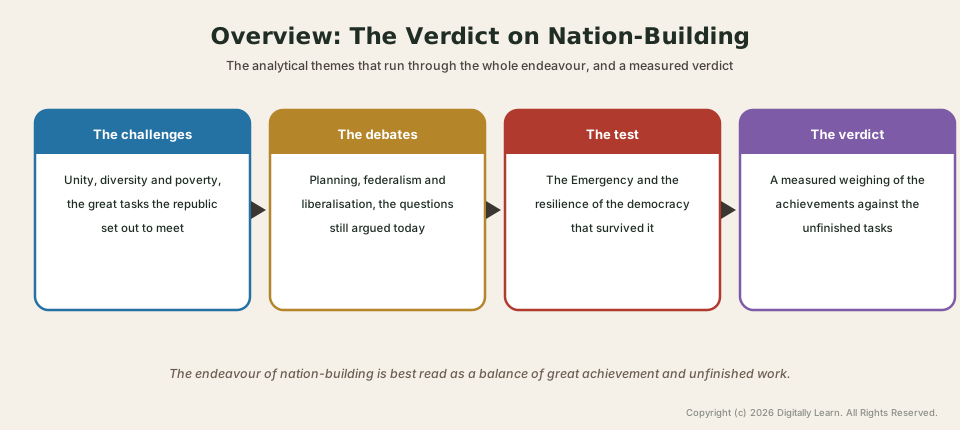
This final part draws the long story of nation-building to a close, not with new events but with the larger themes that run through the whole, and with a measured verdict. Across the preceding parts this series has traced how a poor and newly free nation built its institutions, its unity, its economy and its place in the world. Here that endeavour is read through its great analytical themes, the core challenges of unity, diversity and poverty, the debates over secularism, planning, federalism and liberalisation, and the resilience of the democracy, before offering an honest verdict on nation-building that weighs the achievements against the unfinished tasks, neither a triumph nor a failure but a work still in progress.
Analytical Themes and the Verdict: Reading the Whole Endeavour
Why the Story of Nation-Building Calls for an Analytical Verdict
Why this matters: A long story is understood not only through its events but through its themes. Across this series the republic has been built before our eyes, in its constitution, its economy, its wars and its movements. This final part stands back from the detail to read the whole through its great analytical themes, and to ask the question that any such story must finally face, what is the verdict on the endeavour.
What is the significance of an analytical close: It allows the many threads to be drawn together and weighed. The verdict offered here is deliberately measured, holding the achievements and the unfinished tasks together, and it leaves the partisan judgements of contemporary debate aside. The aim is an honest reckoning with the whole, fit to close a story of such scale, and to leave the reader with the questions that the next generation must answer.
The Core Challenges: Unity, Diversity and Poverty
How the Great Tasks at the Founding Shaped the Whole Endeavour
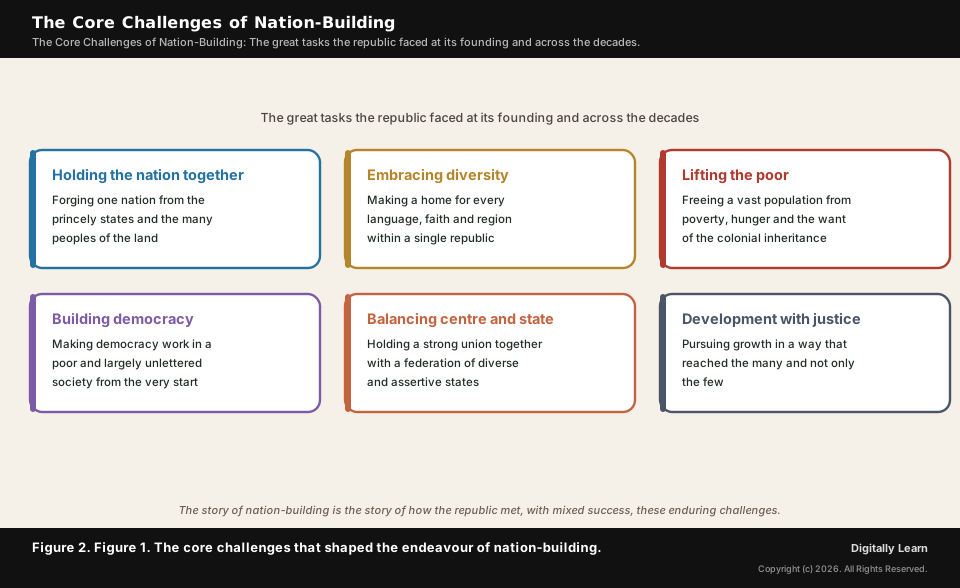
Distinguishing the core challenges: At its founding the republic faced a set of challenges so daunting that many doubted it would survive. It had to hold a single nation together from the princely states and the many peoples of the land; to make a home within one republic for every language, faith and region; and to lift a vast population from the poverty, hunger and want that were the inheritance of colonial rule.
These challenges ran through the whole story. The integration of the states and the linguistic reorganisation answered the challenge of unity; the secular and federal Constitution answered the challenge of diversity; and the plans, the green revolution and the welfare laws answered the challenge of poverty. Each was met with a mixed but real success, and each remains, in a changed form, a challenge of the present. The figure above sets out these enduring tasks.
Observable outcome: The endeavour of nation-building is best understood as the long effort to meet these enduring challenges. That the nation has held together, embraced its diversity and reduced, though not ended, its poverty, is the measure of how far the effort succeeded; that the tasks endure is the measure of how much remains. Both are treated, theme by theme, in the sections that follow.
Secularism and the Indian Idea of the State
How Indian Secularism Differs from the Western Model
Distinguishing Indian secularism: Among the deepest of the challenges was the place of religion in a land of many faiths, and the republic answered it with a distinctive idea of secularism.
Where the western model rests on a strict separation, a wall between religion and the state, and seeks a public sphere free of religion, the Indian model rests on the equal respect of the state for all faiths, a principle captured in the phrase the equal regard of all religions.
The Indian model keeps a principled distance. Rather than withdraw from religion altogether, the Indian state keeps what scholars have called a principled distance, engaging with religion where engagement is needed to secure equality, as in the abolition of untouchability and the reform of religious practice, while keeping an even hand among the faiths. It recognises religious communities in public life and may aid them, provided it favours none, a positive engagement rather than a strict separation.
Observable outcome: Indian secularism, born of a plural society rather than of a quarrel between church and state, is therefore different in kind from the western model, suited to a land where faith is woven through public life. It has been tested by the strains of communal division, treated across this series, yet it remains the constitutional answer to the challenge of holding a nation of many religions together as equal citizens.
The Nehruvian Model and Its Legacy
How the Founding Model Shaped, and Was Later Questioned by, the Republic
Distinguishing the Nehruvian model: The early republic was shaped, more than by any other, by the model associated with Nehru, treated in the part on the architects. It rested on parliamentary democracy, a secular state, a planned and mixed economy led by the public sector, a scientific temper, and a foreign policy of non-alignment, a coherent vision of how a poor new nation should be built.
The model has been both praised and questioned. Its defenders hold that it gave the republic its durable democratic and secular framework, its early industrial base and its independent voice in the world. Its critics hold that the planned economy grew too slowly, that the state took on too much, and that the model delayed the prosperity that the reforms of 1991 later unlocked.
The debate over the model is among the central arguments of the contemporary republic, and it is presented here as a genuine debate.
Observable outcome: Whatever one's view, the Nehruvian model set the framework within which the first decades of nation-building took place, and much of what followed was either a development of it or a reaction against it. Its legacy, in the democratic and secular institutions that endured and in the economic model that was later reformed, runs through the whole of the story this series has told.
The Success and Failure of Planning
How the Record of the Planned Economy Is Weighed on Both Sides
Distinguishing the debate on planning: No theme of nation-building is more debated than the record of the planned economy, traced in the parts on planning and the licence raj. The question is whether the long experiment in central planning was, on balance, a success or a failure for the republic, and the honest answer holds something of both.
The record carries an achievement and a failure. On the side of success, planning built the heavy industry, the dams, the public sector and the scientific base on which later growth rested, and it gave a poor nation a measure of self-reliance. On the side of failure, growth was slow for decades, the controls bred inefficiency and the licence raj, and poverty fell more slowly than it might have, the criticisms that drove the reforms of 1991.
The two sides are weighed here without a final verdict.
Observable outcome: The record of planning is therefore neither the triumph its defenders claim nor the failure its critics charge, but a mixture of real achievement and real limitation. That the debate continues, in the present arguments over the role of the state and the market, is itself a sign that the question of how a nation should build its economy is never finally settled.
Federalism and Regionalism
How the Union Has Balanced a Strong Centre with Assertive States
Distinguishing the federal balance: The republic was built as a federation, yet one with a strong centre, and the balance between the union and the states has been a recurring theme of nation-building. The Constitution leans towards a powerful centre, a feature reflected even in its amendment, for a change to the federal character of the Constitution requires the ratification not of a single house alone but of half the state legislatures as well.
The regions have grown more assertive. Across the decades the states and the regions have asserted themselves more strongly, through the linguistic reorganisation, the rise of regional parties in the age of coalitions, and the language of cooperative federalism, treated across this series. The tension between a strong union and an assertive federation is not a flaw to be cured but a permanent feature of so diverse a nation, to be managed rather than resolved.
Observable outcome: The federal balance has shifted over time, from the dominance of the centre in the early decades towards a stronger role for the states in the contemporary era, yet the union has held. That a nation of such diversity has remained united, without either breaking apart or being held together by force, is among the quiet achievements of its federal design.
The Emergency as a Turning Point
How the Suspension of Democracy Became a Test the Republic Passed
Distinguishing the Emergency as a turning point: The gravest test of the republic's democracy came with the Emergency, treated in its own part, when for a period the democracy was suspended, civil liberties were curtailed and the press was censored. It stands as the single darkest chapter in the democratic history of the republic, and it is set down here as a dated fact, in balanced terms, without a partisan verdict.
The test was, in the end, passed. When the Emergency was lifted and an election held, the people decisively voted out the government that had imposed it and restored the democracy at the ballot, a peaceful transfer of power that proved the depth of the democratic instinct. The constitutional safeguards were strengthened thereafter to make such a suspension harder, so that the episode, dark as it was, left the democracy more resilient than before.
Observable outcome: The Emergency was therefore a turning point in two senses, the moment when the democracy came closest to being lost, and the moment when its recovery proved how deep its roots had grown. That a poor society chose, at the first opportunity, to restore its democracy is among the strongest pieces of evidence for the resilience that the next theme considers.
Liberalisation and Inequality
How the Opening of the Economy Brought Both Growth and Disparity
Distinguishing the debate on liberalisation: The turn of 1991, treated in its own parts, opened a new debate that runs to the present, over the relation between the liberalised economy and the inequality of its gains. The question is whether the opening of the economy, for all the growth it brought, has shared its benefits fairly, and here too the honest answer holds both sides.
The opening brought growth and disparity together. On one side, liberalisation lifted the rate of growth, created a large new middle class and reduced poverty for many; on the other, it widened the gap between the prospering and the lagging, between the city and the countryside and between the regions, and the concern that the growth has been jobless and uneven runs through the contemporary debate.
The two sides are presented here as a genuine argument, not a settled verdict.
Observable outcome: The record of liberalisation is thus, like that of planning, a mixture of real gain and real cost, and the question of how to make growth more inclusive is among the central tasks of the present republic. That the debate over the market and the state continues, after both the planned and the liberalised eras, shows that the right balance between them is still being sought.
The Resilience of Indian Democracy
How a Democracy in a Poor Society Survived and Renewed Itself
Distinguishing the resilience of the democracy: Perhaps the greatest single achievement of nation-building is that democracy has survived and deepened in a poor and immensely diverse society, where many expected it to fail. From the first general election the republic founded itself on the vote of every adult, supervised by a neutral election authority, and the peaceful transfer of power became the settled rule of its political life.
The Constitution proved a living instrument. The democracy drew strength from its institutions, a free press, an independent judiciary and a vigilant citizenry, and from a Constitution that proved a living instrument of enormous dynamism. Through the interpretation of the courts the right to life and personal liberty was expanded far beyond its original words, to embrace dignity, a clean environment and privacy, so that the Constitution grew with the society it served.
The recovery from the Emergency, considered above, was the clearest proof of these deep roots.
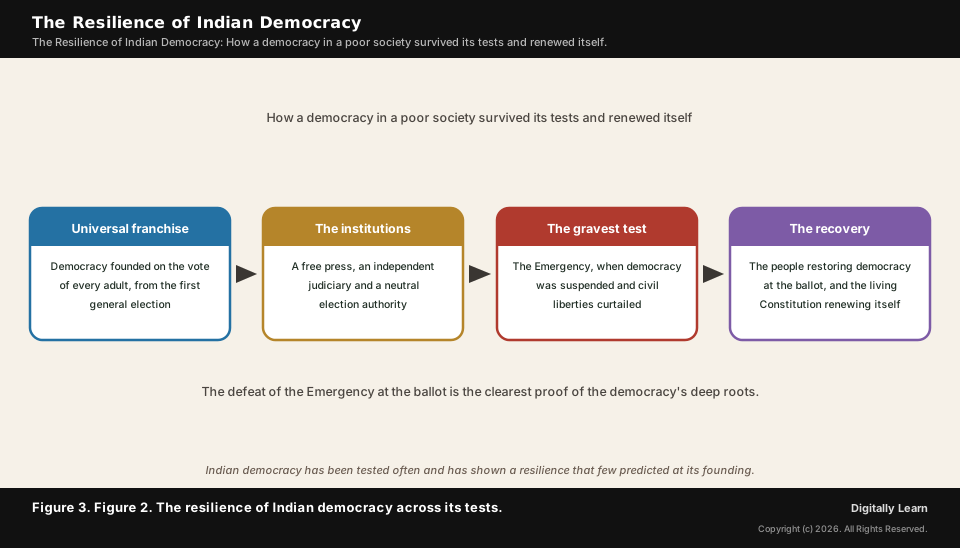
Observable outcome: The resilience of the democracy, tested often and never yet broken, is the firmest ground for a hopeful verdict on the whole endeavour. It is not a finished or a perfect democracy, and its institutions face real strains, but that it has endured and renewed itself for so long, in conditions that defeated democracy elsewhere, is an achievement of the first order.
The Verdict on Nation-Building
How an Honest Reckoning Weighs the Achievements and the Unfinished Tasks
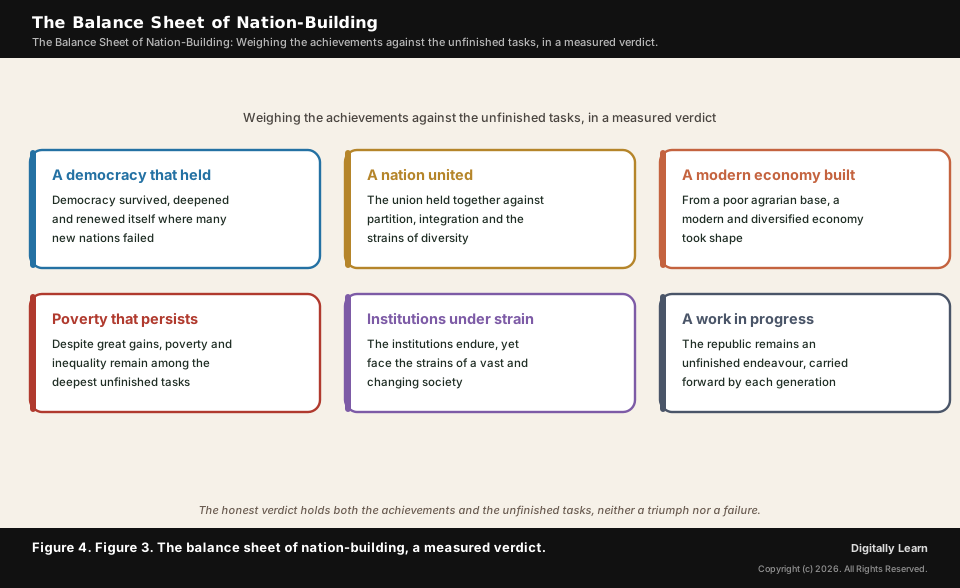
The larger significance of this whole story is best captured in a measured verdict, one that weighs the achievements against the unfinished tasks and claims neither a triumph nor a failure. On the side of achievement, the republic held a vast and diverse nation together, made and kept a working democracy where many new nations failed, built from a poor agrarian base a modern and diversified economy, and reduced, though it did not end, the poverty of its people.
Yet the tasks that remain are deep. Poverty and inequality persist, the institutions face the strains of a vast and changing society, and the challenges of unity, diversity and development endure in new forms. The honest verdict, set out in the figure and the table below, holds the great achievements and the deep unfinished tasks together, for both are true, and an account that recorded only one would be a distortion.
| The achievements | The unfinished tasks |
|---|---|
| A democracy that held and deepened | Poverty and inequality that persist |
| A diverse nation kept united | Regional and social divisions to manage |
| A modern economy built from a poor base | Jobless growth and an uneven prosperity |
| Institutions that have endured | Institutions under strain in a changing society |
Contemporary linkages are, in the end, the whole point of the verdict, for the unfinished tasks of nation-building are the agenda of the present and the future. The questions of poverty and inequality, of the health of the institutions, of the balance of the centre and the states and of the place of the nation in the world are the living continuation of the endeavour this series has traced.
The deepest lesson of the whole story is that nation-building is never finished, that each generation inherits both the achievements and the unfinished tasks of the last, and that the republic remains a work in progress, carried forward by the citizens of each age. With that measured verdict, holding hope and honesty together, the long story of post-independence nation-building, told across these thirty parts, is brought to its close.
- The core challenges of unity, diversity and poverty shaped the whole endeavour and endure, in new forms, today.
- Indian secularism, the Nehruvian model, planning, federalism and liberalisation are the great debates, each two-sided.
- The Emergency was the gravest test of the democracy, which recovered at the ballot and grew more resilient.
- The resilience of Indian democracy, proved by its recovery and its living Constitution, is the central achievement.
- The honest verdict holds the achievements and the unfinished tasks together; the republic remains a work in progress.
Previous Year UPSC-CSE Questions
Previous Year UPSC-CSE Questions By the end you will be able to draft model answers for the following UPSC questions. Each question carries a collapsible framework showing how to approach it in the exam.
- UPSC Mains 2023 GS-II“The Constitution of India is a living instrument with capabilities of enormous dynamism. It is a constitution made for a progressive society.” Illustrate with special reference to the expanding horizons of the right to life and personal liberty.
How to structure the answer in the exam
Introduction: Open with the Constitution as a living instrument made for a progressive society.
Body (sub-themes to develop):
- The living Constitution: judicial interpretation that adapts the text to a changing society.
- The expanding right to life: from mere survival to a life of dignity.
- Illustrations: the right to a clean environment, to livelihood, to privacy and to dignity.
- The result: a Constitution that grows with the society it serves.
Conclusion: Conclude that the dynamic interpretation of the right to life shows the living and progressive character of the Constitution.
- UPSC Mains 2018 GS-IHow the Indian concept of secularism is different from the western model of secularism? Discuss.
How to structure the answer in the exam
Introduction: Open with the distinctive, plural origins of Indian secularism.
Body (sub-themes to develop):
- Western model: strict separation, a wall between religion and state, a public sphere free of religion.
- Indian model: equal respect for all faiths, the equal regard of all religions.
- Principled distance: the state engages with religion to secure equality and reform.
- Public recognition: the state may aid religious communities provided it favours none.
Conclusion: Conclude that Indian secularism is a positive, principled engagement suited to a plural society, not a strict separation.
- UPSC Prelims 2013 GS Paper IConsider the following statements:
- An amendment to the Constitution of India can be initiated by an introduction of a Bill in the Lok Sabha only.
- If such an amendment seeks to make changes in the federal character of the Constitution, the amendment also requires to be ratified by the legislatures of all the States of India.
Which of the statements given above is/are correct?
How to approach this Prelims question
Approach: Test each statement on the amendment procedure.
Trap to watch: An amendment may begin in either house, not the Lok Sabha only; federal-character amendments need half the states, not all.
Key facts to recall:
- A Constitution amendment bill may be introduced in either house
- Federal-character amendments need ratification by half the state legislatures, not all
Answer signal: Neither statement is correct, so option (d).
Sources and Further Reading
Editorial Disclaimer
This article is prepared for civil services preparation. Verify key facts and interpretations against standard reference works before relying on them.