
Overview
Previous Year UPSC-CSE Questions By the end you will be able to draft model answers for the following UPSC questions. Each question carries a collapsible framework showing how to approach it in the exam.
- UPSC Mains 2016 GS-IWhat is the basis of regionalism? Is it that unequal distribution of benefits of development on a regional basis eventually promotes regionalism? Substantiate your answer.
How to structure the answer in the exam
Introduction: Open by defining regionalism and listing its bases: identity, language, history and development.
Body (sub-themes to develop):
- The bases: linguistic-cultural identity, distinct history, and economic grievance.
- The development thesis: uneven distribution of the gains of growth breeds a sense of neglect and regional grievance.
- Evidence: the tribal and forested districts where development failure fed Left-Wing Extremism; demands for separate states from backward regions.
- The qualification: identity and history also matter, so development is a major but not the sole basis.
Conclusion: Conclude that unequal development is a powerful basis of regionalism, though it works alongside identity and history, and that balanced development is the surest answer.
- UPSC Mains 2017 GS-IIIThe North-East region of India has been infested with insurgency for a very long time. Analyze the major reasons for the survival of armed insurgency in this region.
How to structure the answer in the exam
Introduction: Open with the north-east's distinct identities and its loose historical ties to the rest of the country.
Body (sub-themes to develop):
- Identity and history: many distinct peoples, a sense of separateness, fear of demographic change.
- Geography and development: difficult terrain, porous borders and a deep development deficit.
- External dimension: cross-border sanctuary and support in some cases.
- The response: new states, the Sixth Schedule autonomy and peace accords as the path to containment.
Conclusion: Conclude that insurgency has survived where identity, neglect and geography combined, and that accommodation and development are the durable answer.
- UPSC Prelims 2015 GS Paper IThe provisions in Fifth Schedule and Sixth Schedule in the Constitution of India are made in order to
How to approach this Prelims question
Approach: Recall the purpose of the Fifth and Sixth Schedules.
Trap to watch: The Sixth Schedule governs tribal areas of the north-east and the Fifth the scheduled areas elsewhere; both protect the Scheduled Tribes, not state boundaries or panchayats.
Key facts to recall:
- Fifth Schedule: administration of scheduled areas and scheduled tribes
- Sixth Schedule: autonomous district councils in the tribal north-east
- Both protect the interests of the Scheduled Tribes
Answer signal: To protect the interests of Scheduled Tribes, so option (a).
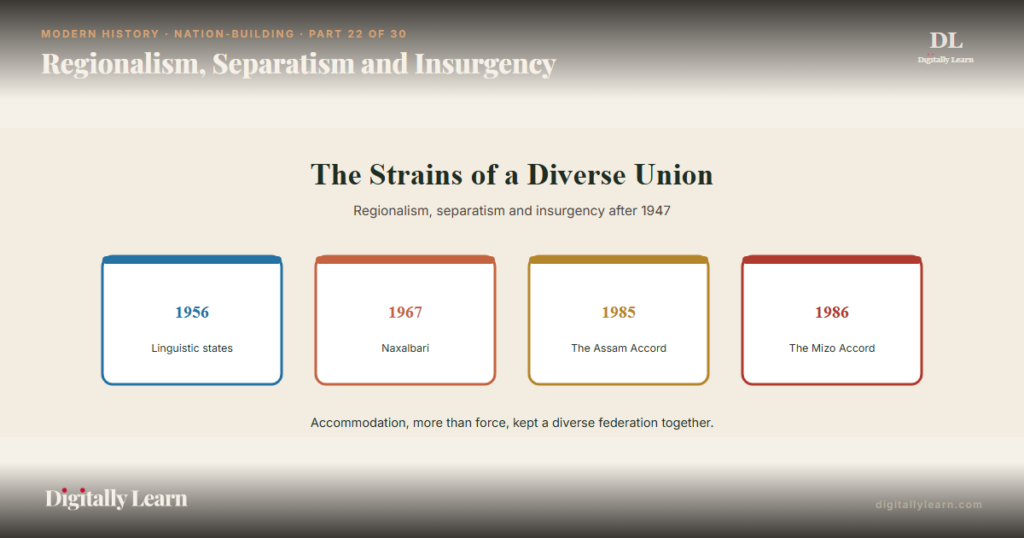
Regionalism, separatism and insurgency were the hardest test of whether a state as large and diverse as India could hold together. As the regions found their voice, they pressed a spectrum of demands: most sought statehood, autonomy or a fairer share of development within the union, a few sought to leave it, and a small number took up arms. The republic met these strains, on the whole, not by suppression alone but by accommodation, drawing the regions into the federal system through new states, autonomy and negotiated accords. This part follows those movements and the federal answer to them, treated throughout as a matter of dated record.
Regional Aspirations: The Test of a Diverse Federation
Why the Demands of the Regions Were the Hardest Test of Unity
Why this matters: A union of many peoples must expect its regions to press their own claims, and how it answers those claims decides whether it endures. India faced, in its first decades, a long series of regional movements, most of them democratic demands for a fairer place, a few of them armed challenges to its unity, and the way it met them, by accommodation far more often than by force, was central to its survival as a single democracy.
What is the significance of these movements: They were the proving ground of federalism. Each demand, for a state, for autonomy, for development, tested whether the union was flexible enough to make room for difference without breaking apart. This part treats these movements neutrally, as dated facts, and its theme is the federal answer, the steady preference for negotiation, new states and accords over suppression, that drew most regional aspirations back into democratic politics.
A Typology of Regional Movements
How Regional Demands Ranged from Statehood to Armed Challenge
Distinguishing the kinds of movement: Regional movements in India have spanned a wide spectrum, and it is a mistake to treat them as one. At one end lay democratic demands for statehood or greater autonomy within the union, the most common form by far; in the middle lay assertions of linguistic and cultural identity expressed through regional parties; and at the far end lay a small number of secessionist and armed movements that challenged the union itself, almost all of which were in time defeated or abandoned.
The roots were as varied as the forms. Some movements grew from the pride of language and culture, treated in the previous part; some from the sense that a region had been left behind in development, its resources taken and its people neglected; and some from the distinct history of areas, such as parts of the north-east, that had been only loosely tied to the rest of the country. The figure below sets out this typology of regional aspiration.
Observable outcome: Recognising this spectrum matters because the union's response varied with it. Demands for statehood were largely met by creating new states; assertions of identity were absorbed into party politics; and only the armed challenges drew a security response, itself usually paired with negotiation. The basis of regionalism, as later analysis has stressed, often lay in the unequal spread of development, a grievance that democratic accommodation alone could ease.
The Dravidian Movement: From a Separatist Demand to the Mainstream
How a Call for a Separate Nation Became Democratic Regional Politics
Distinguishing the southern movement: The Dravidian movement in the Tamil country began, in the hands of E. V. Ramasamy and the early Dravida Kazhagam, as a radical assertion of Tamil and non-Brahmin identity that for a time voiced a demand for a separate Dravida Nadu, a sovereign Dravidian land. It drew on the same anti-Hindi sentiment that produced the language agitations treated earlier, and in its first phase it stood outside, and against, the national mainstream.
The movement turned from secession to elections. The Dravida Munnetra Kazhagam, the DMK, which broke from the parent body, gave up the demand for a separate nation and entered electoral politics, coming to power in the state in 1967; the demand for secession was set aside, and after a constitutional amendment of 1963 barred parties from seeking it, the movement worked wholly within the union. A force that had begun by questioning India's unity became a pillar of its democratic federalism.
Observable outcome: The Dravidian case became the model of accommodation. A movement that had once demanded a separate country was drawn, through the ballot and the federal system, into governing a state within the union and defending the interests of its people through democratic means. It showed that even a separatist impulse could be absorbed when the system offered a region real power and a secure place for its identity.
The Punjab Crisis: From the Punjabi Suba to the Mid-1980s
How a Demand for a State Gave Way to a Decade of Turmoil and Recovery
Distinguishing the Punjab question: The Punjab question began as a demand for a Punjabi Suba, a state in which Punjabi would be the language of administration, a demand met in 1966 when the state was reorganised. In the later 1970s a wider set of demands, expressed in the Anandpur Sahib Resolution, sought greater autonomy for the states and a larger place for Punjab; through the early 1980s the situation deteriorated as an armed militancy arose, and the decade became one of the most difficult in the state's history.
The crisis reached its gravest point in 1984. In June 1984 the union government ordered a military operation, Operation Blue Star, to remove armed militants who had fortified the Golden Temple complex in Amritsar; the operation, conducted from the first to the eighth of June, and the turbulent period that followed were among the most painful episodes of the era. The years afterward saw continued violence, treated here only as a dated fact, before the militancy was brought under control and elected government and normal life were restored in the state by the early 1990s.
Observable outcome: The Punjab crisis, after a hard decade, ended in the restoration of constitutional normalcy rather than in separation, and the state returned to elected government and to peace. It remains a sober reminder of how a demand that began within the federal framework, for a state and for autonomy, can, if unresolved, give way to violence, and of how costly the road back to accommodation can be. The events are recorded here as history, without assigning blame.
Insurgency in Jammu and Kashmir
How Militancy Arose and How the State Has Been Held Within the Union
Distinguishing the Kashmir insurgency: Jammu and Kashmir, an integral part of India whose accession was treated earlier in this series, saw an armed insurgency arise from the end of the 1980s. From 1989 militancy spread in the valley, sustained in part by support from across the border, and the following years were marked by violence and by the displacement of communities, a human cost that is acknowledged here in general terms rather than in figures.
The union has held the state within the constitutional framework. The government met the insurgency with a security response and, over time, with elections and development, holding Jammu and Kashmir within the union as a matter of settled constitutional fact, on the official map of India. The constitutional position of the state, including the changes made to Article 370 in 2019, is recorded here as dated fact, without entering the contested debates that surround it.
Observable outcome: The Kashmir insurgency has been the longest-running of the armed challenges, and the state's place within the union has throughout been maintained as constitutional and settled. The episode shows both the external dimension that some regional conflicts acquired and the union's insistence, held consistently, that the integrity of its territory is not a matter for negotiation, even as it has sought to address grievances through the democratic process.
Insurgency and Accommodation in the North-East
How a Region of Many Peoples Was Drawn into the Federal Fold
Distinguishing the north-eastern movements: The north-east, a region of many distinct peoples only loosely tied to the rest of the country before 1947, saw the longest and most varied set of insurgencies. The Naga movement, the oldest, sought a separate path from the 1950s; a Mizo insurgency arose in the 1960s; and in Assam a movement against outsiders and for the rights of the indigenous people grew through the 1980s. Each had its own roots in identity, history and the fear of being overwhelmed.
The union answered the region largely through accommodation. New states were carved out to give the peoples of the region their own governments; the Sixth Schedule created autonomous district councils to protect tribal areas and their distinct cultures; and a series of peace accords, the Mizo Accord of 1986 and the Assam Accord of 1985 among them, brought several movements into elected politics. The Armed Forces (Special Powers) Act provided the security framework for areas declared disturbed, a measure that has itself been much debated.
Observable outcome: The north-east shows the federal method at its fullest: the steady creation of states, the protection of tribal autonomy through the Sixth Schedule, and the patient negotiation of accords gradually drew most of the region's movements into the democratic mainstream. Insurgency has not wholly ended, but the broad direction has been from armed challenge towards accommodation within the union, the pattern the next analysis underlines.
Naxalbari 1967 and the Left-Wing Extremist Movement
How an Agrarian Uprising Grew into a Long Internal-Security Challenge
Distinguishing the Left-Wing movement: A different kind of challenge arose not from regional identity but from agrarian grievance. In 1967 a peasant uprising at Naxalbari in West Bengal, led by a radical faction of the communist movement, gave its name to the Naxalite or Left-Wing Extremist movement. The faction broke away to form the Communist Party of India (Marxist-Leninist) in 1969, holding that the grievances of the landless and the tribal poor could be answered only by armed struggle rather than by the ballot.
The movement spread and consolidated over the decades. After early setbacks it took root in the forested and tribal districts of central and eastern India, and the several streams of the movement came together in 2004 to form the Communist Party of India (Maoist). For a time the Left-Wing Extremist challenge affected a broad belt of districts across several states, drawing a sustained response that combined security operations with development, and its reach has in recent years been reported to be shrinking.
Observable outcome: The Left-Wing Extremist movement has been among the longest-running internal-security challenges, and it has been understood, in official policy itself, as both a security and a development problem. Its persistence in particular regions has been traced to deep-seated grievances, and the response has accordingly paired law and order with efforts to address the conditions, of poverty and neglect, in which the movement found its support.
The Socio-Economic Roots of Left-Wing Extremism
How Development Failure and Land Alienation Fed the Movement
Distinguishing the roots from the symptoms: The endurance of the Left-Wing Extremist movement in particular districts has been traced, in official and academic study alike, to socio-economic rather than purely ideological causes. The affected areas were often the forested, tribal regions where the gains of development had reached least, where land had been alienated from tribal owners, and where displacement by mining and large projects had deepened a sense of injustice that armed groups could exploit.
The constitutional safeguards were unevenly applied. The Fifth Schedule, which provides for the administration of scheduled areas and the protection of the scheduled tribes, and the laws meant to prevent the alienation of tribal land, were in many places weakly implemented, so that the very protections the Constitution offered the most vulnerable were not fully delivered. The grievance of neglect, more than any doctrine, gave the movement its hold.
Observable outcome: The lesson drawn from the Left-Wing Extremist challenge has been that lasting security in the affected areas depends on closing the development deficit, on delivering the Fifth Schedule protections, securing tribal land rights and bringing roads, schools and health care to the neglected districts. The strategy has come to combine the maintenance of law and order with a determined effort to address the conditions that sustain the movement.
Peace Accords: Accommodation Over Suppression
How Negotiated Settlements Became the Hallmark of the Federal Answer
Distinguishing the Indian method: The characteristic instrument of the union's response to regional movements was the peace accord, a negotiated settlement that brought an agitation to an end by meeting some of its demands within the constitutional framework. The Assam Accord of 1985, which addressed the question of outsiders and the rights of the indigenous people, the Mizo Accord of 1986, which paved the way for statehood for Mizoram in 1987 and brought the Mizo movement into elected politics, and the settlements that ended the Punjab agitation were among the most significant.
The accords followed a common logic. Each offered a movement a place within the system, through statehood, autonomy, a development package or a share of power, in return for an end to agitation and a return to democratic politics. The figure below sets out the instruments of this accommodation, and the table that follows records the major accords. The method was not infallible, and some settlements held better than others, but it expressed a settled preference for negotiation over indefinite force.
| Accord or settlement | What it addressed | Year |
|---|---|---|
| The Assam Accord | The question of outsiders and the rights of the indigenous people | 1985 |
| The Punjab settlement | The autonomy demands and the restoration of normalcy in Punjab | 1985 |
| The Mizo Accord | Statehood for Mizoram and the end of the Mizo insurgency | 1986 |
| The Sixth Schedule councils | Autonomous district councils for the tribal areas of the north-east | ongoing |
Significance: The Resilience of a Federation That Made Room
How Accommodation, More Than Force, Held the Union Together
The larger significance of this long story is that India held together where many predicted it would break, and that it did so chiefly by accommodation. By creating new states, by devolving autonomy, by recognising identities and by negotiating accords, the union answered most regional aspirations within its own framework, turning potential lines of fracture into the ordinary bargaining of a federal democracy. Force was used against armed challenges, but it was rarely the whole of the answer.
Contemporary linkages keep the question alive. The management of the north-east, the situation in Jammu and Kashmir, the reduction of Left-Wing Extremism and the continuing demands of regions for statehood and a fairer share of resources are all live matters, each the descendant of the movements and the methods of these decades.
The deeper lesson is that the unity of a diverse country rests not on uniformity but on a flexible federalism able to make room for difference, and that accommodation, patient and imperfect, has proved a surer foundation than suppression. The next part turns to the gravest internal test of the republic's democracy itself, the Emergency of 1975 to 1977.
- Regional movements ranged from democratic demands for statehood to a few armed and secessionist challenges.
- The Dravidian movement gave up its separatist demand and became mainstream regional politics within the union.
- The Punjab crisis ended, after a hard decade, in the restoration of elected government and normalcy.
- The north-east was largely accommodated through new states, the Sixth Schedule and peace accords.
- Left-Wing Extremism, rooted in development failure and tribal land alienation, has been met with both security and development.
Prelims MCQ practice
Each question below tests one specific concept on the topic. Click to reveal the answer and a full option-wise explanation.
Q1. The Naxalite or Left-Wing Extremist movement takes its name from an uprising in 1967 at which place?
- Telangana
- Naxalbari in West Bengal
- Srikakulam
- Singur
Show answer and explanation
Answer: Naxalbari in West Bengal
Explanation.
Option (b) is correct. The movement takes its name from a peasant uprising in 1967 at Naxalbari in West Bengal, from which the term Naxalite derives. Hence option (b).
Q2. The Sixth Schedule of the Constitution provides for which of the following?
- The official languages of the states
- Autonomous district councils in the tribal areas of the north-east
- The distribution of seats in the Rajya Sabha
- The emergency powers of the President
Show answer and explanation
Answer: Autonomous district councils in the tribal areas of the north-east
Explanation.
Option (b) is correct. The Sixth Schedule provides for autonomous district councils to administer and protect the tribal areas of the north-eastern states. Hence option (b).
Q3. Consider the following statements about the Dravidian movement:
- It at one stage voiced a demand for a separate Dravida Nadu.
- The Dravida Munnetra Kazhagam gave up the demand for secession and entered electoral politics.
- It came to power in the state of Tamil Nadu in 1967.
Which of the statements given above are correct?
- 1 and 2 only
- 2 and 3 only
- 1 and 3 only
- 1, 2 and 3
Show answer and explanation
Answer: 1, 2 and 3
Explanation.
All three are correct: the Dravidian movement once voiced a demand for a separate Dravida Nadu, the DMK gave up secession for electoral politics, and it came to power in 1967. Hence option (d).
Q4. The Punjabi Suba demand, which sought a Punjabi-speaking state, was met by the reorganisation of Punjab in which year?
- 1956
- 1960
- 1966
- 1971
Show answer and explanation
Answer: 1966
Explanation.
Option (c) is correct. The demand for a Punjabi Suba was met in 1966 when Punjab was reorganised into a Punjabi-speaking state, with Haryana created separately. Hence option (c).
Q5. Consider the following statements about insurgency and accommodation in the north-east:
- The Mizo Accord of 1986 paved the way for statehood for Mizoram.
- The Sixth Schedule provides autonomous district councils for tribal areas.
- The Armed Forces (Special Powers) Act applies to areas declared disturbed.
Which of the statements given above are correct?
- 1 and 2 only
- 2 and 3 only
- 1 and 3 only
- 1, 2 and 3
Show answer and explanation
Answer: 1, 2 and 3
Explanation.
All three are correct: the Mizo Accord of 1986 paved the way for the statehood conferred in 1987, the Sixth Schedule provides autonomous district councils, and the Armed Forces (Special Powers) Act applies to areas declared disturbed. Hence option (d).
Q6. The several streams of the Left-Wing Extremist movement came together in 2004 to form which organisation?
- The Communist Party of India (Marxist)
- The Communist Party of India (Marxist-Leninist)
- The Communist Party of India (Maoist)
- The All India Forward Bloc
Show answer and explanation
Answer: The Communist Party of India (Maoist)
Explanation.
Option (c) is correct. The major streams of the movement merged in 2004 to form the Communist Party of India (Maoist). The CPI(ML) had been formed earlier, in 1969. Hence option (c).
Sources and Further Reading
- NCERT, Politics in India since Independence (Class 12)
- NCERT, Indian Constitution at Work (Class 11)
- Wikipedia: Insurgency in Northeast India
- Wikipedia: Naxalite-Maoist insurgency
- Wikipedia: Mizo National Front uprising
- Wikipedia: Sixth Schedule to the Constitution of India
- Ministry of Home Affairs, Government of India
- India Code: The Sixth Schedule to the Constitution of India
- Press Information Bureau, Government of India
- National Portal of India
Editorial Disclaimer
This article is prepared for civil services preparation. It treats sensitive events as dated facts and avoids contested figures; verify details against standard reference works before relying on them.