


Overview
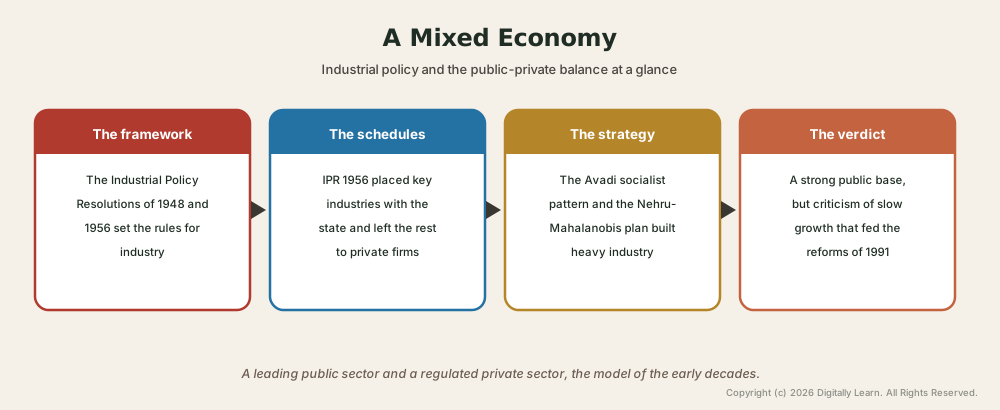
The mixed economy was the model India chose for its early development, in which a powerful public sector and a regulated private sector would work side by side. After independence the state took the commanding heights of the economy, the heavy and basic industries, while private enterprise was left a large space in the rest. This framework was set out in the Industrial Policy Resolutions of 1948 and 1956, built on the goal of a socialist pattern of society and carried forward by the Nehru-Mahalanobis strategy of heavy industry. How that mixed economy was designed, and why it was later criticised, is a central theme of nation-building.
Introduction: Why India Chose a Mixed Economy
The State and the Market After Independence
Why this matters: a newly free and very poor country had to decide who would build its industry, the state or the market. India chose neither pure capitalism nor full state control, but a mixed economy in which the public sector and private enterprise would work together, a choice that shaped its development for four decades.
What is the significance of the mixed economy: it set the rules of growth. By giving the state the commanding heights while keeping a large space for private firms, India tried to combine rapid industrial growth with social goals, and the industrial policy resolutions below put that idea into practice.
The Socialist Pattern of Society and the IPR of 1948
From the Avadi Resolution to the First Industrial Policy
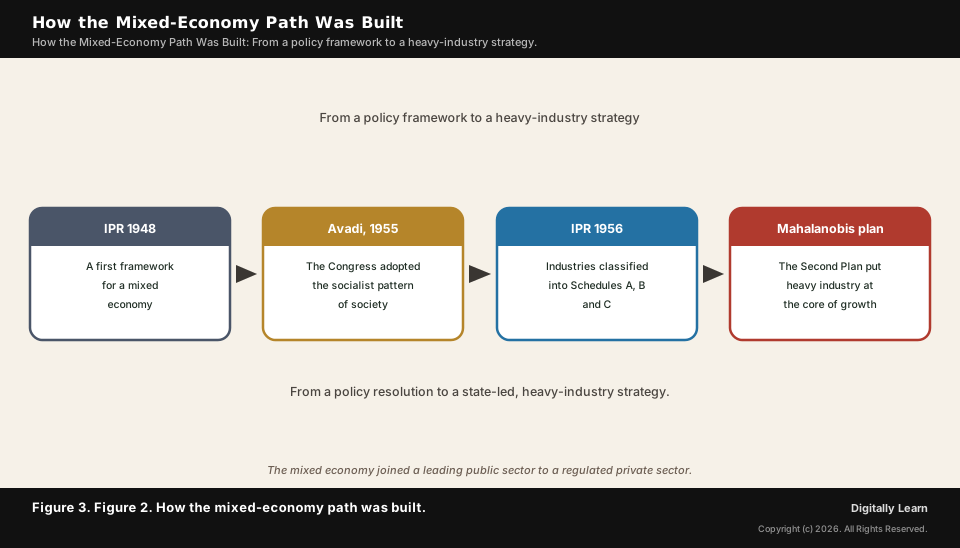
What is the significance of the socialist pattern: it gave the economy its direction. At its Avadi session in 1955 the Congress adopted the goal of a socialist pattern of society, in which growth would serve the many and the state would hold the key means of production, an idea that shaped industrial policy.
Distinguishing the first framework: the Industrial Policy Resolution of 1948, the first such statement of independent India, set out a mixed economy in which a few key industries were reserved for the state and a large field was left to private enterprise, a cautious start that the 1956 resolution would deepen.
The Industrial Policy Resolution of 1956 and Its Schedules
Schedule A, B and C and the Commanding Heights
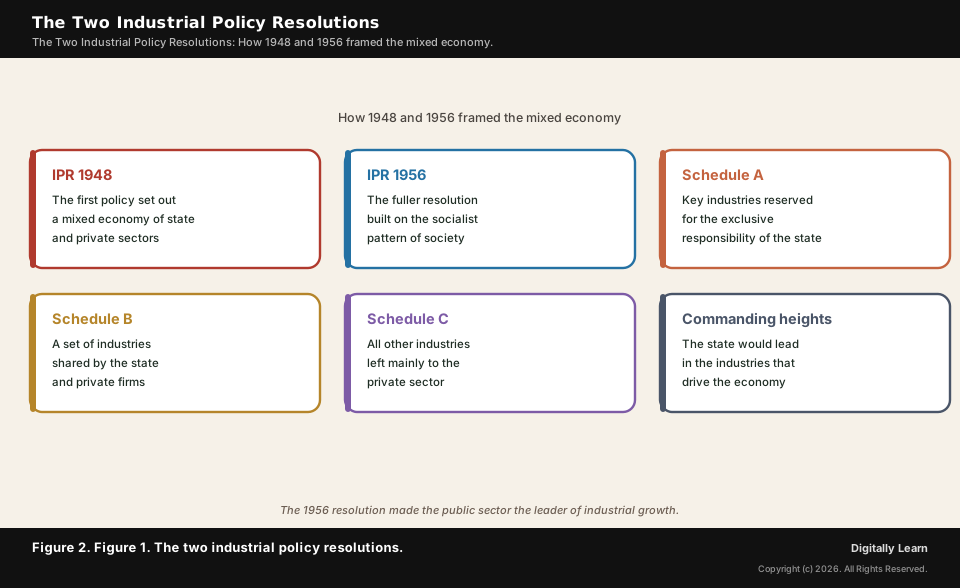
Distinguishing the 1956 resolution: it was the heart of the model. The Industrial Policy Resolution of 1956, based on the socialist pattern, divided industry into three groups: Schedule A, the key industries that would be the exclusive responsibility of the state; Schedule B, a set of industries shared by the state and private firms; and Schedule C, all the rest, left mainly to the private sector.
Observable outcomes followed from this design. The state took the commanding heights, the heavy and basic industries such as steel, power and machine-building, while consumer goods and lighter industry stayed largely with private enterprise, so the public sector led and the private sector filled in around it.
The Nehru-Mahalanobis Strategy of Heavy Industry
The Second Plan and the Drive for Heavy Industry
Distinguishing the strategy: the mixed economy needed an engine. The Nehru-Mahalanobis strategy, built into the Second Five-Year Plan, put heavy industry and capital goods at the core of growth, on the view that a country that could make its own machines and steel would grow faster and depend less on others.
What is the significance of the strategy: it aimed at self-reliance through import substitution, making at home what had earlier been bought abroad. The public sector built the great steel and power plants, and the Industries (Development and Regulation) Act of 1951 gave the state the power to licence and direct private industry, as the figure below sets out.
The Public Sector: The Temples of Modern India
The State Enterprises That Built the Industrial Base
Observable outcomes of the mixed economy were the great public sector enterprises. The state built large steel plants at Bhilai, Rourkela and Durgapur, together with power stations, heavy-engineering works and units for fertiliser, machine tools and oil, creating an industrial base in fields where private capital had been unable or unwilling to invest.
Distinguishing the public sector role: Jawaharlal Nehru called these enterprises the temples of modern India. They were meant not only to produce steel and power but to carry industry to new regions, train a skilled workforce and anchor self-reliance, so the public sector became the visible heart of the mixed economy, with the comparative detail of these plants treated later in this series.
The Strengths and the Criticisms of the Model
What the Mixed Economy Built and Where It Fell Short
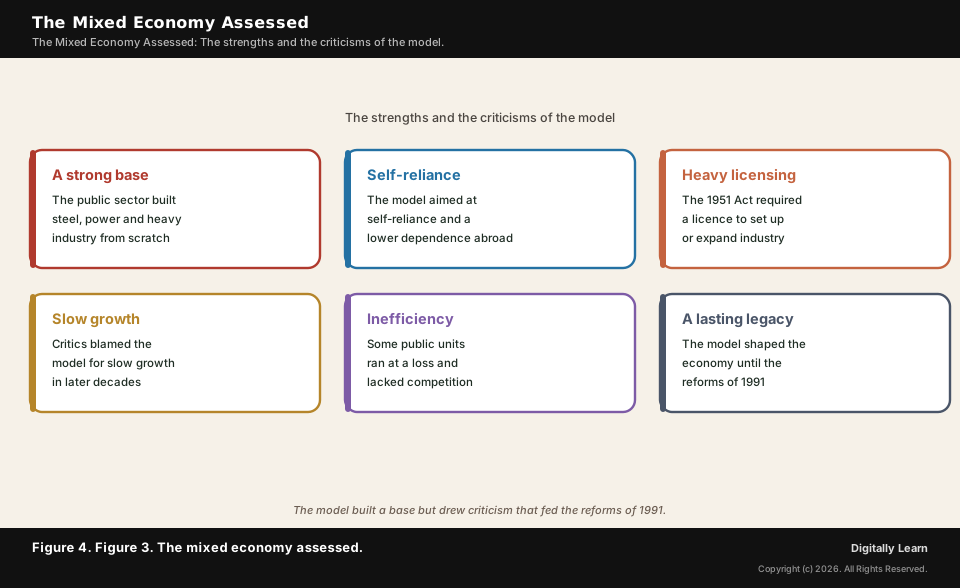
Observable outcomes of the model were real and large. The public sector built a base of steel, power, heavy machinery and atomic and space capability that private capital alone would not have created, and the economy grew more self-reliant and more industrial than before.
Distinguishing the criticisms: the model also drew sharp criticism. Heavy licensing under the 1951 Act slowed private enterprise, some public units ran at a loss and lacked competition, and critics blamed the framework for slow growth in later decades, a debate that fed the economic reforms of 1991, treated later in this series.
| Element | IPR 1948 | IPR 1956 |
|---|---|---|
| Approach | A first mixed-economy framework | A fuller socialist-pattern framework |
| State role | A few key industries reserved for the state | Schedule A: key industries for the state alone |
| Private role | A large space for private enterprise | Schedule C: the rest left to private firms |
| Basis | Early caution after independence | The Avadi socialist pattern of society |
Significance: The Economic Model of the Early Decades
Why the Mixed Economy Matters for Nation-Building
Contemporary linkages run from this model into the present. The public sector giants and the habit of state-led planning shaped India until 1991, and the questions the mixed economy raised, how far the state should lead and how much room the market should have, are still debated in every policy on industry today.
The larger significance is that the mixed economy was India's distinctive answer to the problem of development, neither pure socialism nor pure capitalism. It built a heavy-industrial base and a measure of self-reliance, and its limits later drove the reforms of 1991. The points below gather the threads, and the next part turns to planning and the Five-Year Plans.
- India chose a mixed economy of a leading public sector and a regulated private sector.
- The socialist pattern of society, adopted at Avadi in 1955, gave the model its direction.
- The Industrial Policy Resolutions of 1948 and 1956 framed it; IPR 1956 used Schedules A, B and C.
- The Nehru-Mahalanobis strategy of the Second Plan put heavy industry and self-reliance at the core.
- The model built an industrial base but drew criticism for slow growth that fed the 1991 reforms.
Previous Year UPSC-CSE Questions
Previous Year UPSC-CSE Questions By the end you will be able to draft model answers for the following UPSC questions. Each question carries a collapsible framework showing how to approach it in the exam.
- UPSC Mains 2024 GS-IIn dealing with socio-economic issues of development, what kind of collaboration between government, NGOs and private sector would be most productive?
How to structure the answer in the exam
Introduction: Open with the mixed economy as India's founding model of government-private collaboration.
Body (sub-themes to develop):
- The original design: state in the commanding heights, private enterprise in the rest, the two complementary.
- What worked: the public sector built heavy industry and infrastructure that private capital would not.
- What failed: heavy licensing crowded out private initiative and bred inefficiency.
- The productive balance: the state in public goods and strategic sectors, the market in competitive production.
Conclusion: Conclude that the most productive collaboration pairs a state that builds public goods with a private sector free to compete.
- UPSC Prelims 2009 GS Paper IConsider the following statements regarding Indian Planning :
- The Second Five-Year Plan emphasised on the establishment of heavy industries.
- The Third Five-Year Plan introduced the concept of import substitution as a strategy for industrialisation.
Which of the statements given above is/are correct ?
How to approach this Prelims question
Approach: Match each plan to its emphasis: heavy industry and import substitution belong to the Second Plan.
Trap to watch: Import substitution was a feature of the Second-Plan (Nehru-Mahalanobis) strategy, not a concept first introduced in the Third Plan, so statement 2 is wrong.
Key facts to recall:
- The Second Plan emphasised heavy industries
- The Nehru-Mahalanobis strategy aimed at import substitution
- Only statement 1 is correct
Answer signal: Statement 1 only, so option (a).
Sources and Further Reading
- NCERT, Indian Economic Development (Class 11), Indian Economy 1950 to 1990
- Wikipedia: Licence Raj
- Wikipedia: Industrial Policy Resolution of 1956
- Wikipedia: Mahalanobis model
- Department for Promotion of Industry and Internal Trade
- National Portal of India
- Press Information Bureau, Government of India
- National Archives of India
Editorial Disclaimer
This article is prepared for UPSC examination preparation. Verify key facts and interpretations against standard reference histories before relying on them.