
Overview
Previous Year UPSC-CSE Questions By the end you will be able to draft model answers for the following UPSC questions. Each question carries a collapsible framework showing how to approach it in the exam.
- UPSC Mains 2019 GS-IAssess the role of British imperial power in complicating the process of transfer of power during the 1940s.
How to structure the answer in the exam
Introduction: Open with the 1940s as a decade in which the British managed a rushed and contested transfer of power.
Body (sub-themes to develop):
- The failure of the Cabinet Mission and the hardening of communal politics.
- The haste of the Mountbatten Plan and the advanced date of August 1947.
- The secret Radcliffe boundary, withheld until after independence.
- The divided army, the Punjab Boundary Force and the unmanaged violence.
Conclusion: Conclude that British haste and method deepened the human cost and the disputes that the transfer of power left behind.
- UPSC Prelims 2014 GS Paper IThe Radcliffe Committee was appointed to
How to approach this Prelims question
Approach: Recall the precise task of the Radcliffe Commission.
Trap to watch: Radcliffe drew the India-Pakistan boundary; it did not solve the minorities problem or enquire into riots.
Key facts to recall:
- Radcliffe chaired the Punjab and Bengal Boundary Commissions
- The task was to delimit the India-Pakistan boundary
- The award was withheld until 17 August 1947
Answer signal: Delimit the boundaries between India and Pakistan, so option (c).
- UPSC Prelims 2002 GS Paper IThe President of the Indian National Congress at the time of the partition of India was
How to approach this Prelims question
Approach: Recall who held the Congress presidency in 1947.
Trap to watch: Nehru was the first Prime Minister, not the 1947 Congress president; Azad presided earlier in the 1940s.
Key facts to recall:
- J. B. Kripalani was Congress president in 1947
- Nehru was the first Prime Minister
- Azad was Congress president 1940 to 1946
Answer signal: J. B. Kripalani, so option (b).
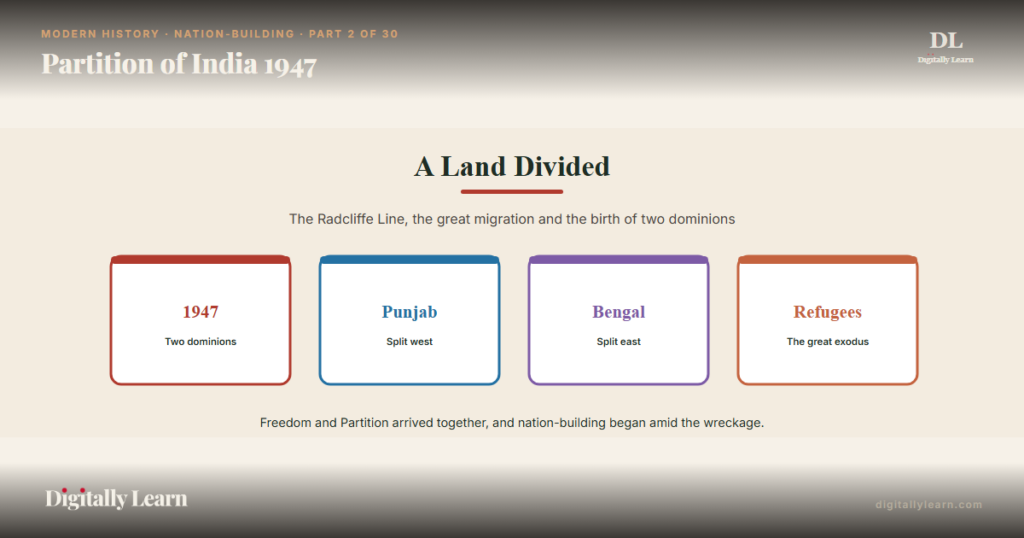
The Partition of India 1947 was the division of British India into the two independent dominions of India and Pakistan on 15 August 1947. Under the Mountbatten Plan of 3 June 1947 and the Indian Independence Act, the provinces of Punjab and Bengal were split along the Radcliffe Line, drawn on the basis of religious majority. The result was one of the largest and most violent migrations in human history, a vast refugee crisis and a contested division of assets, and these wounds shaped the new nation and its relations with Pakistan from its very first day.
Introduction: Freedom and Partition Together
Why Partition Is the Wound at the Heart of Nation-Building
Why this matters: independence and Partition came on the same day, and the new nation was born amid one of the great human catastrophes of the century. The way the subcontinent was divided shaped the refugee crisis, the communal wounds and the rivalry with Pakistan that nation-building would have to manage from the start.
What is the significance of Partition: it set the terms of everything that followed. The division produced a vast refugee movement, a contested boundary, a divided army and treasury, and the unfinished question of Kashmir, all of which the new state inherited along with its freedom, as the map and the sections below set out.
The Road to Partition: From the Breakdown of 1946 to the June 3 Plan
From Direct Action Day to the Plan of June 1947
What is the significance of the road to partition: it shows that partition was the end of a rapid, contested breakdown rather than a settled choice. Direct Action Day on 16 August 1946 and the Great Calcutta Killings hardened communal lines, and the Cabinet Mission plan for a united federal India collapsed over the question of grouping the provinces.
Distinguishing the final steps: Lord Mountbatten, the last Viceroy, arrived in March 1947 with instructions to transfer power quickly. His June 3 Plan set out partition into two dominions; the Congress, then led by its president J. B. Kripalani, accepted it as the only way out of the deadlock, and it was given legal form by the Indian Independence Act.
The Mountbatten Plan and the Indian Independence Act 1947
The June 3 Plan and the Legal Act That Followed
What is the significance of the plan and the Act: they are two distinct things often confused. The Mountbatten Plan of 3 June 1947 was the political settlement that announced partition; the Indian Independence Act, passed by the British Parliament, was the legal instrument that actually created the two dominions on 15 August 1947.
Distinguishing the provinces' choice: the plan let the legislatures of Punjab and Bengal vote on partition, held referenda in Sylhet and the North-West Frontier Province, and lapsed British paramountcy over the princely states, leaving them to accede, the subject of the next part. The Act ended British rule and made each dominion sovereign.
The Radcliffe Boundary Commissions and the India-Pakistan Border
Two Commissions, One Chairman, a Line Drawn in Weeks
What is the significance of the Radcliffe Line: it was the actual border that cut through two provinces. Two Boundary Commissions, one for Punjab and one for Bengal, were chaired by the British lawyer Cyril Radcliffe, who had never before visited the land, and were tasked to divide contiguous majority areas of each community between the two dominions.
Distinguishing the controversy: each commission had two Congress and two Muslim League nominees, so Radcliffe's casting decisions were decisive. The award was withheld until 17 August 1947, after independence, and districts such as Gurdaspur remained bitterly disputed, as the commissions below set out.
| What was divided | How it was divided | The outcome |
|---|---|---|
| Territory | Punjab and Bengal split along the Radcliffe Line by religious majority | Two wings of Pakistan, West and East, on either side of India |
| The armed forces | Units and officers divided between the two dominions | A divided army at the very moment of independence |
| Assets and treasury | Cash balances and stores apportioned between the dominions | A disputed division, including the cash-balance question |
| The administration | Services, records and railways split | A new state machinery had to be built at once |
Communal Violence and the Largest Mass Migration in History
The Human Catastrophe of 1947
Observable outcomes of the line were immediate and terrible. As the boundary became known, Hindus and Sikhs fled eastward and Muslims fled westward and eastward, in one of the largest and swiftest mass migrations ever recorded. The Punjab Boundary Force could not contain the killing, and millions were uprooted within weeks.
Distinguishing the human cost: the violence brought massacres, the abduction of women on a mass scale and the destruction of whole communities. The casualties and the numbers displaced are estimated very differently by different sources, so they are best understood as a catastrophe of millions rather than a single agreed figure.
The Refugee Crisis and the State Response to Rehabilitation
Managing a Catastrophe While Building a State
What is the significance of rehabilitation: it was the first great test of the new state's capacity. A Ministry of Rehabilitation was created to resettle the refugees in camps, new colonies and expanded towns, a task that reshaped cities such as Delhi and the economy of the north-west and the east for decades.
Distinguishing the women's question: an inter-dominion agreement set up operations to recover abducted women on both sides, a fraught and contested process. The refugee crisis below shows how nation-building had to begin by managing a humanitarian emergency, not from a clean slate.
Dividing a State and the Enduring Legacies of Partition
From the Division of Assets to a Lasting Inheritance
Observable outcomes of partition reached into the machinery of the state. The armed forces, the treasury and the services were divided between the two dominions, and the cash-balance dispute strained relations from the start. The new state had to build its administration even as it absorbed millions of refugees, as the timeline below traces.
Contemporary linkages run from 1947 straight into the present. Partition left the seeds of the Kashmir dispute and a permanent rivalry with Pakistan, hardened communalism as a force in politics, and shaped the integration of the states that the next part takes up. The points below gather the threads.
- Independence and Partition came together on 15 August 1947, creating two dominions.
- The Mountbatten Plan and the Independence Act partitioned Punjab and Bengal.
- The Radcliffe Line was drawn in weeks and announced only after independence.
- Partition produced the largest migration in history and a vast refugee crisis.
- Its legacies, Kashmir, communalism and the rivalry with Pakistan, shaped nation-building.
Prelims MCQ practice
Each question below tests one specific concept on the topic. Click to reveal the answer and a full option-wise explanation.
Q1. Under which plan was the partition of India into two dominions announced?
- The Cabinet Mission Plan
- The Wavell Plan
- The Mountbatten Plan of 3 June 1947
- The Cripps Proposals
Show answer and explanation
Answer: The Mountbatten Plan of 3 June 1947
Explanation.
Option (c) is correct. The Mountbatten Plan of 3 June 1947 announced the partition of India into the two dominions of India and Pakistan. Hence option (c).
Q2. The legal instrument that actually created the dominions of India and Pakistan was the:
- Government of India Act 1935
- Indian Independence Act 1947
- Indian Councils Act 1909
- Regulating Act 1773
Show answer and explanation
Answer: Indian Independence Act 1947
Explanation.
Option (b) is correct. The Indian Independence Act 1947 was the legal instrument that ended British rule and created the two dominions. Hence option (b).
Q3. Consider the following statements about the Radcliffe Boundary Commissions:
- They drew the boundary between India and Pakistan in Punjab and Bengal.
- They were chaired by Cyril Radcliffe, who had not previously visited the region.
- Their award was made public before the date of independence.
Which of the statements given above are correct?
- 1 and 2 only
- 2 and 3 only
- 1 and 3 only
- 1, 2 and 3
Show answer and explanation
Answer: 1 and 2 only
Explanation.
Statements 1 and 2 are correct. The award was withheld until 17 August 1947, after independence on 15 August, so statement 3 is wrong. Hence option (a).
Q4. The provinces partitioned along the Radcliffe Line in 1947 were:
- Bengal and Assam
- Punjab and Bengal
- Punjab and Sindh
- Bengal and Bihar
Show answer and explanation
Answer: Punjab and Bengal
Explanation.
Option (b) is correct. The Radcliffe Line partitioned the two Muslim-majority provinces with large minorities, Punjab in the north-west and Bengal in the east. Hence option (b).
Q5. 'Direct Action Day', which led to the Great Calcutta Killings, was observed on:
- 16 August 1946
- 3 June 1947
- 15 August 1947
- 26 January 1950
Show answer and explanation
Answer: 16 August 1946
Explanation.
Option (a) is correct. Direct Action Day was observed on 16 August 1946 and was followed by the Great Calcutta Killings. Hence option (a).
Q6. Consider the following statements about the aftermath of Partition:
- It produced one of the largest mass migrations in human history.
- A Ministry of Rehabilitation was set up to resettle refugees.
Which of the statements given above is/are correct?
- 1 only
- 2 only
- Both 1 and 2
- Neither 1 nor 2
Show answer and explanation
Answer: Both 1 and 2
Explanation.
Both statements are correct. Partition triggered one of the largest migrations in history, and a Ministry of Rehabilitation was created to resettle the refugees. Hence option (c).
Sources and Further Reading
- NCERT, Politics in India Since Independence (Class 12), Chapter 1: Challenges of Nation Building
- Wikipedia: Partition of India
- Wikipedia: Radcliffe Line
- Wikipedia: Indian Independence Act 1947
- Wikipedia: Mountbatten Plan
- National Portal of India
- Press Information Bureau, Government of India
- National Archives of India
- Azadi Ka Amrit Mahotsav, Ministry of Culture
Editorial Disclaimer
This article is prepared for UPSC examination preparation. Verify key facts and interpretations against standard reference histories before relying on them.