
Overview
Previous Year UPSC-CSE Questions By the end you will be able to draft model answers for the following UPSC questions. Each question carries a collapsible framework showing how to approach it in the exam.
- UPSC Mains 2013 GS-IAnalyse the circumstances that led to the Tashkent Agreement in 1966. Discuss the highlights of the agreement.
How to structure the answer in the exam
Introduction: Open with the 1965 war as the immediate circumstance that produced the Tashkent settlement.
Body (sub-themes to develop):
- Circumstances: Pakistan's attacks in the Rann of Kutch and Kashmir, India's counter-offensive to Lahore, the military stalemate.
- The mediation: United Nations intervention and the Soviet Union's offer of Tashkent as the venue.
- The highlights: Shastri and Ayub Khan, withdrawal to pre-war positions, a pledge of non-interference and restored relations.
- The aftermath: Shastri's death at Tashkent and the limited durability of the peace.
Conclusion: Conclude that Tashkent restored the status quo without resolving the underlying Kashmir dispute, so peace proved fragile.
- UPSC Prelims 2015 GS Paper IConsider the following countries:
- China
- France
- India
- Israel
- Pakistan
Which among the above are Nuclear Weapons States as recognized by the Treaty on the Non-Proliferation of Nuclear Weapons (NPT)?
How to approach this Prelims question
Approach: Recall the five NPT-recognised Nuclear Weapons States and match the list.
Trap to watch: India, Israel and Pakistan have nuclear weapons but are not NPT-recognised Nuclear Weapons States; only China and France from the list qualify.
Key facts to recall:
- The NPT recognises the US, Russia, the UK, France and China as Nuclear Weapons States
- India refused to sign the NPT as discriminatory
- Of the listed countries only China and France are recognised
Answer signal: China and France only, so option (a).
- UPSC Prelims 2006 GS Paper IWhich is the correct chronological sequence of the major events given below?
- SLV-3 Launch
- Formation of Bangladesh
- Sikkim becomes 22nd State of the Indian Union
- Pokharan-I test
Select the correct answer using the code given below:
How to approach this Prelims question
Approach: Date each event and order them: 1971, 1974, 1975, 1980.
Trap to watch: The two nation-building events (Bangladesh 1971, Sikkim 1975) bracket the Pokhran-I test of 1974; the SLV-3 launch of 1980 comes last.
Key facts to recall:
- Formation of Bangladesh: 1971
- Pokhran-I test: 1974
- Sikkim becomes the 22nd state: 1975
- SLV-3 launch: 1980
Answer signal: Bangladesh, Pokhran-I, Sikkim, SLV-3, so option (a).
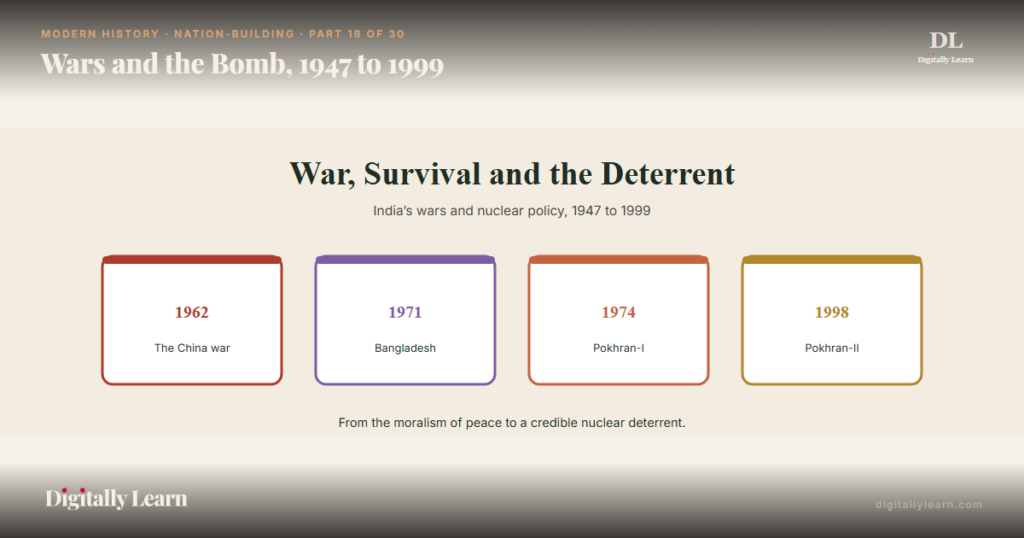
Wars and the bomb mark the hard edge of India's foreign policy, the place where the doctrine of peace met the reality of force. Between independence and the end of the century the republic fought four wars with Pakistan and one with China, signed the Tashkent and Shimla agreements to close two of them, and moved from a peaceful nuclear programme to a declared deterrent after the tests at Pokhran. This part follows those five conflicts and the long road to the bomb, the events that turned the relationships of the previous part into open conflict.
War and the Bomb: The Hard Edge of the Republic's Foreign Policy
How a Nation of Peace Came to Fight and to Deter
Why this matters: A country whose foreign policy preached non-alignment and peaceful coexistence nonetheless fought five wars in its first fifty years and built a nuclear weapon. The gap between the ideal and the necessity is the subject of this part, and it explains why a peace-seeking state ended the century as a declared nuclear power.
What is the significance of the wars and the bomb: They were the schoolroom of India's strategic thinking. Each conflict forced a lesson, about defence, about alliances, about deterrence, and the relationships of the previous part, with Pakistan and China above all, are here followed into the open conflict that the founding treaties could not prevent.
The Theatres of War: Mapping the Conflicts of 1947 to 1999
Where the Wars Were Fought and the Bomb Was Tested
Distinguishing the geography of conflict: India's wars were fought along its disputed frontiers, in the Kashmir Himalayas against Pakistan in 1947, 1965 and 1999, across the high Himalayan border with China in 1962, and on the eastern front against East Pakistan in 1971. Far to the south-west, in the Rajasthan desert, lay the Pokhran range where the bomb was tested, as the map sets out.
The map shows a pattern. The north-west, the Kashmir front with Pakistan, was the recurring battleground across all three of their wars and the Kargil conflict; the northern and eastern Himalayan sectors held the single, sharp war with China; and the eastern front of 1971 stood apart, the one war that ended in a decisive Indian victory and a new nation.
The First War, 1947-48: Kashmir and the United Nations
From the Tribal Invasion to the Ceasefire Line of 1949
Distinguishing the opening conflict: The republic's first war came within weeks of its birth. A tribal invasion from Pakistan into Kashmir in October 1947 prompted the ruler's accession to India, treated earlier in this series, and Indian troops were airlifted to defend the valley; a proxy war between the two armies followed through 1947 and 1948.
Observable outcome: India referred the matter to the United Nations in 1948, and a formal ceasefire took effect on 1 January 1949. The ceasefire line that resulted, later renamed the Line of Control, has divided Kashmir ever since, and the dispute it left unresolved became the wound that the later wars with Pakistan reopened.
The War with China, 1962: The Himalayan Defeat
The Swift Invasion and the National Shock That Followed
Distinguishing the gravest defeat: The boundary dispute with China, over the Aksai Chin in the west and the eastern sector treated in the previous part, came to a head in October 1962, when China launched a swift and massive invasion on both fronts. Indian forces blocked the Chinese advance in the west but were pushed back in the east almost to the plains of Assam, before China declared a unilateral ceasefire and withdrew.
Observable consequences ran deep into politics. The defeat dented India's image at home and abroad and forced it to seek military help from the United States and Britain, while the Soviet Union stayed neutral. It bred a sense of national humiliation that also stiffened nationalism; the Defence Minister Krishna Menon left the cabinet, Nehru was criticised for a naive reading of Chinese intentions and for poor military preparedness, and the first no-confidence motion against his government was moved in Parliament.
The deeper effect was a turn to hard power. The war exposed how unprepared the country was, and India embarked on a sustained drive to modernise and expand its armed forces, diverting scarce resources from development to defence. The idealism of the early years gave way, after 1962, to a colder calculation of strategic need.
The War with Pakistan, 1965, and the Tashkent Agreement
The Rann of Kutch, the Punjab Front and the Soviet-Brokered Peace
Distinguishing the second war with Pakistan: With Lal Bahadur Shastri now Prime Minister, Pakistan launched attacks in the Rann of Kutch in Gujarat in April 1965 and a larger offensive in Jammu and Kashmir in the months that followed, hoping for a local uprising that never came. To relieve the pressure on Kashmir, Shastri ordered a counter-offensive on the Punjab border, and the Indian army drove close to Lahore.
Observable outcome: The hostilities ended with United Nations intervention, and in January 1966 Shastri and Pakistan's General Ayub Khan signed the Tashkent Agreement, brokered by the Soviet Union, under which both sides agreed to withdraw to the pre-war positions. The settlement was overshadowed by tragedy, for Shastri died at Tashkent the day after signing, and though India had inflicted real military losses the war deepened the country's already severe economic strain.
The Bangladesh War, 1971, and the Shimla Agreement
The Refugee Crisis, the Soviet Treaty and the Surrender at Dhaka
Distinguishing the decisive war: Pakistan's crisis began with its 1970 election, won in the east by the Awami League under Sheikh Mujibur Rahman, a verdict the rulers in the west refused to accept. In early 1971 the Pakistani army arrested Mujib and unleashed a reign of terror in East Pakistan, and some eight million refugees fled into India, a burden that turned a foreign crisis into a domestic emergency.
Observable build-up: To counter a tightening axis of the United States, China and Pakistan, India signed a twenty-year Treaty of Peace and Friendship with the Soviet Union in August 1971, treated in the previous part. Full-scale war broke out in December; India struck on both the eastern and western fronts, and within a fortnight its army surrounded Dhaka, where about ninety thousand Pakistani troops surrendered, the largest surrender since the Second World War.
- The 1970 election gave the Awami League a majority that the western rulers would not honour.
- A reign of terror in the east drove some eight million refugees into India.
- India signed a twenty-year friendship treaty with the Soviet Union in August 1971.
- The December war ended in the surrender at Dhaka and the birth of Bangladesh.
Observable outcome: With Bangladesh free, India declared a unilateral ceasefire, and the war was formally closed by the Shimla Agreement of 1972 between Indira Gandhi and Zulfikar Ali Bhutto, which committed the two states to settle their disputes bilaterally and to respect the line of control in Kashmir. The victory was a moment of national triumph and the clearest sign yet of India's growing military weight.
Kargil, 1999: The Limited War in the Nuclear Shadow
The Intrusion on the Heights and the War After the Bomb
Distinguishing the last war of the century: In early 1999 forces from across the Line of Control occupied several points on the Indian side in the Kargil sector, in the Mashkoh, Dras, Kaksar and Batalik areas, an intrusion in which the involvement of the Pakistan army was soon suspected. Indian forces fought through the high summer of May and June to recover the lost heights, and by the end of July 1999 most had been retaken.
What is the significance of Kargil: It was the first war fought after both countries had openly become nuclear powers, only a year after the tests of 1998, and the world watched closely to see whether a conventional clash between two nuclear states would escalate. It did not; the fighting was deliberately confined to the Kargil region, and soon after the conflict the government of Pakistan was taken over by its army chief, General Musharraf.
Pokhran-I, 1974: The Peaceful Nuclear Explosion
From Bhabha's Programme to the First Test, and the Refusal of the NPT
Distinguishing the nuclear beginning: India's nuclear story began not with weapons but with energy. Nehru placed great faith in science, and a nuclear programme was begun in the late 1940s under Homi Bhabha to generate atomic energy for peaceful purposes; Nehru himself opposed nuclear weapons and pleaded with the great powers for comprehensive disarmament.
The Cold War order pushed India towards the bomb. After China tested a nuclear weapon in 1964, the five nuclear-weapon powers framed the Nuclear Non-Proliferation Treaty of 1968, which India judged discriminatory, since it froze the world into nuclear haves and have-nots, and refused to sign. On 18 May 1974 India conducted its first nuclear test at Pokhran, which it termed a peaceful nuclear explosion, insisting it remained committed to using nuclear power only for peace.
Pokhran-II, 1998, and India's Nuclear Doctrine
The Declared Weapon, the Sanctions and the Principles of Restraint
Distinguishing the declared deterrent: India continued to oppose the nuclear order, rejecting the indefinite extension of the Non-Proliferation Treaty in 1995 and refusing to sign the Comprehensive Test Ban Treaty, which it again held to be discriminatory. In May 1998 it conducted a series of nuclear tests at Pokhran, demonstrating a weapons capability; Pakistan soon followed with tests of its own, and the international community imposed sanctions that were later lifted.
Observable outcome: India then declared a nuclear doctrine built on credible minimum deterrence and a pledge of no first use, promising that it would never be the first to use the weapon but would answer any nuclear attack with massive retaliation, and reaffirming its commitment to global, verifiable and non-discriminatory disarmament. The principles are gathered below.
| War or test | Year | Theatre or site | How it closed or what it declared |
|---|---|---|---|
| First War | 1947-48 | Kashmir | Referred to the UN; ceasefire line of 1949 |
| China War | 1962 | Aksai Chin and the east | Chinese unilateral ceasefire and withdrawal |
| Second War | 1965 | Kutch and Punjab | The Tashkent Agreement, 1966 |
| Bangladesh War | 1971 | Eastern and western fronts | The Shimla Agreement, 1972 |
| Kargil | 1999 | The Kargil heights | The intrusion pushed back across the line |
| Pokhran-I and II | 1974 and 1998 | Pokhran, Rajasthan | From a peaceful explosion to a declared deterrent |
The Pattern: From the Ethics of Peace to the Logic of Deterrence
How Each Conflict Pushed India Towards Hard Power
Distinguishing the long arc: Read together, the wars and the tests trace a single journey, from the moralism of the early years, when Nehru trusted in disarmament and friendship, to the hard deterrence of 1998, when India declared the bomb. The defeat of 1962 began the shift, the victory of 1971 confirmed India's regional weight, and the nuclear tests set the seal on a strategic identity built on self-reliance in force.
The domestic effect was as large as the strategic. The wars made and unmade leaders, Nehru's stature fell after 1962 and Indira Gandhi's rose after 1971, and the steady diversion of resources to defence shaped the economy and the budget for decades. War, in independent India, was never only a matter of the frontier; it reached back into the politics and the economy of the nation.
Significance: How the Wars and the Bomb Forged India's Strategic Identity
From the Idealism of 1947 to the Nuclear Power of 1998
The larger significance of this half-century is that it turned an idealistic young republic into a hard-headed strategic power. The wars taught India that doctrine alone could not guarantee security, and the bomb gave it, at last, a deterrent of its own; together they fixed the principle that India would rely on its own strength, the strategic autonomy of the previous parts carried into the realm of force.
Contemporary linkages keep this story at the centre of policy. The Line of Control, the unresolved boundary with China, the doctrine of no first use and the place of India outside the Non-Proliferation Treaty are all live questions today.
The lesson the era taught, that a nation must be able to defend itself before it can shape the world, underlies India's strategic posture still. The next part turns from the frontier back to the society, to caste, reservation and social justice.
- India fought four wars with Pakistan and one with China between 1947 and 1999.
- The 1962 defeat reshaped India’s defence; the 1971 victory created Bangladesh and confirmed its weight.
- The Tashkent Agreement of 1966 and the Shimla Agreement of 1972 closed the 1965 and 1971 wars.
- Pokhran-I of 1974 was a peaceful explosion; Pokhran-II of 1998 declared a weapons capability.
- India’s nuclear doctrine rests on credible minimum deterrence and a pledge of no first use.
Prelims MCQ practice
Each question below tests one specific concept on the topic. Click to reveal the answer and a full option-wise explanation.
Q1. The Tashkent Agreement of 1966, which ended the 1965 India-Pakistan war, was brokered by which of the following?
- The United States
- The Soviet Union
- The United Nations alone
- The United Kingdom
Show answer and explanation
Answer: The Soviet Union
Explanation.
Option (b) is correct. The Tashkent Agreement was signed in January 1966 by Lal Bahadur Shastri and General Ayub Khan, brokered by the Soviet Union. Hence option (b).
Q2. Consider the following statements about the India-China war of 1962:
- The dispute centred on the Aksai Chin and the eastern sector.
- China declared a unilateral ceasefire and withdrew its troops.
- The Soviet Union gave India direct military assistance during the war.
Which of the statements given above is/are correct?
- 1 and 2 only
- 2 and 3 only
- 1 and 3 only
- 1, 2 and 3
Show answer and explanation
Answer: 1 and 2 only
Explanation.
Statements 1 and 2 are correct: the dispute centred on the Aksai Chin and the eastern sector, and China declared a unilateral ceasefire and withdrew. Statement 3 is wrong, because the Soviet Union remained neutral; India sought help from the United States and Britain. Hence option (a).
Q3. The first war between India and Pakistan over Kashmir ended with a ceasefire that took effect on which date?
- 15 August 1947
- 1 January 1949
- 26 January 1950
- 1 July 1972
Show answer and explanation
Answer: 1 January 1949
Explanation.
Option (b) is correct. The first India-Pakistan war over Kashmir ended with a ceasefire effective from 1 January 1949, and the resulting ceasefire line later became the Line of Control. Hence option (b).
Q4. Consider the following statements about the 1971 India-Pakistan war:
- It followed a crackdown by the Pakistani army in East Pakistan after the 1970 election.
- India signed a friendship treaty with the Soviet Union before the full-scale war.
- The war ended with the Tashkent Agreement.
Which of the statements given above are correct?
- 1 and 2 only
- 2 and 3 only
- 1 and 3 only
- 1, 2 and 3
Show answer and explanation
Answer: 1 and 2 only
Explanation.
Statements 1 and 2 are correct: the war followed the crackdown in East Pakistan and India signed the friendship treaty with the Soviet Union in August 1971. Statement 3 is wrong, because the 1971 war ended with the Shimla Agreement of 1972, not Tashkent. Hence option (a).
Q5. India's first nuclear test at Pokhran in 1974 was officially described as which of the following?
- A weapons demonstration
- A peaceful nuclear explosion
- A reactor accident
- A test under IAEA safeguards
Show answer and explanation
Answer: A peaceful nuclear explosion
Explanation.
Option (b) is correct. India termed its first nuclear test of 1974 a peaceful nuclear explosion, maintaining that it was committed to using nuclear power only for peaceful purposes. Hence option (b).
Q6. Consider the following statements about India's nuclear doctrine declared after 1998:
- It rests on the principle of credible minimum deterrence.
- It includes a pledge of no first use of nuclear weapons.
- India signed the Comprehensive Test Ban Treaty in 1998.
Which of the statements given above is/are correct?
- 1 and 2 only
- 2 and 3 only
- 1 and 3 only
- 1, 2 and 3
Show answer and explanation
Answer: 1 and 2 only
Explanation.
Statements 1 and 2 are correct: India's doctrine rests on credible minimum deterrence and a no-first-use pledge. Statement 3 is wrong, because India refused to sign the Comprehensive Test Ban Treaty. Hence option (a).
Sources and Further Reading
- NCERT, Politics in India since Independence (Class 12), India's External Relations
- Wikipedia: Indo-Pakistani war of 1971
- Wikipedia: Smiling Buddha (Pokhran-I)
- Wikipedia: Pokhran-II
- Wikipedia: Treaty on the Non-Proliferation of Nuclear Weapons
- Ministry of External Affairs, Government of India
- United Nations: Security Council Resolution 47 on Kashmir
- Press Information Bureau, Government of India
- National Portal of India
Editorial Disclaimer
This article is prepared for UPSC examination preparation. Verify key facts and interpretations against standard reference histories before relying on them.