


Overview
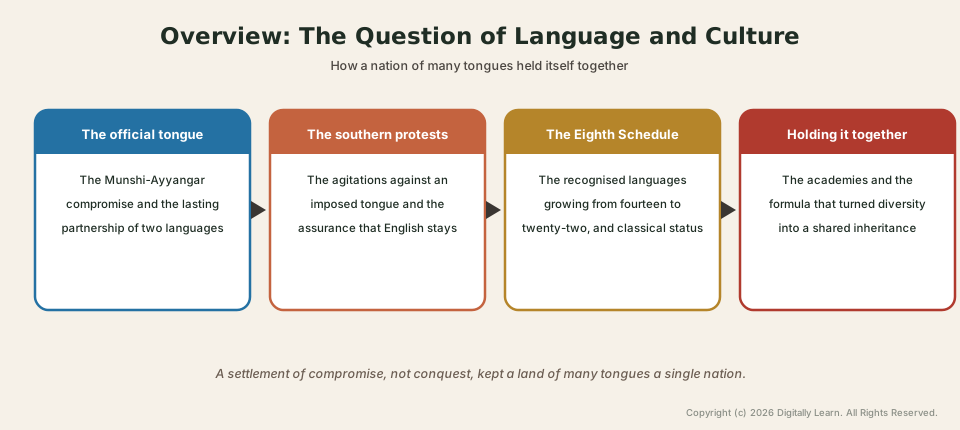
The language and cultural question was the most delicate of the tasks of nation-building, for in a land of many tongues the choice of how the state would speak touched the identity of every region. The republic refused to impose a single national language, settling instead on a compromise: Hindi as the official language of the union with English alongside it, a constitutional scheme of language rights, and a steadily growing list of recognised languages in the Eighth Schedule. This part follows that settlement, the protests it provoked, and the cultural framework through which a diverse nation held together.
The Language Question: The Hardest Test of Unity in Diversity
Why the Choice of a Common Tongue Could Have Broken the Nation
Why this matters: A nation can survive many disagreements, but a quarrel over the language in which it governs itself reaches the identity of every citizen. India, with no single language spoken by even half its people, faced in the choice of an official tongue a test that had broken other states, and the way it answered, by compromise rather than imposition, was among the quiet triumphs of its nation-building.
What is the significance of the language question: It was the place where the ideal of unity in diversity met its hardest case. To make one language supreme risked alienating the rest; to recognise all risked paralysis. The settlement the republic reached, a shared official tongue, protected regional languages and a refusal to crown any language as national, became the model for how a plural society could hold together.
The Munshi-Ayyangar Compromise: Settling the Official Language
How the Constituent Assembly Defused Its Most Divisive Debate
Distinguishing the founding bargain: No question divided the Constituent Assembly more sharply than language. Members from the Hindi-speaking north pressed for Hindi as the sole national language, while those from the south and east, who did not speak it, feared being shut out of government and the professions. The deadlock was broken by a compromise associated with K. M. Munshi and N. Gopalaswami Ayyangar, a formula that gave each side something and crowned no language as supreme.
The compromise had three parts. Hindi in the Devanagari script was made the official language of the union, not the national language, a distinction deliberately kept; English was to continue as an associate official language for a period of fifteen years, until 1965, to give the non-Hindi regions time to adjust; and the constitution charged the state to develop Hindi while protecting the languages of the regions. The settlement was a truce, not a victory, and it left the final transition to the future.
Observable outcome: By refusing to declare a national language and by guaranteeing English for a generation, the compromise took the heat out of a question that might have split the new state. It rested, however, on an assumption that Hindi would steadily replace English by 1965, an assumption that the events of that year would overturn, reopening the bargain the framers had thought settled.
The Constitutional Settlement: Articles 343 to 351
How the Constitution Balanced the Official Tongue Against the Regions
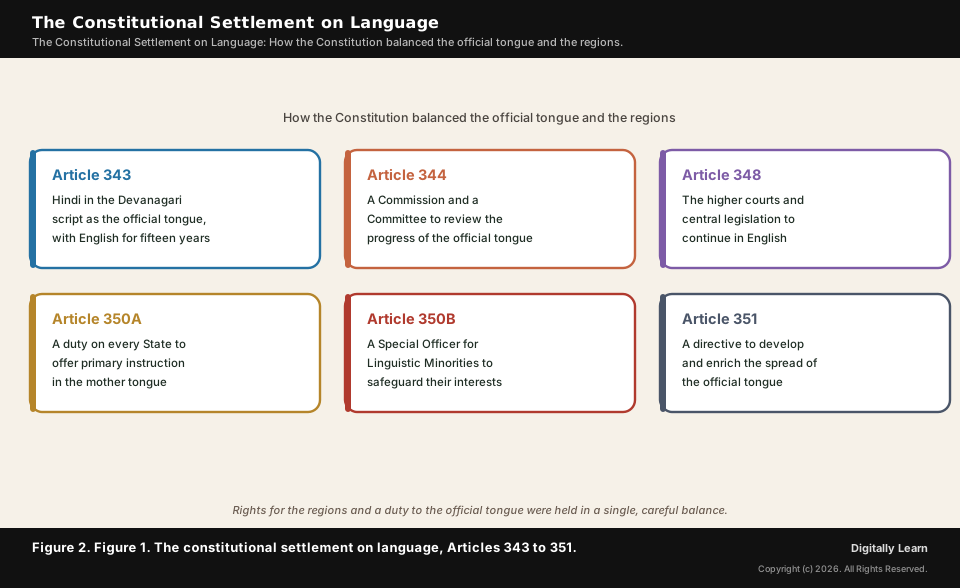
Distinguishing the constitutional scheme: The language settlement was written into a careful set of provisions. Article 343 made Hindi in the Devanagari script the official language of the union with English continuing for fifteen years; Article 344 provided for a Commission and a parliamentary Committee to review progress; and Article 348 kept the higher courts and central laws in English. The states, under Articles 345 to 347, could choose their own official languages, so that government could be carried on in the language of the region.
The scheme protected the speakers of every tongue. Article 350A placed a duty on every state to provide primary instruction in the mother tongue, Article 350B created a Special Officer for Linguistic Minorities to safeguard their interests, and Article 351 directed the union to develop and enrich Hindi while drawing on the other languages of the country. The figure below sets out this balance between a common official tongue and the rights of the regions.
Observable outcome: The Constitution thus did not so much resolve the language question as institutionalise its management, creating a framework of rights and duties within which the contest between Hindi, English and the regional languages could be carried on by law rather than by force. The mother-tongue guarantee and the protection of linguistic minorities gave the regions a constitutional shield that later agitations would invoke.
The Official Languages Act of 1963: English Stays On
How the Approaching Deadline of 1965 Was Defused by Statute
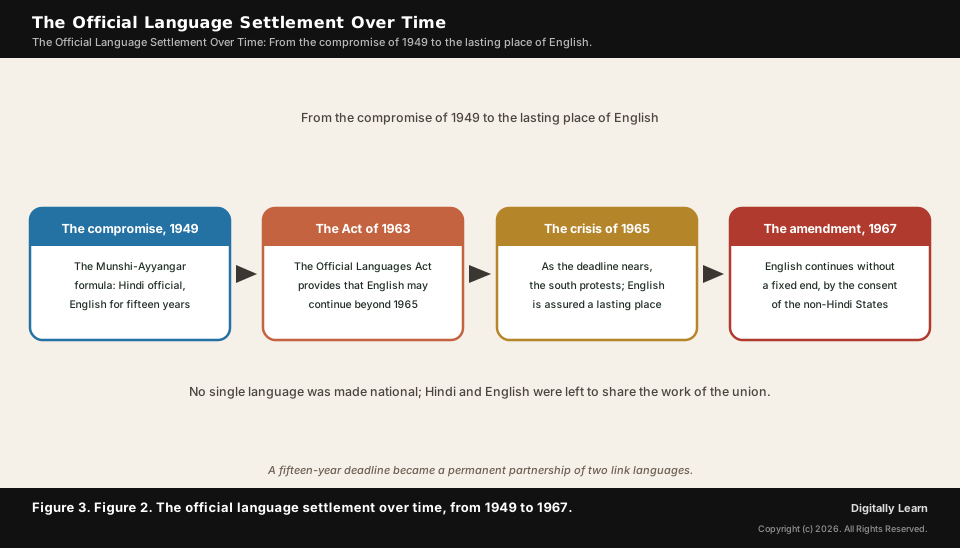
Distinguishing the second settlement: As 1965 approached and English was due to give way to Hindi, the non-Hindi states grew alarmed that they would be governed and examined in a language most of their people did not know. To reassure them, Parliament passed the Official Languages Act of 1963, which provided that English may continue to be used, alongside Hindi, for the official purposes of the union even after 1965. The word may, however, fell short of a guarantee, and unease in the south persisted.
The settlement was completed after the crisis. Following the agitations of 1965, the Act was amended in 1967 to provide that English would continue without a fixed end, and that Hindi could not be made the sole official language without the consent of the states that had not adopted it. This gave the non-Hindi regions, in effect, a standing assurance, converting the temporary place of English into a permanent partnership of two link languages.
Observable outcome: The Act and its amendment turned the fifteen-year deadline of the Constitution into an open-ended arrangement in which Hindi and English shared the work of the union indefinitely. The transition the framers had imagined never came; instead, India settled into a stable bilingualism at the centre, with English as the link between the Hindi and the non-Hindi worlds.
The Anti-Hindi Agitations of 1937 and 1965
How the South Resisted the Imposition of a Language It Did Not Speak
Distinguishing the language protests: Resistance to compulsory Hindi was older than the republic. When the Congress ministry under C. Rajagopalachari made Hindi compulsory in the schools of Madras in 1937, it met a powerful agitation led by E. V. Ramasamy, Periyar, and the Justice Party, who saw it as an imposition of the north upon the Tamil south; the measure was withdrawn. The episode planted a deep suspicion of Hindi in Tamil politics that independence did not dissolve.
The deeper crisis came in 1965. As the constitutional deadline arrived and Hindi was set to become the sole official language, a powerful anti-Hindi agitation broke out in Madras State, led by students and the rising Dravida Munnetra Kazhagam, the DMK. The protests were intense and, in places, turned tragic, and they shook the government in Delhi, which moved quickly to assure the south, through the prime minister and then the 1967 amendment, that English would not be taken away.
Observable outcome: The agitations of 1965 secured the lasting place of English and taught the union a permanent lesson about the limits of linguistic imposition. They also transformed the politics of the Tamil country, carrying the DMK to power in 1967 and making the defence of the regional language a central theme of its movement, so that the language question reshaped the party system of an entire state.
The Three-Language Formula
How a Compromise on Schooling Tried to Spread a Shared Tongue
Distinguishing the educational compromise: Alongside the settlement at the centre, a formula was devised for the schools. The three-language formula, recommended by the education commissions and adopted in the National Policy on Education of 1968, proposed that every child learn three languages: the regional language and English everywhere, Hindi in the non-Hindi areas, and a modern Indian language, ideally a southern one, in the Hindi-speaking areas. It was meant to spread Hindi without compulsion and to bind the regions through a shared schooling.
The formula was applied unevenly. In practice the Hindi-speaking states rarely taught a southern language, while Tamil Nadu rejected the formula altogether and held to a two-language policy of Tamil and English, refusing to teach Hindi. The asymmetry, southern children learning Hindi while northern children learned no southern tongue, became a lasting grievance, and the formula remained more an aspiration than a settled practice.
Observable outcome: The three-language formula expressed the republic's hope that schooling could knit the language regions together, and where it worked it gave a generation a window into another part of the country. Yet its uneven application showed the limits of persuasion, and the language of instruction remained, like the official language, a matter of negotiation rather than of national command.
The Eighth Schedule and the Classical Languages
How the List of Recognised Languages Grew from Fourteen to Twenty-Two
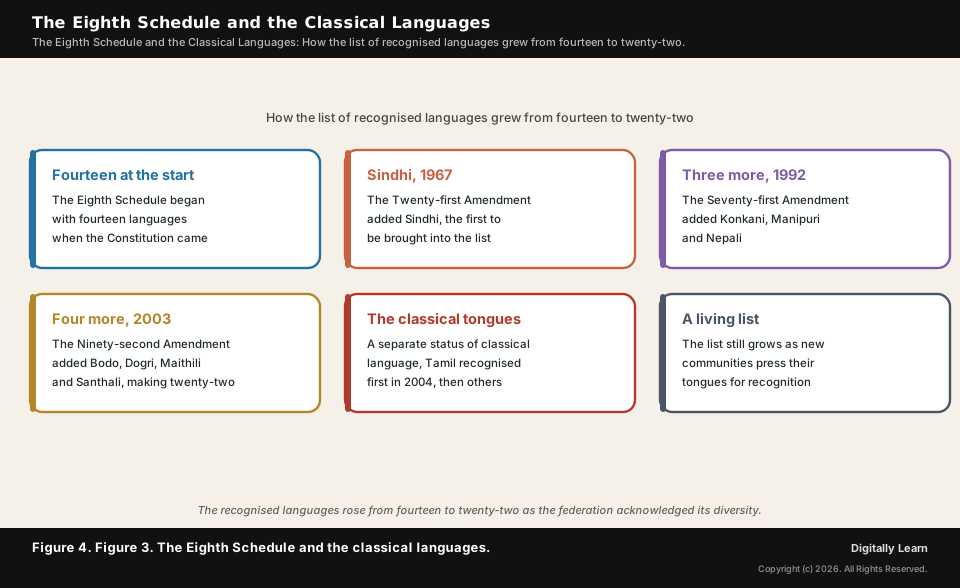
Distinguishing the politics of recognition: Beyond the official language lay the question of which languages the republic would formally recognise, listed in the Eighth Schedule of the Constitution. It began with fourteen languages and grew as communities pressed their claims: the Twenty-first Amendment added Sindhi in 1967, the Seventy-first added Konkani, Manipuri and Nepali in 1992, and the Ninety-second added Bodo, Dogri, Maithili and Santhali in 2003, raising the number to twenty-two. Each addition was a recognition that a language, and the people who spoke it, belonged to the national mainstream.
A further status marked the oldest tongues. From 2004 the state began to confer the rank of classical language on languages of great antiquity and independent literary tradition, beginning with Tamil and extending afterwards to Sanskrit and to several others, bringing with it scholarships and centres of study. The figure below traces the growth of the recognised languages and the new classical status.
Observable outcome: The expanding Eighth Schedule turned the recognition of languages into a continuing act of national inclusion, by which the federation acknowledged its diversity rather than suppressing it. Recognition carried real benefits, in education, administration and public examinations, and the list remains open, a standing invitation to communities to claim their place within the constitutional family.
Language as Federal Politics
How Language Became the Basis of State Identity and Regional Power
Distinguishing language from administration: Language in India is not merely a medium but a marker of identity, and after the reorganisation of the states on linguistic lines, treated earlier in this series, it became the foundation of the federal map. Each major language acquired a state in which it was supreme, and the boundary between the regions formed, in many places, a cultural unit more deeply felt than the administrative line that defined the state.
Language gave rise to regional power. The defence of the mother tongue became a powerful theme of regional politics, nowhere more than in the Tamil country, where parties built on the language question came to govern, but also in the assertion of Marathi, Bengali, Kannada and other identities. Language thus fed the rise of strong regional parties and the bargaining of a genuinely federal politics, in which the centre had to accommodate the linguistic pride of the states.
Observable outcome: Far from dividing the country, the recognition of language as the basis of the states gave each region a secure home for its identity and so, paradoxically, strengthened the union by removing the fear of cultural erasure. The cultural region and the political state did not always coincide, but the broad alignment of the two turned linguistic pride from a threat to unity into a pillar of a stable federation.
Cultural Integration: Holding Diversity Together
How the Republic Wove Many Cultures into a Shared Inheritance
Distinguishing integration from uniformity: The republic sought not to melt its cultures into one but to weave them into a shared inheritance, a unity that preserved difference. It built institutions for the purpose: the Sahitya Akademi for letters, the Sangeet Natak Akademi for music and drama and the Lalit Kala Akademi for the arts, all founded in the mid-1950s, together with the Indian Council for Cultural Relations, to honour the country's many traditions and carry them across the regions.
The idea behind these efforts was distinctive. India's was to be a unity in diversity, a federation that drew strength from its plurality rather than fearing it, more a garden of many plants than a single mould. The national symbols, the academies, the three-language formula and the recognition of regional languages all served this vision, that a citizen could be wholly Tamil or Bengali or Marathi and wholly Indian at once, the two identities reinforcing rather than competing.
Observable outcome: The cultural settlement gave the political one its deeper foundation, for the language compromise could hold only because it rested on a genuine respect for diversity. The institutions of cultural integration helped to make the idea of a plural nation a lived reality, and the survival of India as a single democracy of many languages stands as the vindication of that idea.
Significance: Unity in Diversity as a Living Settlement
How the Language Settlement Became a Model for a Plural Democracy
The larger significance of the language settlement is that it showed how a vast and diverse society could resolve its deepest cultural quarrel without coercion. By refusing to impose a single tongue, by protecting the regions and by recognising rather than suppressing its many languages, the republic turned what might have been a source of breakup into a source of strength, a settlement that other plural states have studied and few have matched.
Contemporary linkages keep the question alive. The place of Hindi and English, the demands of new languages for inclusion in the Eighth Schedule, the renewed debates over the three-language formula and the recognition of further classical languages are all live matters, each a continuation of the bargain struck in these decades.
| Stage | Change | Year |
|---|---|---|
| The compromise | The Munshi-Ayyangar formula: Hindi official, English for fifteen years | 1949 |
| The Act | The Official Languages Act lets English continue | 1963 |
| First addition | Sindhi added to the Eighth Schedule by the 21st Amendment | 1967 |
| Three more | Konkani, Manipuri and Nepali added by the 71st Amendment | 1992 |
| Four more | Bodo, Dogri, Maithili and Santhali added by the 92nd Amendment, making twenty-two | 2003 |
| Classical status | Tamil recognised as the first classical language | 2004 |
The deeper lesson is that unity in diversity is not a slogan but a continuing act of accommodation, that a plural nation is held together not by sameness but by a settled respect for difference. The next part turns from the cultural question to its harder edge, the regional movements, separatism and insurgency that tested the limits of that accommodation.
- The Munshi-Ayyangar compromise of 1949 made Hindi the official language with English alongside it, naming no national language.
- Articles 343 to 351 set the constitutional scheme, including the mother-tongue instruction of Article 350A.
- The Official Languages Act of 1963, amended in 1967, secured the lasting place of English.
- The anti-Hindi agitations of 1937 and 1965 resisted imposed Hindi and reshaped Tamil politics.
- The Eighth Schedule grew from fourteen languages to twenty-two, and a classical-language status was created from 2004.
Previous Year UPSC-CSE Questions
Previous Year UPSC-CSE Questions By the end you will be able to draft model answers for the following UPSC questions. Each question carries a collapsible framework showing how to approach it in the exam.
- UPSC Mains 2017 GS-IIn the context of the diversity of India, can it be said that the regions form cultural units rather than the States? Give reasons with examples for your viewpoint.
How to structure the answer in the exam
Introduction: Open with language as the marker that turns a region into a cultural unit.
Body (sub-themes to develop):
- The case for cultural units: shared language, literature and identity define regions like the Tamil country, Maharashtra and Bengal.
- The alignment: linguistic reorganisation drew states to match these cultural units.
- The mismatch: sub-regional cultures and multilingual states show culture and state do not always coincide.
- A balanced view: the state is the political form, the cultural region the deeper identity, and India accommodates both.
Conclusion: Conclude that regions form cultural units that the states largely, but not perfectly, embody, and that India's strength lies in respecting both.
- UPSC Prelims 2008 GS Paper IUnder which one of the following Constitution Amendment Acts, four languages were added to the languages under the Eighth Schedule of the Constitution of India, thereby raising their number to 22?
How to approach this Prelims question
Approach: Recall which amendment raised the Eighth Schedule to twenty-two languages.
Trap to watch: The Twenty-first Amendment added Sindhi and the Seventy-first added three languages; it was the Ninety-second Amendment of 2003 that added four more to make twenty-two.
Key facts to recall:
- The Eighth Schedule began with fourteen languages
- The 92nd Amendment of 2003 added Bodo, Dogri, Maithili and Santhali
- The total rose to twenty-two
Answer signal: The Ninety-second Amendment, so option (c).
- UPSC Prelims 2001 GS Paper IWhich Article of the Constitution provides that it shall be the endeavour of every State to provide adequate facility for instruction in the mother tongue at the primary stage of education?
How to approach this Prelims question
Approach: Match the mother-tongue instruction duty to the correct article.
Trap to watch: Article 350 concerns representations for redress; Article 351 directs the development of Hindi; the mother-tongue instruction duty is Article 350A.
Key facts to recall:
- Article 350A: primary instruction in the mother tongue
- Article 350B: Special Officer for Linguistic Minorities
- Article 351: development of Hindi
Answer signal: Article 350-A, so option (c).
Sources and Further Reading
- NCERT, Politics in India since Independence (Class 12)
- NCERT, Indian Constitution at Work (Class 11)
- Wikipedia: Eighth Schedule to the Constitution of India
- Wikipedia: Official Languages Act, 1963
- Wikipedia: Anti-Hindi agitations of Tamil Nadu
- Wikipedia: Classical languages of India
- Department of Official Language, Government of India
- Sahitya Akademi
- Press Information Bureau, Government of India
- National Portal of India
Editorial Disclaimer
This article is prepared for civil services preparation. Verify key facts and interpretations against standard reference works before relying on them.