


Overview
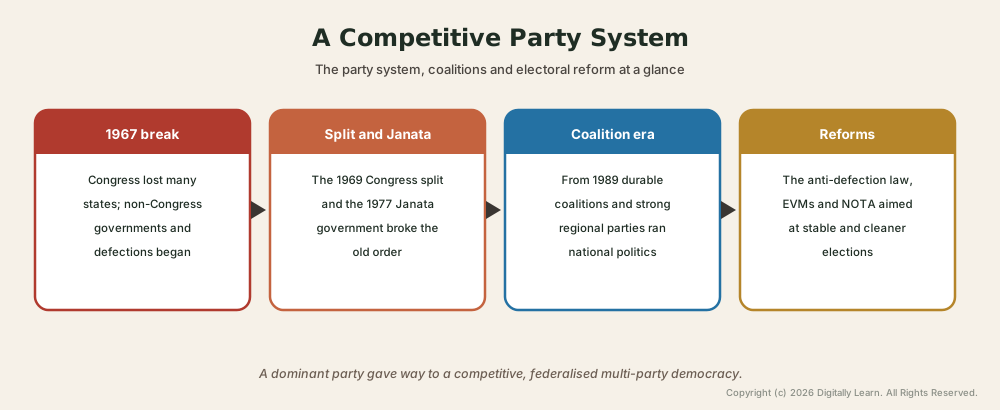
The party system, coalitions and electoral reform describe how Indian politics changed from one-party dominance to a competitive, multi-party democracy. After the 1967 general election broke the dominance of the Congress, politics was marked by defections, the split of the Congress in 1969, the first non-Congress government in 1977 and, from 1989, an era of coalition governments and powerful regional parties. To stabilise this fluid politics, the state enacted the anti-defection law of 1985 and a series of electoral reforms. How the party system was transformed, and how it was made more stable and clean, is a central theme of nation-building and the sequel to the founding Congress system.
Introduction: From One-Party Dominance to a Competitive Politics
Why the Party System Changed After 1967
Why this matters: the dominance of the Congress, which had defined the first two decades, did not last. From the late 1960s, defections, splits and the rise of new parties turned a one-party system into a competitive one, and that transformation shaped how power is won and shared in India to this day.
What is the significance of the party system: it decides how a democracy actually works. The move from the dominance of the Congress to coalition governments and strong regional parties made Indian politics more competitive and more federal, as this part, the sequel to the founding Congress system, sets out.
The 1967 Earthquake: The End of Congress Dominance
How the Fourth General Election Broke the Monopoly
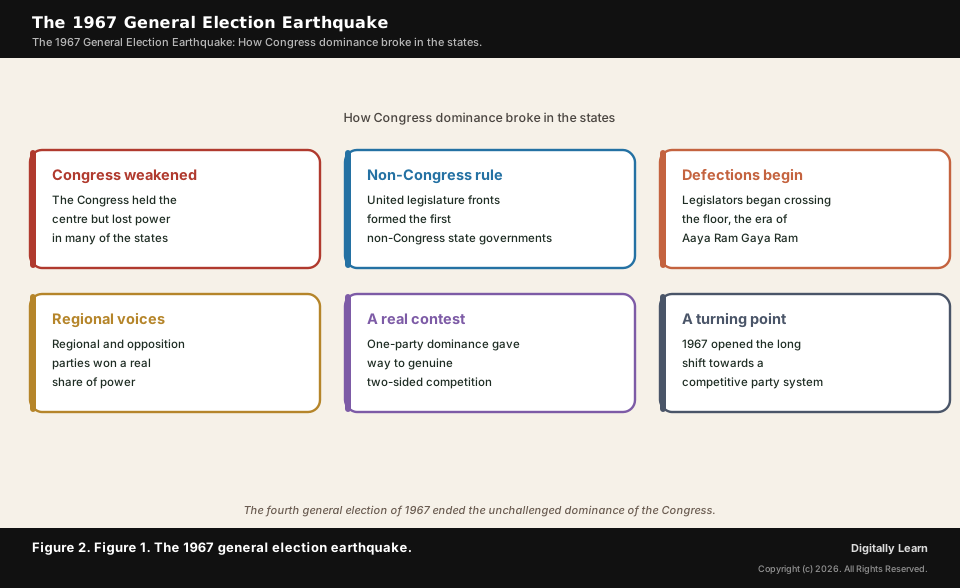
What is the significance of 1967: it was the great turning point. In the fourth general election of 1967, the Congress held on at the centre but lost power in many states, where opposition coalitions formed the first non-Congress governments, ending its unchallenged dominance.
Distinguishing the earthquake: this was more than a swing of seats. It opened an era of real competition, in which regional and opposition parties shared power, legislators began crossing the floor, and the politics of defection known as Aaya Ram Gaya Ram became common, as the figure below sets out.
Defections and the 1969 Split in the Congress
Aaya Ram Gaya Ram and the Splitting of the Congress
Observable outcomes of the new competition appeared at once. Frequent defections, in which legislators changed parties for office or gain, made governments unstable, and the phrase Aaya Ram Gaya Ram, from a legislator who switched sides repeatedly, came to stand for this floor-crossing.
Distinguishing the 1969 split: the strain reached the ruling party itself. In 1969 the Congress split into rival factions, which weakened the old party discipline and deepened the fluidity of politics, making the question of party loyalty a central concern for the years that followed.
The Janata Experiment and the Coalition Era
From the 1977 Janata Government to Coalitions After 1989
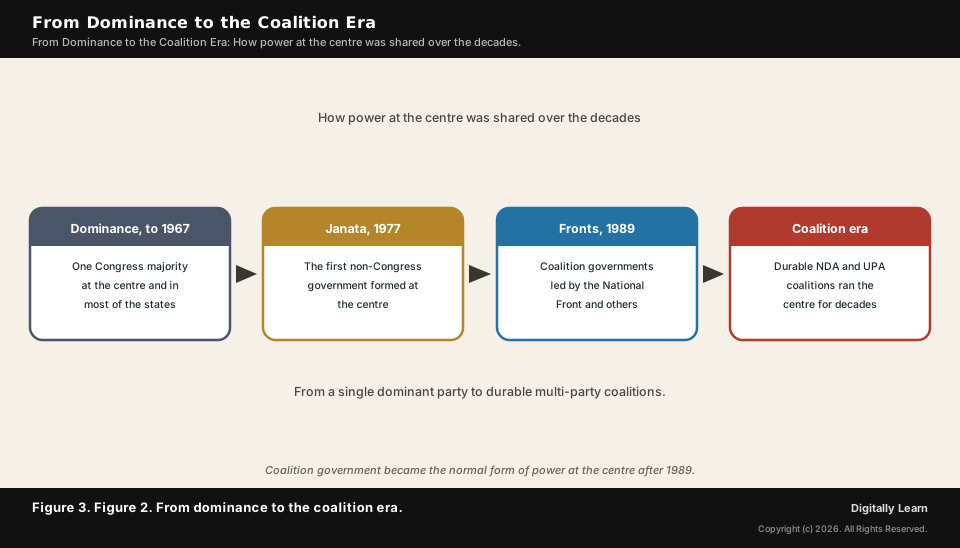
Distinguishing the Janata experiment: the first break at the centre came in 1977. After the Emergency, opposition parties united as the Janata Party and formed the first non-Congress government at the centre, showing that the dominance of the Congress could be ended at the national level too.
What is the significance of the coalition era: it became the new normal. From 1989, no single party often held a majority, and durable coalition governments, led by fronts such as the National Front and later the larger alliances, ran the centre for decades, as the figure below sets out.
The Rise of Regional Parties and a Federalised Polity
How Regional Parties Reshaped National Politics
Observable outcomes of these decades were the rise of strong regional parties. Parties rooted in particular states grew powerful, won state governments and, in the coalition era, became essential partners in forming governments at the centre, giving the regions a real voice in national politics.
Distinguishing the federalised polity: this changed the balance of the union. As regional parties bargained for their states within national coalitions, politics became more federal in practice, linking the party system directly to the centre-state relations treated earlier in this series.
The Anti-Defection Law and the Reform of Elections
The Tenth Schedule, EVMs, NOTA and Cleaner Elections
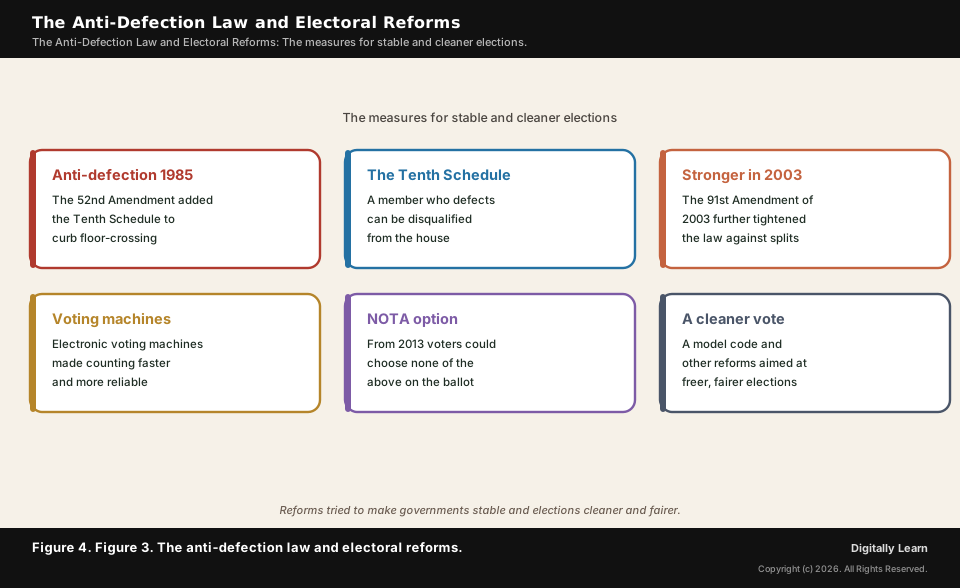
Distinguishing the anti-defection law: the fluidity of politics demanded a remedy. The 52nd Amendment of 1985 added the Tenth Schedule to the Constitution, under which a legislator who defects can be disqualified from the house, and the 91st Amendment of 2003 strengthened it against splits.
Distinguishing the trade-off: the law came at a price. Because the Tenth Schedule lets a member be disqualified for voting against the direction, or whip, of their own party, legislators are bound to the party line on most votes. This secured more stable governments, yet it also narrowed the independent voice of individual members of parliament and the room for open debate on the floor.
What is the significance of the reforms: they aimed at stable and cleaner elections. Alongside the anti-defection law, the use of electronic voting machines, the option of None of the Above on the ballot from 2013, and a strict model code of conduct sought to make elections freer, fairer and more credible, as the figure and table below set out.
| Phase | What changed | Why it mattered |
|---|---|---|
| 1967 | The Congress lost many states; non-Congress governments formed | The end of one-party dominance |
| 1969 | The Congress split into rival factions | Party loyalty and discipline weakened |
| 1977 to 1989 | The Janata government and then coalition fronts | Non-Congress rule became possible at the centre |
| After 1989 | Durable coalitions and strong regional parties | A competitive, federalised multi-party democracy |
Significance: A Mature Multi-Party Democracy
Why the Transformed Party System Matters
Contemporary linkages run from this transformation into the present. The competitive, multi-party politics of coalitions and strong regional parties is the system India lives with today, and the anti-defection law and electoral reforms remain live questions of how to keep it stable and clean.
The larger significance is that Indian democracy proved able to absorb deep political change without breaking. The party system moved from one-party dominance to a competitive order, and the republic kept governing by elections throughout. The points below gather the threads, and the next part turns to the building of the mixed economy.
- The 1967 general election ended Congress dominance and produced the first non-Congress state governments.
- Defections (Aaya Ram Gaya Ram) and the 1969 Congress split made politics fluid and unstable.
- The 1977 Janata government and the coalition era from 1989 made non-Congress rule the norm at the centre.
- Strong regional parties turned Indian politics into a competitive, federalised multi-party democracy.
- The anti-defection law of 1985 (Tenth Schedule) and reforms like EVMs and NOTA aimed at stable, cleaner elections.
Previous Year UPSC-CSE Questions
Previous Year UPSC-CSE Questions By the end you will be able to draft model answers for the following UPSC questions. Each question carries a collapsible framework showing how to approach it in the exam.
- UPSC Mains 2013 GS-IIThe role of individual MPs (Members of Parliament) has diminished over the years and as a result healthy constructive debates on policy issues are not usually witnessed. How far can this be attributed to the anti-defection law which was legislated but with a different intention?
How to structure the answer in the exam
Introduction: Open with the anti-defection law of 1985 and the problem of defections it was meant to solve.
Body (sub-themes to develop):
- The original intention: to curb the Aaya Ram Gaya Ram defections that made governments unstable.
- The mechanism: the Tenth Schedule disqualifies a member who votes against the party whip.
- The unintended effect: members must follow the whip, weakening independent debate and the role of individual MPs.
- The balance: stability of governments versus the freedom and voice of legislators.
Conclusion: Conclude that the law secured stability but at some cost to the independent role of MPs, inviting calibrated reform.
- UPSC Prelims 2014 GS Paper IWhich one of the following Schedules of the Constitution of India contains provisions regarding anti-defection?
How to approach this Prelims question
Approach: Recall which Schedule carries the anti-defection provisions.
Trap to watch: The anti-defection provisions are in the Tenth Schedule, not the Second (offices/salaries), Fifth (scheduled areas) or Eighth (languages).
Key facts to recall:
- The 52nd Amendment of 1985 created the anti-defection law
- It was added as the Tenth Schedule
- A member who defects can be disqualified
Answer signal: The Tenth Schedule, so option (d).
Sources and Further Reading
- NCERT, Politics in India Since Independence (Class 12), Parties and the Party System
- Wikipedia: 1967 Indian general election
- Wikipedia: Anti-defection law
- Election Commission of India
- Wikipedia: Janata Party
- National Portal of India
- Press Information Bureau, Government of India
- National Archives of India
Editorial Disclaimer
This article is prepared for UPSC examination preparation. Verify key facts and interpretations against standard reference histories before relying on them.