
Overview
Previous Year UPSC-CSE Questions By the end you will be able to draft model answers for the following UPSC questions. Each question carries a collapsible framework showing how to approach it in the exam.
- UPSC Mains 2013 GS-IIIn respect of India – Sri Lanka relations, discuss how domestic factors influence foreign policy.
How to structure the answer in the exam
Introduction: Open with the principle that foreign policy is the interplay of domestic and external factors, sharpest with a close neighbour.
Body (sub-themes to develop):
- The early case: persons of Indian origin and the Sirimavo-Shastri Pact of 1964 as a domestic-driven settlement.
- The Tamil question: Tamil Nadu's politics shaping India's stance on the island's ethnic conflict.
- The structural point: a federal democracy lets regional sentiment reach into foreign policy.
- The balance: national interest versus domestic pressure in handling a neighbour.
Conclusion: Conclude that with a close neighbour like Sri Lanka, domestic factors are not noise but a permanent input into foreign policy.
- UPSC Prelims 2006 GS Paper IConsider the following statements:
- Assam shares a border with Bhutan and Bangladesh.
- West Bengal shares a border with Bhutan and Nepal.
- Mizoram shares a border with Bangladesh and Myanmar.
Which of the statements given above are correct?
How to approach this Prelims question
Approach: Recall which Indian state touches which neighbour using the neighbours map.
Trap to watch: All three look plausible; the map confirms each pairing, so the answer is all three, not a subset.
Key facts to recall:
- Assam borders Bhutan and Bangladesh
- West Bengal borders Bhutan and Nepal
- Mizoram borders Bangladesh and Myanmar
Answer signal: All three statements are correct, so option (a).
- UPSC Prelims 1996 GS Paper IThe Palk Bay lies between
How to approach this Prelims question
Approach: Place the Palk Bay in the south-east, between India and Sri Lanka.
Trap to watch: The western-coast gulfs (Kachchh, Khambhat) are distractors; the Palk Bay is in the south-east.
Key facts to recall:
- The Palk Strait and Palk Bay lie between India and Sri Lanka
- They connect the Gulf of Mannar with the Bay of Bengal
- The strait is the maritime boundary zone with Sri Lanka
Answer signal: Between the Gulf of Mannar and the Bay of Bengal, so option (b).
India and its neighbours form the first circle of its foreign policy, the place where the lofty doctrine of non-alignment met the hard ground of geography. Ringed by Pakistan, China, Nepal, Bhutan, Bangladesh, Myanmar and Sri Lanka, the new republic inherited a contested Partition border, a long and disputed Himalayan frontier, and a set of small neighbours wary of a giant in their midst. This part follows each of those relationships from independence to the early 1970s, anchored by the founding treaties that still frame them; the wars are treated in the next part.
The Neighbourhood: Where India's Foreign Policy Meets the Ground
Why the First Circle Is the Hardest Test of Doctrine
Why this matters: A doctrine framed for the great powers, non-alignment, had first to work close to home, among neighbours that shared India's rivers, mountains and history. The neighbourhood is where foreign policy stops being abstract: a border, a refugee, a river, a dispute, each demanding an answer that doctrine alone could not give.
What is the significance of the neighbourhood: It set the limits of India's larger ambition. A foreign policy reflects the interplay of domestic and external factors, and nowhere is that truer than next door, where the size of India and the wariness of its smaller neighbours shaped every relationship from the start.
India's Frontiers: The Seven Neighbours and the Disputed Lines
Mapping the Land and Maritime Borders of the Republic
Distinguishing the geography: India shares land borders with Pakistan and Afghanistan to the north-west, with China, Nepal and Bhutan along the Himalayas, and with Bangladesh and Myanmar to the east; across the narrow Palk Strait to the south lies the island of Sri Lanka. The border states tell the story at a glance, as the map below sets out.
The map repays close reading. Assam touches both Bhutan and Bangladesh; West Bengal touches Bhutan and Nepal; Mizoram touches Bangladesh and Myanmar; and the northern boundary with China runs along a long, disputed line through the Aksai Chin in the west and the eastern sector once called the North-East Frontier Agency. Each neighbour, the table later in this part shows, was anchored to India by a founding treaty.
India and Pakistan: Partition's Legacy, Kashmir and the Indus Waters Treaty
A Relationship of Conflict Over Kashmir and Cooperation Over Water
Distinguishing the oldest rivalry: With Pakistan the conflict began the moment the two states were born. The dispute over Kashmir opened in 1947, a proxy war broke out in the state that year, and the matter was referred to the United Nations; the relationship has carried that wound ever since. The wars it produced are treated in the next part; here the concern is the structure of the relationship itself.
Yet conflict did not crowd out all cooperation. The two governments worked together to restore the women abducted during Partition to their families, and a long dispute over the sharing of river waters was resolved through the mediation of the World Bank. The India-Pakistan Indus Waters Treaty, signed by Nehru and General Ayub Khan in 1960, has worked through every later conflict, a rare durable success between hostile neighbours.
India and China: From Panchsheel to the Tibet Question
The Friendly Start, the Annexation of Tibet and the Boundary Dispute
Distinguishing the relationship that soured: Unlike its tie with Pakistan, free India began with China on a warm note. India was among the first countries to recognise the new communist government after the revolution of 1949, and the enunciation of Panchsheel in 1954 marked the high noon of the friendship, captured in the slogan of brotherhood between the two peoples.
Two developments strained the relationship. China annexed Tibet in 1950, removing the historical buffer between the two countries, and when the Dalai Lama sought and was granted asylum in India in 1959, Beijing protested. Alongside ran a boundary dispute: India held that the border had been settled in colonial times, while China rejected any colonial decision and claimed the Aksai Chin in Ladakh and much of the eastern sector then called the North-East Frontier Agency.
Observable outcome: between 1957 and 1959 China occupied the Aksai Chin and built a strategic road across it, and the long correspondence between the two governments failed to resolve the differences. The rupture that followed, the war of 1962 and its aftermath, belongs to the next part; full diplomatic relations were not restored until 1976.
India and Sri Lanka: The Palk Strait and the Question of Indian-Origin Persons
The Sirimavo-Shastri Pact and the Domestic Threads of Foreign Policy
Distinguishing the maritime neighbour: To the south, across the narrow Palk Strait that separates the Gulf of Mannar from the Bay of Bengal, lies Sri Lanka, then Ceylon. The relationship's defining early issue was human: the status of the people of Indian origin, mostly Tamil plantation labour taken to the island under colonial rule, whom Ceylon's citizenship laws had left stateless.
The issue was settled by agreement. The Sirimavo-Shastri Pact of 1964, between Prime Ministers Sirimavo Bandaranaike and Lal Bahadur Shastri, provided that a large share of these persons would take Ceylonese citizenship and a larger share would be repatriated to India, with the rest left for later negotiation. The arrangement showed how a domestic question, the welfare of a community, drove a foreign-policy settlement.
- The Palk Strait separates the Gulf of Mannar from the Bay of Bengal.
- The Sirimavo-Shastri Pact of 1964 addressed persons of Indian origin in Ceylon.
- Some were granted Ceylonese citizenship, a larger number repatriated to India.
- The Tamil question would continue to bind the two countries’ domestic politics together.
India and Bangladesh: From Liberation to the 1972 Treaty of Friendship
The Indira-Mujib Treaty and the Warm Beginning
Distinguishing the youngest neighbour: Bangladesh entered the world in 1971, and India's role in its liberation from Pakistan, the war itself treated in the next part, gave the new relationship an exceptionally warm start. The two newly bound states moved quickly to put that warmth into treaty form.
The relationship was framed within a year. The Treaty of Friendship, Cooperation and Peace, signed on 19 March 1972 by Prime Ministers Indira Gandhi and Sheikh Mujibur Rahman and known as the Indira-Mujib Treaty, was a twenty-five-year compact. Its articles bound the two states to respect each other's sovereignty and territorial integrity, to condemn colonialism and racialism, and to reaffirm their faith in non-alignment and peaceful coexistence, carrying the language of India's wider doctrine into the neighbourhood.
India and Nepal: The Special Relationship of the 1950 Treaty
An Open Border, Defence Coordination and the Seeds of Friction
Distinguishing the Himalayan partner: With Nepal, India built what is often called a special relationship, founded on the Treaty of Peace and Friendship signed at Kathmandu on 31 July 1950. The treaty allowed the free movement of people and goods across an open border and committed the two states to close collaboration on matters of defence and foreign policy.
Observable consequences ran both ways. The open border and the deep ties of kinship, trade and faith made the two countries unusually close, yet the very asymmetry of the relationship, a small kingdom bound tightly to a large republic, planted the seeds of the periodic friction over sovereignty and equal treatment that has marked the relationship since. The treaty remains in force, and contested, to this day.
Bhutan and the Himalayan Frontier
The 1949 Treaty, the Guided Frontier and the Eastern Approaches
Distinguishing the guided relationship: With Bhutan, India inherited and renewed the role the British had played. The Treaty of Friendship of 1949 committed India to exercise no interference in Bhutan's internal administration, while Bhutan agreed to be guided by India's advice in the conduct of its external relations, a formula that made the kingdom a protected northern buffer.
The wider frontier completed the ring. The merger of Sikkim as the twenty-second state in 1975, treated earlier in this series, secured the central Himalayan approach; to the east, the long and lightly governed border with Myanmar framed the approach to the North-East. Together with Nepal and Bhutan, these formed the Himalayan and eastern frontier that the war with China had shown to be dangerously exposed.
The Pattern of India's Neighbourhood Policy
Size, Asymmetry and the Perennial Dilemma of the Large Neighbour
Distinguishing the recurring pattern: Across these relationships runs a single structural fact. India is far larger than any of its neighbours in size, population and power, and that asymmetry shaped every tie: the smaller states feared domination even as they needed the partnership, and India had to reassure as much as it led.
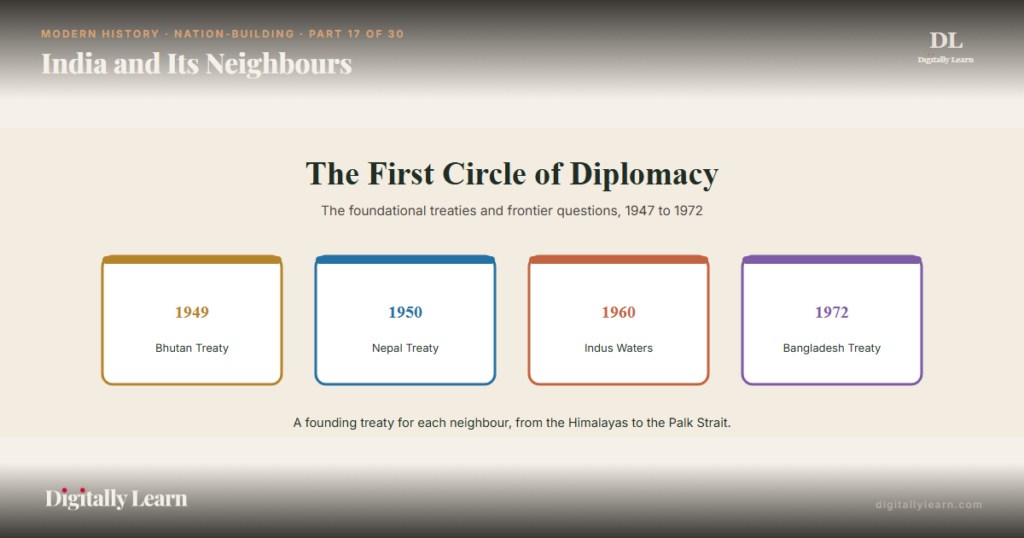
The treaties were the answer to the dilemma. Each founding compact tried to fix the terms of an unequal friendship in writing, and the table below gathers them. Where the treaty was narrow and mutual, as with the Indus waters, it endured; where it was broad and asymmetric, as with Nepal and Bhutan, it bred the very resentment it sought to prevent.
| Neighbour | Founding anchor | Year | The defining issue |
|---|---|---|---|
| Bhutan | Treaty of Friendship | 1949 | Guided external relations; the northern buffer |
| Nepal | Treaty of Peace and Friendship | 1950 | An open border and a special relationship |
| China | Panchsheel | 1954 | Friendship undone by the boundary dispute |
| Pakistan | Indus Waters Treaty | 1960 | Cooperation over water amid conflict over Kashmir |
| Sri Lanka | Sirimavo-Shastri Pact | 1964 | Persons of Indian origin across the Palk Strait |
| Bangladesh | Treaty of Friendship | 1972 | A warm start after the 1971 liberation |
Significance: Why the Neighbourhood Remains India's First Circle
From the Founding Treaties to Today's Strategic Frontier
The larger significance of these early relationships is that they laid the permanent grammar of India's regional policy. The treaties of 1949 to 1972 still frame the relations they founded, the durable ones holding and the asymmetric ones straining, and the dilemmas of the large neighbour, how to be both leader and reassurer, remain exactly as the Nehru era found them.
Contemporary linkages keep the neighbourhood at the centre of policy. The Indus Waters Treaty, the open border with Nepal, the Tibet question and the contested northern line are all live issues today, and the principle the era established, that a great power's first responsibility is its own region, underlies every present-day formula for the neighbourhood. The next part turns from the relationships to their hardest expression, the wars and the bomb.
- India’s neighbourhood was the first and hardest test of its non-aligned foreign policy.
- The Indus Waters Treaty of 1960 endured because it was narrow, mutual and well-designed.
- Friendship with China under Panchsheel collapsed over the Aksai Chin and eastern-sector dispute.
- Founding treaties with Nepal, Bhutan, Sri Lanka and Bangladesh framed the rest of the ring.
- The asymmetry between India and its neighbours is the permanent fact of its regional policy.
Prelims MCQ practice
Each question below tests one specific concept on the topic. Click to reveal the answer and a full option-wise explanation.
Q1. The India-Pakistan Indus Waters Treaty of 1960 was brokered by which of the following?
- The United Nations
- The World Bank
- The Non-Aligned Movement
- The Commonwealth
Show answer and explanation
Answer: The World Bank
Explanation.
Option (b) is correct. The long dispute over the sharing of the Indus river waters was resolved through the mediation of the World Bank, and the Indus Waters Treaty was signed by Nehru and General Ayub Khan in 1960. Hence option (b).
Q2. Consider the following statements about the early India-China relationship:
- India was among the first countries to recognise the communist government of China after 1949.
- China annexed Tibet in 1950, removing a buffer between the two countries.
- The Dalai Lama was granted asylum in India in 1959.
Which of the statements given above are correct?
- 1 and 2 only
- 2 and 3 only
- 1 and 3 only
- 1, 2 and 3
Show answer and explanation
Answer: 1, 2 and 3
Explanation.
All three statements are correct. India recognised communist China early, China annexed Tibet in 1950, and the Dalai Lama was granted asylum in India in 1959. Hence option (d).
Q3. The Sirimavo-Shastri Pact of 1964 between India and Ceylon dealt primarily with which of the following?
- The sharing of the waters of the Kelani river
- The status of persons of Indian origin in Ceylon
- The maritime boundary in the Palk Strait
- Fishing rights in the Gulf of Mannar
Show answer and explanation
Answer: The status of persons of Indian origin in Ceylon
Explanation.
Option (b) is correct. The Sirimavo-Shastri Pact of 1964 was an agreement on persons of Indian origin in Ceylon, providing for citizenship and repatriation. Hence option (b).
Q4. Consider the following pairs of a neighbour and its founding treaty or pact with India:
- Nepal: Treaty of Peace and Friendship, 1950
- Bhutan: Treaty of Friendship, 1949
- Bangladesh: Treaty of Friendship, Cooperation and Peace, 1972
Which of the pairs given above are correctly matched?
- 1 and 2 only
- 2 and 3 only
- 1 and 3 only
- 1, 2 and 3
Show answer and explanation
Answer: 1, 2 and 3
Explanation.
All three pairs are correct: the India-Nepal Treaty of Peace and Friendship was signed in 1950, the India-Bhutan Treaty of Friendship in 1949, and the India-Bangladesh Treaty of Friendship, Cooperation and Peace in 1972. Hence option (d).
Q5. Under the Treaty of Friendship of 1949, Bhutan agreed to which of the following?
- Merge with the Indian Union
- Be guided by India's advice in its external relations
- Cede the Chumbi valley to India
- Maintain a joint army with India
Show answer and explanation
Answer: Be guided by India's advice in its external relations
Explanation.
Option (b) is correct. Under the 1949 treaty India undertook not to interfere in Bhutan's internal administration, while Bhutan agreed to be guided by India's advice in the conduct of its external relations. Hence option (b).
Q6. Consider the following statements about the early India-Pakistan relationship:
- The dispute over Kashmir began in 1947 and was referred to the United Nations.
- The two governments cooperated to restore women abducted during Partition.
- The Indus Waters Treaty has broken down in every subsequent conflict.
Which of the statements given above is/are correct?
- 1 and 2 only
- 2 and 3 only
- 1 and 3 only
- 1, 2 and 3
Show answer and explanation
Answer: 1 and 2 only
Explanation.
Statements 1 and 2 are correct: the Kashmir dispute began in 1947 and went to the United Nations, and the two governments cooperated over abducted women. Statement 3 is wrong, because the Indus Waters Treaty has in fact held through every later conflict. Hence option (a).
Sources and Further Reading
- NCERT, Politics in India since Independence (Class 12), India's External Relations
- Wikipedia: India-Pakistan Indus Waters Treaty
- Wikipedia: 1950 Indo-Nepal Treaty of Peace and Friendship
- Wikipedia: Indo-Bangla Treaty of Friendship, Cooperation and Peace
- Wikipedia: Sirima-Shastri Pact
- Ministry of External Affairs, Government of India
- United Nations: Peacemaking and the UN
- Press Information Bureau, Government of India
- National Portal of India
Editorial Disclaimer
This article is prepared for UPSC examination preparation. Verify key facts and interpretations against standard reference histories before relying on them.