


Overview
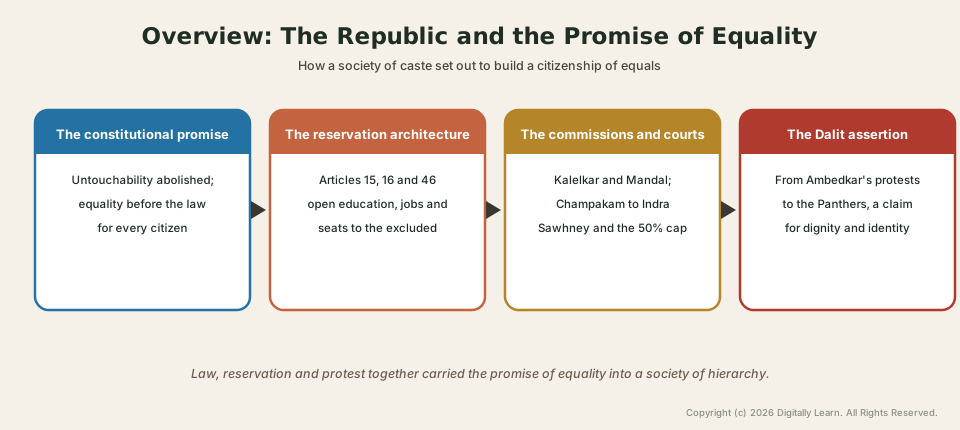
Social justice in independent India means the deliberate effort to dismantle the inequalities of caste and to carry the constitutional promise of equality into a society long ordered by hierarchy. It runs along three lines: the abolition of untouchability and the guarantee of equality before the law, the system of reservation that opened education, public employment and legislatures to the Scheduled Castes, Scheduled Tribes and backward classes, and the long political and social movement, led above all by B. R. Ambedkar, that turned the demand for dignity into a force in national life. This part follows that effort from the Poona Pact of 1932 to the Mandal verdict of 1992.
Social Justice: The Republic's Quarrel with Caste
Why a Society of Hierarchy Set Out to Build a Citizenship of Equals
Why this matters: Independent India inherited a social order in which caste fixed a person's worth, work and worship at birth, and the framers resolved that the new republic would not rest on that order. The pursuit of social justice was the long, contested labour of turning a constitution of equals into a lived reality, and it shaped the politics of the decades that followed as deeply as any war or plan.
What is the significance of social justice: It was the test of whether political freedom could become social freedom. The vote was won in 1947, but the dignity that Ambedkar demanded, the right to a temple, a well, a school and a public post, had still to be secured against the weight of centuries; this part traces how law, reservation and protest were brought to bear on that task.
From the Communal Award to the Poona Pact: The Politics of Representation
How 1932 Settled the Question of How the Depressed Classes Would Vote
Distinguishing the founding bargain: The architecture of reservation has its origin not in 1950 but in 1932. In August 1932 the British Prime Minister Ramsay MacDonald announced the Communal Award, which granted separate electorates to the depressed classes, allowing them to elect their own representatives from reserved constituencies in which only they could vote. Ambedkar, who had pressed this demand at the Round Table Conferences, welcomed it as a shield for a community that the wider Hindu electorate might otherwise ignore.
The award split the national movement. Gandhi held that separate electorates would cut the depressed classes off from Hindu society and harden the very division reform should heal, and he began a fast unto death in Yerwada jail in September 1932 against the measure. The crisis was resolved by the Poona Pact of 24 September 1932, an agreement between Gandhi and Ambedkar under which the separate electorates were given up in favour of a single, joint electorate, but with a far larger number of seats reserved for the depressed classes within it.
Observable outcome: The Poona Pact raised the reserved seats in the provincial legislatures from the seventy-one of the Communal Award to one hundred and forty-eight, and provided for representation in the central legislature as well, the depressed classes voting alongside other Hindus rather than apart from them. The settlement set the template that the Constitution would later adopt: not separate electorates, but reserved seats inside a common roll, a model of inclusion rather than separation that endures in the reserved constituencies of today.
The Abolition of Untouchability and the Right to Equality
How the Constitution Outlawed the Deepest Inequality of Caste
Distinguishing the constitutional break: The framers treated untouchability not as a social evil to be discouraged but as a practice to be abolished. Article 17 of the Constitution declares untouchability abolished and forbids its practice in any form, and makes the enforcement of any disability arising out of it an offence punishable by law. It is one of the few fundamental rights that binds not only the state but private persons, a measure of how grave the framers judged the wrong to be.
The guarantee was given teeth by statute. Parliament passed the Untouchability (Offences) Act of 1955, later strengthened and renamed the Protection of Civil Rights Act, to punish the denial of temples, wells, shops and public services on grounds of untouchability. The right against untouchability sits within the wider right to equality, the bar on discrimination in Article 15 and the equality before the law of Article 14, so that the excluded could claim not charity but a legal entitlement to equal treatment.
Observable outcome: Untouchability passed, in law, from custom to crime. The change did not end caste prejudice, which persisted in village and workplace, but it removed its legal sanction and gave the Scheduled Castes a constitutional ground on which to stand. The reform completed in law what generations of reformers, from Jyotirao Phule to Ambedkar, had demanded: that no Indian could be held impure or untouchable by reason of birth.
The Reservation Architecture: Articles 15, 16 and 46
How Compensatory Discrimination Was Built into the Constitution
Distinguishing the design of reservation: The Constitution does more than forbid discrimination; it permits, and indeed directs, the state to discriminate in favour of the disadvantaged. Article 15 bars discrimination on grounds of caste, yet Article 15(4) allows the state to make special provision for the advancement of socially and educationally backward classes and of the Scheduled Castes and Tribes. Article 16 guarantees equality of opportunity in public employment, yet Article 16(4) permits the reservation of posts for backward classes inadequately represented in the services.
The guarantees rest on a directive and a machinery. Article 46, a directive principle, charges the state to promote with special care the educational and economic interests of the weaker sections, and the Scheduled Castes and Tribes in particular, and to protect them from injustice. Article 335 requires that the claims of the Scheduled Castes and Tribes in appointments be considered consistently with administrative efficiency, while the lists of Scheduled Castes and Scheduled Tribes drawn under Articles 341 and 342 fix who the protections reach. The figure below sets out this architecture.
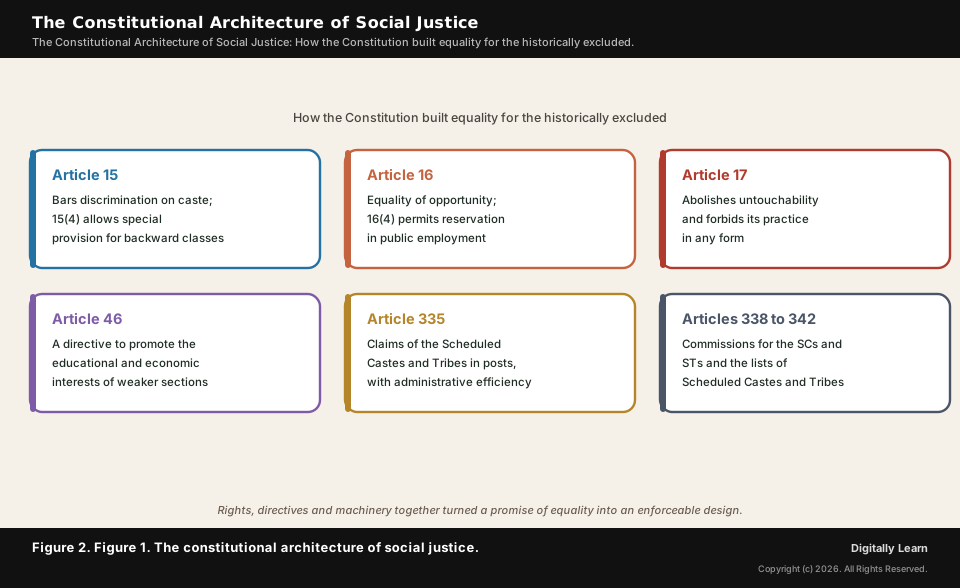
Observable outcome: Together these provisions created what the courts have called compensatory or protective discrimination, reserving a share of seats in legislatures, places in education and posts in the public services for the groups that caste had excluded. The principle was that formal equality alone could not undo centuries of disadvantage, and that the state must act, for a time, to level a field that birth had tilted. How far that action has reached its intended beneficiaries remains a live and unsettled question, and one of the central debates of social policy.
Safeguarding the Vulnerable: The Atrocities Law and the Welfare Machinery
How the State Moved from Guarantee to Active Protection
Distinguishing protection from provision: Reservation opened doors, but the Scheduled Castes and Tribes remained exposed to violence and humiliation that the ordinary criminal law was slow to reach. Parliament therefore enacted the Scheduled Castes and the Scheduled Tribes (Prevention of Atrocities) Act of 1989, which defines a set of offences specific to caste, from social and economic boycott to public humiliation and worse, and provides for special courts and stiffer punishment. It marked a shift from passive guarantee to active protection of the most vulnerable.
The Constitution also built a standing machinery. The National Commission for the Scheduled Castes and the National Commission for the Scheduled Tribes, established under Articles 338 and 338A, investigate complaints, monitor safeguards and advise on policy, while reserved constituencies in the legislatures and a wide range of welfare and scholarship schemes carry the protection into education and livelihood. The framework treats social justice not as a single act but as a permanent function of the state.
Observable outcome: A dense structure of law, commission and scheme now surrounds the guarantee of equality, so that a member of the Scheduled Castes can in principle claim not only a reserved place but protection from the violence and exclusion that reservation alone cannot prevent. The gap between this framework and the daily reality of caste remains wide, which is why the machinery is continually tested and reformed.
The Backward Classes Commissions: Kalelkar and Mandal
How the Question of the Other Backward Classes Was Posed and Postponed
Distinguishing the harder question: The Scheduled Castes and Tribes were named in the Constitution, but the wider category of socially and educationally backward classes, the Other Backward Classes, was left to be defined. Article 340 empowered the President to appoint a commission to investigate their condition, and in 1953 the first Backward Classes Commission was set up under Kaka Kalelkar. Its report of 1955 named thousands of backward castes and urged reservation for them, but the government, doubting caste as the test of backwardness, shelved it, and the question lay dormant for a generation.
The question returned with the Mandal Commission. In 1979 the government appointed the second Backward Classes Commission under B. P. Mandal, and its report of 1980 recommended that twenty-seven per cent of posts in the central government and public undertakings be reserved for the Other Backward Classes, identified largely by caste. The recommendation, which would extend reservation far beyond the Scheduled Castes and Tribes to a vast swathe of Indian society, was itself left unimplemented for a decade, too explosive for any government to act upon. The figure below traces this arc.
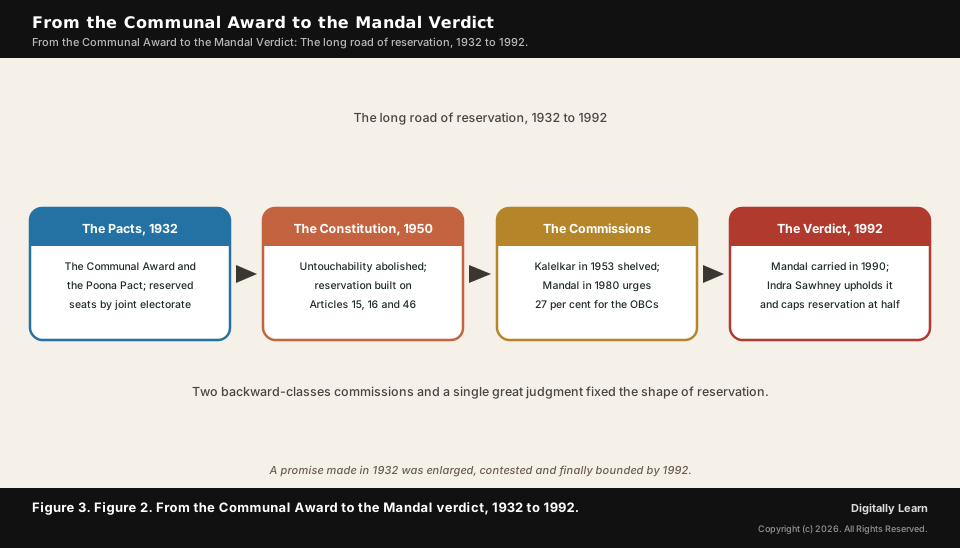
Observable outcome: Two commissions, a quarter-century apart, had now established the case for reserving a share of the state's offices for the backward classes. The Kalelkar report had raised the question and been set aside; the Mandal report had answered it with a figure, twenty-seven per cent, that would dominate the politics of the 1990s once a government finally chose to act.
The Mandal Moment, 1990: Reservation and Its Reckoning
How the Implementation of Mandal Transformed Indian Politics
Distinguishing the decisive turn: In August 1990 the National Front government of V. P. Singh announced that it would implement the Mandal report, reserving twenty-seven per cent of central government posts for the Other Backward Classes. The decision brought the long-postponed question into the open and changed the shape of Indian politics, mobilising the backward classes as a political bloc and giving caste a new and central place in electoral life.
Observable consequences were immediate and fierce. The announcement set off an intense anti-reservation agitation, led largely by students of the forward castes who feared the narrowing of opportunity, and the protests, some of them tragic, convulsed northern India for months. Caste, which the founders had hoped to dissolve, instead became more openly the language of politics, and the parties realigned around the new arithmetic of backward, forward and Dalit.
Observable outcome: The Mandal moment fixed reservation for the Other Backward Classes as a permanent feature of the Indian state and remade its party system around questions of social justice. It is from this contest that a central question of Indian social policy arises: why, despite comprehensive policies for equity, the full benefits of affirmative action still elude the underprivileged; the answer lies partly in the contests, legal and political, that the Mandal decision unleashed.
The Dalit Movement: From Ambedkar to the Panthers
How the Demand for Dignity Became a Force in National Life
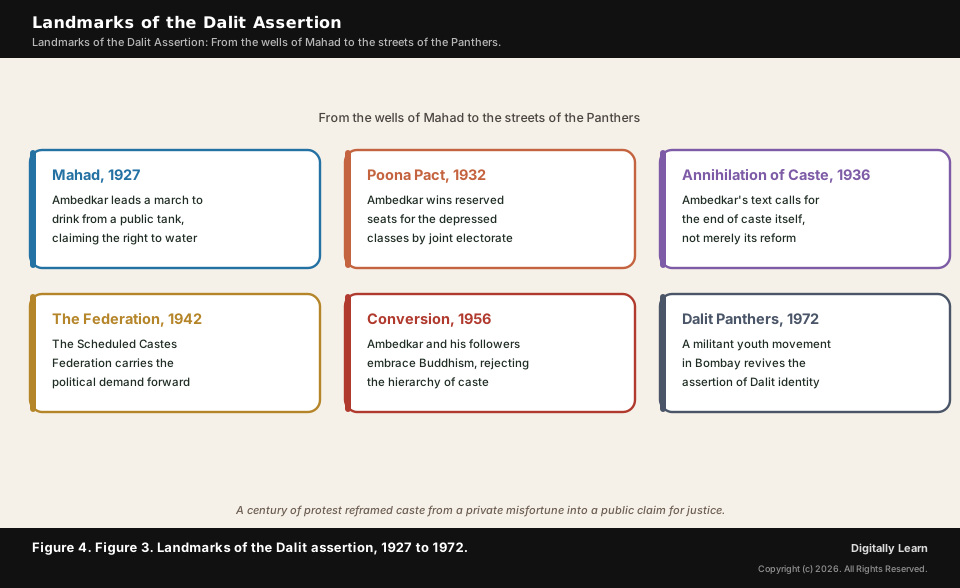
Distinguishing assertion from provision: Reservation and law were granted from above; the Dalit movement was the claim pressed from below. Its towering figure was B. R. Ambedkar, who as early as 1927 led the Mahad Satyagraha to assert the right of the depressed classes to drink from a public tank, and who in 1936 wrote Annihilation of Caste, a text that called not for the reform of caste but for its abolition, holding that the system could not be mended, only ended.
Ambedkar carried the demand into politics and faith. He built the Scheduled Castes Federation in 1942 to press the political claim, shaped the safeguards written into the Constitution he helped draft, and in 1956, despairing of equality within Hinduism, led hundreds of thousands of followers in conversion to Buddhism, a rejection of the caste order at its root. His life fused the scholar, the statesman and the rebel, and made the dignity of the excluded a national question.
Observable outcome: The assertion did not end with Ambedkar. In 1972 a militant youth movement, the Dalit Panthers, arose in Bombay, drawing on his thought and on the example of protest abroad, and a powerful Dalit literature gave the experience of caste a voice in the wider culture. The figure below gathers these landmarks. The enduring question, whether the contemporary assertion of Dalit identity works towards the annihilation of caste, reaches back directly to Ambedkar's demand that caste be not softened but destroyed.
From Champakam to Indra Sawhney: The Courts and the Limits of Reservation
How the Judiciary Drew the Boundaries of Compensatory Discrimination
Distinguishing the judicial frame: Reservation has been shaped as much in the courtroom as in Parliament. The first great case came in 1951, when in State of Madras v. Champakam Dorairajan the Supreme Court struck down a caste-based reservation of seats in education as a violation of the right against discrimination, since Article 15 then carried no saving clause. The government responded at once with the First Amendment of 1951, inserting Article 15(4) to authorise special provision for backward classes, the first of many amendments by which Parliament answered the courts.
The boundaries were finally drawn in 1992. In Indra Sawhney v. Union of India, the Mandal case, the Supreme Court upheld the twenty-seven per cent reservation for the Other Backward Classes, but hedged it with limits that still govern the field: total reservation should not ordinarily exceed fifty per cent; the advanced among the backward, the so-called creamy layer, should be excluded; and reservation could rest on social and educational backwardness, not on economic criteria alone. The judgment became the settled framework within which all later reservation has been tested.
| Commission or case | Year | What it did |
|---|---|---|
| State of Madras v. Champakam Dorairajan | 1951 | Struck down caste reservation in education; prompted the First Amendment and Article 15(4) |
| Kalelkar (First Backward Classes Commission) | 1953 | Named the backward classes but its report was shelved |
| Mandal (Second Backward Classes Commission) | 1980 | Recommended 27 per cent reservation for the Other Backward Classes |
| Implementation of Mandal | 1990 | The V. P. Singh government carried the 27 per cent reservation |
| Indra Sawhney v. Union of India | 1992 | Upheld 27 per cent; capped reservation near 50 per cent; excluded the creamy layer |
Observable outcome: The judiciary thus accepted reservation as a legitimate instrument of equality but bounded it, fixing the fifty per cent ceiling and the creamy-layer exclusion that frame every later debate, including the more recent provision of a reservation for the economically weaker sections. The courts confirmed, in the end, that compensatory discrimination was constitutional, provided it remained a measure of social justice and did not swallow the equality it was meant to serve.
Significance: Social Justice and the Unfinished Promise of the Republic
How the Pursuit of Equality Reshaped Indian Democracy
The larger significance of this effort is that it made social justice a defining purpose of the Indian state, not a charity but a constitutional obligation. From the Poona Pact to the Mandal verdict, the republic enlarged the circle of those it counted as equal citizens, and in doing so it deepened its democracy, drawing the once-excluded into legislatures, services and public life and giving them, through reservation and law, a stake in the order that governs them.
Contemporary linkages keep the question at the centre of politics. The fifty per cent ceiling and the creamy layer of Indra Sawhney, the demands of new groups for inclusion in the backward lists, the place of the private sector and of the economically weaker sections, and the persistence of caste violence despite the law are all live matters, debated in Parliament and the courts today.
The deeper lesson of the era is that formal equality is not the same as real equality, and that a society of hierarchy must act, and keep acting, if the promise of equal citizenship is to be kept. The next part turns from caste to the other great fields of social reform after 1947, the position of women and the building of education and health.
- The Communal Award of 1932 gave separate electorates to the depressed classes; the Poona Pact replaced them with reserved seats in a joint electorate.
- Article 17 abolished untouchability and the Protection of Civil Rights Act gave it force.
- Reservation rests on Articles 15(4), 16(4) and 46, with the Scheduled Castes and Tribes named under Articles 341 and 342.
- The Kalelkar report of 1955 was shelved; the Mandal report of 1980 recommended 27 per cent reservation for the Other Backward Classes.
- The Mandal moment of 1990 implemented that reservation, and Indra Sawhney in 1992 upheld it while capping reservation near fifty per cent.
Previous Year UPSC-CSE Questions
Previous Year UPSC-CSE Questions By the end you will be able to draft model answers for the following UPSC questions. Each question carries a collapsible framework showing how to approach it in the exam.
- UPSC Mains 2024 GS-IDespite comprehensive policies for equity and social justice, underprivileged sections are not yet getting the full benefits of affirmative action envisaged by the Constitution. Comment.
How to structure the answer in the exam
Introduction: Open with affirmative action as a constitutional mandate, not a concession, under Articles 15, 16 and 46.
Body (sub-themes to develop):
- The design: reservation under Articles 15(4) and 16(4), the directive of Article 46, and the protective machinery (Atrocities Act, commissions, reserved seats).
- The reach: the Scheduled Castes and Tribes named under Articles 341-342 and the Other Backward Classes after Mandal.
- The shortfalls: the fifty per cent ceiling and creamy-layer limits, elite capture within beneficiary groups, weak implementation and the gap between law and the violence of caste.
- The unfinished agenda: demands for sub-categorisation, private-sector inclusion and stronger delivery.
Conclusion: Conclude that the constitutional promise is sound but its delivery is uneven, so equity requires better implementation rather than a retreat from affirmative action.
- UPSC Mains 2015 GS-IDebate the issue of whether and how contemporary movements for assertion of Dalit identity work towards annihilation of caste.
How to structure the answer in the exam
Introduction: Open with Ambedkar's distinction between reforming caste and annihilating it.
Body (sub-themes to develop):
- The case for: identity assertion empowers the excluded, demands dignity, and exposes caste to public challenge, in Ambedkar's spirit.
- The case against: mobilising on caste identity may harden caste as a permanent political category rather than dissolving it.
- The middle ground: assertion as a necessary stage, raising consciousness before the longer task of dissolving caste.
- Evidence: the Dalit Panthers, Dalit literature, conversion movements and contemporary political mobilisation.
Conclusion: Conclude that assertion is a necessary instrument of dignity, but the annihilation of caste that Ambedkar sought requires that identity ultimately give way to equal citizenship.
- UPSC Prelims 1997 GS Paper IThe Poona Pact which was signed between the British Government and Mahatma Gandhi in 1932 provided for
How to approach this Prelims question
Approach: Recall what the Poona Pact changed about the Communal Award's separate electorates.
Trap to watch: The Communal Award gave separate electorates to the depressed classes; the Poona Pact replaced them with a joint electorate and reserved seats, so the answer is not separate electorates.
Key facts to recall:
- The Communal Award of 1932 granted separate electorates to the depressed classes
- Gandhi's fast led to the Poona Pact of 24 September 1932
- The Pact substituted a joint electorate with reserved seats, raised from 71 to 148
Answer signal: Joint electorate with reservation for the Harijans, so option (d).
Sources and Further Reading
- NCERT, Politics in India since Independence (Class 12)
- NCERT, Indian Constitution at Work (Class 11)
- Wikipedia: Poona Pact
- Wikipedia: Mandal Commission
- Wikipedia: Reservation in India (Indra Sawhney and the 50 per cent cap)
- National Commission for Scheduled Castes
- India Code: The Scheduled Castes and the Scheduled Tribes (Prevention of Atrocities) Act, 1989
- Press Information Bureau, Government of India
- National Portal of India
Editorial Disclaimer
This article is prepared for UPSC examination preparation. Verify key facts and interpretations against standard reference works before relying on them.