
Overview
Previous Year UPSC-CSE Questions By the end you will be able to draft model answers for the following UPSC questions. Each question carries a collapsible framework showing how to approach it in the exam.
- UPSC Mains 2016 GS-II“The Indian party system is passing through a phase of transition which looks to be full of contradictions and paradoxes.” Discuss.
How to structure the answer in the exam
Introduction: Open with the Congress system of one-party dominance as the original form of the party system.
Body (sub-themes to develop):
- The Congress system: a dominant party of consensus with internal factions.
- The paradox: dominance that still allowed a real opposition as parties of pressure.
- The contradiction: a single party absorbing diverse and competing interests.
- The transition: rising opposition and regional forces opening a competitive politics from 1967.
Conclusion: Conclude that the party system moved from a paradoxical one-party dominance towards a competitive, multi-party politics.
- UPSC Prelims 2007 GS Paper IWho was the Speaker of the First Lok Sabha?
How to approach this Prelims question
Approach: Recall the first Speaker of the Lok Sabha after the first general election.
Trap to watch: G. V. Mavalankar, not Hukam Singh (a later Speaker), was the first Speaker of the Lok Sabha.
Key facts to recall:
- The first general election was held in 1951-52
- It produced the First Lok Sabha
- G. V. Mavalankar was its first Speaker
Answer signal: G. V. Mavalankar, so option (b).
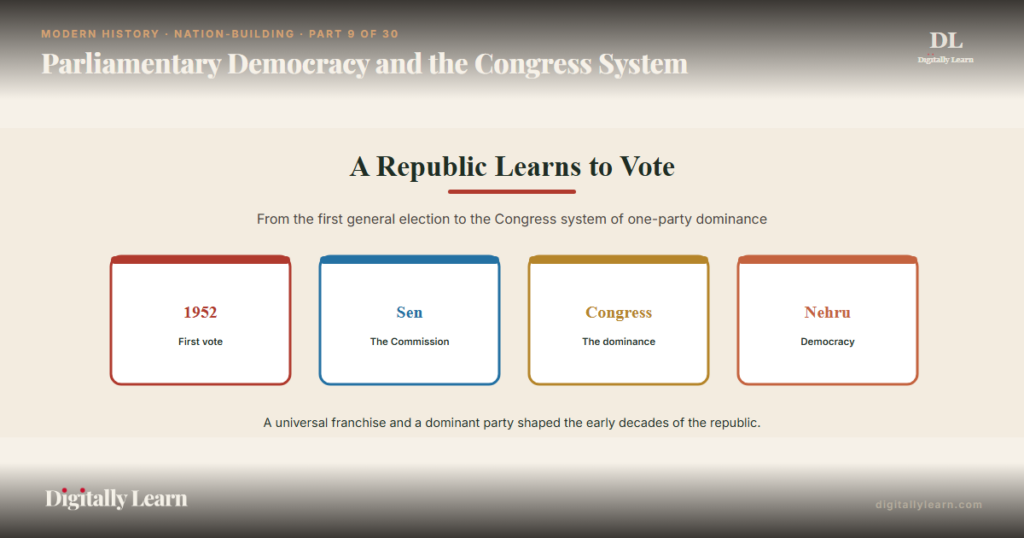
Parliamentary democracy and the Congress system describe how India became a working democracy in its first two decades. After 1947 the new republic chose a parliamentary form of government, held its first general election in 1951-52 on the basis of universal adult franchise, and built an independent Election Commission to run free and fair votes. Politics in these years was shaped by the dominance of the Congress, a pattern the political scientist Rajni Kothari called the Congress system, a single dominant party of consensus balanced by a real opposition. How that democracy struck root, and how its one-party dominance slowly gave way to a more competitive politics, is a central theme of nation-building.
Introduction: How a New Republic Became a Working Democracy
Why Parliamentary Democracy Took Root After 1947
Why this matters: when India became free in 1947, few expected a poor and largely non-literate country to sustain a full democracy. Yet within a few years it held a general election on universal adult franchise and built the institutions of a working parliamentary government, an achievement at the heart of nation-building.
What is the significance of parliamentary democracy: it settled how the new republic would be governed. The framers chose a parliamentary system in which the government is responsible to an elected legislature, and the early decades, shaped by the Congress system of one-party dominance, show how that democracy took root, as the sections below set out.
The First General Election of 1951-52: Democracy on an Unprecedented Scale
Universal Adult Franchise and the World's Largest Vote
What is the significance of the first general election: it was a leap of faith. Held in 1951-52, it gave the vote to every adult, with no bar of property, tax or literacy, making it the largest exercise of universal adult franchise the world had then seen, with about one hundred and seventy million voters.
Distinguishing the scale: the challenge was immense. Most voters could not read, so parties were given symbols and separate ballot boxes were used, and the polling was spread over months from late 1951 into early 1952. The Congress won a large majority in the first Lok Sabha, which chose G. V. Mavalankar as its first Speaker, as the figure below sets out.
Sukumar Sen and the Election Commission: Building the Machinery
How the Election Commission Ran a Free and Fair Vote
Distinguishing the machinery: a free vote needed an impartial referee. The Constitution created an independent Election Commission in 1950 to superintend and conduct elections, and its first Chief Election Commissioner, Sukumar Sen, organised the enormous first election almost from scratch.
Observable outcomes followed from this institution. Electoral rolls were drawn up for the whole adult population, polling staff and boxes were arranged across a vast country, and the result was widely accepted as free and fair. A strong and independent Election Commission became one of the lasting pillars of the democracy.
The Congress System: One-Party Dominance Explained
The Party of Consensus and the Parties of Pressure
What is the significance of the Congress system: it explains the paradox of those years. The Congress won most elections at the centre and in the states, yet it was not a closed one-party state, because it worked as a party of consensus that held many factions and views together within one broad tent.
Distinguishing consensus from pressure: the political scientist Rajni Kothari called this the Congress system. The opposition parties, the communists, socialists and others, acted as parties of pressure that shaped the Congress from outside and through its internal factions, so dominance went with real competition, as the figure below sets out.
The 1957 Kerala Verdict and the Strength of the Opposition
The First Elected Communist Government and Its Dismissal
Observable outcomes of a real opposition appeared early. In 1957, the state of Kerala elected the first communist government to come to power through the ballot anywhere in India, under E. M. S. Namboodiripad, showing that the dominance of the Congress could be challenged.
Distinguishing the turning point: in 1959 that Kerala government was dismissed under Article 356, a step later widely criticised as an early misuse of central power against an elected state government. The episode showed both the strength of the opposition and the strains in centre-state relations treated in the previous part.
Nehru's Leadership and the Making of Democratic Conventions
How Nehru Nurtured Parliament, Elections and Dissent
Distinguishing Nehru's conventions: leadership mattered as much as institutions. As Prime Minister from 1947 until his death in 1964, Jawaharlal Nehru treated Parliament with respect, answered its debates, accepted criticism and let a free press and a real opposition flourish, setting the conventions of a democratic political life.
What is the significance of his leadership: it gave the young democracy time to settle. By honouring elections, the courts and the rights of dissent, Nehru helped turn the formal rules of the Constitution into living habits, even as the dominance of the Congress slowly weakened on the road to 1967, as the figure and table below set out.
| The Congress system | What it meant | Why it mattered |
|---|---|---|
| Dominance | One party won most elections at the centre and in the states | Gave stable, single-party government in the early years |
| Consensus | Many factions and views were held within one party | Diverse interests were accommodated rather than excluded |
| Pressure | The opposition shaped policy from outside and within | Kept the system responsive and open, not closed |
| Change | Opposition and regional forces grew by the 1960s | Opened the road to a more competitive politics by 1967 |
Significance: The Roots of a Resilient Democracy
Why the Early Democratic Foundations Matter
Contemporary linkages run from these first decades into the present. The universal franchise, an independent Election Commission and the habit of competitive elections set in these years still anchor Indian democracy, and the slow decline of one-party dominance led directly to the party system and coalitions of later decades.
The larger significance is that India built a durable democracy out of unpromising conditions. The Congress system gave early stability, a real opposition kept it honest, and Nehru's conventions gave it depth. The points below gather the threads, and the next part turns to the party system, coalitions and electoral reform after 1967.
- India’s first general election of 1951-52 was held on universal adult franchise, the largest then in the world.
- An independent Election Commission under Sukumar Sen made the early elections free and fair.
- The Congress system was one-party dominance by a party of consensus, balanced by parties of pressure.
- The 1957 Kerala communist verdict showed a real opposition; its 1959 dismissal showed the strains of central power.
- Nehru’s respect for parliament, elections and dissent gave the young democracy durable conventions.
Prelims MCQ practice
Each question below tests one specific concept on the topic. Click to reveal the answer and a full option-wise explanation.
Q1. India's first general election, held on the basis of universal adult franchise, took place in:
- 1947
- 1951-52
- 1957
- 1962
Show answer and explanation
Answer: 1951-52
Explanation.
Option (b) is correct. India's first general election was held in 1951-52 on universal adult franchise. Hence option (b).
Q2. Who served as the first Chief Election Commissioner of India and conducted the first general election?
- B. R. Ambedkar
- Sukumar Sen
- G. V. Mavalankar
- Rajni Kothari
Show answer and explanation
Answer: Sukumar Sen
Explanation.
Option (b) is correct. Sukumar Sen was the first Chief Election Commissioner and organised the first general election. Hence option (b).
Q3. The concept of the 'Congress system' to describe one-party dominance in India was developed by which political scientist?
- Rajni Kothari
- Granville Austin
- Paul Brass
- W. H. Morris-Jones
Show answer and explanation
Answer: Rajni Kothari
Explanation.
Option (a) is correct. Rajni Kothari described one-party dominance in India as the 'Congress system'. Hence option (a).
Q4. Consider the following statements about India's first general election:
- It was held in 1951-52 on the basis of universal adult franchise.
- Sukumar Sen was the Chief Election Commissioner who conducted it.
Which of the statements given above is/are correct?
- 1 only
- 2 only
- Both 1 and 2
- Neither 1 nor 2
Show answer and explanation
Answer: Both 1 and 2
Explanation.
Both statements are correct. The first general election of 1951-52 was held on universal adult franchise and was conducted by the first Chief Election Commissioner, Sukumar Sen. Hence option (c).
Q5. In 1957, the first elected communist government in India came to power in which state?
- West Bengal
- Kerala
- Tripura
- Andhra Pradesh
Show answer and explanation
Answer: Kerala
Explanation.
Option (b) is correct. In 1957, Kerala elected the first communist government to come to power through the ballot in India, under E. M. S. Namboodiripad. Hence option (b).
Q6. Consider the following features of the 'Congress system' as described by Rajni Kothari:
- The Congress functioned as a dominant party of consensus.
- Opposition groups worked as parties of pressure from outside and within the Congress.
- No opposition party was legally permitted to exist.
Which of the features given above are correct?
- 1 and 2 only
- 2 and 3 only
- 1 and 3 only
- 1, 2 and 3
Show answer and explanation
Answer: 1 and 2 only
Explanation.
Statements 1 and 2 are correct. The Congress was a dominant party of consensus and the opposition acted as parties of pressure; opposition parties were fully legal and contested elections, so statement 3 is wrong. Hence option (a).
Sources and Further Reading
- NCERT, Politics in India Since Independence (Class 12), Era of One-Party Dominance
- Wikipedia: 1951-52 Indian general election
- Wikipedia: Sukumar Sen (civil servant)
- Election Commission of India
- Wikipedia: G. V. Mavalankar
- National Portal of India
- Press Information Bureau, Government of India
- National Archives of India
Editorial Disclaimer
This article is prepared for UPSC examination preparation. Verify key facts and interpretations against standard reference histories before relying on them.