


Overview
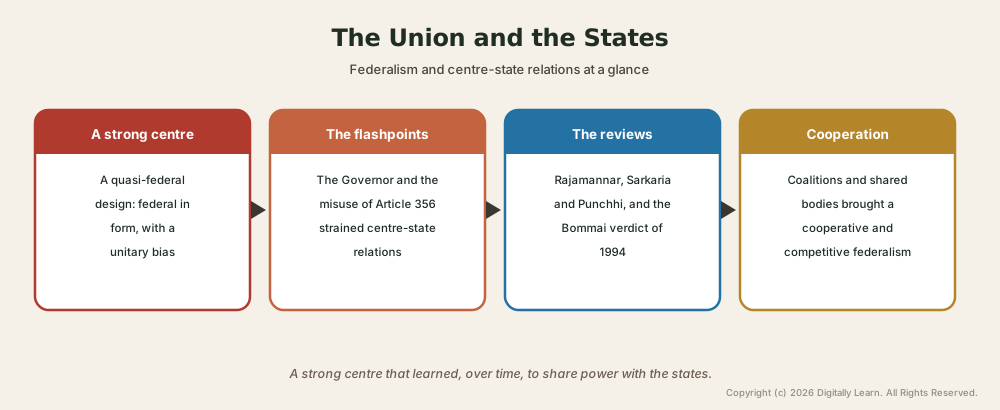
Federalism and centre-state relations describe how power is shared between the union and the states in India. The Constitution made India quasi-federal, federal in form but with a strong, unitary-leaning centre, through devices such as the all-India services, the office of the Governor and Article 356. Over the decades these relations evolved from a commanding centre under one-party dominance, through strain and the misuse of emergency powers, to a bargaining federalism of coalitions and a more cooperative federalism built on shared bodies and the goods and services tax. The story of that balance is central to how a diverse nation governs itself.
Introduction: How a Diverse Union Shares Power
Why Centre-State Relations Are Central to Nation-Building
Why this matters: a country as vast and diverse as India could be held together only by sharing power between a centre and the states. How that power was divided, and how the balance shifted over time, is one of the central themes of nation-building and a constant question in Indian politics.
What is the significance of federalism: it settled how unity and diversity would live together. The framers built a federal union with a strong centre to guard against fragmentation, and the long evolution of centre-state relations since then shows the union learning to share power, as the sections below set out.
The Nature of Indian Federalism: Quasi-Federal by Design
Federal in Form, With a Unitary Bias
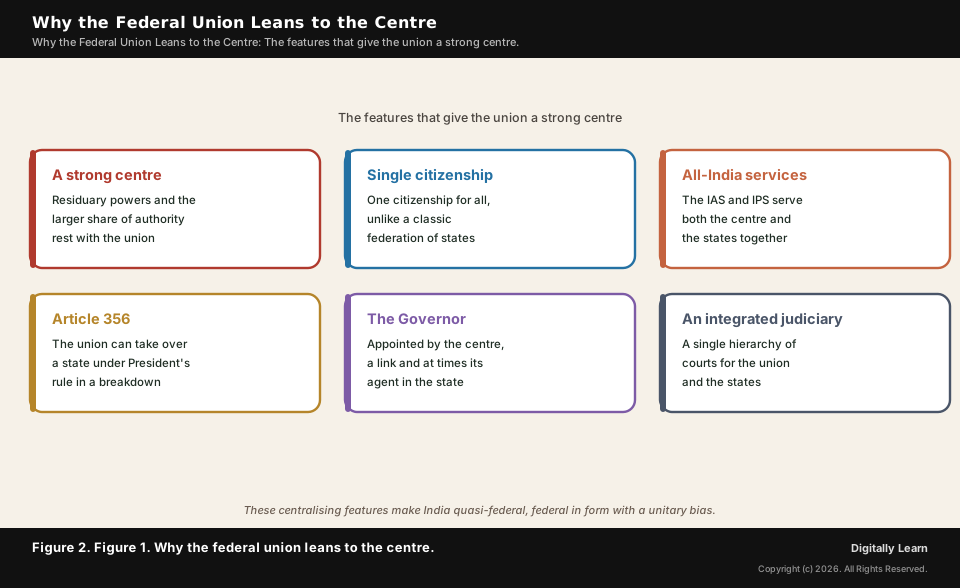
What is the significance of the quasi-federal design: it was deliberate. The Constitution gives India a federal structure of union and states, yet tilts power towards the centre through the larger share of subjects, residuary powers, the all-India services and a single citizenship, a model often called quasi-federal.
Distinguishing the reasons: this unitary bias was shaped by the trauma of Partition and the fear of break-up. The framers held that only a strong centre could hold a diverse country together, even though, as critics note, it leans against the idea of a fully strong federalism, as the features below set out.
The Governor and Article 356: The Flashpoints of Federalism
How the Governor and President's Rule Strained Relations
Observable outcomes of the strong centre appeared in two devices above all. The Governor, appointed by the centre, was meant to be a constitutional link, but came at times to be seen as an agent of the union in the state. Article 356, or President's rule, let the centre take over a state in a breakdown of constitutional machinery.
Distinguishing the misuse: from 1967, as opposition parties won states, Article 356 was used many times to dismiss state governments for political reasons, and the resulting tension made centre-state relations one of the most contested questions in Indian politics for decades.
From Rajamannar to Sarkaria: The Commissions on Centre-State Relations
The Bodies That Reviewed and Reshaped the Balance
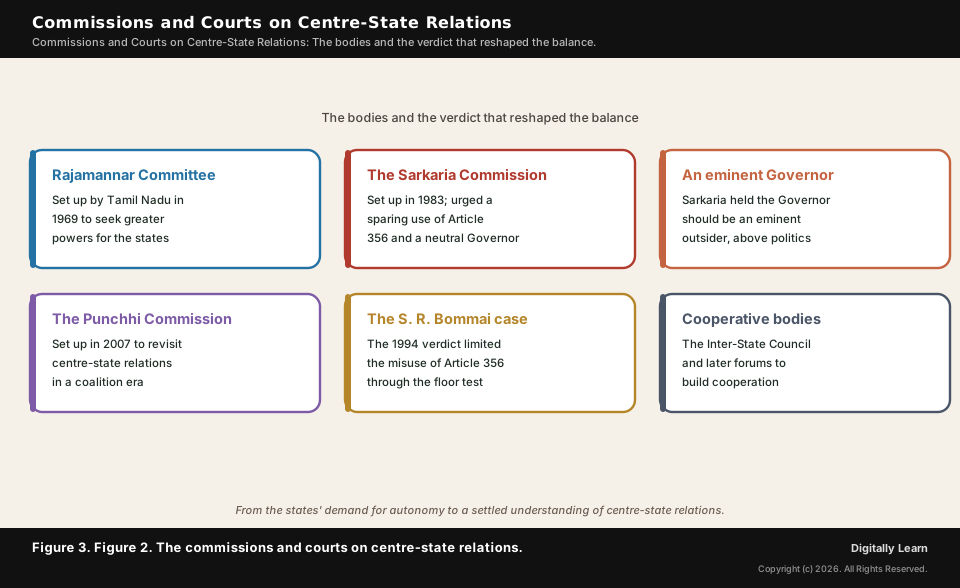
What is the significance of the commissions: they were the response to the strain. The Rajamannar Committee, set up by Tamil Nadu in 1969, sought greater powers for the states, and the Sarkaria Commission, set up in 1983, made a careful review of centre-state relations.
Distinguishing the Sarkaria recommendations: it urged a sparing use of Article 356 and held that the Governor should be an eminent person from outside the state, detached from recent politics. The later Punchhi Commission of 2007 revisited the subject in a coalition era, as the commissions below set out.
Regionalism, State Autonomy and the S. R. Bommai Verdict
The States Assert Themselves and the Courts Rebalance Federalism
Observable outcomes of the strain were the rise of regionalism and demands for state autonomy. Regional parties grew strong, states pressed for more powers and revenue, and the federal question became a live force in politics, especially as one-party dominance faded after 1967.
Distinguishing the turning point: the S. R. Bommai case of 1994 was decisive. The Supreme Court limited the misuse of Article 356, holding that a government's majority must be tested on the floor of the house rather than by the Governor's word, which rebalanced federalism in favour of the states.
Fiscal Federalism and the Turn to Cooperative Federalism
From a Commanding Centre to a Bargaining and Cooperative Federalism
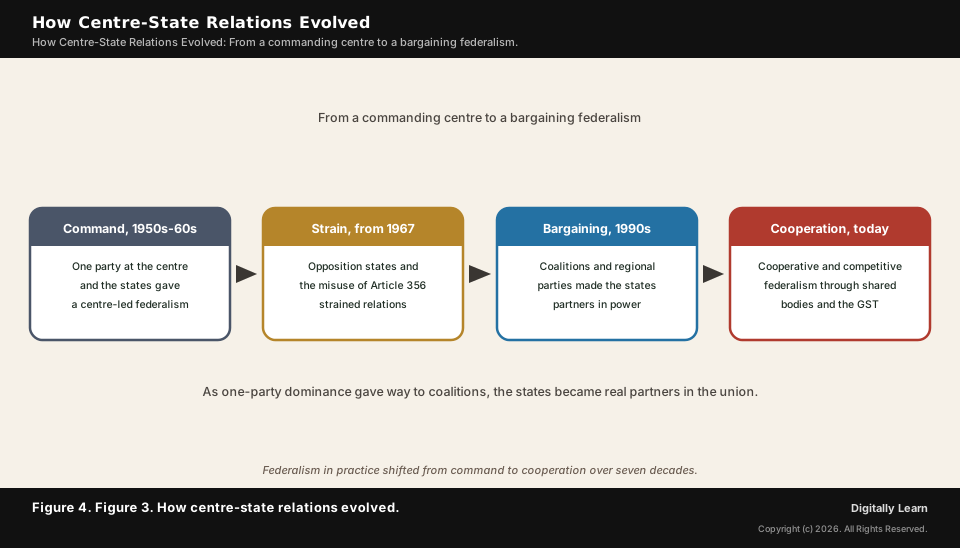
Distinguishing the evolution of the balance shows three phases. A commanding centre under one-party dominance gave way, after 1967, to strain and the misuse of Article 356, and then, in the coalition era of the 1990s, to a bargaining federalism in which regional parties became partners in power at the centre.
What is the significance of the cooperative turn: fiscal and institutional change deepened it. The replacement of the Planning Commission by NITI Aayog in 2015 and the goods and services tax with its shared GST Council from 2017 pointed towards a cooperative and competitive federalism, as the evolution and the timeline below set out.
| The federal balance | Centralising features | Federal features |
|---|---|---|
| Powers | Residuary powers with the centre; a larger union list | Division of powers between union and states |
| Administration | All-India services and the Governor | Elected state governments and assemblies |
| Emergencies | Article 356 and the union's emergency powers | The Bommai limits on the misuse of Article 356 |
| Finance | A centre-led Planning Commission, now NITI Aayog | Finance Commission transfers and the GST Council |
Significance: A Federalism That Learned to Share Power
Why the Evolving Balance Matters for the Union
Contemporary linkages run from this history into the present. The federal balance shapes every major question of Indian politics, from the working of coalition governments and the sharing of taxes to the autonomy of the states, and the long shift towards cooperation continues to be debated.
The larger significance is that Indian federalism, though it began with a strong centre, proved flexible enough to share power as the states grew stronger. That flexibility is a quiet achievement of nation-building. The points below gather the threads, and the next part turns to the working of parliamentary democracy and the Congress system.
- Indian federalism is quasi-federal, federal in form but with a strong, unitary-leaning centre.
- The Governor and Article 356 became the main flashpoints of centre-state relations.
- From 1967 the states asserted themselves, and the misuse of Article 356 strained relations.
- The Sarkaria Commission and the Bommai verdict of 1994 rebalanced federalism towards the states.
- Coalitions, NITI Aayog and the GST pointed towards a cooperative and competitive federalism.
Previous Year UPSC-CSE Questions
Previous Year UPSC-CSE Questions By the end you will be able to draft model answers for the following UPSC questions. Each question carries a collapsible framework showing how to approach it in the exam.
- UPSC Mains 2014 GS-IIThough the federal principle is dominant in our Constitution and that principle is one of its basic features, but it is equally true that federalism under the Indian Constitution leans in favour of a strong Centre, a feature that militates against the concept of strong federalism. Discuss.
How to structure the answer in the exam
Introduction: Open with federalism as a basic feature, but one with a clear unitary bias.
Body (sub-themes to develop):
- The federal features: division of powers, elected states, an integrated structure.
- The centralising features: residuary powers, all-India services, single citizenship.
- The Governor and Article 356 as instruments of central control.
- The later rebalancing through Sarkaria, Bommai and cooperative federalism.
Conclusion: Conclude that Indian federalism is dominant in principle but leans to a strong centre, softened over time.
- UPSC Prelims 2019 GS Paper IWhich one of the following suggested that the Governor should be an eminent person from outside the State and should be a detached figure without intense political links or should not have taken part in politics in the recent past?
How to approach this Prelims question
Approach: Recall which commission recommended a neutral, outsider Governor.
Trap to watch: It was the Sarkaria Commission (1983), not the Rajamannar Committee or the others, that recommended an eminent outsider Governor.
Key facts to recall:
- The Sarkaria Commission was set up in 1983
- It urged a sparing use of Article 356
- It held the Governor should be an eminent outsider, above politics
Answer signal: The Sarkaria Commission (1983), so option (c).
Sources and Further Reading
- NCERT, Indian Constitution at Work (Class 11), Federalism
- Wikipedia: Federalism in India
- Wikipedia: Sarkaria Commission
- Wikipedia: S. R. Bommai v. Union of India
- National Portal of India
- Press Information Bureau, Government of India
- National Archives of India
- Azadi Ka Amrit Mahotsav, Ministry of Culture
Editorial Disclaimer
This article is prepared for UPSC examination preparation. Verify key facts and interpretations against standard reference histories before relying on them.