
Overview
Previous Year UPSC-CSE Questions By the end you will be able to draft model answers for the following UPSC questions. Each question carries a collapsible framework showing how to approach it in the exam.
- UPSC Mains 2017 GS-IIIAccount for the failure of the manufacturing sector in achieving the goal of labour-intensive exports. Suggest measures for more labour intensive rather capital-intensive exports.
How to structure the answer in the exam
Introduction: Open with the paradox: a labour-abundant economy whose manufacturing grew capital-intensive under the control regime.
Body (sub-themes to develop):
- Strategy bias: the Nehru-Mahalanobis emphasis on capital goods over light manufacturing.
- Licensing and reservation: entry gates plus small-scale reservation capped the scale and quality of labour-intensive producers.
- Protection: import substitution removed export discipline; exports an afterthought until the mid-1980s.
- Factor-market rigidities raised the cost of running large labour-intensive plants.
- Measures: scale-friendly labour and land rules, logistics and infrastructure, export openness, skilling and product-quality upgrading.
Conclusion: Conclude that labour-intensive exports need the reversal of the old structure: scale, openness and competitiveness in place of permission and protection.
- UPSC Prelims 2002 GS Paper IWhich one of the following committees recommended the abolition of reservation of items for the small-scale sector in industry?
How to approach this Prelims question
Approach: Map each committee to its domain; only Abid Hussain dealt with small-scale industry policy.
Trap to watch: Narasimham and Nayak are banking-sector committees and Rakesh Mohan is associated with infrastructure; none touched SSI reservation.
Key facts to recall:
- Abid Hussain Committee recommended abolition of SSI reservation
- Karve Committee, 1955, had launched the small-industry development case
- Dereservation proceeded in phases from the late 1990s
Answer signal: Abid Hussain Committee, so option (a).
- UPSC Prelims 2011 GS Paper IWhy is the Government of India disinvesting its equity in the Central Public Sector Enterprises (CPSEs)?
- The Government intends to use the revenue earned from the disinvestment mainly to pay back the external debt.
- The Government no longer intends to retain the management control of the CPSEs.
Which of the statements given above is/are correct?
How to approach this Prelims question
Approach: Test each statement against the stated purpose of disinvestment receipts and the control policy.
Trap to watch: Both statements sound plausible; the National Investment Fund's social-sector earmarking kills statement 1, and minority-sale practice kills statement 2.
Key facts to recall:
- Disinvestment receipts went to the National Investment Fund from 2005
- NIF income was earmarked for social-sector schemes
- Most disinvestments were minority sales; management control stayed with the government
Answer signal: Neither statement is correct, so option (d).
The licence raj is the name India gave to its system of industrial controls: a regime in which the state built the biggest factories itself and gated every private factory behind licences, capacity limits and location rules. This part follows the system at work, the public sector undertakings and the great steel plants, the licensing machinery, the MRTP Act of 1969 and FERA of 1973, the protected small-scale sector, and the sluggish growth that critics tagged the Hindu rate, down to the unwinding through disinvestment and DIPAM.
Industry After Independence: The State Takes the Commanding Heights
From the Industrial Policy Resolutions to the Factory Floor
Why this matters: The previous parts set out the design, the mixed economy of the Industrial Policy Resolutions and the plans that funded it. This part watches the design at work on the factory floor: who actually built India's industry, how the licence system governed every private decision, and what the controls cost.
What is the significance of the licence raj: It is the institutional bridge between the socialist pattern of the 1950s and the reforms of 1991. Every later debate, on public sector efficiency, on disinvestment, on the ease of doing business, argues with this system, so its parts must be known precisely.
The story runs in three acts: the building act, in which the state raised the plants and towns of heavy industry; the gating act, in which licences, the MRTP Act and FERA wrapped the private economy in permissions; and the unwinding act, from the criticisms of the 1980s through disinvestment to DIPAM, each act treated in turn below.
Public Sector Undertakings: The Temples of Modern India at Work
Six Jobs the State Enterprises Were Built to Do
Distinguishing the public sector's brief: The state enterprises were never meant to be mere companies. They were to build the heavy and basic industries private capital would not attempt, anchor self-reliance by making at home what was imported, carry industry into backward regions, train a skilled workforce, and earn a surplus to fund further growth.
Observable outcomes were real: by 1990 Indian industry was far more diversified than the cotton-and-jute economy of 1950, and the industrial sector's share of national output roughly doubled across the first seven plans, a structural shift built largely on the public sector.
The plants also built towns. Around each great public works rose a planned township with housing, schools and hospitals, so the steel cities of the interior doubled as instruments of urbanisation, carrying modern employment into regions the colonial economy had bypassed. The enterprise was social as much as industrial, which is why Jawaharlal Nehru could call these projects the temples of modern India without irony.
The Great Steel Plants Compared: Bhilai, Rourkela, Durgapur and Bokaro
Four Plants, Three Foreign Partners and the SAIL Umbrella
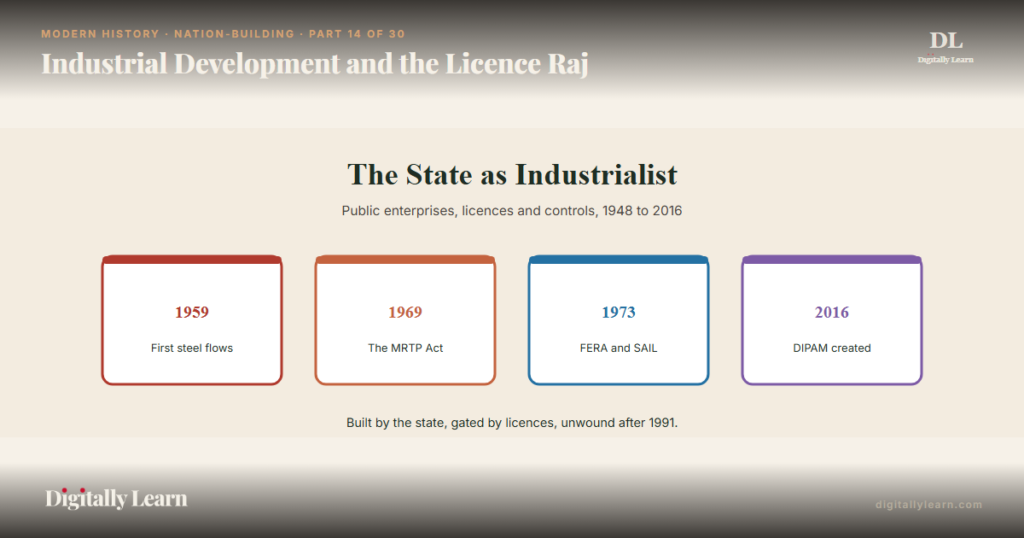
Distinguishing the steel programme: Steel was the signature public industry, and the Second Plan era raised three integrated plants almost together, each with a different foreign partner: Bhilai with Soviet collaboration, Rourkela with West German collaboration, and Durgapur with British assistance, the first two beginning production in 1959.
A fourth giant followed at Bokaro, set up with Soviet collaboration in the 1960s, and in 1973 the Steel Authority of India Limited was established as the holding umbrella for the public steel sector.
Private steel was older, the Tata works at Jamshedpur dating from the late colonial decades, but iron and steel stood in Schedule A of the 1956 resolution, so the new capacity of the plan era was public. The trio of partner countries is easily confused, and the table below fixes it.
| Plant | State today | Foreign partner | Note for the exam |
|---|---|---|---|
| Bhilai | Chhattisgarh | Soviet Union | Began production in 1959; the Soviet flagship |
| Rourkela | Odisha | West Germany | Among the first integrated public sector steel plants |
| Durgapur | West Bengal | United Kingdom | British-assisted; operations from the late 1950s |
| Bokaro | Jharkhand | Soviet Union | The later giant of the 1960s |
The Industrial Licensing System: How the Licence Raj Actually Worked
Permission to Start, Permission to Grow, and Steered Location
Distinguishing the machinery: No new industry could be started without a government licence, and an existing unit needed a fresh licence to expand output or to diversify into new products, so that production stayed within what planners judged the economy required. The instrument of control was the Industries (Development and Regulation) Act of 1951, introduced in the previous part.
The system soon earned its lasting nickname: the elder statesman C. Rajagopalachari attacked it as the permit-licence raj, and the label stuck to the whole control economy.
The system also steered geography: It was easier to obtain a licence for a unit in an economically backward area, and such units earned tax benefits and cheaper electricity, a deliberate use of licensing to promote regional equality. The intent was planning; the working reality added queues, delay and discretion, and the balance sheet section weighs both.
Queues, Discretion and the Political Economy of Permissions
Observable distortions followed the gates. Files moved slowly, so the queue itself became a cost of production; approval depended on official discretion, which invited lobbying and patronage; and well-connected business houses learned to corner licences for capacity they did not build, pre-empting rivals from entering at all.
Even the system's best intention, steering plants to backward areas, could be gamed on paper while real investment stayed near the ports and the metros. The lesson the era taught, that controls breed their own evasions, became a standing argument in Indian political economy and the opening case of the reformers after 1991.
MRTP Act 1969 and FERA 1973: Controlling Bigness and Foreign Exchange
The Two Control Laws and Their Post-1991 Successors
Distinguishing the second wave of controls: From the late 1960s the state tightened its grip. The Monopolies and Restrictive Trade Practices Act, which received assent in December 1969, was aimed at preventing the concentration of economic power and put the largest business houses under extra scrutiny and approval requirements.
The Foreign Exchange Regulation Act of 1973 imposed strict regulation on foreign exchange dealings and on foreign-owned companies operating in India; rather than comply with its ownership-dilution rules, well-known multinationals, Coca-Cola and IBM among them, wound up their Indian operations in the late 1970s.
Both laws outlived their usefulness and were replaced after liberalisation: the Competition Act of 2002 superseded MRTP, and FEMA, passed in 1999, replaced FERA with a management rather than regulation approach.
Small-Scale Industry: The Karve Committee, Reservation and Abid Hussain
Why Products Were Reserved for Small Units and Who Said Stop
Distinguishing the small-scale pillar: In 1955 the Village and Small-Scale Industries Committee, known as the Karve Committee, pressed the case for using small industry to promote rural development. Small units, defined by a ceiling on investment that was raised over the decades, were judged more labour-intensive than large firms, generating more employment per rupee.
Because small units could not compete with big factories, the state shielded them: the production of many products was reserved exclusively for the small-scale sector, with concessions on excise and bank credit. Four decades later the Abid Hussain Committee recommended doing away with this reservation, and dereservation proceeded in phases from the late 1990s.
- Karve Committee, 1955: Small industry as the route to rural development and employment.
- Reservation: Many products set aside for exclusive manufacture by small units.
- Concessions: Lower excise duty and cheaper bank loans for the small sector.
- Abid Hussain Committee: Recommended abolition of the reservation; phased dereservation followed.
Import Substitution: Tariffs, Quotas and the Inward-Looking Decades
Protection's Logic and Its Costs Across the First Seven Plans
Distinguishing the trade policy: Industrial policy worked arm in arm with an inward-looking trade strategy of import substitution: replace imports with domestic production behind a wall of tariffs (taxes on imports) and quotas (limits on import quantities). The infant-industry argument held that protected firms would learn to compete in time.
Observable consequences cut both ways. Protection allowed indigenous industries, from electronics to automobiles, to come up at all, yet it also removed the spur of competition, and serious thought was not given to promoting exports until the mid-1980s, leaving Indian industry comfortable at home and absent abroad.
The consumer paid the quiet bill. With imports walled out and domestic capacity licensed to plan, choice narrowed to a handful of makes, quality faced no challenger, and the waiting list became a fixture of middle-class life, the same queue logic that kept a household waiting years for a telephone connection from the state monopoly.
The Balance Sheet: Diversification, Inefficiency and the Hindu Rate of Growth
What the Control Economy Built and What It Cost in Growth
Observable achievements deserve their due: a diversified industrial base, public capability in steel, power, machines, atomic energy and space, and an industrial sector whose share of output roughly doubled between 1950-51 and 1990-91. The public sector created industry where none would otherwise have come.
The costs accumulated alongside. Loss-making units could almost never be closed, monopolised services kept consumers waiting, and firms whose products the private sector could easily supply, the bread-maker Modern Bread being the textbook case, stayed on the public books until the firm was finally sold to a private buyer.
The deeper criticism was conceptual: no distinction was drawn between what only the state can provide and what the private sector can also supply, so public capital spread thin across hotels and bread instead of concentrating where markets cannot deliver.
The growth verdict gave the era its label. Aggregate growth stayed sluggish and low by Asian standards from the 1950s through the 1980s, and the economist Raj Krishna coined the phrase the Hindu rate of growth in 1978 for this stubborn plateau. The phrase was a provocation, not a theology: it indicted the control economy, and it became the reformers' shorthand after 1991.
| Side of the ledger | The entries |
|---|---|
| Achievements | Diversified industrial base; heavy-industry and strategic capability; industry's output share roughly doubled; regional spread of plants and townships |
| Costs | Queues and discretion in licensing; loss-making units kept alive; monopolised services and waiting lists; weak export effort until the mid-1980s |
| The verdict | Sluggish aggregate growth, tagged the Hindu rate of growth by Raj Krishna in 1978, which fed the case for the 1991 reforms |
Why Indian Manufacturing Stayed Capital-Intensive in a Labour-Rich Economy
The Structural Bias Against Labour-Intensive Exports
Why this puzzle matters: A labour-rich country should have exported labour-intensive goods, yet Indian manufacturing leaned capital-intensive, and accounting for that failure is a standing analytical question. The answer lies in the structure this part has described.
- Strategy: The Nehru-Mahalanobis bet put capital goods and heavy industry, not light manufacturing, at the core of growth.
- Licensing: Entry and expansion gates discouraged the nimble, labour-hungry firms that export markets reward.
- Reservation: Keeping labour-intensive products with protected small units capped their scale, technology and export quality.
- Protection: Import substitution removed the pressure to compete abroad, so exports were an afterthought until the mid-1980s.
- Rigidities: Labour and land rules made large-scale, labour-intensive factories costly to run and to close.
The measures side follows from the causes: scale-friendly factor markets, infrastructure and logistics, openness that rewards exporters, and skilling, the threads the reform parts of this series pick up after 1991.
From Disinvestment to DIPAM: Unwinding the State's Industrial Estate
Minority Sales, the National Investment Fund and the 2016 Renaming
Contemporary linkages begin where the controls ended. After 1991 the state began selling minority equity in public enterprises, while keeping management control with the government in most cases. From 2005 the receipts were channelled into the National Investment Fund, whose income was earmarked for social-sector schemes, not for repaying external debt.
The machinery matured with the institutions: the Department of Disinvestment was renamed the Department of Investment and Public Asset Management, DIPAM, in 2016, signalling a shift from one-off sales to managing the state's whole investment portfolio.
Alongside the sales, the strongest enterprises were graded into the ratna categories that grant their boards greater operational autonomy, the carrot beside the disinvestment stick. In the later policy vocabulary the sales themselves split into minority disinvestment, which raises money while keeping control, and strategic sale, which transfers control itself. These two facts, the purpose of the receipts and the retention of management control, are the pair most often misremembered about disinvestment.
Significance: The Licence Raj as the Hinge of India's Economic Story
Why the Control Decades Still Frame Every Industrial Policy Debate
The larger significance of the licence raj is that it is the hinge on which India's economic narrative turns. The same state that built Bhilai and trained an industrial workforce also taught a generation of entrepreneurs that growth required permission, and both legacies are real.
Contemporary linkages keep the period current: every ease-of-doing-business ranking, every disinvestment target in the Union Budget, every debate on strategic sales and on what the state should own, argues with the licence raj.
The comparative lesson sharpens the verdict. Where the export-driven East Asian economies disciplined their protected firms with performance targets and world-market tests, India protected without discipline, so infant industries could stay infants indefinitely. The distinction between protection as a ladder and protection as a shelter is the analytical heart of the era, and the next part turns to the crisis that broke the system, the 1991 balance-of-payments emergency and the LPG reforms.
- The PSUs built heavy industry; Bhilai, Rourkela and Durgapur rose with Soviet, German and British partners, with SAIL the umbrella from 1973.
- Licensing gated entry, expansion and location; MRTP 1969 checked bigness and FERA 1973 policed foreign exchange.
- Karve 1955 made small industry a development tool; reservation shielded it until Abid Hussain recommended dereservation.
- Import substitution protected industry but dulled exports; growth plateaued at the Hindu rate, named by Raj Krishna in 1978.
- The unwinding ran from minority disinvestment through the National Investment Fund, 2005, to DIPAM, 2016.
Prelims MCQ practice
Each question below tests one specific concept on the topic. Click to reveal the answer and a full option-wise explanation.
Q1. Consider the following pairs of public sector steel plants and their foreign collaborators:
- Bhilai: Soviet Union
- Rourkela: West Germany
- Durgapur: United Kingdom
Which of the pairs given above are correctly matched?
- 1 and 2 only
- 2 and 3 only
- 1 and 3 only
- 1, 2 and 3
Show answer and explanation
Answer: 1, 2 and 3
Explanation.
All three pairs are correct. Bhilai was built with Soviet collaboration, Rourkela with West German collaboration and Durgapur with British assistance, the classic Second Plan era trio. Hence option (d).
Q2. In which year was the Steel Authority of India Limited (SAIL) established as the holding company for public sector steel?
- 1965
- 1973
- 1978
- 1991
Show answer and explanation
Answer: 1973
Explanation.
Option (b) is correct. SAIL was established in January 1973 as the umbrella for the public steel sector; 1978 saw its restructuring as an operating company. Hence option (b).
Q3. Consider the following statements about the control laws of the licence raj era:
- The MRTP Act of 1969 was aimed at preventing the concentration of economic power.
- FERA of 1973 imposed strict regulation on foreign exchange dealings.
- The MRTP Act was later replaced by FEMA, 1999.
Which of the statements given above is/are correct?
- 1 only
- 1 and 2 only
- 2 and 3 only
- 1, 2 and 3
Show answer and explanation
Answer: 1 and 2 only
Explanation.
Statements 1 and 2 are correct on the aims of MRTP 1969 and FERA 1973. Statement 3 crosses the successors: MRTP was replaced by the Competition Act, 2002, while FEMA, 1999 replaced FERA. Hence option (b).
Q4. The Karve Committee of 1955 is associated with which of the following?
- Reorganisation of states
- Village and small-scale industries
- Banking sector reform
- Agricultural price policy
Show answer and explanation
Answer: Village and small-scale industries
Explanation.
Option (b) is correct. The Village and Small-Scale Industries Committee of 1955, known as the Karve Committee, pressed the case for small industry as a tool of rural development. Hence option (b).
Q5. Consider the following statements about industrial licensing in the licence raj era:
- A licence was needed to start a new industrial unit.
- A licence was needed even to expand output or diversify production.
- Units set up in backward areas found it easier to obtain a licence and received concessions.
Which of the statements given above are correct?
- 1 and 2 only
- 2 and 3 only
- 1 and 3 only
- 1, 2 and 3
Show answer and explanation
Answer: 1, 2 and 3
Explanation.
All three statements are correct: licensing gated entry, expansion and diversification, and the system deliberately favoured backward-area locations with easier licences, tax benefits and cheaper electricity. Hence option (d).
Q6. Consider the following statements about the National Investment Fund (NIF):
- Disinvestment receipts were channelled into the NIF from 2005.
- The income of the NIF was earmarked for financing social-sector schemes.
Which of the statements given above is/are correct?
- 1 only
- 2 only
- Both 1 and 2
- Neither 1 nor 2
Show answer and explanation
Answer: Both 1 and 2
Explanation.
Both statements are correct. From 2005 the realisations from disinvestment were appropriated to the National Investment Fund, and the Fund's income was earmarked for selected social-sector schemes. Hence option (c).
Sources and Further Reading
- NCERT, Indian Economic Development (Class 11), Indian Economy 1950 to 1990
- Wikipedia: Licence Raj
- Wikipedia: Steel Authority of India Limited
- Wikipedia: Disinvestment in India
- Report of the Expert Committee on Small Enterprises (Abid Hussain Committee)
- Department of Investment and Public Asset Management (DIPAM)
- Press Information Bureau, Government of India
- National Portal of India
Editorial Disclaimer
This article is prepared for UPSC examination preparation. Verify key facts and interpretations against standard reference histories before relying on them.