


Overview
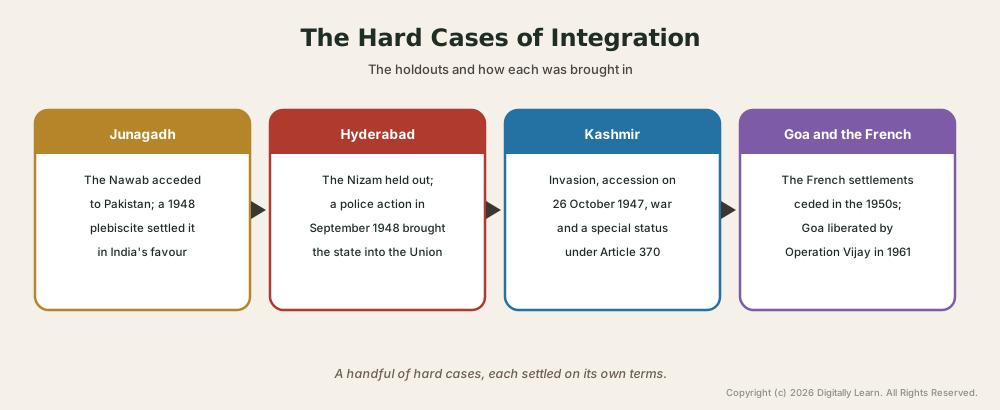
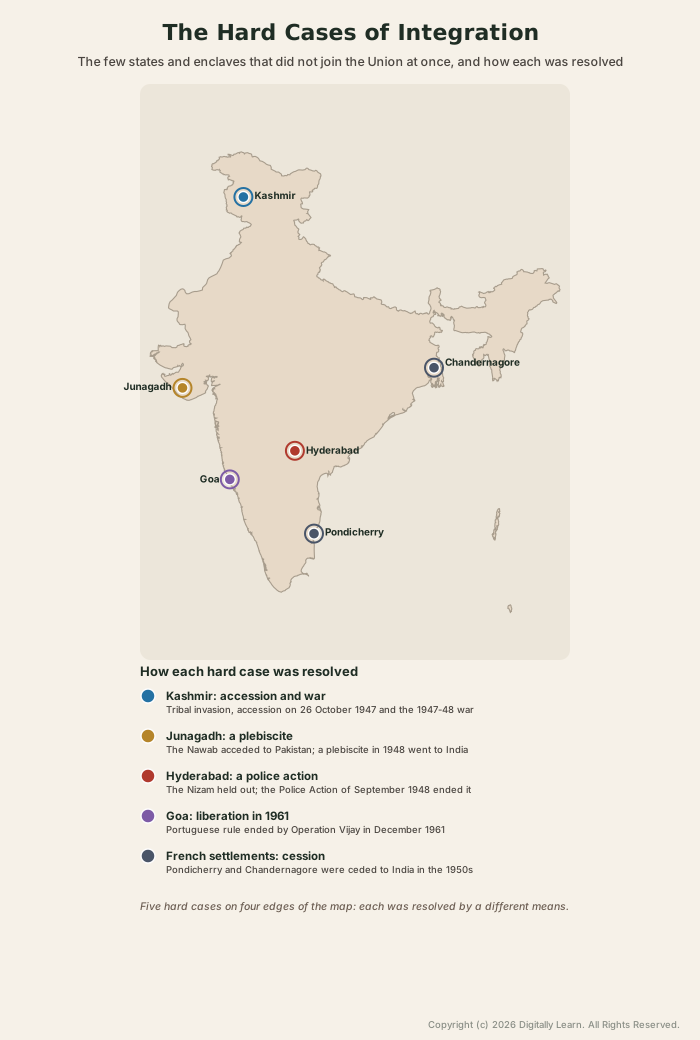
The hard cases of integration were the few states and colonial enclaves that did not join the Indian Union at once. The princely states of Junagadh, Hyderabad and Kashmir held out, and the French and Portuguese still ruled coastal enclaves. Each was resolved by a different means: Junagadh by a plebiscite, Hyderabad by a police action, Kashmir by accession and war, the French settlements by cession, and Goa by liberation in 1961. Together these few cases completed the territorial map of the Union and, in Kashmir, left one of the longest-running questions in Indian politics.
Introduction: The Few States That Did Not Accede at Once
Why a Handful of Hard Cases Mattered So Much
Why this matters: almost every princely state acceded peacefully, but a few hard cases held out, and on these the territorial unity of the new nation turned. How they were resolved, by persuasion, by a vote, by a police action or by force, tested the statecraft of the young Union.
What is the significance of the hard cases: they show that integration was not automatic. Each was settled on its own terms, and one of them, Kashmir, became a dispute that has shaped Indian politics and its relations with Pakistan ever since, as the map and the sections below set out.
Junagadh: Accession to Pakistan and the Plebiscite of 1948
A Hindu-Majority State Whose Nawab Chose Pakistan
What is the significance of Junagadh: it was the mirror image of Kashmir. Junagadh was a small state on the Kathiawar coast with a Hindu-majority population and no land link to Pakistan, yet its Nawab acceded to Pakistan, against the wishes of his people and the logic of geography.
Distinguishing the outcome: India did not accept the accession. After the Nawab left and the administration broke down, a plebiscite was held in February 1948, and the people voted overwhelmingly to join India, settling the matter by the very principle of popular will.
Hyderabad and Operation Polo: The Nizam and the Police Action
The Largest State, the Razakars and the Police Action of 1948
What is the significance of Hyderabad: it was the largest and richest princely state, and its Nizam wished to stay independent in the heart of India. A Standstill Agreement bought time, but order broke down as an irregular force, the Razakars, terrorised the population and resisted accession.
Distinguishing the resolution: in September 1948 the Indian government launched a Police Action, code-named Operation Polo, and the state was brought into the Union within days. The action ended the holdout, though the violence around it remained a painful and contested chapter.
The Kashmir Question: Invasion, Accession and Article 370
From the Tribal Invasion to a Special Constitutional Status
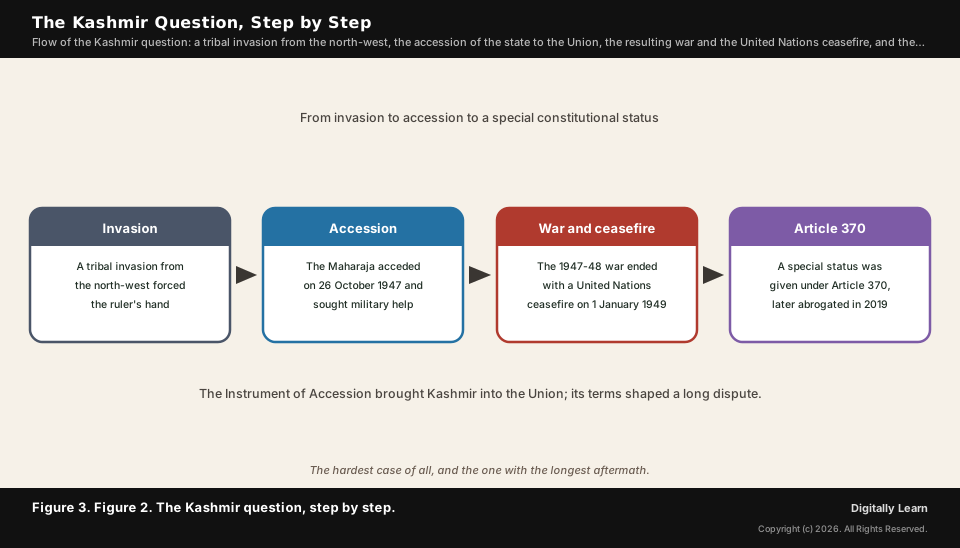
What is the significance of Kashmir: it was the hardest case of all. Jammu and Kashmir had a Muslim-majority population and a Hindu ruler, Maharaja Hari Singh, who hesitated. A tribal invasion from the north-west in October 1947 forced his hand, and he acceded to India on 26 October 1947 in return for military help.
Distinguishing the aftermath: the accession led to the 1947-48 war with Pakistan, which ended in a United Nations ceasefire on 1 January 1949 and a ceasefire line that still divides the region. Under Article 370, Kashmir was given a special status, described in the Constitution as a temporary provision, as the sequence below shows.
Article 370 as a Temporary Provision and Its Later Abrogation
Observable outcomes flowed from the special status. Article 370 carried the marginal note of a temporary provision and gave Jammu and Kashmir its own constitution and a degree of autonomy, an arrangement that was debated for decades over how temporary it truly was.
Distinguishing the later change: in August 2019 the provisions of Article 370 were abrogated and the state was reorganised into two union territories. The point here is the historical thread: a special status born of the manner of accession in 1947 endured for over seventy years before that change.
The French Settlements and the Liberation of Goa, Daman and Diu
Cession by the French and the End of Portuguese Rule
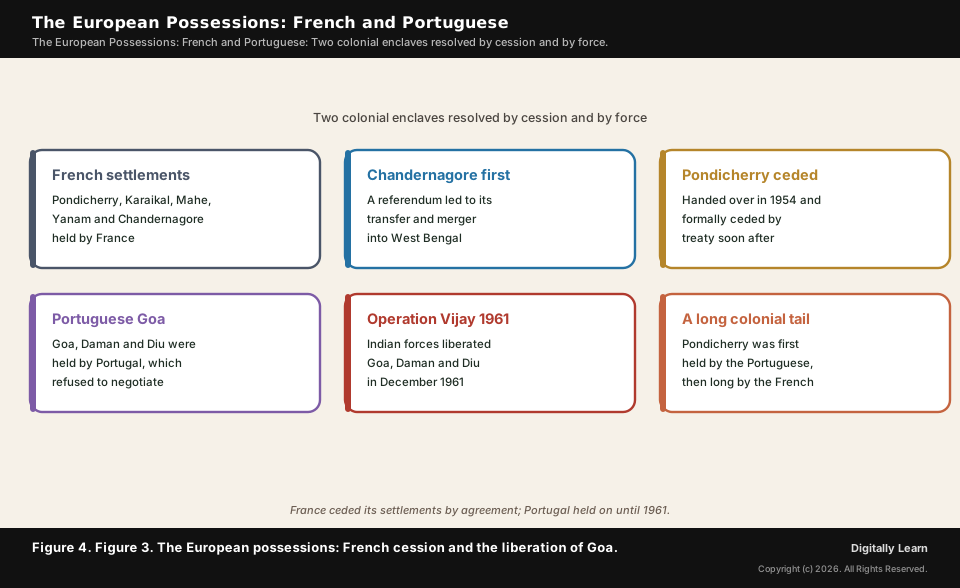
What is the significance of the European enclaves: independence did not end colonial rule on India's coasts. France held Pondicherry, Karaikal, Mahe, Yanam and Chandernagore, while Portugal held Goa, Daman and Diu. Pondicherry itself had a long colonial tail, first occupied by the Portuguese, long held by the French and seized at times by the English, before its cession to India.
Distinguishing the two ends: France chose to leave by agreement. Chandernagore was transferred after a referendum and merged into West Bengal, and Pondicherry and the other settlements were handed over in 1954 and ceded by treaty. Portugal, by contrast, refused to negotiate, so in December 1961 Indian forces ended its rule by Operation Vijay, liberating Goa, Daman and Diu.
Comparing the Hard Cases and the Completion of the Union
Why Some States Resisted and How the Map Was Completed
Observable outcomes can be read across the cases. The holdouts resisted for different reasons, a ruler's ambition in Hyderabad, a ruler against his people in Junagadh, a divided loyalty in Kashmir, and a foreign power in Goa, and each was answered by the means that fitted it, as the comparison below sets out.
Contemporary linkages run from these cases to the present. The resolution of the hard cases completed the territorial frame of the Union, fed into the later reorganisation of states, and left in Kashmir a question that still shapes Indian politics. The points below gather the threads, and the next part turns to the making of the Constitution.
| Hard case | The problem | How it was resolved |
|---|---|---|
| Junagadh | A Hindu-majority state whose Nawab acceded to Pakistan | A plebiscite in 1948 went overwhelmingly to India |
| Hyderabad | The largest state; the Nizam sought independence | The Police Action, Operation Polo, in September 1948 |
| Kashmir | A Muslim-majority state, a tribal invasion and a hesitant ruler | Accession on 26 October 1947, the 1947-48 war and Article 370 |
| French settlements | Pondicherry, Chandernagore and others held by France | Transfer and cession to India in the 1950s |
| Goa, Daman and Diu | Held by Portugal, which refused to negotiate | Operation Vijay liberated them in December 1961 |
Significance: Completing the Map of the Union
How the Hard Cases Finished the Work of Integration
The larger significance is that the resolution of the hard cases finished the work that the wider integration had begun. With the holdouts settled and Goa liberated in 1961, the territorial map of the Union was substantially complete, and the principle that India was one indivisible Union was firmly established.
Contemporary linkages remain visible. The manner of the Kashmir accession shaped a dispute and a special status that lasted until 2019, while the integration as a whole secured the unity on which the rest of nation-building rested. The points below gather the threads.
- A few hard cases, not the general integration, tested the unity of the new nation.
- Junagadh was settled by plebiscite, Hyderabad by a police action and Kashmir by accession and war.
- Kashmir’s accession produced the 1947-48 war, a United Nations ceasefire and Article 370.
- The French settlements were ceded and Goa was liberated by Operation Vijay in 1961.
- The resolution of the hard cases completed the territorial map of the Union.
Previous Year UPSC-CSE Questions
Previous Year UPSC-CSE Questions By the end you will be able to draft model answers for the following UPSC questions. Each question carries a collapsible framework showing how to approach it in the exam.
- UPSC Mains 2016 GS-IITo what extent is Article 370 of the Indian Constitution, bearing marginal note “temporary provision with respect to the State of Jammu and Kashmir”, temporary? Discuss the future prospects of this provision in the context of Indian polity.
How to structure the answer in the exam
Introduction: Open with Article 370 as a provision born of the manner of Kashmir's accession in 1947, marked temporary.
Body (sub-themes to develop):
- The origin of the special status in the accession and the 1947-48 war.
- The marginal note describing it as a temporary provision and the autonomy it gave.
- The decades-long debate over how temporary the provision really was.
- The 2019 abrogation and the reorganisation of the state, as the final turn.
Conclusion: Conclude that a provision labelled temporary endured for decades before it was abrogated, settling the debate by action.
- UPSC Prelims 2010 GS Paper IWith reference to Pondicherry (now Puducherry), consider the following statements:
- The first European power to occupy Pondicherry were the Portuguese.
- The second European power to occupy Pondicherry were the French.
- The English never occupied Pondicherry.
Which of the statements given above is/are correct?
How to approach this Prelims question
Approach: Test each statement about the colonial occupation of Pondicherry.
Trap to watch: The Portuguese were the first at Pondicherry; the French were not the second occupier, and the English did occupy it at times, so only statement 1 is correct.
Key facts to recall:
- The Portuguese were the first European power at Pondicherry
- Pondicherry was long a French settlement
- The English occupied Pondicherry at points
Answer signal: Only statement 1 is correct, so option (a).
Sources and Further Reading
- NCERT, Politics in India Since Independence (Class 12), Chapter 1: Challenges of Nation Building
- Wikipedia: Political integration of India
- Wikipedia: Annexation of Goa
- Wikipedia: Instrument of Accession (Jammu and Kashmir)
- National Portal of India
- Press Information Bureau, Government of India
- National Archives of India
- Azadi Ka Amrit Mahotsav, Ministry of Culture
Editorial Disclaimer
This article is prepared for UPSC examination preparation. Verify key facts and interpretations against standard reference histories before relying on them.