


Overview
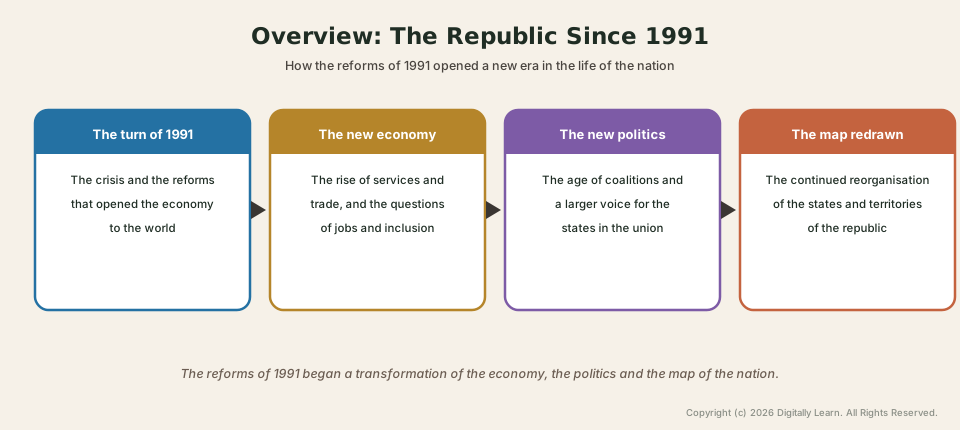
Contemporary India since 1991 opens with the year that turned the course of the republic. A grave economic crisis forced a decisive break with the old order, and the reforms of that year, known as liberalisation, privatisation and globalisation, opened the long-protected economy to the market and to the world. From that turn flowed a generation of change: a transformed economy led by services, an age of coalition politics and a stronger role for the states, the rise of information technology, the shadows of jobless growth and regional imbalance, and a political map redrawn with new states and territories. This part follows that contemporary era as the closing chapter of the long story of nation-building, in dated and balanced terms.
The Great Turn of 1991: India Enters a New Economic Era
Why 1991 Marks a Watershed in the Story of the Republic
Why this matters: For more than four decades the republic had followed a path of planning and of a closely regulated economy, the path this series has traced from the early plans to the licence raj. In 1991 that path reached a crisis, and the nation chose a decisive change of direction. The year is therefore a true watershed, the line between the planned economy of the early decades and the open, market-led economy of contemporary India.
What is the significance of this turn: From the reforms of 1991 flowed a generation of change in the economy, the politics and the very map of the nation. This part follows that contemporary era as the closing chapter of nation-building, and it does so in dated and balanced terms, treating the events since the turn of the century as matters of record rather than of judgement, and leaving the verdicts of partisan debate aside.
The Crisis and the Reforms of 1991: Liberalisation, Privatisation, Globalisation
How a Balance-of-Payments Crisis Remade the Economic Path
Distinguishing the crisis: By 1991 the old economic order had run into a wall. A balance-of-payments crisis, in which the foreign exchange reserves fell to the point where the country could barely pay for a few weeks of imports, forced an immediate response. The deeper causes lay in years of heavy borrowing, slow growth and a closed and over-regulated economy, the limits of which were treated in the part on the licence raj.
The response opened a new path. Under Prime Minister Narasimha Rao and Finance Minister Manmohan Singh, the government devalued the rupee, sought emergency support to steady the reserves, and then launched a set of structural reforms. The New Industrial Policy of 1991 swept away most of the system of industrial licensing, the heart of the old controls, and opened the door to private enterprise, to competition and to foreign investment.
The full origin and detail of the reforms are treated in the part on the reforms of 1991.
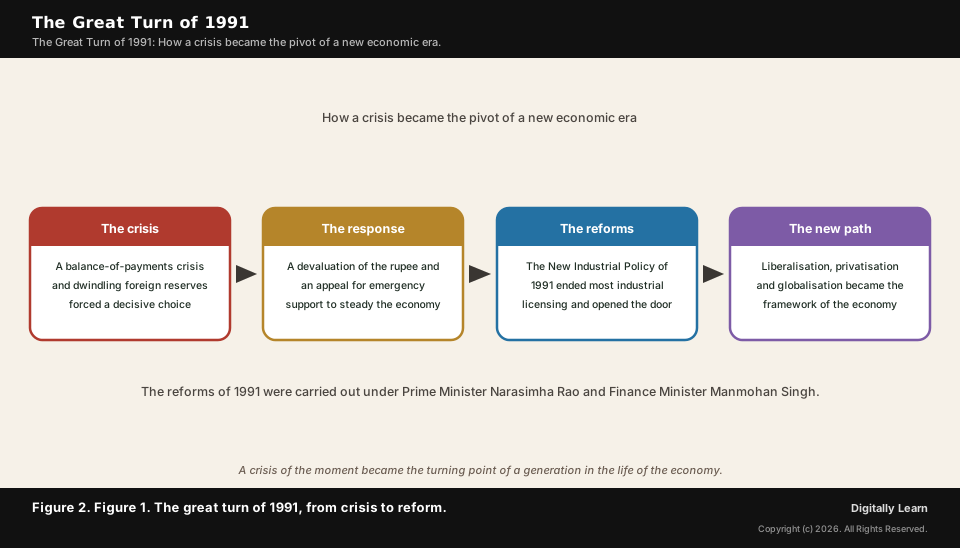
Observable outcome: The reforms came to be known by three words, liberalisation, privatisation and globalisation, the loosening of controls, the larger role of private enterprise, and the opening of the economy to the world. Whatever one's view of their consequences, a matter still debated, they marked the decisive turn from the planned and protected economy of the early republic to the open and market-led economy of the present.
The Economy Transformed: From the Licence Raj to the Open Market
How Liberalisation Changed the Shape of the Indian Economy
Distinguishing the transformation: The reforms reshaped the structure of the economy over the decades that followed. The share of agriculture in the nation's output, long the largest, fell as the economy grew and diversified, while the share of services rose to become the leading part of the economy. Industry was freed from much of the old licensing, the private sector took a far larger role, and competition entered many fields once reserved or closely controlled.
The economy opened to the world. India's share in world trade rose, the inflow of foreign direct investment grew far beyond its earlier trickle, and the foreign exchange reserves, so dangerously low in 1991, were rebuilt to a great height over the following years. The economy that had stood apart from the world market for forty years became, within a generation, one tied into the flows of global trade, capital and technology.
The table below sets out the milestones of this era.
| Milestone | What it marked | Year |
|---|---|---|
| The New Industrial Policy | The end of most industrial licensing | 1991 |
| The World Trade Organisation | India a founding member of the new trade body | 1995 |
| The National Institution for Transforming India | A new body in place of the Planning Commission | 2015 |
| The Goods and Services Tax | A single national indirect tax, by the 101st Amendment | 2017 |
Observable outcome: Within a generation the shape of the economy was remade, from one led by agriculture and closed to the world to one led by services and open to it. The change brought rapid growth and a new prosperity to many, even as it raised the questions of jobs and of fairness that a later section takes up.
India and the World Economy: The WTO and Global Integration
How India Joined the Rules-Based Global Trading Order
Distinguishing global integration: The opening of 1991 drew the nation into the institutions of the world economy. In 1995 India became a founding member of the World Trade Organisation, the new body that succeeded the older trade agreement and set the rules for global commerce.
Membership tied the country into a rules-based order of trade, with both the opportunities of access to world markets and the obligations and disputes that such membership brings, treated in detail in the material on the World Trade Organisation.
The integration ran wider than trade. The economy was drawn into the flows of global capital, technology and ideas, and the foreign policy of the era, examined in the part on India and its neighbours and the wider world, turned towards economic diplomacy and a Look East, later Act East, engagement with the fast-growing economies of Asia. The nation that had prized self-reliance learned to pursue its interests within an interdependent world.
Observable outcome: By joining the rules-based order of world trade and opening to global capital, India became an active participant in the world economy rather than a guarded outsider. The engagement was not without friction or debate, particularly over questions of agriculture and of fairness to developing nations, but it marked a settled change in the country's place in the world.
The Age of Coalitions: Politics in the Era of Reform
How Single-Party Dominance Gave Way to the Coalition
Distinguishing the political shift: The economic opening was accompanied by a change in the shape of politics. The long predominance of a single party in Parliament, which had marked the early decades, had given way by the late 1980s, and for a generation thereafter no single party commanded a majority in the Lok Sabha. Government became the work of coalitions, in which several parties shared power and a common programme.
The states gained a larger voice. The age of coalitions raised the weight of regional and state parties, which bargained for their regions within the governing alliances, and it strengthened the practical federalism of the union, as the centre had to carry the states with it. Later years saw the return of a single-party majority, and the language of cooperative federalism and of bodies for shared decision between the centre and the states.
These shifts are recorded here as facts of the period, without judgement on the parties or the governments involved.
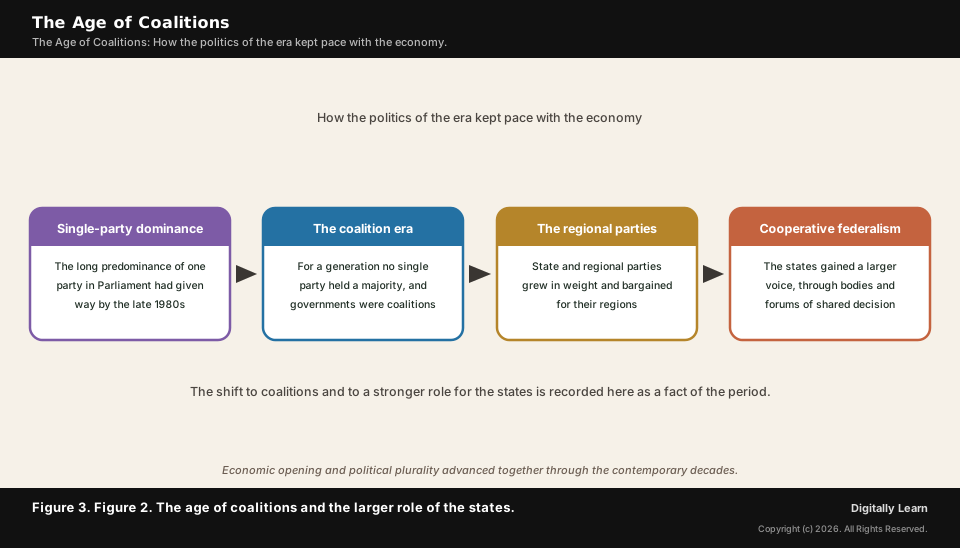
Observable outcome: The politics of the contemporary era became more plural and more regional, and the relationship between the centre and the states more a matter of negotiation than of command. Economic opening and political plurality advanced together, the two great currents of the period running side by side.
The Rise of Services and Information Technology
How India Became a Services and Software Power
Distinguishing the rise of services: The most striking feature of the new economy was the swift growth of the services sector, which came to lead the economy in a way that few had predicted. Finance, trade, telecommunication and, above all, information technology grew rapidly, and the software and business-services industry, building on the scientific and technical education described in the part on science and technology, became a major export and a symbol of the new India.
The growth reached into daily life. The spread of the mobile telephone and, later, of the internet transformed communication, commerce and the delivery of public services, and a large new middle class, employed in the cities and the services economy, came into being. The information-technology industry, cross-referenced to the part on science and technology, carried the name of Indian skill across the world and drew millions into new kinds of work.
Observable outcome: The leadership of services gave the contemporary economy a character different from the path of older industrial nations, which had grown rich through manufacturing first. The strength of the services economy was real, but so was the concern, taken up below, that it did not create jobs fast enough for the millions entering the workforce each year.
Urbanisation and the Inclusive City
How a Rural Nation Began to Become an Urban One
Distinguishing the urban turn: The growth of the new economy drew people from the countryside to the towns and cities in great numbers, and the nation, long overwhelmingly rural, began the long passage towards an urban future. The cities became the engines of the services economy and the homes of the new middle class, even as they strained to house and serve the millions who arrived in search of work.
The city posed its own questions. Rapid urbanisation brought the challenges of housing, of the slum, of water, transport and clean air, and of making the city inclusive of the poor who built and served it. The state responded with missions for urban renewal and for smart and inclusive cities, cross-referenced to the material on urbanisation, seeking to plan for an urban future that was arriving faster than the institutions could manage.
Observable outcome: The drift to the city was among the great social changes of the era, reshaping where and how Indians lived and worked. The making of cities that were both prosperous and inclusive, that served the migrant and the poor as well as the prosperous, became one of the defining tasks of contemporary governance.
Jobless Growth and Regional Imbalance: The Shadows of the Boom
How the Benefits of Growth Were Unevenly Shared
Distinguishing the shadows: The growth of the contemporary era was real and rapid, yet it cast shadows that troubled observers across the spectrum of opinion. The foremost was the concern that the growth was jobless, that output rose faster than the jobs needed to absorb the millions of young people entering the workforce each year, leaving much of the workforce in informal and insecure employment.
The gains fell unevenly. The benefits of growth were shared unequally across the regions, so that some states and cities prospered greatly while others lagged, and the distance between the prospering city and much of the countryside widened. The lifting of the incomes of those who still lived by the land, and the spread of the gains of growth to the poor and the left-behind, remained the great unfinished tasks, gathered under the idea of inclusive growth.
The figure below sets out these concerns.
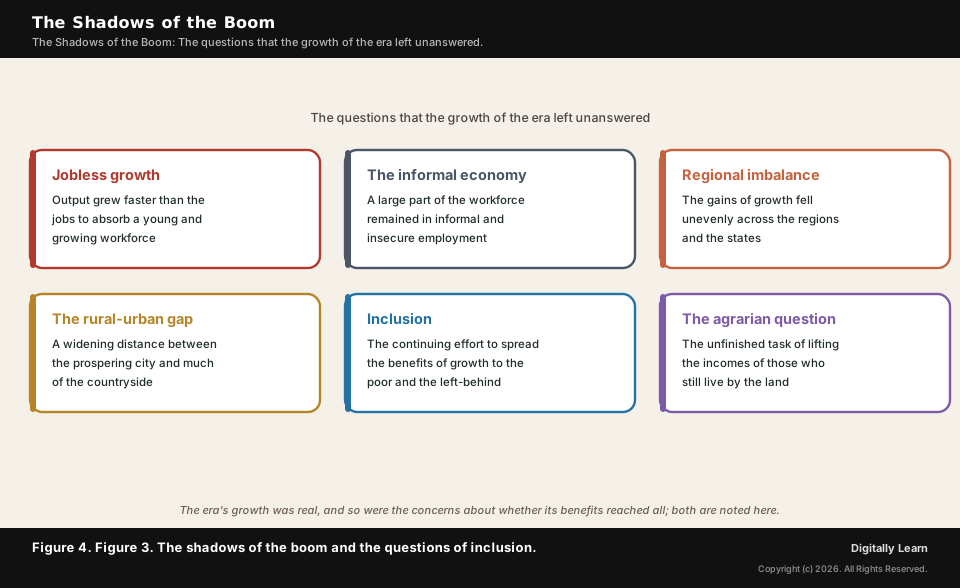
Observable outcome: The era's prosperity and its inequalities were two sides of a single record, and an honest account holds both. The growth was a genuine achievement; the question of whether its benefits reached all, and how to make growth more inclusive, became the central debate of contemporary economic policy, and it is presented here as a debate rather than as a settled verdict.
The Map Redrawn: Telangana and the Reorganisation of Jammu and Kashmir
How the Political Map of the Republic Continued to Change
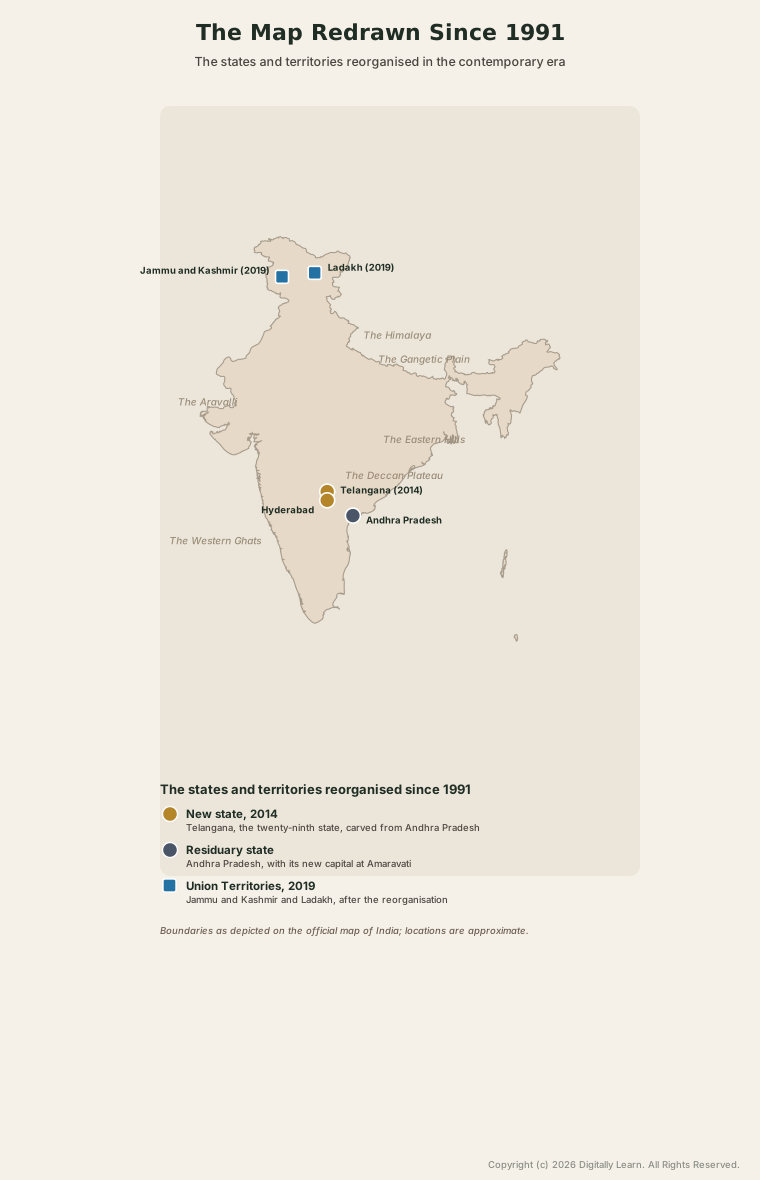
Distinguishing the redrawing of the map: The reorganisation of the states, traced in the part on the linguistic states, did not end in the early decades but continued into the contemporary era. In 2014 the state of Telangana was created as the twenty-ninth state, carved from Andhra Pradesh after a long movement, with Hyderabad to serve as a shared capital for a period before passing to Telangana alone.
The far north was reorganised in 2019. By the Jammu and Kashmir Reorganisation Act of 2019, and the constitutional changes to Article 370 that accompanied it, the former state of Jammu and Kashmir was reorganised into two Union Territories, that of Jammu and Kashmir and that of Ladakh.
These changes are set out here strictly as dated constitutional facts, in the terms of the law and on the official map of the nation, without entering the contested political debate that surrounds them. The map below shows the states and territories so reorganised.
Observable outcome: The political map of the republic, far from being settled at independence, has continued to be redrawn into the present. The era also saw other changes in the architecture of the state, the Goods and Services Tax of 2017 by the 101st Amendment, the body for transforming India that replaced the Planning Commission in 2015, and the anti-corruption movement of 2011 and the law for an ombudsman that followed, each recorded here as a dated development.
Significance: The Republic at the Turn of the Century and Beyond
How the Post-1991 Era Reshaped the Idea of India
The larger significance of the era since 1991 is that it remade the economy, the politics and the map of the nation within a single generation, and shaped the India in which the student of today has grown up. The planned and protected economy of the early decades gave way to an open and market-led one; the dominance of a single party gave way to a plural and more regional politics; and the map itself continued to change.
The republic of the present is in large part the creation of this contemporary turn.
| Development | What it marked | Year |
|---|---|---|
| The LPG reforms | The opening of the economy after the crisis | 1991 |
| Membership of the WTO | Integration into the rules-based world trade order | 1995 |
| The creation of Telangana | The twenty-ninth state, in the contemporary era | 2014 |
| The reorganisation of Jammu and Kashmir | Two Union Territories, by the Act of that year | 2019 |
Contemporary linkages carry the story to the present day. The continuing debates over jobs and inclusive growth, over the balance between the centre and the states, over the place of India in a changing world economy, and over the management of a fast-urbanising nation are all the descendants of the turn of 1991.
The deeper lesson is that the work of nation-building did not end with the founding generation but goes on, that each era inherits the achievements and the unfinished tasks of the last, and that the republic remains a work in progress. The parts that follow turn from this chronological story to the architects, the policies and the larger themes of the whole long endeavour.
- The crisis of 1991 led to the LPG reforms under Narasimha Rao and Manmohan Singh, opening the economy to the market and the world.
- Services rose to lead the economy, India joined the WTO in 1995, and trade, investment and the reserves grew.
- Politics entered the age of coalitions and a stronger role for the states, recorded here without party judgement.
- Jobless growth and regional imbalance were the shadows of the boom, and inclusive growth its central debate.
- The map was redrawn with Telangana in 2014 and the reorganisation of Jammu and Kashmir in 2019, as dated facts.
Previous Year UPSC-CSE Questions
Previous Year UPSC-CSE Questions By the end you will be able to draft model answers for the following UPSC questions. Each question carries a collapsible framework showing how to approach it in the exam.
- UPSC Mains 2016 GS-IIHas the Indian governmental system responded adequately to the demands of Liberalization, Privatization and Globalization started in 1991? What can the government do to be responsive to this important change?
How to structure the answer in the exam
Introduction: Open with the crisis of 1991 and the turn to liberalisation, privatisation and globalisation.
Body (sub-themes to develop):
- Response: dismantling the licence raj, opening to trade and foreign investment, joining the WTO.
- Institutional reform: the Goods and Services Tax, the body that replaced the Planning Commission, ease of doing business.
- Gaps: jobless growth, the informal economy, regional imbalance, the unfinished agenda of inclusion.
- Measures: skilling and jobs, cooperative federalism, inclusive growth, a responsive and simpler state.
Conclusion: Conclude that the system responded substantially to the demands of the new economy, while the tasks of inclusion and of jobs remain the test of its responsiveness.
- UPSC Mains 2015 GS-IIIThe nature of economic growth in India in recent times is often described as jobless growth. Do you agree with this view? Give arguments in favour of your answer.
How to structure the answer in the exam
Introduction: Open with the meaning of jobless growth, output rising without matching employment.
Body (sub-themes to develop):
- For: services-led growth is less labour-intensive than manufacturing; the informal economy dominates.
- For: output and productivity have risen faster than formal job creation for a young workforce.
- Nuance: some jobs are created but are informal, low-paid or under-counted.
- The remedy: labour-intensive manufacturing, skilling, and support to small enterprise.
Conclusion: Conclude with a balanced judgement that the growth has been substantially jobless in the formal sense, and that creating jobs is the central economic task.
- UPSC Prelims 2017 GS Paper IWhich of the following has/have occurred in India after its liberalization of economic policies in 1991?
- Share of agriculture in GDP increased enormously.
- Share of India’s exports in world trade increased.
- FDI inflows increased.
- India’s foreign exchange reserves increased enormously.
Select the correct answer using the codes given below.
How to approach this Prelims question
Approach: Test each consequence of the 1991 liberalisation.
Trap to watch: The share of agriculture in GDP fell after liberalisation; it did not increase.
Key facts to recall:
- Agriculture's share of GDP fell as services rose
- India's share in world trade and FDI inflows rose
- Foreign exchange reserves were rebuilt from the 1991 low
Answer signal: Statements 2, 3 and 4 only, so option (b).
Sources and Further Reading
- NCERT, Politics in India since Independence (Class 12)
- India Code: the Jammu and Kashmir Reorganisation Act, 2019
- Wikipedia: Economic liberalisation in India
- Wikipedia: Telangana
- Wikipedia: Jammu and Kashmir Reorganisation Act, 2019
- NITI Aayog, Government of India
- Press Information Bureau, Government of India
- National Portal of India
Editorial Disclaimer
This article is prepared for civil services preparation. Verify key facts and interpretations against standard reference works before relying on them.