
Overview
Previous Year UPSC-CSE Questions By the end you will be able to draft model answers for the following UPSC questions. Each question carries a collapsible framework showing how to approach it in the exam.
- UPSC Mains 2018 GS-IIIHow are the principles followed by NITI Aayog different from those followed by the erstwhile planning commission in India?
How to structure the answer in the exam
Introduction: Open by noting that NITI Aayog replaced the Planning Commission on 1 January 2015 and works on different principles.
Body (sub-themes to develop):
- Top-down directive planning under the Commission versus a bottom-up advisory role under NITI Aayog.
- The Commission allotted funds and outlays to states; NITI Aayog has no fund-allocation power.
- A one-size template for all states versus state-specific plans and cooperative-competitive federalism.
- The states as recipients of directions versus the states as equal partners in cooperative federalism.
Conclusion: Conclude that the shift was from a centralised planner to an advisory think-tank built on cooperative federalism.
- UPSC Prelims 2019 GS Paper IWith reference to India's Five-Year Plans, which of the following statements is/are correct?
- From the Second Five-Year Plan, there was a determined thrust towards substitution of basic and capital good industries.
- The Fourth Five-Year Plan adopted the objective of correcting the earlier trend of increased concentration of wealth and economic power.
- In the Fifth Five-Year Plan, for the first time, the financial sector was included as an integral part of the Plan.
Select the correct answer using the code given below.
How to approach this Prelims question
Approach: Match each plan to its stated objective, as the body sets them out.
Trap to watch: Statement 3 is the trap: the body presents the Fifth Plan as employment and Garibi Hatao, not the first inclusion of the financial sector, so statement 3 is wrong.
Key facts to recall:
- Second Plan: substitution of basic and capital goods
- Fourth Plan: correcting the concentration of wealth and economic power
- Fifth Plan: employment and Garibi Hatao
Answer signal: Statements 1 and 2 only, so option (a).
- UPSC Prelims 2002 GS Paper IA Five Year Plan in India is finally approved by the
How to approach this Prelims question
Approach: Recall the body that gives a plan its final approval, not the body that drafts it.
Trap to watch: The Planning Commission only drafted the plan; the final approval was given by the National Development Council.
Key facts to recall:
- The Planning Commission drafts the plan
- The National Development Council finally approves it
- The NDC is chaired by the Prime Minister
Answer signal: The National Development Council, so option (d).
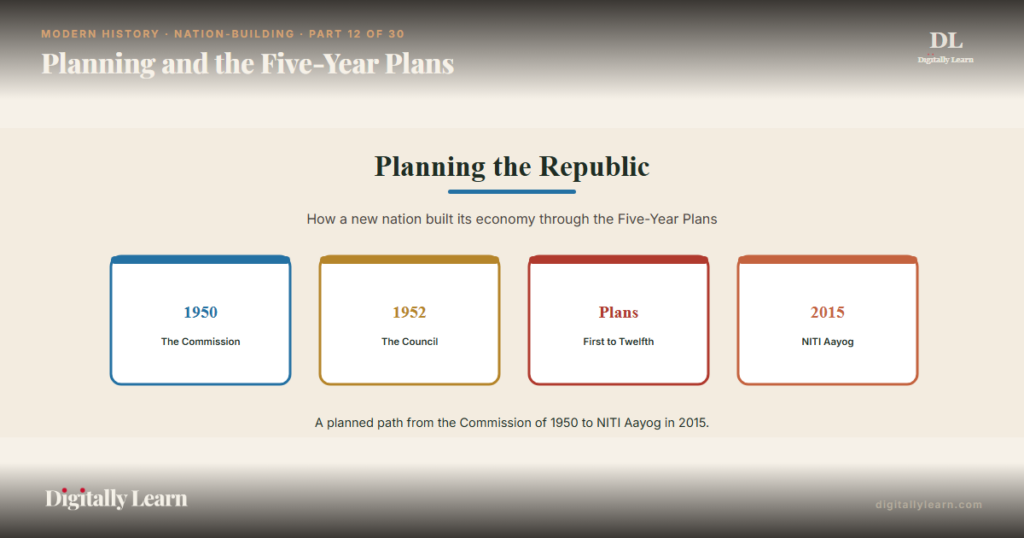
Economic planning was the method India chose to develop a poor and largely agrarian economy after independence, in which the state set goals for the whole economy over a fixed span of years and steered investment towards them. From 1951 these goals were framed as Five-Year Plans, drafted by the Planning Commission set up in 1950 and given final approval by the National Development Council. Over more than six decades the plans moved from agriculture to heavy industry and back to poverty and employment, reached into the villages through community development, and were finally wound up in 2015 when NITI Aayog replaced the Commission. How that planning system was built, what it achieved and why it ended is a central theme of nation-building.
Introduction: Why a Poor Republic Turned to Planning
Planning as the Strategy of Nation-Building
Why this matters: a new and very poor country could not wait for the market alone to build industry, irrigate its fields and spread schooling. India chose economic planning, in which the state set targets for the whole economy and guided investment towards them, as the central instrument of its development for more than six decades.
What is the significance of economic planning: it gave the early republic a shared method and a shared timetable. Through the Five-Year Plans the country could decide what to build first, move scarce capital towards it, and measure its progress against stated goals, a discipline the sections below trace from 1950 to 2015.
The Architecture of Planning: the Commission and the Council
The Planning Commission of 1950 and Its Extra-Constitutional Status
Distinguishing the Planning Commission: it was the body that drew up the plans. Set up on 15 March 1950 by a simple resolution of the Union Cabinet, it drew its authority not from the Constitution or from any statute but as an arm of the central government, and the Prime Minister, Jawaharlal Nehru, was its chairman.
Observable outcomes followed from this design. The Commission framed each Five-Year Plan, assessed the resources of the country, fixed priorities and recommended how investment should be shared between the Centre and the states, so it became the powerful planning brain of the early decades even though it was an advisory body in form.
The National Development Council and the Final Approval of a Plan
What is the significance of the National Development Council: it tied the states into the plan. Set up on 6 August 1952, the Council was chaired by the Prime Minister and brought together the Union Cabinet Ministers and the Chief Ministers of all the states, so that a national plan carried the assent of the units that had to carry it out.
Distinguishing the two bodies matters for the exam. The Planning Commission drafted a Five-Year Plan, but the plan was finally approved by the National Development Council, the apex body for planning. The Commission was the planner and the Council was the forum where the Centre and the states gave the plan its final seal.
The Early Plans: from the Harrod-Domar to the Mahalanobis Strategy
The First Five-Year Plan 1951-56 and the Harrod-Domar Model
Distinguishing the First Plan: it was a plan of recovery. Running from 1951 to 1956 and shaped by the Harrod-Domar model, which linked growth to the rate of saving and investment, it gave first place to agriculture, irrigation and power at a time when partition and food shortage had left the economy under strain.
Observable outcomes were modest but real. The plan largely met its limited targets, harvests improved with new irrigation such as the early river-valley projects, and the experience taught the planners that the next plan could be more ambitious, turning their attention from farms to factories.
The Second Five-Year Plan 1956-61 and the Mahalanobis Strategy
What is the significance of the Second Plan: it set the direction of Indian planning for a generation. Running from 1956 to 1961 and built on the Mahalanobis model, it made heavy and capital-goods industries the engine of growth, on the view that a country able to make its own machines and steel would grow faster and depend less on others.
Distinguishing its central thrust: from the Second Plan onward there was a determined thrust towards the substitution of basic and capital goods, making at home what had been bought abroad. This is why the public-sector steel and machine plants of the mixed economy, treated in the previous part, belong to the Second-Plan strategy of self-reliance.
Crisis and Redirection: the Third Plan, the Plan Holiday and the Plans of the 1970s
The Third Plan 1961-66, the War-and-Drought Shock and the Plan Holiday
Distinguishing the Third Plan: it aimed high and was overtaken by events. Running from 1961 to 1966, it sought a self-reliant and self-generating economy, but the war with China in 1962, the war with Pakistan in 1965 and successive droughts drained resources and forced food imports, so its targets were badly missed.
Observable outcomes of that crisis included a pause in long planning. For the three years from 1966 to 1969, known as the plan holiday, the country was run on three yearly annual plans while it recovered, devalued the rupee in 1966 and waited for stability before the Fourth Plan could begin.
The Fourth and Fifth Plans: Concentration of Wealth and Garibi Hatao
Distinguishing the Fourth Plan: it turned to fairness as well as growth. Running from 1969 to 1974 and built on the Gadgil formula of growth with stability, it took as one of its objectives the correcting of the earlier trend towards a greater concentration of wealth and economic power, a concern that the bank nationalisation of 1969 also reflected.
Observable outcomes shaped the Fifth Plan too. Running from 1974 to 1978, it placed its stress on employment and on poverty, under the slogan Garibi Hatao, remove poverty. The Emergency of 1975 to 1977 fell within this plan, and when the newly elected Janata government came to power it cut the Fifth Plan short in 1978.
| Plan | Years | Chief emphasis | Model or guiding idea |
|---|---|---|---|
| First | 1951-56 | Agriculture, irrigation and power | Harrod-Domar model |
| Second | 1956-61 | Heavy and capital-goods industry | Mahalanobis model |
| Third | 1961-66 | A self-reliant economy | Self-reliance, then war and drought |
| Plan holiday | 1966-69 | Recovery through three annual plans | No five-year plan framed |
| Fourth | 1969-74 | Growth with stability | Gadgil formula; less concentration of wealth |
| Fifth | 1974-78 | Employment and poverty (Garibi Hatao) | Cut short by the Janata government in 1978 |
Planning for the Village: the Community Development Programme of 1952
The Community Development Programme and the Reach of the State into the Village
What is the significance of the Community Development Programme: it carried planning into the countryside. Launched in 1952, it grouped villages into development blocks and tried to lift the whole life of the village at once, through better farming, roads, schools, drinking water and health, with a development officer to coordinate the effort.
Distinguishing its weakness: the programme reached the village but not the villager. It was run from above by officials, and the people for whom it was meant had little say in it, so much of its early promise faded for want of genuine local participation, a failing that led directly to the search for elected village government.
From Community Development to Panchayati Raj
The Balwantrai Mehta Committee 1957 and Three-Tier Democratic Decentralisation
Distinguishing democratic decentralisation: it was the answer to the gap in community development. The Balwantrai Mehta Committee of 1957, asked to examine why the programme had not taken root, found that it had failed for want of popular participation and recommended a scheme of democratic decentralisation that came to be called panchayati raj.
Observable outcomes took the shape of a three-tier system: the gram panchayat at the village level, the panchayat samiti at the block level and the zila parishad at the district level. Rajasthan was the first state to set it up, inaugurated at Nagaur on 2 October 1959, and the system was later given constitutional status by an amendment treated later in this series.
The End of the Plan Era: from the Planning Commission to NITI Aayog
NITI Aayog 2015 and the Turn to Cooperative Federalism
Distinguishing the end of the plan era: the long plans ran their course. The Twelfth Plan, for 2012 to 2017, was the last of the Five-Year Plans, and on 1 January 2015 the Planning Commission was replaced by NITI Aayog, the National Institution for Transforming India.
What is the significance of the shift: the guiding principles changed, not just the name. The Planning Commission had planned from the top, allotting funds and a common template to every state. NITI Aayog is instead a policy think-tank with no power to allot funds; it advises rather than directs, lets each state shape its own path, and rests on cooperative federalism with the states as equal partners.
Significance: What Planning Built and Where It Fell Short
Why the Plan Era Matters for Nation-Building
Observable outcomes of the plan era were large. Planning built the steel plants, dams, power stations, fertiliser units and institutes of science and technology that gave the country an industrial and scientific base, raised the rate of saving and investment, and spread irrigation and electricity into new regions.
Distinguishing the criticisms: the record also drew sharp criticism. Growth stayed slow for long stretches, agriculture and employment were neglected in the early industry-first plans, the planning machinery grew centralised and bureaucratic, and these limits fed the case for the economic reforms of 1991, treated later in this series.
Contemporary linkages run from the plan era into the present. The institutions it created shaped the economy until 2015, NITI Aayog now performs the planning function in a different way, and the deeper question the plans raised, how far the state should steer development and how much should be left to states and markets, is still alive in policy today.
The larger significance is that planning was the chosen instrument of nation-building, the means by which a poor country tried to industrialise, feed itself and govern its own development. The points below gather the threads, and the next part turns to land reforms and the green and white revolutions.
- India developed through Five-Year Plans, drafted by the Planning Commission of 1950 and finally approved by the National Development Council.
- The First Plan, on the Harrod-Domar model, stressed agriculture; the Second, on the Mahalanobis model, put heavy industry at the core.
- The Third Plan broke under war and drought, leading to the plan holiday of 1966 to 1969 and three annual plans.
- Community development from 1952 and the Balwantrai Mehta report of 1957 led to the three-tier panchayati raj.
- The Twelfth Plan was the last; in 2015 NITI Aayog replaced the Planning Commission, ending the plan era.
Prelims MCQ practice
Each question below tests one specific concept on the topic. Click to reveal the answer and a full option-wise explanation.
Q1. In which year was the Planning Commission of India set up by a resolution of the Union Cabinet?
- 1948
- 1950
- 1952
- 1956
Show answer and explanation
Answer: 1950
Explanation.
Option (b) is correct. The Planning Commission was set up on 15 March 1950 by a resolution of the Union Cabinet. Hence option (b).
Q2. In India, a Five-Year Plan is finally approved by which of the following bodies?
- The Planning Commission
- The Union Cabinet
- The National Development Council
- The Finance Commission
Show answer and explanation
Answer: The National Development Council
Explanation.
Option (c) is correct. The Planning Commission drafted a plan, but a Five-Year Plan was finally approved by the National Development Council. Hence option (c).
Q3. The First Five-Year Plan, which gave priority to agriculture and irrigation, was based on which model?
- The Mahalanobis model
- The Harrod-Domar model
- The Gadgil formula
- The Wadia plan
Show answer and explanation
Answer: The Harrod-Domar model
Explanation.
Option (b) is correct. The First Five-Year Plan (1951-56) was based on the Harrod-Domar model and stressed agriculture. The Mahalanobis model guided the Second Plan. Hence option (b).
Q4. Consider the following statements about the Second Five-Year Plan:
- It was based on the Mahalanobis model.
- It gave priority to heavy and capital-goods industries.
Which of the statements given above is/are correct?
- 1 only
- 2 only
- Both 1 and 2
- Neither 1 nor 2
Show answer and explanation
Answer: Both 1 and 2
Explanation.
Both statements are correct. The Second Five-Year Plan (1956-61) was based on the Mahalanobis model and put heavy and capital-goods industries at the core. Hence option (c).
Q5. The period from 1966 to 1969, when three annual plans were framed instead of a five-year plan, is known as the
- Rolling Plan
- Plan holiday
- Plan vacation
- Interim Plan
Show answer and explanation
Answer: Plan holiday
Explanation.
Option (b) is correct. The years 1966 to 1969, run on three annual plans after the war-and-drought crisis, are called the plan holiday. Hence option (b).
Q6. Consider the following statements about the end of the Five-Year Plan era:
- The Twelfth Plan (2012-17) was the last of the Five-Year Plans.
- NITI Aayog replaced the Planning Commission in 2015.
- NITI Aayog has the power to allot plan funds to the states.
Which of the statements given above are correct?
- 1 and 2 only
- 2 and 3 only
- 1 and 3 only
- 1, 2 and 3
Show answer and explanation
Answer: 1 and 2 only
Explanation.
Statements 1 and 2 are correct. The Twelfth Plan was the last Five-Year Plan and NITI Aayog replaced the Planning Commission on 1 January 2015. NITI Aayog is an advisory think-tank with no power to allot funds, so statement 3 is wrong. Hence option (a).
Sources and Further Reading
- NCERT, Indian Economic Development (Class 11), Indian Economy 1950 to 1990
- Wikipedia: Five-Year Plans of India
- Wikipedia: Planning Commission (India)
- Wikipedia: National Development Council (India)
- Wikipedia: NITI Aayog
- Wikipedia: Panchayati raj (India)
- NITI Aayog, Government of India
- Ministry of Statistics and Programme Implementation
- Reserve Bank of India, History
- National Portal of India
- Press Information Bureau, Government of India
Editorial Disclaimer
This article is prepared for UPSC examination preparation. Verify key facts and interpretations against standard reference histories before relying on them.