


Overview
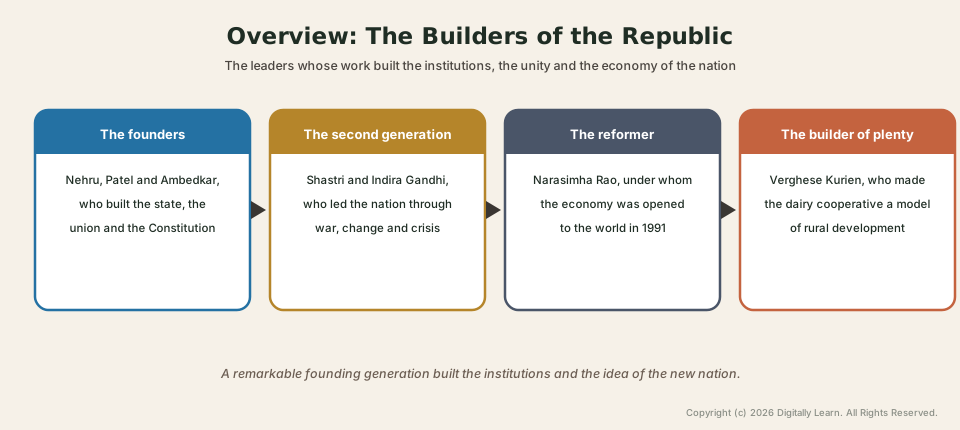
The architects of nation-building were the leaders whose visions and choices built the institutions, the unity, the Constitution and the economy of the republic. This part draws together, as a closing portrait, the figures who recur through the long story this series has told: Nehru, who shaped the democratic and secular state; Patel, who forged a single nation from the princely states; Ambedkar, who gave the nation its Constitution and its promise of equality; Shastri, who steadied the republic; Indira Gandhi, whose leadership was both towering and contested; Narasimha Rao, under whom the economy was opened; and Verghese Kurien, who built the white revolution. It treats each as a builder, in balanced terms, and gathers the threads of the whole endeavour.
The Architects of Nation-Building: The Leaders Who Built the Republic
Why the Story of Nation-Building Is Also the Story of Its Builders
Why this matters: The institutions, the unity and the Constitution of the republic did not build themselves. They were the work of particular leaders, whose visions, talents and choices gave the new nation its shape. To understand nation-building, one must understand the builders, the men and women whose names recur through the long story this series has told.
What is the significance of these architects: This part gathers them into a single portrait, treating each as a builder of one or more of the foundations of the nation, in balanced terms that note both achievement and criticism. It is a compilation, drawing together threads followed in earlier parts, and it leaves the partisan verdicts aside to record the contribution of each.
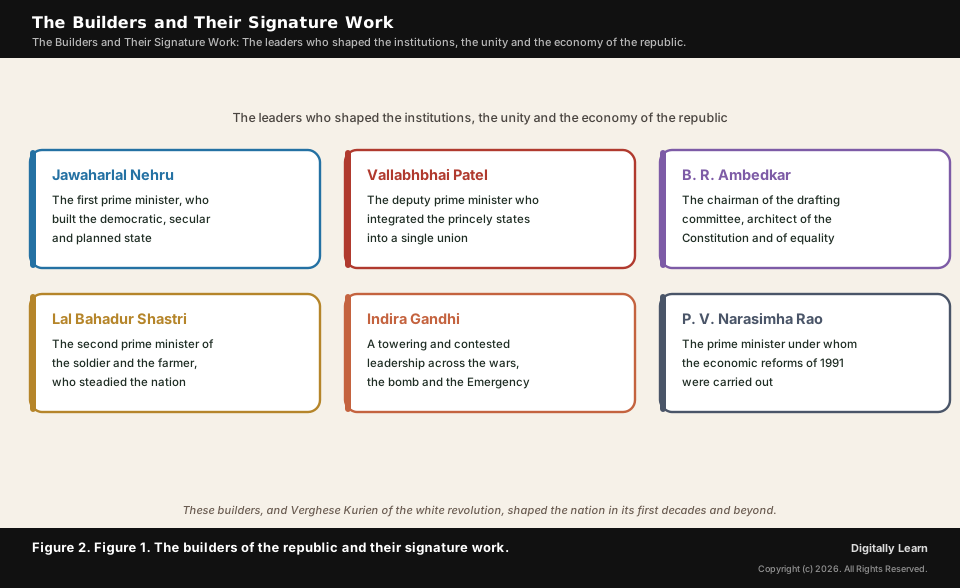
| Architect | Role | Signature contribution |
|---|---|---|
| Jawaharlal Nehru | First prime minister | The democratic, secular and planned state |
| Vallabhbhai Patel | Deputy prime minister | The integration of the princely states |
| B. R. Ambedkar | Chairman of the drafting committee | The Constitution and the charter of equality |
| Lal Bahadur Shastri | Second prime minister | Steady leadership in war and in food |
| Indira Gandhi | Prime minister | A towering and contested leadership |
| P. V. Narasimha Rao | Prime minister | The economic reforms of 1991 |
| Verghese Kurien | Founder of the dairy movement | The white revolution and the cooperative |
Jawaharlal Nehru: The Architect of the Democratic and Secular State
How the First Prime Minister Shaped the Institutions and the Idea of the Nation
Distinguishing Nehru's contribution: Jawaharlal Nehru, the first prime minister, governed for the first seventeen years of the republic and shaped its character more than any other single figure. He set the new nation firmly on the path of parliamentary democracy, holding regular elections and respecting the institutions, at a time when many new nations slid towards dictatorship.
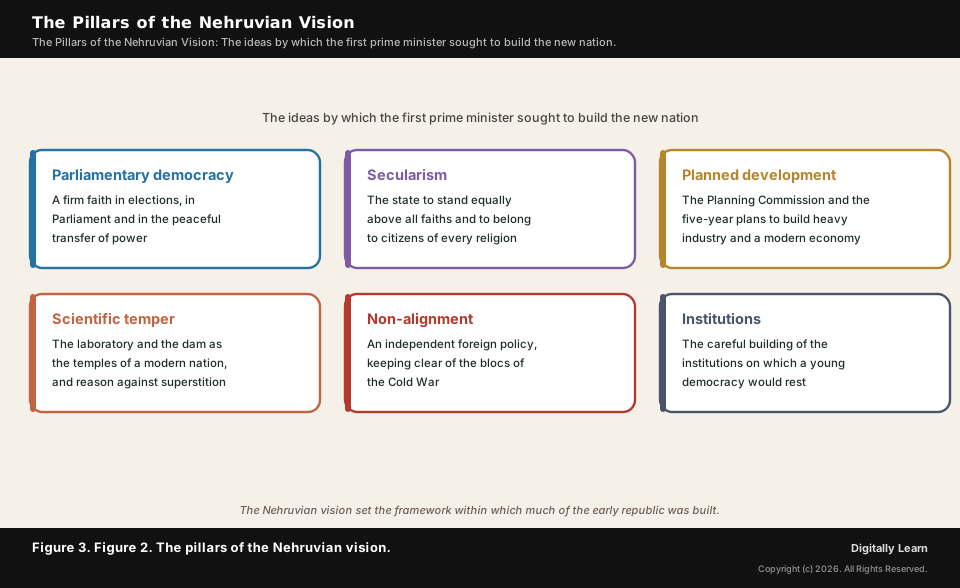
His vision had several pillars. He built a secular state that stood equally above all faiths; a planned economy, through the Planning Commission and the five-year plans, to build heavy industry; a scientific temper, with the laboratory and the dam as the temples of the new age; and a foreign policy of non-alignment, keeping clear of the Cold War blocs. The figure below sets out these pillars.
Observable outcome: The institutions and the idea of India that Nehru built proved remarkably durable, and the democratic and secular framework he laid down has outlasted him by generations. His record was not without criticism, over the reverse in the war of 1962 and the limits of the planned economy, but his place as the principal builder of the republic's framework is secure.
Sardar Vallabhbhai Patel: The Iron Man and the Integration of the States
How the Deputy Prime Minister Forged a United Nation from the Princely States
Distinguishing Patel's contribution: Sardar Vallabhbhai Patel, the first deputy prime minister and home minister, gave the new nation its unity. At independence more than five hundred princely states stood outside British India, and the danger that the country would break into fragments was real. Patel, with V. P. Menon at the States Department, persuaded almost every ruler to accede, by a mixture of appeal to patriotism, firm pressure and generous terms.
The integration met both administrative and human challenges. The administrative task was to merge hundreds of separate administrations, with their own laws, currencies and services, into the structure of the union, a work of great complexity. The human and cultural problem was to reconcile the rulers and the diverse peoples of the states to a common citizenship, and the hard cases of Junagadh, Hyderabad and Kashmir, treated in an earlier part, showed how difficult the work could be.
Observable outcome: Patel's achievement, which earned him the name of the Iron Man, was the making of a single nation from the patchwork the British left behind. The full account of the integration is given in the parts on the princely states; his place here is as the architect of the nation's territorial unity, without which little else could have been built.
B. R. Ambedkar: The Architect of the Constitution and Social Justice
How the Chairman of the Drafting Committee Built the Charter of Equality
Distinguishing Ambedkar's contribution: Bhimrao Ramji Ambedkar, the first law minister, served as chairman of the drafting committee of the Constituent Assembly and is honoured as the principal architect of the Constitution. He defended the draft through the long debates, and into it he wrote the fundamental rights, the remedies to enforce them and the framework of a democratic republic.
His deeper cause was social justice. Born into an untouchable community and a lifelong fighter against caste, Ambedkar made the Constitution a charter of equality, abolishing untouchability and opening the way to the protective discrimination that would lift the oppressed. He described the right to constitutional remedies, the right to move the courts to enforce the fundamental rights, as the heart and soul of the Constitution.
Like Gandhi, with whom he often differed in method, he sought the amelioration of the downtrodden, the goal that united two very different reformers.
Observable outcome: Ambedkar gave the republic a Constitution that has endured as the supreme law and the framework of its democracy, and a promise of equality that, however imperfectly realised, remains the standard against which the nation measures itself. His legacy is both the document and the continuing struggle for the dignity of the oppressed.
Lal Bahadur Shastri: The Soldier, the Farmer and the Quiet Leader
How the Second Prime Minister Steadied the Nation in a Difficult Hour
Distinguishing Shastri's contribution: Lal Bahadur Shastri, the second prime minister, led the nation through a difficult passage after the death of Nehru. A man of great simplicity and integrity, he steadied a country shaken by the loss of its founding leader, and his calm authority held the republic firm in a testing hour.
His leadership was tested by war and by hunger. He led the nation through the war of 1965, and his slogan Jai Jawan Jai Kisan, hail the soldier and the farmer, honoured those who defended and fed the country. He encouraged the beginnings of the green revolution in food and the white revolution in milk, and at Tashkent in 1966 he made peace after the war, dying there the day after the agreement was signed.
Observable outcome: Shastri's short tenure left a memory of integrity and quiet strength out of proportion to its length. He showed that the republic could survive the passing of its founders and renew its leadership, and his support for the farmer and the soldier set a tone that long outlived him.
Indira Gandhi: A Towering and Contested Leadership
How a Long and Powerful Premiership Shaped, and Divided, Its Era
Distinguishing Indira Gandhi's leadership: Indira Gandhi, prime minister across much of the period from the later 1960s to the early 1980s, was among the most powerful and the most contested leaders the republic has known. Her leadership is recorded here as a historical fact in balanced terms, for it carried both great achievements and a grave departure from democratic norms, and it is treated more fully in the earlier parts.
Her record held both achievement and controversy. On one side stood the nationalisation of the banks, the victory in the war of 1971 and the creation of Bangladesh, the first nuclear test, and a powerful appeal to the poor; on the other stood the suspension of democracy in the Emergency of 1975 to 1977, examined in its own part, which remains the gravest test the republic's democracy has faced.
The two sides of the record are set down here together, without a partisan verdict on either.
Observable outcome: Indira Gandhi left a republic changed by her strength and shadowed by the Emergency, and a politics more centred on a single leader. Her era, with its achievements and its dark chapter, is narrated in the parts on the wars, the nuclear programme and the Emergency; her place here is as a towering and divisive builder whose record the nation still debates.
P. V. Narasimha Rao: The Architect of the Economic Turn
How the Prime Minister of 1991 Opened the Economy to the World
Distinguishing Rao's contribution: P. V. Narasimha Rao, prime minister from 1991, presided over the decisive turn in the economic history of the republic. Faced with a grave balance-of-payments crisis on taking office, he supported his finance minister, Manmohan Singh, in carrying out the reforms of liberalisation, privatisation and globalisation that opened the long-protected economy to the market and the world.
His leadership was quiet but consequential. A scholar and a veteran of long political experience, Rao managed a minority government with patience and steered the difficult reforms through a wary Parliament. He also began the turn in foreign policy towards the fast-growing economies of the east, the Look East engagement treated in the part on foreign relations. The full account of the reforms is given in the parts on the reforms of 1991 and on contemporary India.
Observable outcome: The economic turn of 1991, carried out under Rao, reshaped the economy for a generation and is among the most consequential decisions of the contemporary republic. His contribution is recorded here as a dated fact of leadership, without entering the debate over the merits of the reforms, which belongs to the study of the economy itself.
Verghese Kurien: The Milkman of the Nation and the White Revolution
How a Dairy Engineer Built the World's Largest Movement of Milk Producers
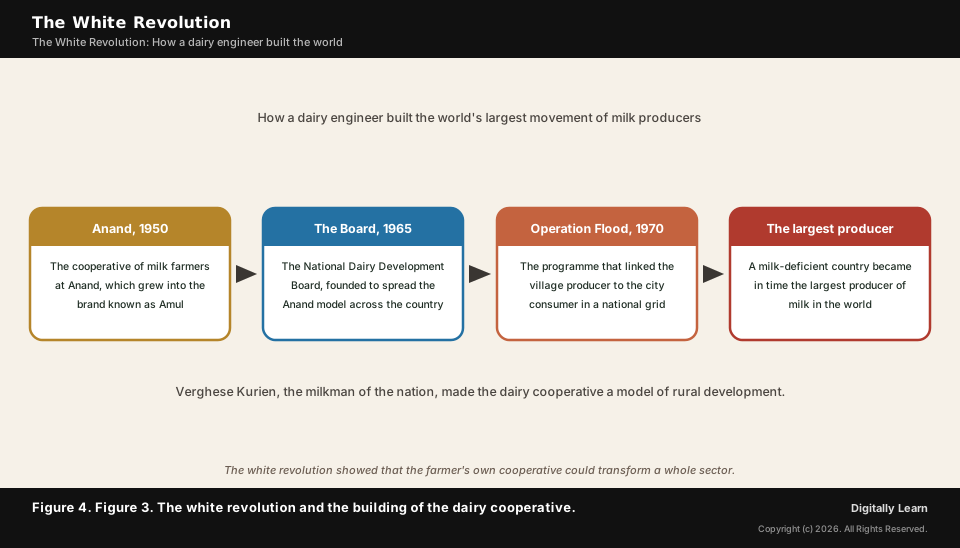
Distinguishing Kurien's contribution: Not every architect of the nation was a politician. Verghese Kurien, a dairy engineer, built one of the great social and economic movements of the republic, the white revolution, which transformed a milk-deficient country into the largest producer of milk in the world. His work showed that the building of the nation went on in the village and the cooperative as much as in the capital.
His method was the farmer's own cooperative. At Anand he helped build the cooperative of milk farmers that grew into the brand known as Amul, in which the producers owned the dairy and kept the profit.
As head of the National Dairy Development Board he spread this Anand model across the country through the programme of Operation Flood, linking the village producer to the city consumer in a national grid, the story treated in the part on the agrarian revolutions.
Observable outcome: Kurien's cooperative movement lifted the incomes of millions of small dairy farmers and made the nation the world's foremost producer of milk. His example, that a farmer-owned institution could transform a whole sector, is among the most successful models of rural development the republic has produced.
Significance: Leadership and the Building of a Nation
How a Founding Generation Shaped the Republic and Its Future
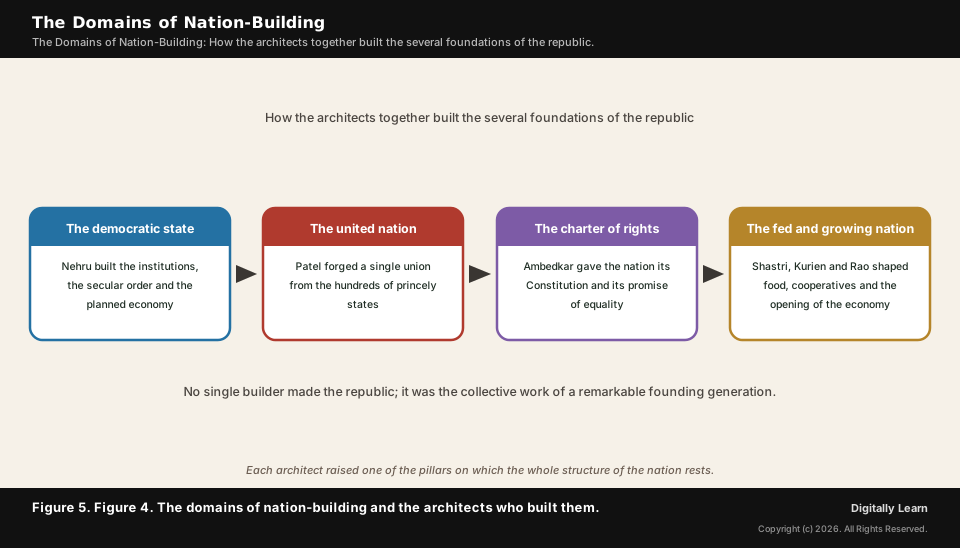
The larger significance of these architects is that the republic was built not by an abstract process but by particular men and women, whose visions and choices gave it its shape. The democratic state, the territorial unity, the Constitution, the steadying of the nation, the opening of the economy and the cooperative movement were each the work of a builder, and the nation of the present rests on the foundations they laid.
No single architect made the republic. It was the collective achievement of a remarkable founding generation, who often differed sharply in their visions yet together built the several pillars on which the structure stands. The figure below sets out how their work combined.
Contemporary linkages carry their legacy into the present. The debates over the institutions Nehru built, the unity Patel forged, the equality Ambedkar promised and the economy Rao opened are living debates, and the work of nation-building, far from finished, continues in each generation.
The deeper lesson is that a nation is built by the choices of its leaders within the possibilities of their time, and that the founding generation, for all its differences and its flaws, left a republic strong enough to carry the hopes of those who came after. The parts that follow turn from the builders to the policies and the larger themes of the whole endeavour of nation-building.
- Nehru built the democratic and secular state, its institutions and its planned economy and non-aligned foreign policy.
- Patel integrated more than five hundred princely states into a single union, earning the name of the Iron Man.
- Ambedkar, as chairman of the drafting committee, gave the nation its Constitution and its charter of equality.
- Shastri steadied the nation, Indira Gandhi led a towering and contested era, and Narasimha Rao opened the economy in 1991.
- Verghese Kurien built the white revolution, a reminder that the architects of the nation were not only its politicians.
Previous Year UPSC-CSE Questions
Previous Year UPSC-CSE Questions By the end you will be able to draft model answers for the following UPSC questions. Each question carries a collapsible framework showing how to approach it in the exam.
- UPSC Mains 2015 GS-IMahatma Gandhi and Dr. B R Ambedkar, despite having divergent approaches and strategies, had a common goal of amelioration of the downtrodden. Elucidate.
How to structure the answer in the exam
Introduction: Open with the shared goal of the amelioration of the downtrodden.
Body (sub-themes to develop):
- Common goal: the upliftment and dignity of the depressed classes and the end of untouchability.
- Gandhi's approach: change of heart, Harijan upliftment, reform within Hinduism, the Poona Pact.
- Ambedkar's approach: law, constitutional safeguards, rights, and ultimately conversion.
- Convergence and divergence: same end, different means, occasional sharp conflict.
Conclusion: Conclude that despite their differences of method, both worked toward the dignity and equality of the oppressed.
- UPSC Mains 2021 GS-IAssess the main administrative issues and socio- cultural problems in the integration process of Indian Princely States.
How to structure the answer in the exam
Introduction: Open with the scale of the task, more than five hundred states outside British India.
Body (sub-themes to develop):
- Administrative: merging separate laws, currencies, services and administrations into the union.
- Socio-cultural: reconciling rulers and diverse peoples to a common citizenship and identity.
- The instruments: accession, merger, and the role of Patel and V. P. Menon.
- The hard cases: Junagadh, Hyderabad and Kashmir as the difficult exceptions.
Conclusion: Conclude that the integration, despite its administrative and cultural difficulties, forged a single nation from a patchwork.
- UPSC Prelims 2002 GS Paper IWhich one of the following rights was described by Dr B. R. Ambedkar as the heart and soul of the Constitution?
How to approach this Prelims question
Approach: Recall Ambedkar's description of the right that enforces all others.
Trap to watch: The heart and soul is the right to constitutional remedies (Article 32), not the right to equality or freedom.
Key facts to recall:
- Ambedkar called the right to constitutional remedies the heart and soul of the Constitution
- It is the right to move the courts to enforce fundamental rights
- It corresponds to Article 32
Answer signal: The right to Constitutional remedies, option (d).
Sources and Further Reading
- NCERT, Politics in India since Independence (Class 12)
- Wikipedia: Jawaharlal Nehru
- Wikipedia: Vallabhbhai Patel
- Wikipedia: B. R. Ambedkar
- Wikipedia: Lal Bahadur Shastri
- Wikipedia: Verghese Kurien
- Prime Minister's Office, Government of India
- Ministry of Culture, Government of India
- Press Information Bureau, Government of India
- National Portal of India
Editorial Disclaimer
This article is prepared for civil services preparation. Verify key facts and interpretations against standard reference works before relying on them.