

Overview
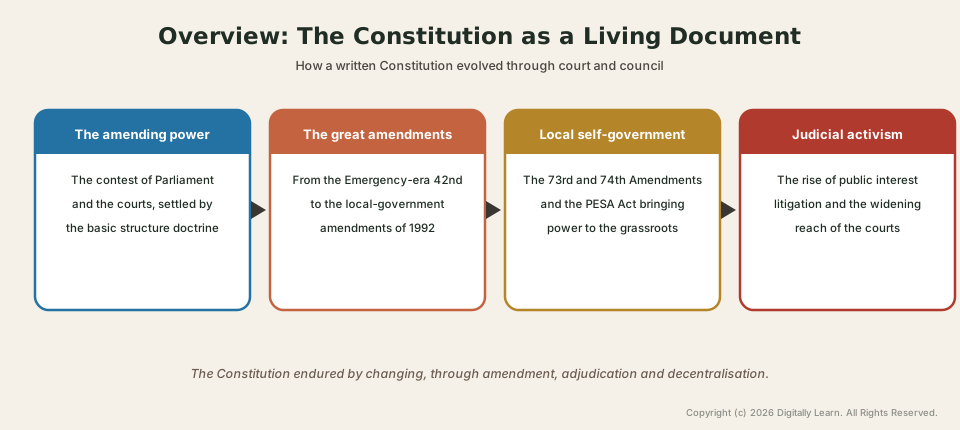
Constitutional evolution is the story of how the Constitution of 1950, far from being a fixed text, grew and adapted over the decades while keeping its essential character. It evolved along three lines: by formal amendment under Article 368, a power whose limits were settled by the long contest between Parliament and the judiciary and the doctrine of the basic structure; by the constitutionalisation of local self-government through the 73rd and 74th Amendments; and by the courts themselves, through judicial activism and public interest litigation. This part traces that evolution, drawing together the amendments, the great cases and the deepening of democracy at the grassroots.
Constitutional Evolution: A Living Document
Why a Written Constitution Had to Grow Without Losing Itself
Why this matters: A constitution that cannot change ossifies, while one that can be changed at will offers no security; the genius of the Indian system lay in finding a path between the two. The Constitution of 1950 was made amendable, but the question of how far it could be amended, and whether anything in it was beyond change, became one of the great constitutional debates of the republic, and the answer it reached shaped the working of democracy itself.
What is the significance of constitutional evolution: It is the proof that the Constitution is a living document, not a museum piece. Through amendment, through the judgments of the courts and through the devolution of power to the grassroots, the charter of 1950 was continually renewed, kept in step with a changing society while its core, the democratic and federal structure and the rights of the citizen, was held secure. This part follows the chief lines of that growth.
Parliament versus the Judiciary: The Struggle Over the Amending Power
How the Question of Whether Rights Could Be Amended Was Fought Out
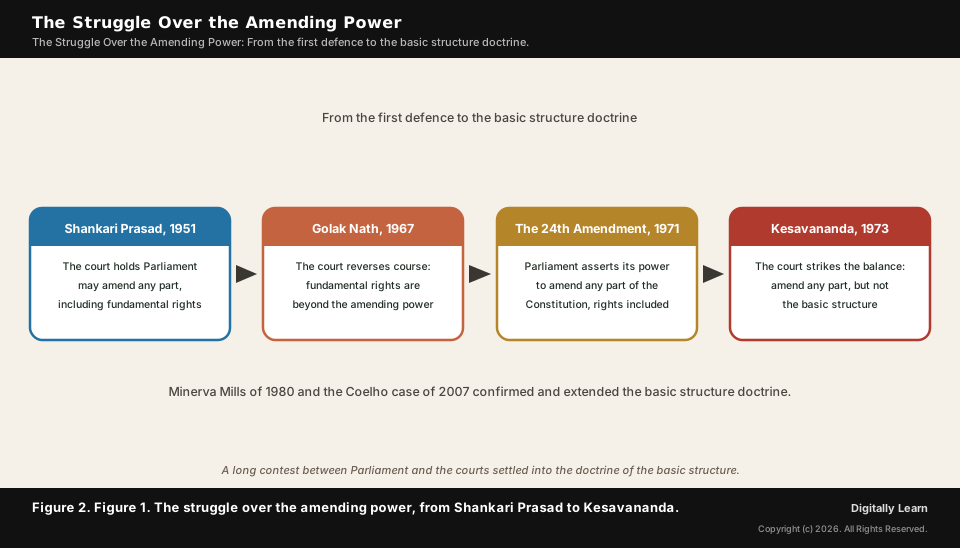
Distinguishing the central contest: At the heart of constitutional evolution lay a struggle between Parliament and the judiciary over the reach of the amending power in Article 368. Could Parliament amend any part of the Constitution, including the fundamental rights of the citizen? In the early years the court said yes, holding in the Shankari Prasad case of 1951 that the amending power extended even to the rights, a position it reaffirmed for over a decade.
The court then reversed itself, and Parliament answered. In the Golak Nath case of 1967 the court held that fundamental rights stood outside the amending power and could not be abridged by amendment at all. Parliament responded with the Twenty-fourth Amendment of 1971, asserting in plain terms its power to amend any part of the Constitution, the rights included, and setting the stage for the decisive confrontation that followed.
Observable outcome: The contest was not a mere lawyers' quarrel but a question of where sovereignty finally lay, with the elected Parliament or with the Constitution as guarded by the courts. Each side pressed its claim, Parliament through amendment and the judiciary through interpretation, and the unresolved tension drove the constitutional law of the republic towards the landmark settlement of 1973.
The Basic Structure Doctrine: From Golak Nath to Kesavananda
How the Court Settled the Limits of the Amending Power
Distinguishing the great settlement: The contest was resolved in 1973 in the case of Kesavananda Bharati, the most important constitutional judgment in the history of the republic. A full bench of the Supreme Court held that Parliament could amend any part of the Constitution, overruling Golak Nath, but that it could not alter or destroy its basic structure, the essential framework of features such as democracy, the rule of law, judicial review, federalism and the separation of powers.
The doctrine became the guard of the constitutional order. The basic structure doctrine gave the courts a power to strike down even a constitutional amendment if it damaged the core, and it was this doctrine that, in the Minerva Mills case of 1980, was used to undo the attempt of the 42nd Amendment to place amendments beyond judicial review, as the previous part described. In the later Coelho case of 2007 the court extended the test to laws placed in the Ninth Schedule after 1973, so that even they could be examined against the basic structure. The figure below traces this long arc.
Observable outcome: The basic structure doctrine is the single most important contribution of the Indian judiciary to constitutional law, copied since in other countries. It struck a durable balance, allowing the Constitution to be amended freely to meet new needs while placing its democratic core beyond the reach of any transient majority, and it remains the ultimate safeguard of the constitutional order.
The 42nd and 44th Amendments: The Emergency and Its Reversal
How the Most Dramatic Amendments Fit into the Wider Evolution
Distinguishing the most dramatic amendments: The single most far-reaching pair of amendments belongs to the period of the Emergency, treated in detail in the previous part. The 42nd Amendment of 1976, the so-called mini-constitution, recast the document on a vast scale, while the 44th Amendment of 1978 reversed much of that overreach and built safeguards against another emergency.
Seen within the longer arc, they illustrate the contest of the period. The 42nd Amendment was the high point of Parliament's attempt to assert an unlimited amending power and to subordinate the courts, and its partial undoing, by the 44th Amendment and by the basic structure doctrine in Minerva Mills, was the reassertion of the constitutional balance. Some of the 42nd Amendment's additions, the words socialist and secular and the Fundamental Duties, endured, while its assault on judicial review did not.
Observable outcome: The two amendments stand as the most vivid demonstration of how the amending power can be used and misused, and of how the basic structure doctrine works as the final check upon it. They are treated as dated facts here and at greater length in the part on the Emergency; their place in this account is as the central episode of the long struggle over the Constitution's evolution.
The Anti-Defection Law: Discipline in the Legislatures
How a Later Amendment Addressed the Problem of Defections
Distinguishing a reform of political conduct: A different kind of constitutional evolution addressed not the structure of power but the conduct of politics. The defection of legislators from one party to another, which had destabilised governments since the late 1960s, was checked by the 52nd Amendment of 1985, which added the Tenth Schedule, the anti-defection law, providing for the disqualification of members who defy their party, treated more fully in the earlier part on the party system.
The law was later refined and tested in the courts. The 91st Amendment of 2003 tightened it, barring the splits it had originally exempted, while the courts, in the Kihoto Hollohan case of 1992, upheld the law but brought the decisions of the presiding officer under judicial review. The anti-defection law shows the Constitution evolving to meet a practical danger to stable government, and the continuing role of the courts in shaping how a new provision works.
Observable outcome: The anti-defection law has given a measure of stability to governments, at some cost to the independence of the individual legislator, a trade-off that remains debated. Its place in the story of constitutional evolution is as an example of amendment used to manage the practical working of democracy, alongside the great structural questions of the amending power and the rights.
Panchayati Raj: From Balwant Rai Mehta to the 73rd Amendment
How the Long Effort to Build Local Democracy Reached the Constitution
Distinguishing the road to local democracy: The idea of self-government at the village level was old, but its constitutional form was long in coming. The Balwant Rai Mehta Committee of 1957 had recommended a three-tier system of panchayats, treated in the earlier part on planning, and the Ashok Mehta Committee of 1978 proposed a two-tier scheme; but the panchayats set up under state law remained weak, starved of funds and powers, and often left unelected for years.
The remedy was to give them a constitutional foundation. The directive principles had always urged the state to organise village panchayats, but a directive could be ignored; only by writing local self-government into the Constitution itself could it be made secure. After earlier attempts failed, the way was prepared for the comprehensive amendments of 1992 that would at last give the panchayats and the municipalities a guaranteed place in the constitutional structure.
Observable outcome: The long neglect of the panchayats taught the lesson that local democracy could not be left to the goodwill of the states, and that a constitutional guarantee was needed to protect it. That lesson was acted upon in the 73rd and 74th Amendments, which converted the aspiration of the directive principles into an enforceable part of the Constitution.
The 73rd and 74th Amendments: Local Self-Government Constitutionalised
How the Amendments of 1992 Created the Third Tier of Democracy
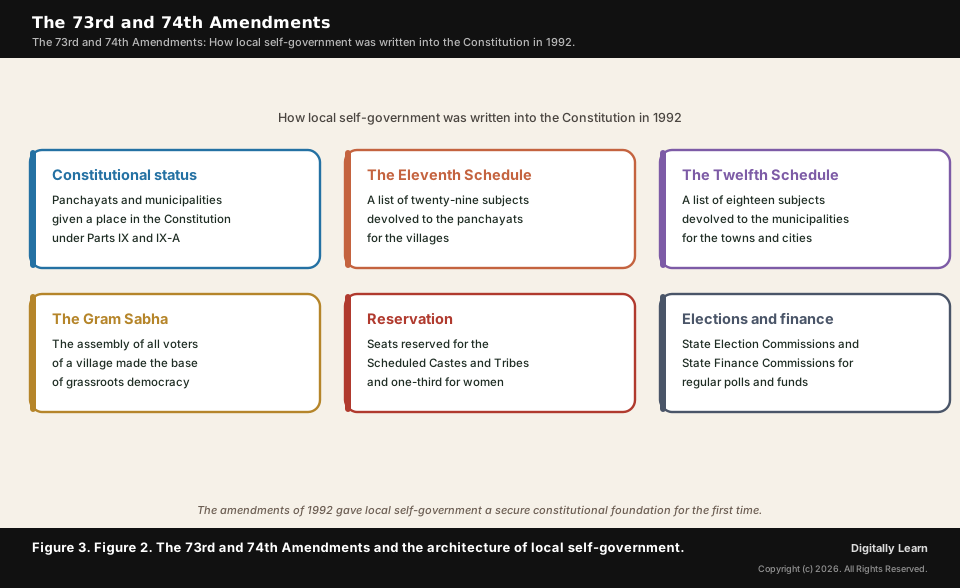
Distinguishing the constitutionalisation of local government: The 73rd and 74th Amendments of 1992 were among the most significant of the later evolution, creating a third tier of government below the union and the states. The 73rd Amendment gave the rural panchayats a constitutional place under a new Part IX, with the village assembly, the Gram Sabha, at its base, while the 74th did the same for the urban municipalities under Part IX-A; the Eleventh and Twelfth Schedules listed the subjects to be devolved to them.
The amendments built in the conditions of a real local democracy. They required regular elections held by independent State Election Commissions, provided for State Finance Commissions to assure the flow of funds, and reserved seats for the Scheduled Castes, the Scheduled Tribes and, in a landmark provision, a third of all seats for women, bringing more than a million women into elected office. The figure below sets out this architecture.
Observable outcome: The amendments of 1992 carried the practice of democracy down to the village and the town, completing the structure of the republic with a third tier closest to the people. Their working has been uneven, with the states often slow to devolve real powers and funds, but they established, beyond the reach of any reluctant government, the constitutional right of local communities to govern themselves.
Judicial Activism and Public Interest Litigation
How the Courts Widened Their Reach Through Public Interest Litigation
Distinguishing the new role of the courts: From the late 1970s the Supreme Court took on a more active role in the life of the nation, and the chief instrument of this judicial activism was public interest litigation. By relaxing the old rule that only the person directly affected could approach the court, the judges allowed any public-spirited citizen, and even a letter to the court, to raise the grievances of those too poor or powerless to come themselves, opening the courts to the prisoner, the bonded labourer and the slum-dweller.
Public interest litigation grew from several causes. It grew from the courts' wish to repair their standing after the Emergency, from the failures of the executive and the legislature to deliver on rights, and from a creative reading of the right to life in Article 21, which the courts expanded to include a life of dignity, a clean environment and many other entitlements. Through public interest litigation the courts reached into prisons, hospitals, forests and workplaces, and some have called the Indian Supreme Court the most powerful in the world.
Observable outcome: Public interest litigation widened access to justice and made the courts a forum for the unheard, a real gain for the poor and for the protection of rights and the environment. It has also drawn the charge of judicial overreach, of the courts straying into the proper work of the elected branches, and the balance between an activist judiciary and the separation of powers remains one of the live questions of constitutional evolution.
PESA and Tribal Self-Government
How Self-Rule Was Extended to the Tribal Scheduled Areas
Distinguishing the tribal extension: The 73rd Amendment did not apply automatically to the scheduled areas with large tribal populations, whose distinct customs needed a tailored form of self-government. To extend local democracy to them, Parliament passed the Panchayat (Extension to the Scheduled Areas) Act, the PESA Act, of 1996, carrying the panchayat system into the Fifth Schedule areas while protecting tribal traditions of self-rule.
PESA gave the village assembly real powers. Under the Act the Gram Sabha of a tribal village was given a central role, with powers to safeguard community resources, to manage minor forest produce, to be consulted before land was acquired or people displaced, and to approve plans and identify beneficiaries, making the village assembly, rather than a distant office, the centre of decision in the scheduled areas. It was a recognition that tribal self-government had to rest on the community's own institutions.
Observable outcome: PESA marked an important step in tribal self-government, giving the scheduled areas a form of local democracy shaped to their own traditions and a measure of control over the resources on which their life depended. Its promise has often outrun its delivery, with the powers of the Gram Sabha unevenly honoured, but it stands as the constitutional recognition that self-rule must be adapted to the people it serves.
Significance: The Living Constitution and the Deepening of Democracy
How Amendment, Adjudication and Decentralisation Renewed the Republic
The larger significance of this evolution is that the Constitution proved able to grow without breaking, to change with the times while keeping its essential character. The three instruments of that growth, amendment by Parliament, interpretation by the courts and the devolution of power to the grassroots, together kept the document of 1950 a living charter, responsive to new demands yet anchored by the basic structure that no majority could erase.
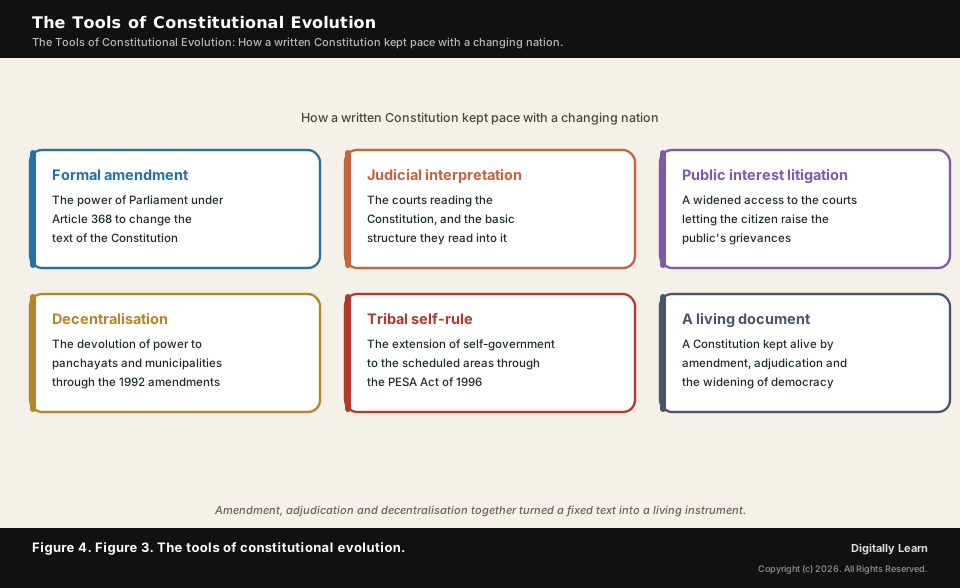
Contemporary linkages keep this evolution at the centre of public life. The reach of the amending power, the boundaries of judicial activism, the unfinished devolution of real power to the panchayats and municipalities, and the rights of tribal communities under PESA are all live questions, each a continuation of the constitutional development of these decades.
| Case | Year | What it settled |
|---|---|---|
| Shankari Prasad | 1951 | Parliament may amend even the fundamental rights |
| Golak Nath | 1967 | Fundamental rights are beyond the amending power |
| Kesavananda Bharati | 1973 | Amend any part, but not the basic structure |
| Minerva Mills | 1980 | The limited amending power is itself part of the basic structure |
| Coelho | 2007 | Ninth Schedule laws after 1973 are open to basic-structure review |
The deeper lesson is that a constitution lives not in its words alone but in the institutions that interpret and apply it, and that the health of a democracy depends on the balance among Parliament, the courts and the people it keeps. The next part turns from the constitutional order to the building of the nation's capacities in science, technology and space.
- The struggle over the amending power ran from Shankari Prasad in 1951 to Kesavananda Bharati in 1973.
- The basic structure doctrine lets Parliament amend any part of the Constitution but not its essential core.
- The 73rd and 74th Amendments of 1992 gave panchayats and municipalities a constitutional status with reserved seats for women.
- Public interest litigation widened access to the courts and expanded the right to life under Article 21.
- The PESA Act of 1996 extended self-government, through the Gram Sabha, to the tribal scheduled areas.
Previous Year UPSC-CSE Questions
Previous Year UPSC-CSE Questions By the end you will be able to draft model answers for the following UPSC questions. Each question carries a collapsible framework showing how to approach it in the exam.
- UPSC Mains 2024 GS-IIExplain the reasons for the growth of public interest litigation in India. As a result of it, has the Indian Supreme Court emerged as the world’s most powerful judiciary ?
How to structure the answer in the exam
Introduction: Open with PIL as the chief instrument of judicial activism since the late 1970s.
Body (sub-themes to develop):
- Reasons: relaxed locus standi and epistolary jurisdiction; the failures of the executive and legislature; the post-Emergency wish to restore legitimacy; the expansive reading of Article 21.
- The reach: PIL extending the courts into prisons, environment, labour and governance.
- The case for 'most powerful': the breadth of judicial review and the basic structure doctrine.
- The caution: the charge of judicial overreach and the separation of powers.
Conclusion: Conclude that PIL has made the court exceptionally powerful and a guardian of rights, but that its activism must respect the limits of the judicial role.
- UPSC Mains 2022 GS-IITo what extent, in your opinion, has the decentralisation of power in India changed the governance landscape at the grassroots?
How to structure the answer in the exam
Introduction: Open with the 73rd and 74th Amendments as the foundation of grassroots democracy.
Body (sub-themes to develop):
- The change: a constitutional third tier, regular elections, reservation for women and the weaker sections, devolved subjects.
- The deepening: more than a million women and many from the weaker sections brought into elected office.
- The limits: states slow to devolve funds, functions and functionaries; weak finances; elite capture.
- PESA: the extension of self-rule to tribal areas, with its own gap between promise and delivery.
Conclusion: Conclude that decentralisation has changed the grassroots landscape substantially but that its promise awaits the full devolution of power.
- UPSC Prelims 2018 GS Paper IConsider the following statements :
- The Parliament of India can place a particular law in the Ninth Schedule of the Constitution of India.
- The validity of a law placed in the Ninth Schedule cannot be examined by any court and no judgement can be made on it.
Which of the statements given above is/are correct ?
How to approach this Prelims question
Approach: Test each statement against the Ninth Schedule and the Coelho judgment.
Trap to watch: After the Coelho case of 2007, Ninth Schedule laws added after 1973 are open to judicial review on the basic-structure test, so statement 2 is wrong.
Key facts to recall:
- Parliament can add a law to the Ninth Schedule
- The Coelho case 2007 opened post-1973 Ninth Schedule laws to basic-structure review
- Their validity can therefore be examined
Answer signal: Statement 1 only, so option (a).
Sources and Further Reading
- NCERT, Indian Constitution at Work (Class 11)
- NCERT, Politics in India since Independence (Class 12)
- Wikipedia: Basic structure doctrine
- Wikipedia: Kesavananda Bharati v. State of Kerala
- Wikipedia: 73rd Amendment of the Constitution of India
- Wikipedia: Panchayats (Extension to Scheduled Areas) Act, 1996
- Ministry of Panchayati Raj, Government of India
- India Code: The Constitution of India
- Supreme Court of India
- National Portal of India
Editorial Disclaimer
This article is prepared for civil services preparation. Verify key facts and interpretations against standard reference works before relying on them.