
Overview
Previous Year UPSC-CSE Questions By the end you will be able to draft model answers for the following UPSC questions. Each question carries a collapsible framework showing how to approach it in the exam.
- UPSC Mains 2021 GS-IBring out the constructive programmes of Mahatma Gandhi during Non-Cooperation Movement and Civil Disobedience Movement.
How to structure the answer in the exam
Introduction: Open with the constructive programme as the positive, nation-building arm of Gandhi's politics.
Body (sub-themes to develop):
- Khadi and the charkha; the boycott of foreign cloth and self-reliance.
- National and basic education (Nai Talim) and Hindu-Muslim unity.
- The removal of untouchability and the upliftment of the weak.
- Village industries, sanitation and rural reconstruction.
Conclusion: Conclude that the constructive programme made the movements self-sustaining and built the nation from below.
- UPSC Mains 2018 GS-IThrow light on the significance of the thoughts of Mahatma Gandhi in the present times.
How to structure the answer in the exam
Introduction: Open with Gandhi's economic ideas as a living resource for present problems.
Body (sub-themes to develop):
- Trusteeship and the question of inequality.
- Swadeshi, self-reliance and local economies.
- Sustainability and the critique of unlimited consumption.
- Decentralisation, the village and panchayati raj.
Conclusion: Conclude that Gandhi's economic thought remains a relevant, if debated, guide to development.
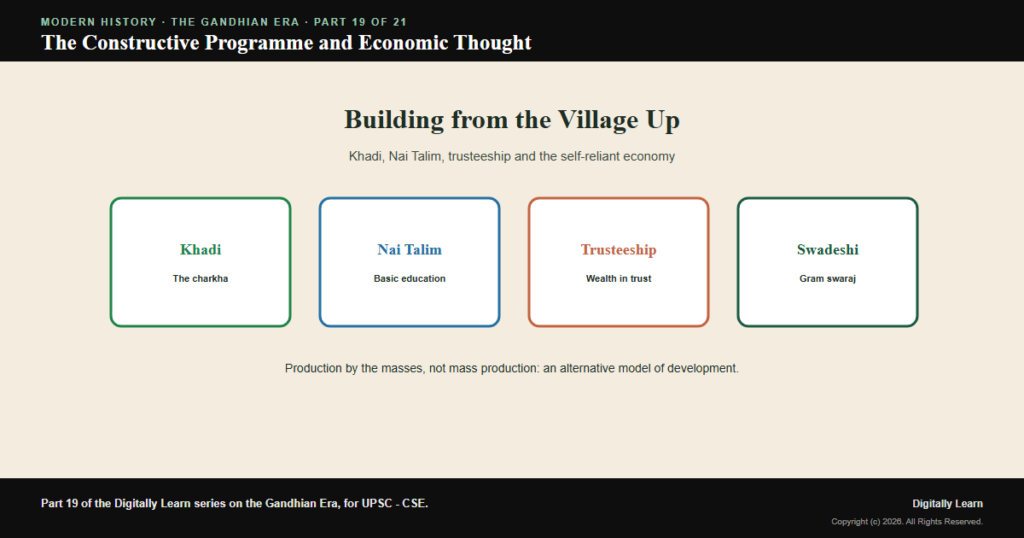
Gandhi's constructive programme was his positive agenda of nation-building, to be pursued alongside, and beyond, political agitation. Centred on the charkha and khadi, it embraced village industries, basic education, communal unity, the removal of untouchability and rural reconstruction. Behind it lay a distinct body of Gandhian economic thought: a decentralised, village-centred and self-sufficient economy, the principle of swadeshi, and the idea of trusteeship, by which the wealthy would hold their surplus in trust for society. It offered an alternative model of development that still shapes Indian debate.
Introduction: An Alternative Model of Development
Why the Constructive Programme Matters
Why this matters: Gandhi's politics had two arms, not one. Beside the great campaigns of agitation, he built a steady programme of positive, constructive work, and he held that real freedom would come only when Indians rebuilt their own society and economy from below.
What is the significance of this theme: it sets out Gandhi as a social and economic thinker, not only a political leader. His constructive programme and his economic ideas offered an alternative model of development whose questions, about the village, self-reliance and the limits of the machine, are still alive today.
The Constructive Programme: Khadi, Village Industries and Rural Reconstruction
Building the Nation from the Village Up
What is the significance of the constructive programme: it was Gandhi's blueprint for building a free nation from the ground up. At its centre stood the charkha, the spinning wheel, and khadi, the homespun cloth, which he made symbols of self-reliance and of dignity in labour.
Distinguishing its breadth: the programme ran along many fronts at once, village industries, basic education, communal unity, the removal of untouchability, sanitation and the upliftment of the weak, as the wheel below sets out. Each was a way of making Indians independent of the colonial order in daily life.
The Many Fronts of Self-Reliance
Observable outcomes took institutional shape over two decades. Gandhi founded the All India Spinners Association in 1925 to organise khadi, and the All India Village Industries Association in 1934 to revive crafts such as hand-pounded rice, oil-pressing, soap and paper-making.
Distinguishing the aim: these bodies were not charity but a strategy of economic self-reliance, giving the village an income and the nation a base independent of imported goods and machine industry.
Basic Education (Nai Talim) and the Gandhian School
Learning Through Productive Work
What is the significance of Nai Talim: it was Gandhi's answer to a colonial education that he thought made Indians clerks and strangers to their own society. His scheme of basic education, or Nai Talim, was presented at a conference at Wardha in 1937.
Distinguishing its method: it sought to teach the whole child, body, mind and spirit, through a productive handicraft, so that learning and work were joined and the school could even pay for itself. It valued the dignity of manual labour and the knowledge of the village, and stood among the institutions of Gandhi's constructive work set out below.
| Institution or charter | Year | Purpose |
|---|---|---|
| All India Spinners Association | 1925 | To organise and promote khadi |
| All India Village Industries Association | 1934 | To revive village crafts and industries |
| Nai Talim (the Wardha scheme) | 1937 | Basic education through productive work |
| Constructive Programme (pamphlet) | 1940s | Gandhi's written charter of the programme |
Gandhian Economic Thought: The Village-Centric, Decentralised Economy
Swadeshi, Decentralisation and Self-Sufficiency
What is the significance of Gandhian economics: it placed the village, not the city or the factory, at the centre of the economy. Gandhi argued for a decentralised order of self-sufficient village communities, or gram swaraj, producing for local needs from local resources.
Distinguishing its principles: swadeshi meant using what was made near home; decentralisation meant spreading production widely rather than concentrating it; and Sarvodaya, the welfare of all, meant putting the poorest first. These pillars are set out below.
Trusteeship and the Critique of Industrialisation
Wealth as a Trust, and the Limits of the Machine
What is the significance of trusteeship: it was Gandhi's answer to inequality without class war. By the doctrine of trusteeship, those with wealth would not be dispossessed but would hold their surplus, above their own needs, as a trust for the welfare of the whole community, especially the poorest.
Distinguishing the critique: drawing on Ruskin and on his own Hind Swaraj of 1909, Gandhi rejected the modern industrial civilisation of endlessly multiplying wants, favouring 'production by the masses' over mass production by the machine. He did not oppose all machinery, but he wanted it to serve the village, not to displace it, as the contrast below sets out.
Significance: An Alternative Model of Development and Self-Reliance
Why the Gandhian Model Still Matters
Contemporary linkages run from Gandhi's economic thought into present-day debates. His stress on self-reliance, village industry and sustainability echoes in the khadi and village-industries movement, in panchayati raj and in arguments for ecologically sustainable, decentralised development.
The larger significance is that Gandhi offered a whole alternative vision of progress, one measured not by output alone but by the dignity and welfare of the last person. Critics, including Nehru, held that a poor country needed heavy industry to advance, and that debate endures, as the timeline and points below set out. The next part turns to the many other voices, of peasants, tribals, workers and women, that enriched the movement.
- The constructive programme made nation-building a daily, grassroots task, not only a political one.
- Khadi and village industries survive in the work of bodies such as the Khadi and Village Industries Commission.
- Trusteeship offered a path to reduce inequality without class conflict.
- Nai Talim’s idea of learning through work still informs debates on education.
- The Gandhian model of decentralised, sustainable development remains a live alternative.
Prelims MCQ practice
Each question below tests one specific concept on the topic. Click to reveal the answer and a full option-wise explanation.
Q1. At the centre of Gandhi's constructive programme was:
- heavy industry
- the charkha and khadi
- the cooperative bank
- the trade union
Show answer and explanation
Answer: the charkha and khadi
Explanation.
Option (b) is correct. The charkha (spinning wheel) and khadi were the centre of Gandhi's constructive programme. Hence option (b).
Q2. Gandhi's scheme of basic education was known as:
- Sarvodaya
- Nai Talim
- Satyagraha
- Swadeshi
Show answer and explanation
Answer: Nai Talim
Explanation.
Option (b) is correct. Gandhi's basic-education scheme, presented at Wardha in 1937, was called Nai Talim. Hence option (b).
Q3. The Gandhian doctrine of 'trusteeship' held that:
- the state should own all industry
- the wealthy should hold their surplus in trust for society
- land should be redistributed by force
- foreign capital should run key industries
Show answer and explanation
Answer: the wealthy should hold their surplus in trust for society
Explanation.
Option (b) is correct. Trusteeship meant the wealthy holding their surplus wealth in trust for the welfare of all. Hence option (b).
Q4. Consider the following statements about Gandhian economic thought:
- It favoured a decentralised, village-centred economy.
- It preferred mass production by large machines over production by the masses.
Which of the statements given above is/are correct?
- 1 only
- 2 only
- Both 1 and 2
- Neither 1 nor 2
Show answer and explanation
Answer: 1 only
Explanation.
Only statement 1 is correct. Gandhi favoured a decentralised village economy and 'production by the masses', not mass production by large machines. Hence option (a).
Q5. Gandhi's critique of modern industrial civilisation was first set out in his 1909 work:
- Hind Swaraj
- The Story of My Experiments with Truth
- Unto This Last
- Sarvodaya
Show answer and explanation
Answer: Hind Swaraj
Explanation.
Option (a) is correct. Gandhi set out his critique of modern civilisation in Hind Swaraj (1909). 'Unto This Last' was Ruskin's work, which Gandhi paraphrased as Sarvodaya. Hence option (a).
Q6. Consider the following pairs of a Gandhian body and its work:
- All India Spinners Association : the promotion of khadi.
- All India Village Industries Association : the revival of village crafts.
Which of the pairs given above is/are correctly matched?
- 1 only
- 2 only
- Both 1 and 2
- Neither 1 nor 2
Show answer and explanation
Answer: Both 1 and 2
Explanation.
Both pairs are correct: the All India Spinners Association promoted khadi and the All India Village Industries Association revived village crafts. Hence option (c).
Sources and Further Reading
- Wikipedia: Gandhian economics
- Wikipedia: Nai Talim (Basic Education)
- Wikipedia: Hind Swaraj
- Wikipedia: Trusteeship (Gandhism)
- Wikipedia: Khadi and Village Industries Commission
- NCERT, India's Struggle for Independence / Themes in Indian History III
- Ministry of Culture: Indian Culture Freedom Archive
- Azadi Ka Amrit Mahotsav (Freedom Movement portal)
- Press Information Bureau, Government of India
- National Portal of India
Editorial Disclaimer
This article is prepared for UPSC examination preparation. Verify key facts and interpretations against standard reference histories before relying on them.