
Overview
Previous Year UPSC-CSE Questions By the end you will be able to draft model answers for the following UPSC questions. Each question carries a collapsible framework showing how to approach it in the exam.
- UPSC Mains 2021 GS-IBring out the constructive programmes of Mahatma Gandhi during Non-Cooperation Movement and Civil Disobedience Movement.
How to structure the answer in the exam
Introduction: Open with the constructive programme as the positive face of Gandhian struggle.
Body (sub-themes to develop):
- Non-Cooperation: national schools, panchayat courts, khadi, Hindu-Muslim unity, anti-untouchability.
- Civil Disobedience: salt-making, boycott of foreign cloth and liquor, swadeshi, no-tax self-reliance.
- The constant thread: khadi, the charkha and self-reliance as the economic base of freedom.
- Effect: the constructive work kept the movement rooted in everyday life.
Conclusion: Conclude that the constructive programmes made each movement a way of life, not merely a protest.
- UPSC Prelims 2009 GS Paper IWhich one of the following began with the Dandi March?
How to approach this Prelims question
Approach: Connect the Dandi March to the movement it began.
Trap to watch: Non-Cooperation (1920) and Quit India (1942) are different movements; the Dandi March (1930) began Civil Disobedience.
Key facts to recall:
- Dandi March 1930
- Salt law broken at Dandi
- It launched Civil Disobedience
Answer signal: Civil Disobedience Movement, so option (c).
- UPSC Prelims 2005 GS Paper IAt which Congress Session was the Working Committee authorized to launch a programme of Civil Disobedience?
How to approach this Prelims question
Approach: Link the authorisation of Civil Disobedience to the right session.
Trap to watch: Lahore (1929), not Lucknow (1916) or Tripuri (1939), declared Purna Swaraj and authorised Civil Disobedience.
Key facts to recall:
- Lahore Congress 1929
- Purna Swaraj declared
- Working Committee authorised Civil Disobedience
Answer signal: Lahore, so option (b).
- UPSC Prelims 2015 GS Paper IWho of the following organized a march on the Tanjore coast to break the Salt Law in April 1930?
How to approach this Prelims question
Approach: Identify the leader of the southern salt march.
Trap to watch: It was C. Rajagopalachari (the Vedaranyam march), not the earlier leaders V. O. C. Pillai or Annie Besant.
Key facts to recall:
- Vedaranyam / Tanjore coast salt march
- Led by C. Rajagopalachari
- April 1930, part of Civil Disobedience
Answer signal: C. Rajagopalachari, so option (b).
- UPSC Prelims 2002 GS Paper IDuring the Indian freedom struggle, the Khudai Khidmatgars, also known as Red Shirts, called for
How to approach this Prelims question
Approach: Identify what the Khudai Khidmatgars stood for.
Trap to watch: They were non-violent (not terrorist) and were not a communist or pro-Afghanistan movement; they stood for Pathan nationalism and anti-colonial struggle.
Key facts to recall:
- Khudai Khidmatgars = Red Shirts
- Khan Abdul Ghaffar Khan, the Frontier Gandhi
- Pathan regional nationalism, non-violent, anti-colonial
Answer signal: Pathan regional nationalist unity and a struggle against colonialism, so option (d).
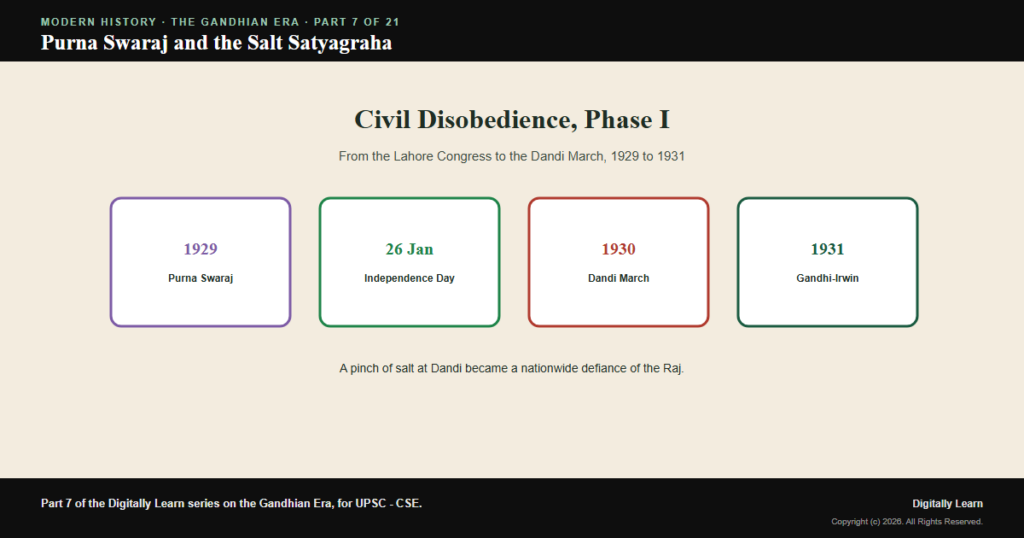
The Salt Satyagraha of 1930 launched the Civil Disobedience Movement, the second great mass struggle of the Gandhian era. After the Congress declared Purna Swaraj, complete independence, at Lahore in 1929, Gandhi marched from Sabarmati to Dandi and broke the salt law on 6 April 1930. Defiance spread across India in many forms, from no-tax campaigns to the boycott of foreign cloth, until the Gandhi-Irwin Pact of 1931 brought a truce and Gandhi to the Second Round Table Conference.
Introduction: From Complete Independence to Mass Action (1929-1931)
Why Civil Disobedience Was the Second Great Movement
Why this matters: the constitutional deadlock of 1927 to 1929 ended not in a settlement but in a new and sharper goal. With the demand for Purna Swaraj, complete independence, the Congress turned once more to mass struggle, and the Salt Satyagraha of 1930 launched the second great movement of the Gandhian era.
What is the significance of Civil Disobedience: where Non-Cooperation had asked Indians to withhold their cooperation, Civil Disobedience went further and asked them to break the law itself, peacefully but openly, beginning with the law on salt. Its course is traced below.
The Course of the Movement at a Glance
Distinguishing the sequence clarifies the whole period. The goal was declared at Lahore, dramatised on 26 January 1930, carried to the sea at Dandi, spread across the country, and finally suspended by a pact with the Viceroy.
What ties the sequence together is a single arc from declaration to mass action to truce, shown in the timeline below.
The Lahore Congress and the Purna Swaraj Declaration (1929)
Jawaharlal Nehru, the Tricolour and 26 January 1930
What is the significance of the Lahore Congress: it changed the goal of the freedom struggle. At the Lahore session of December 1929, with Jawaharlal Nehru as president, the Congress adopted the resolution of Purna Swaraj, complete independence, in place of the older demand for Dominion Status.
Distinguishing the symbolism: at midnight on the last day of 1929, Nehru hoisted the tricolour on the banks of the river Ravi, and the Congress called on Indians to observe 26 January 1930 as Independence Day. It was celebrated across the country and remained the symbolic date until it became the day the Constitution came into force in 1950.
The Causes and Gandhi's Eleven Demands
Why Salt? Gandhi's Eleven Demands and the Choice of Symbol
What is the significance of the choice of salt: it was a masterstroke of mass politics. Before launching the movement, Gandhi put eleven demands to the Viceroy, ranging from the reduction of the land revenue to the release of prisoners, and at their heart was the abolition of the hated salt tax.
Distinguishing why salt worked is set out below. The salt law made it a crime for Indians to make their own salt from the sea, taxing a necessity that the poorest could not do without, and that made it the perfect symbol of an unjust rule.
- A universal grievance: every Indian, rich or poor, used salt every day.
- A visible injustice: it was a crime to make salt from one’s own seashore.
- A burden on the poor: the salt tax fell hardest on those least able to pay.
- Easy to defy: anyone on the coast could break the law simply by making salt.
- A moral symbol: it dramatised an entire system of unjust law in a single act.
The Dandi March: Sabarmati to the Sea (12 March to 6 April 1930)
The March and the Breaking of the Salt Law
Observable outcomes began with the march itself. On 12 March 1930, Gandhi set out from the Sabarmati Ashram with seventy-eight chosen volunteers, and over about twenty-four days they walked some 240 miles to the coastal village of Dandi, gathering crowds at every stop.
Distinguishing the climax: on the morning of 6 April 1930, Gandhi picked up a lump of natural salt from the shore at Dandi, breaking the salt law and giving the signal for the nation to follow. The route of the march is shown below.
The Spread and the Forms of Civil Disobedience
Salt-Law Violation, Dharasana and the Satyagraha Beyond Gujarat
What is the significance of the spread: it made salt a national symbol. Salt was made and sold in open defiance along the coasts, and in the south C. Rajagopalachari led a salt march to the Tanjore coast at Vedaranyam. The forms the movement took are shown below.
Distinguishing the most famous episode: after Gandhi was arrested in May 1930, the raid on the Dharasana Salt Works, led by Sarojini Naidu and Abbas Tyabji, met with brutal police beating of unresisting volunteers, and the reports of it carried the moral force of the movement around the world.
No-Tax, Forest-Law Defiance, Boycott and the Entry of Women
Observable outcomes went far beyond salt. In Gujarat the peasants withheld the land revenue in no-tax campaigns; in the forest provinces villagers defied the forest laws; and across the towns there was a fierce boycott of foreign cloth and liquor, with picketing of shops.
A distinguishing feature of this movement was the entry of women. For the first time, women came out in large numbers to picket, to make salt, and to court arrest, and their participation transformed the social reach of the national movement.
The Frontier Gandhi and the Khudai Khidmatgars
What is the significance of the Frontier: it showed that Gandhian non-violence could take root even among a people famed as warriors. In the North-West Frontier Province, Khan Abdul Ghaffar Khan, the Frontier Gandhi, led the Pathans into the movement.
Distinguishing his movement: his volunteers, the Khudai Khidmatgars or Red Shirts, were a disciplined non-violent organisation that stood for Pathan regional nationalism and the struggle against colonial rule, and their courage at Peshawar in 1930 was among the most remarkable episodes of the movement.
The Gandhi-Irwin Pact and the First Round Table Conference (1931)
The Truce, the Terms and the Road to the Second Round Table
What is the significance of the Gandhi-Irwin Pact: it was a truce between equals. The First Round Table Conference of 1930 to 1931 had met without the Congress, which had boycotted it, and the British saw that no settlement was possible without Gandhi. In March 1931 Gandhi and the Viceroy, Lord Irwin, signed a pact, the give and take of which is set out below.
Distinguishing its terms: the Congress agreed to suspend Civil Disobedience and to attend the Second Round Table Conference, while the government agreed to release political prisoners and to allow salt-making on the coast. It was a controversial bargain, but it brought Gandhi to London as the sole Congress representative.
| The government agreed to | The Congress agreed to |
|---|---|
| Release political prisoners (not those guilty of violence) | Suspend the Civil Disobedience Movement |
| Withdraw the repressive ordinances | Attend the Second Round Table Conference |
| Allow the making of salt on the coast | Give up the demand for an enquiry into police action |
Significance: A Truly National Defiance
Why the Salt Satyagraha Changed the Movement
Contemporary linkages run from the Salt Satyagraha through the whole later struggle. It turned the abstract goal of complete independence into a concrete mass act, made the breaking of an unjust law a national duty, and drew in women and new regions as never before.
The larger significance is that the movement changed the terms of the argument. The British could no longer pretend that the Congress did not speak for India, and Gandhi went to the Second Round Table Conference as the nation's representative. The next part follows that conference, the Communal Award, the Poona Pact and the second phase of Civil Disobedience.
Prelims MCQ practice
Each question below tests one specific concept on the topic. Click to reveal the answer and a full option-wise explanation.
Q1. The Civil Disobedience Movement was launched in 1930 by:
- The Chauri Chaura incident
- The Dandi March
- The Lucknow Pact
- The Quit India resolution
Show answer and explanation
Answer: The Dandi March
Explanation.
Option (b) is correct. The Dandi March (March to April 1930), breaking the salt law, launched the Civil Disobedience Movement. Hence option (b).
Q2. The Purna Swaraj resolution was adopted at the Congress session held at:
- Lahore (1929)
- Karachi (1931)
- Nagpur (1920)
- Calcutta (1928)
Show answer and explanation
Answer: Lahore (1929)
Explanation.
Option (a) is correct. The Lahore Congress of December 1929, presided over by Jawaharlal Nehru, adopted the Purna Swaraj resolution. Hence option (a).
Q3. With reference to the Dandi March of 1930, consider the following statements:
- Gandhi began the march from the Sabarmati Ashram.
- He broke the salt law at Dandi on 6 April 1930.
Which of the statements given above is/are correct?
- 1 only
- 2 only
- Both 1 and 2
- Neither 1 nor 2
Show answer and explanation
Answer: Both 1 and 2
Explanation.
Both are correct. Gandhi began the march from Sabarmati on 12 March 1930 and broke the salt law at Dandi on 6 April 1930. Hence option (c).
Q4. The raid on the Dharasana Salt Works, after Gandhi's arrest, was led by:
- Vallabhbhai Patel
- Sarojini Naidu
- Jawaharlal Nehru
- C. R. Das
Show answer and explanation
Answer: Sarojini Naidu
Explanation.
Option (b) is correct. The Dharasana Salt Works raid was led by Sarojini Naidu (with Abbas Tyabji) after Gandhi's arrest in May 1930. Hence option (b).
Q5. The Khudai Khidmatgars (Red Shirts) of the North-West Frontier were led by:
- Muhammad Ali Jinnah
- Khan Abdul Ghaffar Khan
- Maulana Azad
- Shaukat Ali
Show answer and explanation
Answer: Khan Abdul Ghaffar Khan
Explanation.
Option (b) is correct. The Khudai Khidmatgars were led by Khan Abdul Ghaffar Khan, the Frontier Gandhi. Hence option (b).
Q6. Consider the following pairs of an event and its date:
- The first Independence Day : 26 January 1930.
- The breaking of the salt law at Dandi : 6 April 1930.
Which of the pairs given above is/are correctly matched?
- 1 only
- 2 only
- Both 1 and 2
- Neither 1 nor 2
Show answer and explanation
Answer: Both 1 and 2
Explanation.
Both pairs are correct: 26 January 1930 was the first Independence Day and 6 April 1930 was the day the salt law was broken at Dandi. Hence option (c).
Sources and Further Reading
- Wikipedia: Salt March
- Wikipedia: Purna Swaraj
- Wikipedia: Gandhi-Irwin Pact
- Wikipedia: Khudai Khidmatgar
- NCERT, India's Struggle for Independence / Themes in Indian History III
- Ministry of Culture: Indian Culture Freedom Archive
- Azadi Ka Amrit Mahotsav (Freedom Movement portal)
- Press Information Bureau, Government of India
- National Portal of India
Editorial Disclaimer
This article is prepared for UPSC examination preparation. Verify key facts and interpretations against standard reference histories before relying on them.