


Overview
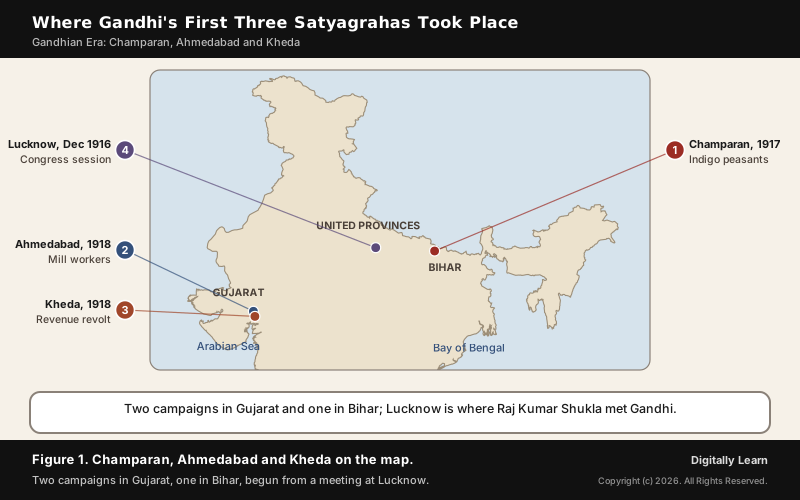
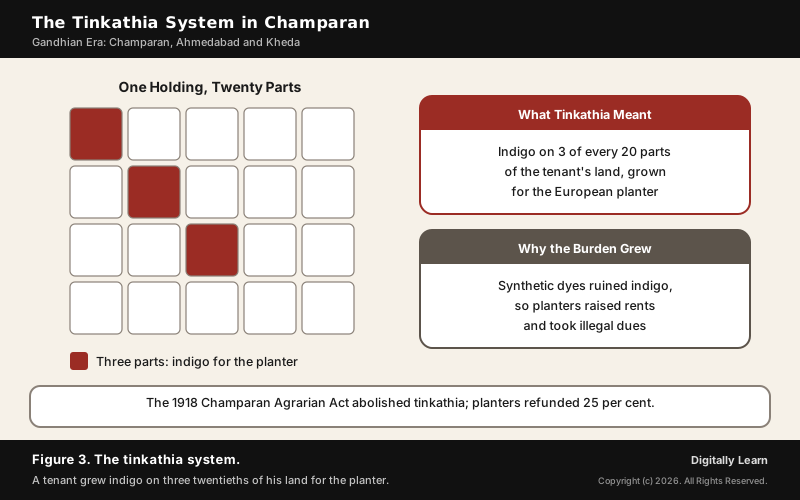
The Champaran Satyagraha of 1917 was Mahatma Gandhi's first satyagraha in India, fought for the indigo peasants of Champaran in Bihar against the tinkathia system. It was followed in 1918 by two campaigns in Gujarat: the Ahmedabad mill strike, where Gandhi went on his first hunger strike for the textile workers, and the Kheda Satyagraha, where peasants refused to pay land revenue after their crops failed. All three were local, non-violent and successful, and together they showed that satyagraha could win real gains for ordinary Indians.
Champaran, Kheda and Ahmedabad Satyagraha at a Glance (1917-1918)
Champaran, Kheda and Ahmedabad Satyagraha: Dates and Chronology
The Champaran Satyagraha took place in 1917, and the Ahmedabad mill strike and the Kheda Satyagraha followed in 1918. In 1917 Gandhi took up the cause of the indigo peasants of Champaran in Bihar. In 1918 he turned to his home state of Gujarat, first to a wage dispute in the textile mills of Ahmedabad and then to the cultivators of Kheda, who could not pay their land revenue after a failed harvest. Each dispute was small and local, and each ended in a gain for the people who had protested.
| Year | Campaign | Where | Who protested | What they won |
|---|---|---|---|---|
| 1917 | Champaran Satyagraha | Champaran district, Bihar | Indigo tenants | Tinkathia abolished by the Champaran Agrarian Act; 25 per cent of illegal dues refunded |
| 1918 | Ahmedabad mill strike | Ahmedabad, Gujarat | Textile mill workers | A 35 per cent wage increase |
| 1918 | Kheda Satyagraha | Kheda district, Gujarat | Cultivators after crop failure | Revenue collected only from those able to pay |
On the map, Champaran lies in the north of Bihar on the border with Nepal, while Kheda and Ahmedabad lie close together in Gujarat, far to the west.
Why Gandhi Began with Peasants and Workers
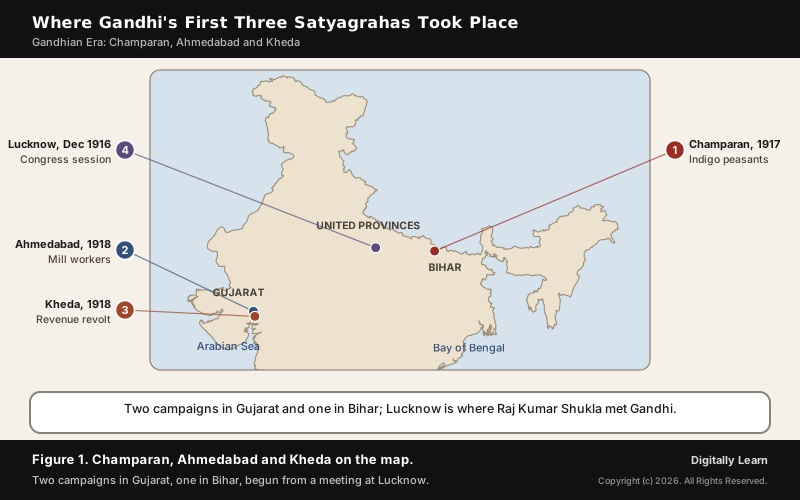
Gandhi returned from South Africa with a method already tested there but little standing in Indian politics. Three steps took him from his return to the indigo fields of Champaran:
- 1915: He came back to India and, on the advice of his political mentor Gopal Krishna Gokhale, spent a year travelling around British India to learn the country.
- February 1916: At the opening of the Banaras Hindu University he reminded princes and philanthropists of the poor Indians who were absent, and said the country’s salvation could only come through the farmer.
- December 1916: At the Lucknow session of the Congress, a peasant from Champaran told him about the harsh treatment of cultivators by British indigo planters and persuaded him to come.
Behind these steps lay a clear aim. Indian nationalism at the time was largely a movement of lawyers, doctors and landlords, and Gandhi wanted to bring in the peasants and workers who made up most of the population. The timeline below shows how quickly the three campaigns followed.
Champaran Satyagraha 1917: Indigo Planters and the Tinkathia System
The Tinkathia System and the Indigo Grievance
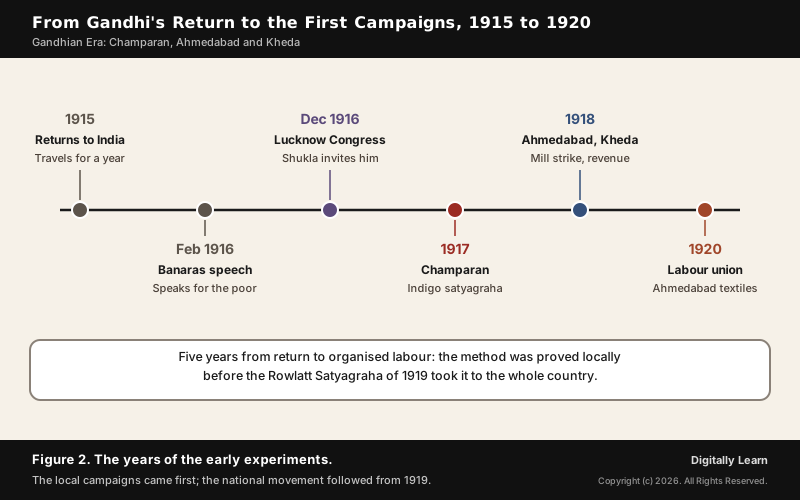
In Champaran, European planters made their tenants grow indigo on three kathas out of every twenty, the katha being a local unit of land. The arrangement was called the tinkathia system, from teen kathia, meaning three kathas.
The system had been in force for about a century when Gandhi arrived, and the tenants carried three separate burdens:
- Forced cultivation: Part of every holding went to indigo for the planter, whatever the tenant would rather have grown.
- Fixed prices: The dye had to be sold to the planter at a price the planter set.
- Rents and illegal dues: When synthetic dyes made in Germany ruined the indigo market by the end of the nineteenth century, the planters raised rents and took illegal dues before tenants could switch to other crops.
How Gandhi Reached Champaran: Raj Kumar Shukla and the Lucknow Congress
Gandhi did not go looking for Champaran. Raj Kumar Shukla, a cultivator from the district, approached him at the Lucknow Congress of December 1916 and kept pressing him until he agreed to investigate. Gandhi spent much of 1917 in Champaran. His aim, in the words of the NCERT textbook, was to obtain for the peasants security of tenure as well as the freedom to cultivate the crops of their choice.
He did not work alone. Lawyers and young nationalists from Bihar and beyond joined him in recording the peasants' statements, and several of them became leading figures of the national movement:
- Rajendra Prasad
- Mazharul Haq
- Mahadev Desai
- Narhari Parekh
- J. B. Kripalani
Defying the Order to Leave and the Champaran Agrarian Act
The Champaran dispute was settled in five steps, without a single act of violence:
- Ordered out: When Gandhi reached Champaran, the authorities ordered him to leave the district at once.
- Refusal: He refused and said he was ready to accept the punishment. This open, peaceful defiance of an unjust order made Champaran his first civil disobedience in India.
- Inquiry allowed: The government backed down and let his inquiry go ahead.
- Committee: A government committee examined the grievances, with Gandhi as a member, and accepted that tinkathia should end and the peasants should be compensated.
- Settlement: The Champaran Agrarian Act of 1918 abolished tinkathia. As a compromise, the planters refunded 25 per cent of the money taken, and within a decade they had left the area.
The larger result was political. For the first time, a peasant grievance was taken up by a leader of the national movement and won through non-violent means. Champaran joined peasant unrest to the national movement, which is the aspect UPSC Prelims 2018 asked candidates to identify.
Ahmedabad Mill Strike 1918: Gandhi's First Hunger Strike
The Plague Bonus Dispute and the 35 Per Cent Demand
In early 1918 Gandhi was drawn into a dispute between the cotton mill owners of Ahmedabad and their workers. During a plague outbreak the owners had paid the workers a plague bonus. When they moved to withdraw it, the workers, facing high wartime prices, demanded a large rise in wages instead.
The workers were organised by Anasuya Sarabhai, a social worker whose brother Ambalal Sarabhai was among the leading mill owners, so the dispute ran through a single family. The two sides' positions were far apart:
- The weavers: Wanted a far larger rise than the owners would give.
- Gandhi’s view: He judged a 35 per cent increase fair, advised the workers to strike for it, and asked them to stay non-violent.
- The mill owners: Offered only 20 per cent.
This dispute differed from Champaran in one important way. There was no colonial order to defy: the other side were Indian employers, some of them Gandhi's own supporters, and the aim was a fair settlement rather than a defeat for either side. Gandhi therefore argued from the figures, asked for a rise he could defend as reasonable, and insisted that the strike stay peaceful.
The Fast, the Award and the Textile Labour Association
As the strike dragged on and the workers began to waver, Gandhi went on a fast to strengthen their resolve. It was his first hunger strike in India. The fast also put moral pressure on the mill owners, many of whom knew Gandhi personally, and they agreed to settle. The workers received a 35 per cent increase in wages, the figure an arbitrator's award finally confirmed.
The dispute left a lasting institution. In 1920 the Ahmedabad Textile Labour Association, known in Gujarati as the Majoor Mahajan Sangh, was founded by Anasuya Sarabhai with Gandhi's guidance. It became one of India's oldest and most disciplined trade unions, and showed that satyagraha could serve industrial workers as well as peasants.
Kheda Satyagraha 1918: The Campaign Against Land Revenue
Crop Failure and the One-Fourth Remission Rule
In 1918 the crops failed in the Kheda district of Gujarat, and famine and plague made the cultivators' position worse. Under the revenue code, if the yield was less than one-fourth of the normal produce, the cultivators were entitled to a remission of land revenue. The yield had fallen that low, but the authorities refused to grant the remission and pressed for full payment.
Gandhi took up the peasants' case and advised them to withhold the revenue. The cultivators agreed together not to pay, accepting that the state might seize their property rather than give in. Because it was a refusal to cooperate with the revenue administration, Kheda is remembered as the first non-cooperation.
Sardar Patel, Indulal Yagnik and the Quiet Settlement
Kheda brought a new generation of leaders to Gandhi:
- Vallabhbhai Patel: A successful Ahmedabad lawyer who threw himself into the campaign. A decade later he led the Bardoli Satyagraha of 1928, and its success made him one of the main leaders of the national movement.
- Indulal Yagnik, Shankarlal Banker and Mahadev Desai: Among the others who worked in the villages.
The government did not concede openly. Instead it issued secret instructions that revenue should be recovered only from those who could afford to pay, so that the poorest cultivators were spared. The relief was partial and quiet, but the peasants had held together, the campaign had stayed non-violent, and a better-off peasantry had been drawn into disciplined resistance for the first time.
What the Early Satyagrahas Achieved for the National Movement
One Method Applied to Three Different Grievances
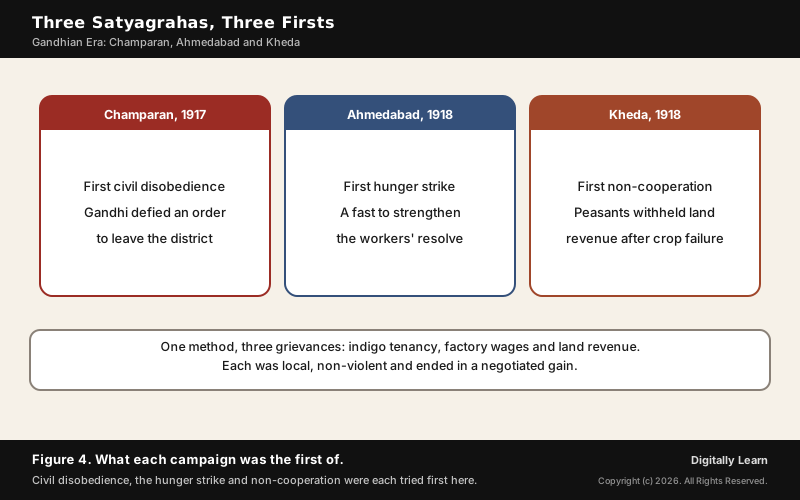
The three campaigns dealt with very different problems: a tenancy system, a factory wage and a revenue demand. The method did not change. In each, Gandhi began from a concrete local injustice, gathered the facts before he acted, kept the protest non-violent, and settled for a real but limited gain.
| Aspect | Champaran (1917) | Ahmedabad (1918) | Kheda (1918) |
|---|---|---|---|
| Grievance | Tinkathia and illegal dues | Withdrawal of the plague bonus | Revenue demanded despite crop failure |
| Protesters | Indigo tenants | Textile mill workers | Cultivators |
| Method | Refusal to leave; inquiry | Strike and Gandhi's fast | Agreement to withhold revenue |
| First of its kind | Civil disobedience | Hunger strike | Non-cooperation |
| Outcome | Tinkathia abolished; 25 per cent refund | 35 per cent wage rise | Revenue only from those able to pay |
| Leaders who emerged | Rajendra Prasad, J. B. Kripalani | Anasuya Sarabhai | Vallabhbhai Patel, Indulal Yagnik |
Seen together, the campaigns show how satyagraha worked in practice:
- Facts first: At Champaran the peasants’ statements were recorded before any demand was made.
- A fair demand: A figure that could be defended, such as 35 per cent at Ahmedabad or the remission the revenue code itself allowed at Kheda.
- Firmness with compromise: Non-violent pressure that stopped at a real gain, as when Gandhi accepted a 25 per cent refund at Champaran rather than the whole amount.
Why the Early Experiments Mattered
The NCERT textbook sums up the result: these initiatives in Champaran, Ahmedabad and Kheda marked Gandhi out as a nationalist with a deep sympathy for the poor. They also gave him a band of trusted organisers drawn from the places where the struggles were fought, and first-hand knowledge of what ordinary people would and would not do.
They were still local struggles. What they proved was that the method worked on Indian soil, and within a year it was tested nationally, in the Rowlatt Satyagraha of 1919 and then the Non-Cooperation Movement.
Champaran, Kheda and Ahmedabad in UPSC Previous Year Questions
What UPSC Has Asked About These Campaigns
Since 2005, UPSC has set six objective questions on these three campaigns and the indigo system behind them, and they test precise details rather than broad themes. Knowing who did what, and why each campaign began, answers almost all of them.
| Year | What the question asked | The point being tested |
|---|---|---|
| 2005 | Match campaigns with the people associated with them | Rajendra Prasad with Champaran and Patel with Kheda; Morarji Desai had no role at Ahmedabad |
| 2009 | Who founded the Ahmedabad Textile Labour Association | Gandhi, among the options given |
| 2010 | Who persuaded Gandhi to go to Champaran | Raj Kumar Shukla, not Rajendra Prasad; Kripalani was a colleague |
| 2011 | Why Gandhi organised the Kheda satyagraha | Revenue was not suspended despite the crop failure |
| 2018 | The most significant aspect of Champaran | It joined peasant unrest to the national movement |
| 2020 | Why indigo cultivation declined | Synthetic dyes made it unprofitable |
The campaigns also serve as evidence in longer answers. The 2015 GS Paper I question on how difficult independence would have been without Gandhi is best answered with Champaran, Ahmedabad and Kheda as proof of what his method added.
Previous Year UPSC-CSE Questions
Previous Year UPSC-CSE Questions By the end you will be able to draft model answers for the following UPSC questions. Each question carries a collapsible framework showing how to approach it in the exam.
- UPSC Prelims 2005 Prelims-GSWhich one of the following pairs are correctly matched? Movement / Satyagraha Person Actively Associated With
- Champaran Rajendra Prasad
- Ahmedabad Mill Workers Morarji Desai
- Kheda Vallabhbhai Patel Select the correct answer using the codes given below:
How to approach this Prelims question
Approach: Place each person in the campaign he actually worked in. Rajendra Prasad worked with Gandhi in the Champaran inquiry, and Vallabhbhai Patel joined Gandhi at Kheda, so pairs 1 and 3 hold. The Ahmedabad mill workers were organised by Anasuya Sarabhai; Morarji Desai had no role in the 1918 strike, so pair 2 fails.
Trap to watch: Morarji Desai had no role in the Ahmedabad mill strike; Anasuya Sarabhai organised the workers.
Key facts to recall:
- (a) 1 and 2: wrong. Pair 2 is false: the mill workers were organised by Anasuya Sarabhai, not Morarji Desai.
- (b) 2 and 3: wrong. It includes the false pair 2 and leaves out the true pair 1.
- (c) 1 and 3: right. Rajendra Prasad at Champaran, Vallabhbhai Patel at Kheda.
- (d) 1, 2 and 3: wrong. Pair 2 is false.
Answer signal: Pairs 1 and 3 are correctly matched, so option (c) is the answer.
- UPSC Prelims 2009 Prelims-GSWho of the following founded the Ahmedabad Textile Labour Association?
How to approach this Prelims question
Approach: Link the 1918 Ahmedabad mill strike to the union that grew out of it. In 1920 the Ahmedabad Textile Labour Association, the Majoor Mahajan Sangh, was founded by Anasuya Sarabhai with Gandhi's guidance. Of the four names offered, only Gandhi is part of its founding.
Trap to watch: N. M. Joshi was a trade union leader, but not of the Ahmedabad association.
Key facts to recall:
- (a) Mahatma Gandhi: right. The association was founded in 1920 under his guidance, after the strike he led in 1918.
- (b) Sardar Vallabhbhai Patel: wrong. His early work with Gandhi was the Kheda satyagraha, not the Ahmedabad union.
- (c) N. M. Joshi: wrong. He was not among the founders of the Ahmedabad association.
- (d) J. B. Kripalani: wrong. He worked with Gandhi in the Champaran inquiry, not in founding the Ahmedabad union.
Answer signal: Gandhi is the only founder among the options, so option (a) is the answer.
- UPSC Prelims 2010 Prelims-GSConsider the following statements:
- Dr. Rajendra Prasad persuaded Mahatma Gandhi to come to Champaran to investigate the problem of peasants.
- Acharya J. B. Kripalani was one of Mahatma Gandhi's colleagues in his Champaran investigation.
Which of the statements given above is/are correct?
How to approach this Prelims question
Approach: Separate who brought Gandhi to Champaran from who worked with him there. Raj Kumar Shukla, a cultivator from the district, approached Gandhi at the Lucknow Congress of December 1916 and persuaded him to come, so statement 1 is false. J. B. Kripalani, with Rajendra Prasad, joined Gandhi's inquiry, so statement 2 is true.
Trap to watch: Statement 1 swaps Raj Kumar Shukla for Rajendra Prasad.
Key facts to recall:
- (a) 1 only: wrong. Statement 1 is false: it was Raj Kumar Shukla, not Rajendra Prasad, who brought Gandhi to Champaran.
- (b) 2 only: right. Kripalani was one of Gandhi's colleagues in the Champaran investigation.
- (c) Both 1 and 2: wrong. It includes the false statement 1.
- (d) Neither 1 nor 2: wrong. Statement 2 is true.
Answer signal: Only statement 2 is correct, so option (b) is the answer.
- UPSC Prelims 2011 Prelims-GSWhat was the reason for Mahatma Gandhi to organize a satyagraha on behalf of the peasants of Kheda?
- The Administration did not suspend the land revenue collection in spite of a drought.
- The Administration proposed to introduce Permanent Settlement in Gujarat.
Which of the statements given above is/are correct?
How to approach this Prelims question
Approach: Recall the actual grievance at Kheda in 1918. Crops failed, and remission, the reduction or cancellation of land revenue in a year of crop failure, was due when the yield fell below one-fourth; the administration refused it, so statement 1 holds. Nothing about extending the Permanent Settlement to Gujarat was involved, so statement 2 is invented.
Trap to watch: Statement 2 invents a plan to extend the Permanent Settlement to Gujarat.
Key facts to recall:
- (a) 1 only: right. Revenue collection was not suspended despite the crop failure.
- (b) 2 only: wrong. There was no proposal to introduce the Permanent Settlement in Gujarat.
- (c) Both 1 and 2: wrong. It includes the invented statement 2.
- (d) Neither 1 nor 2: wrong. Statement 1 is the real grievance.
Answer signal: Only statement 1 is correct, so option (a) is the answer.
- UPSC Prelims 2018 Prelims-GSWhich one of the following is a very significant aspect of the Champaran Satyagraha?
How to approach this Prelims question
Approach: Ask what Champaran changed for the national movement. It was a local campaign by indigo cultivators against the planters, and its significance was that a peasant grievance entered the national movement under Gandhi's leadership.
Trap to watch: Champaran was a local campaign, so 'all-India participation' overstates it.
Key facts to recall:
- (a) All-India participation of lawyers, students and women: wrong. Champaran was a local campaign in one district, so 'all-India' overstates it.
- (b) Involvement of Dalit and tribal communities: wrong. The movement was of the indigo cultivators of Champaran, not defined by these communities.
- (c) Joining of peasant unrest to the national movement: right. Champaran brought the peasants' grievance into the national movement.
- (d) Drastic decrease in plantation and commercial crops: wrong. Indigo was already declining because synthetic dyes had replaced it; Champaran did not cut crop cultivation.
Answer signal: Champaran joined peasant unrest to the national movement, so option (c) is the answer.
- UPSC Prelims 2020 Prelims-GSIndigo cultivation in India declined by the beginning of the 20th century because of
How to approach this Prelims question
Approach: Look for the economic cause, not a political one. By the end of the nineteenth century, synthetic dyes had replaced natural indigo in the world market, which made indigo unprofitable; peasant resistance and government action mattered locally but did not end the crop.
Trap to watch: Peasant resistance mattered locally but did not end indigo worldwide.
Key facts to recall:
- (a) Peasant resistance to the planters: wrong. It mattered in places such as Champaran, but it did not end indigo worldwide.
- (b) Unprofitability because of new inventions: right. Synthetic dyes made natural indigo unprofitable.
- (c) National leaders' opposition to indigo: wrong. The decline was driven by the market, not by leaders' opposition.
- (d) Government control over the planters: wrong. Government action did not cause the worldwide decline.
Answer signal: The new synthetic dyes made indigo unprofitable, so option (b) is the answer.
- UPSC Mains 2015 GS-IHow different would have been the achievement of Indian independence without Mahatma Gandhi? Discuss.
Answer outline: how to structure the answer
What the question asks, the main arguments, relevant examples and the direction of the conclusion. This is not a full model answer.
Introduction: Open with Gandhi as the figure who turned nationalism into a mass movement through a new method.
Body (sub-themes to develop):
- His unique contribution: Satyagraha as a mass, non-violent technique (proven first at Champaran, Ahmedabad, Kheda).
- Reach: he drew peasants, workers and women into politics as the earlier leadership had not.
- Counter-view: structural forces (war, economy, global decolonisation) and other leaders also mattered.
- Balance: freedom may have come regardless, but its mass, non-violent character was distinctly Gandhian.
Conclusion: Conclude that independence might have come without him, but not in the same mass, non-violent form.
Sources and Further Reading
- Wikipedia: Champaran Satyagraha
- Wikipedia: Tinkathia System
- Wikipedia: Kheda Satyagraha
- Wikipedia: Anasuya Sarabhai
- Wikipedia: Mahatma Gandhi
- NCERT: Themes in Indian History Part III (Class XII), Mahatma Gandhi and the Nationalist Movement
- NCERT: Our Pasts III (Class VIII), Ruling the Countryside
- Ministry of Culture: Indian Culture Freedom Archive
- Azadi Ka Amrit Mahotsav (Freedom Movement portal)
- Press Information Bureau, Government of India
- National Portal of India
Editorial Disclaimer
This article is prepared for UPSC examination preparation. Verify key facts and interpretations against standard reference histories before relying on them.