
Overview
Previous Year UPSC-CSE Questions By the end you will be able to draft model answers for the following UPSC questions. Each question carries a collapsible framework showing how to approach it in the exam.
- UPSC Mains 2020 GS-ISince the decade of the 1920s, the national movement acquired various ideological strands and thereby expanded its social base. Discuss.
How to structure the answer in the exam
Introduction: Open with the 1920s-30s as the decades nationalism broadened into many strands.
Body (sub-themes to develop):
- Gandhian mass satyagraha (Non-Cooperation, Civil Disobedience).
- The constitutional strand: the Swarajists and the Round Table negotiations.
- Social broadening: the Depressed Classes via the Poona Pact, peasants, workers and women.
- The revolutionary and socialist strands running alongside.
Conclusion: Conclude that the period turned a narrow nationalism into a broad, multi-strand movement.
- UPSC Prelims 1997 GS Paper IThe Poona Pact which was signed between the British Government and Mahatma Gandhi in 1932 provided for
How to approach this Prelims question
Approach: Recall what the Poona Pact substituted for the Communal Award.
Trap to watch: The Award gave separate electorates to the Harijans; the Poona Pact replaced this with a joint electorate plus reserved seats, not separate electorates.
Key facts to recall:
- Poona Pact 1932
- Joint electorate retained
- Reserved seats for the Depressed Classes (Harijans)
Answer signal: Joint electorate with reservation for Harijans, so option (d).
- UPSC Prelims 2009 GS Paper IConsider the following statements:
- The discussions in the Third Round Table Conference eventually led to the passing of the Government of India Act of 1935.
- The Government of India Act of 1935 provided for the establishment of an All India Federation to be based on a Union of the provinces of British India and the Princely States.
Which of the statements given above is/are correct?
How to approach this Prelims question
Approach: Test both statements against the road to the 1935 Act.
Trap to watch: Both are correct: the conferences led to the 1935 Act, which did provide (on paper) for an All-India Federation of provinces and princely states.
Key facts to recall:
- Third RTC fed into the 1935 Act
- 1935 Act provided for an All-India Federation
- Provinces of British India and the Princely States
Answer signal: Both 1 and 2, so option (c).
- UPSC Prelims 1996 GS Paper IThe meeting of Indian and British political leaders during 1930-32 in London has often been referred to as the First, Second and Third Round Table Conferences. It would be incorrect to refer to them as such because
How to approach this Prelims question
Approach: Identify the technical reason the 'three conferences' label is loose.
Trap to watch: It is true the Congress missed two, but the question asks why the very label is incorrect: it was one conference held in three sessions.
Key facts to recall:
- One Round Table Conference, three sessions (1930-32)
- Congress only attended the second
- Sessions, not separate conferences
Answer signal: It was one conference in three sessions, so option (d).
Between 1931 and 1934 the freedom struggle moved from the streets to the conference table and the fast. The Round Table Conferences in London tried, and failed, to settle the Indian constitution; the Communal Award of 1932 granted separate electorates to the Depressed Classes; and Gandhi's fast forced the Poona Pact, which gave them reserved seats within a joint electorate instead. Civil Disobedience, resumed after the talks broke down, was finally withdrawn in 1934.
Introduction: From Truce to Final Exhaustion (1931-1934)
Why This Phase of Negotiation Matters
Why this matters: the Gandhi-Irwin truce of 1931 took the struggle off the streets and into a different arena, the conference table in London and the prison fast at Yerwada. The years 1931 to 1934 were a phase of negotiation, deadlock and slow exhaustion between two great mass movements.
What is the significance of these years: they proved that no constitutional settlement was possible without the Congress, they brought the Depressed Classes into the political framework through the Poona Pact, and they ended the second phase of Civil Disobedience. The sequence is traced below.
The Negotiations and the Movement at a Glance
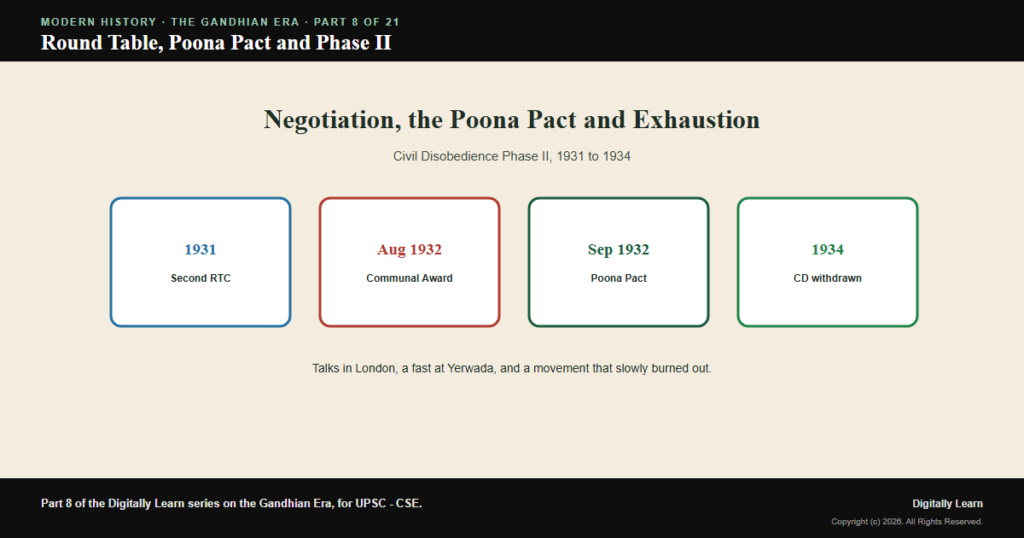
Distinguishing the sequence clarifies a crowded period. Gandhi went to the Second Round Table Conference, the talks deadlocked over the minorities, the Communal Award and Gandhi's fast produced the Poona Pact, the Third Conference met without the Congress, and Civil Disobedience was finally withdrawn.
What ties the sequence together is a movement running down even as the negotiations failed, as the timeline below shows.
The Second Round Table Conference and the Communal Deadlock (1931)
Gandhi in London and the Deadlock over the Minorities
What is the significance of the Second Round Table Conference: it brought Gandhi to London as the voice of the nation. Under the Gandhi-Irwin Pact, the Congress attended the conference of September to December 1931, with Gandhi as its sole representative, claiming to speak for all of India.
Distinguishing the deadlock: the conference broke down over the question of the minorities. The British and the minority leaders pressed for separate electorates for Muslims, the Depressed Classes and others, while Gandhi insisted that the Congress alone represented the whole nation, and no agreement could be reached.
The Communal Award and the Poona Pact (1932)
The Communal Award and Gandhi's Fast
What is the significance of the Communal Award: it forced the question of the Depressed Classes to a crisis. In August 1932 the British Prime Minister, Ramsay MacDonald, announced the Communal Award, which granted separate electorates not only to Muslims and others but, for the first time, to the Depressed Classes.
Distinguishing Gandhi's response: he accepted separate electorates for the religious minorities but bitterly opposed them for the Depressed Classes, holding that they would split Hindu society permanently. In September 1932 he began a fast unto death in Yerwada jail, and the before-and-after of that fast is shown below.
The Poona Pact: Joint Electorates and Reserved Seats
Observable outcomes followed within days. As Gandhi's life hung in the balance, the leaders reached the Poona Pact, signed on 24 September 1932 between caste-Hindu leaders and B. R. Ambedkar on behalf of the Depressed Classes, with Madan Mohan Malaviya among the signatories.
Distinguishing its terms from the Award, set out below, the Pact replaced separate electorates with a joint electorate and reserved seats. The Depressed Classes were to vote within the general electorate but with seats reserved for them, raised from about seventy-one to roughly a hundred and forty-eight in the provincial legislatures.
- Separate electorates dropped: the Award’s separate electorates were given up.
- Joint electorate kept: the Depressed Classes voted within the general electorate.
- Reserved seats instead: seats were reserved for the Depressed Classes.
- More seats: the reserved seats rose from about 71 to roughly 148 in the provinces.
- Within the Hindu fold: the settlement kept the Depressed Classes politically within Hindu society.
The Resumption and Final Withdrawal of Civil Disobedience (1932-1934)
The Second Phase and Its Exhaustion
What is the significance of the second phase: it showed the limits of repeated mass struggle. When Gandhi returned from London to find the talks failed and the government armed with sweeping ordinances, the Congress resumed Civil Disobedience early in 1932, but the government met it with mass arrests and the banning of the Congress.
Distinguishing why it faded: the second phase never reached the height of 1930. Faced with severe repression and a tiring movement, Gandhi suspended mass Civil Disobedience and finally withdrew it in 1934, turning instead to the constructive programme and to individual satyagraha.
The Third Round Table Conference and the Road to the 1935 Act
The Three Conferences Compared and Their Outcome
Observable outcomes can be read across the three conferences, compared below. The Third Round Table Conference of late 1932 met without the Congress and with only a handful of delegates, and was the least productive of the three.
Distinguishing the result: barren as the conferences seemed, their proceedings and the work of a Joint Committee became the basis of the Government of India Act 1935, which provided for provincial autonomy and an All-India Federation of the provinces and the princely states. The three conferences are set out below.
| Conference | Year | The Congress | Outcome |
|---|---|---|---|
| First | 1930-31 | Boycotted (Gandhi in jail) | No national settlement possible |
| Second | 1931 | Gandhi, sole representative | Communal deadlock over minorities |
| Third | 1932 | Did not attend | Least productive; fed into the 1935 Act |
Significance: Negotiation, the Depressed Classes and Exhaustion
What the Phase Achieved and Why It Ended
Contemporary linkages run from this phase into both the constitutional and the social history of India. The conferences proved that the British could not frame a constitution without the Congress, and they led, however indirectly, to the Government of India Act of 1935. The Poona Pact brought the Depressed Classes into the political framework, a turning point whose social meaning is examined in Part 18.
The larger significance is that the movement had reached exhaustion. Two great waves of mass struggle had not won freedom, and the next years would be a phase of constitutional work and office, before the Second World War reopened the whole question. The next part turns aside to the revolutionary stream of the 1920s and 1930s, which ran alongside the Gandhian movement.
Prelims MCQ practice
Each question below tests one specific concept on the topic. Click to reveal the answer and a full option-wise explanation.
Q1. At which Round Table Conference did Gandhi attend as the sole representative of the Congress?
- First
- Second
- Third
- None of them
Show answer and explanation
Answer: Second
Explanation.
Option (b) is correct. Gandhi attended only the Second Round Table Conference (1931), as the sole Congress representative. Hence option (b).
Q2. The Communal Award of 1932, granting separate electorates to the Depressed Classes, was announced by:
- Lord Irwin
- Ramsay MacDonald
- Lord Linlithgow
- Sir John Simon
Show answer and explanation
Answer: Ramsay MacDonald
Explanation.
Option (b) is correct. The Communal Award was announced by the British Prime Minister Ramsay MacDonald in August 1932. Hence option (b).
Q3. With reference to the Poona Pact (1932), consider the following statements:
- It was signed after Gandhi's fast against the Communal Award.
- It replaced separate electorates for the Depressed Classes with reserved seats in a joint electorate.
Which of the statements given above is/are correct?
- 1 only
- 2 only
- Both 1 and 2
- Neither 1 nor 2
Show answer and explanation
Answer: Both 1 and 2
Explanation.
Both are correct. The Poona Pact followed Gandhi's fast and replaced separate electorates with reserved seats in a joint electorate. Hence option (c).
Q4. Under the Poona Pact, the number of seats reserved for the Depressed Classes in the provincial legislatures was raised to about:
- 71
- 148
- 250
- 30
Show answer and explanation
Answer: 148
Explanation.
Option (b) is correct. The Communal Award had given about 71 seats; the Poona Pact raised the reserved provincial seats to roughly 148. Hence option (b).
Q5. The Third Round Table Conference (1932) was notable because:
- Gandhi led the Congress delegation
- The Congress did not take part
- It granted complete independence
- It abolished the salt tax
Show answer and explanation
Answer: The Congress did not take part
Explanation.
Option (b) is correct. The Congress did not attend the Third Round Table Conference, which was the least productive of the three. Hence option (b).
Q6. Consider the following pairs of a settlement and its electoral provision:
- The Communal Award : separate electorates for the Depressed Classes.
- The Poona Pact : reserved seats in a joint electorate.
Which of the pairs given above is/are correctly matched?
- 1 only
- 2 only
- Both 1 and 2
- Neither 1 nor 2
Show answer and explanation
Answer: Both 1 and 2
Explanation.
Both pairs are correct: the Communal Award gave separate electorates, and the Poona Pact substituted reserved seats in a joint electorate. Hence option (c).
Sources and Further Reading
- Wikipedia: Round Table Conferences (India)
- Wikipedia: Poona Pact
- Wikipedia: Communal Award
- Wikipedia: Civil Disobedience Movement
- NCERT, India's Struggle for Independence / Themes in Indian History III
- Ministry of Culture: Indian Culture Freedom Archive
- Azadi Ka Amrit Mahotsav (Freedom Movement portal)
- Press Information Bureau, Government of India
- National Portal of India
Editorial Disclaimer
This article is prepared for UPSC examination preparation. Verify key facts and interpretations against standard reference histories before relying on them.