
Overview
Previous Year UPSC-CSE Questions By the end you will be able to draft model answers for the following UPSC questions. Each question carries a collapsible framework showing how to approach it in the exam.
- UPSC Mains 2017 GS-IHighlight the importance of the new objectives that got added to the vision of Indian Independence since the twenties of the last century.
How to structure the answer in the exam
Introduction: Open with the 1920s-30s as the decades the goal sharpened to full, responsible self-government.
Body (sub-themes to develop):
- Complete independence (Purna Swaraj) replacing Dominion Status.
- Responsible self-government, tested in the 1937 provincial ministries.
- Social and economic justice (agrarian relief, the Karachi resolution).
- Secular nationhood, tested against the deepening communal divide.
Conclusion: Conclude that the 1937 experiment advanced, but did not satisfy, the new objective of full self-rule.
- UPSC Prelims 2008 GS Paper IConsider the following statement and reason:
- Assertion (A): The Congress Ministries in all the provinces resigned in the year 1939.
- Reason (R): The Congress did not accept the decision of the Viceroy to declare war against Germany in the context of the Second World War.
Select the correct answer using the code given below.
How to approach this Prelims question
Approach: Judge A and R, then whether R explains A.
Trap to watch: Both are true and R genuinely explains A: the war declaration without consultation was the stated reason for the resignations.
Key facts to recall:
- Congress ministries resigned Oct-Nov 1939
- India declared a belligerent without consultation
- The war decision was the cause
Answer signal: Both A and R true and R explains A, so option (a).
- UPSC Prelims 2005 GS Paper IIn which one of the following provinces was a Congress Ministry not formed under the Act of 1935?
How to approach this Prelims question
Approach: Recall where the Congress did and did not take office.
Trap to watch: Bihar, Madras and Orissa were Congress provinces; Punjab was governed by the Unionist Party of Sikandar Hyat Khan.
Key facts to recall:
- Congress ministries in Bihar, Madras, Orissa
- Punjab = Unionist Party
- Bengal and Sindh also non-Congress
Answer signal: Punjab, so option (d).
- UPSC Prelims 2012 GS Paper IThe Congress ministries resigned in the seven provinces in 1939, because
How to approach this Prelims question
Approach: Identify the true reason and reject the distractors.
Trap to watch: None of (a), (b) or (c) is the reason; the resignations were over the war declaration without consultation.
Key facts to recall:
- Resigned over the war declaration
- Not over the left wing or communal disturbances
- The real reason is not among the options
Answer signal: None of the above, so option (d).
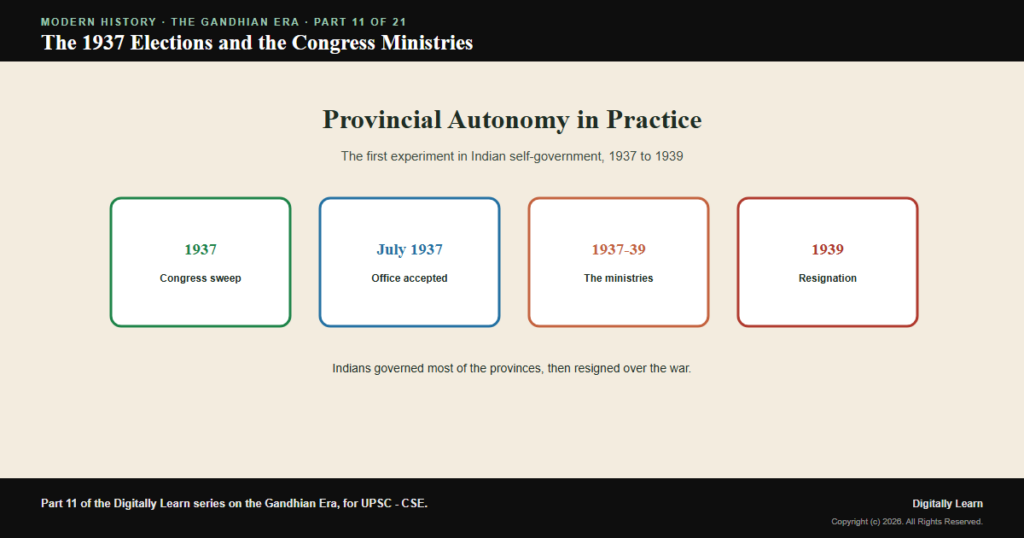
The Congress ministries of 1937 to 1939 were India's first experiment in provincial self-government. In the 1937 elections held under the Government of India Act 1935, the Congress swept to power in most of the provinces, and after a sharp debate it accepted office. For just over two years its ministries governed the provinces, pressing agrarian and civil-liberties reforms within colonial limits, until they resigned in 1939 when India was made a belligerent in the Second World War without consultation.
Introduction: The First Experiment in Self-Government (1937-1939)
Why the 1937 Ministries Matter
Why this matters: the only part of the Government of India Act 1935 that ever came into force was provincial autonomy, and the 1937 elections put it to the test. For the first time, elected Indians, not British officials, would run the governments of the provinces.
What is the significance of the 1937 ministries: they were India's first experiment in self-government. How the Congress fared in office, and why it walked out two years later, told Indians a great deal about both the promise and the limits of working a colonial constitution.
The Provincial Map of 1937
Distinguishing the result across the provinces is the place to begin. The Congress won outright majorities and formed ministries in seven provinces, was the largest party in others, and faced non-Congress governments in Punjab, Bengal and Sindh.
What the map shows is the geography of the new self-government: where the Congress now held power, and where the future communal and regional fault-lines already ran, as set out below.
The 1937 Provincial Elections and the Congress Sweep
The Results and the Provinces Won
What is the significance of the 1937 elections: they were a decisive verdict for the Congress. Held early in 1937 under the new Act, on a franchise of about a tenth of the population, they returned the Congress as much the largest force, with around seven hundred of the roughly fifteen hundred seats.
Distinguishing where it won: the Congress took clear majorities in Madras, Bombay, the United Provinces, Bihar, the Central Provinces and Orissa, and formed a seventh ministry in the North-West Frontier Province, as the table below records. In Assam it was the single-largest party but lacked a majority, while Punjab, Bengal and Sindh went to non-Congress parties.
| Province | Who formed the ministry |
|---|---|
| Madras, Bombay, UP, Bihar, CP, Orissa | The Indian National Congress (majorities) |
| North-West Frontier Province | The Congress (the 'Frontier Gandhi' allied) |
| Punjab | The Unionist Party (Sikandar Hyat Khan) |
| Bengal | The Krishak Praja Party and the Muslim League (Fazlul Huq) |
| Sindh | A non-Congress coalition |
The Office-Acceptance Debate and the Congress Ministries
To Take Office, or Not
What is the significance of the office-acceptance debate: it exposed a real division within the Congress. Having won the elections, the party had to decide whether to accept office under an Act it had condemned, or to refuse it and keep up the agitation, and the two cases are set out below.
Distinguishing the two sides: Jawaharlal Nehru and Subhas Bose opposed office, fearing it would legitimise the 1935 Act and blunt the mass movement; the majority held that office could be used to do real good and to keep worse parties out. After the Viceroy gave an assurance that governors would not abuse their special powers, the Congress accepted office in July 1937.
The Work of the Ministries (1937-1939)
Reforms and Achievements
Observable outcomes followed in the work of the ministries. Within the limits of the Act, they pursued agrarian relief for tenants and the indebted, the release of political prisoners and the widening of civil liberties, the spread of education and, in some provinces, prohibition. Their main efforts are set out below.
- Agrarian reform: tenancy laws and relief for the indebted peasantry.
- Civil liberties: release of political prisoners and the lifting of bans.
- Education: the spread of schooling, including the Wardha scheme of basic education.
- Prohibition: restrictions on liquor in several provinces.
- Welfare: attention to the conditions of workers and the depressed classes.
A measured verdict is fair. The ministries did useful work and proved Indian competence in government, but they also met the limits of the Act: tight provincial finances, the governor's overriding powers, and the difficulty of radical reform within a colonial frame.
The Congress-League Rupture and the Resignation (1939)
The League's Grievances and the Day of Deliverance
What is the significance of the Congress-League rupture: it deepened the communal divide that would lead to Partition. The Muslim League, shut out of office in the Congress provinces, charged the ministries with majoritarian rule, compiling lists of grievances such as the Pirpur Report and alleging the neglect of Muslim interests.
Distinguishing the League's response: whether or not the charges were fair, they gave Jinnah a powerful grievance. When the Congress ministries resigned, the League called for a Day of Deliverance in December 1939 to mark the end of what it called Congress tyranny, a sign of how far the two parties had drawn apart.
The War and the Resignation
Observable outcomes came to a head over the war. In September 1939 the Viceroy, Lord Linlithgow, declared India a belligerent in the Second World War without consulting a single Indian leader or the elected ministries, treating the country as a possession to be committed to war at will.
Distinguishing the Congress response: the party would not be a partner in such a war without a clear commitment to Indian freedom. When that was refused, the Congress ministries resigned in October and November 1939, as the timeline below records, ending the experiment in office.
Significance: A Trial Run for Self-Government
What the Ministries Proved
Contemporary linkages run from this brief experiment into the rest of the struggle. The ministries proved Indian competence in government, gave a generation of leaders real administrative experience, and showed that nationalism could be responsible as well as agitational.
The larger significance is double-edged. The experiment showed both the promise of self-rule and the bitterness of the deepening communal divide, and the 1939 resignation confirmed that the Congress would not serve a colonial war. The next part follows what came after, the Second World War, the failed British missions and the individual satyagraha of 1940 to 1944.
Prelims MCQ practice
Each question below tests one specific concept on the topic. Click to reveal the answer and a full option-wise explanation.
Q1. The 1937 provincial elections were held under the:
- Government of India Act 1919
- Government of India Act 1935
- Indian Councils Act 1909
- Indian Independence Act 1947
Show answer and explanation
Answer: Government of India Act 1935
Explanation.
Option (b) is correct. The 1937 elections were held under the provincial-autonomy provisions of the Government of India Act 1935. Hence option (b).
Q2. In the 1937 elections, the Congress formed ministries in about:
- Two provinces
- Seven provinces
- All eleven provinces
- No province
Show answer and explanation
Answer: Seven provinces
Explanation.
Option (b) is correct. The Congress formed ministries in seven provinces (and was the largest party in others). Hence option (b).
Q3. With reference to the office-acceptance debate of 1937, consider the following statements:
- Jawaharlal Nehru and Subhas Bose opposed the acceptance of office.
- The Congress finally accepted office in July 1937.
Which of the statements given above is/are correct?
- 1 only
- 2 only
- Both 1 and 2
- Neither 1 nor 2
Show answer and explanation
Answer: Both 1 and 2
Explanation.
Both are correct. Nehru and Bose opposed accepting office, but the Congress decided to take office in July 1937. Hence option (c).
Q4. Which of the following provinces did NOT have a Congress ministry after the 1937 elections?
- United Provinces
- Bombay
- Punjab
- Bihar
Show answer and explanation
Answer: Punjab
Explanation.
Option (c) is correct. Punjab was governed by the Unionist Party; the UP, Bombay and Bihar had Congress ministries. Hence option (c).
Q5. The Congress ministries resigned in 1939 because:
- Of communal riots
- India was made a belligerent in the war without consultation
- Of a split in the Congress
- The Governors dismissed them
Show answer and explanation
Answer: India was made a belligerent in the war without consultation
Explanation.
Option (b) is correct. The ministries resigned when the Viceroy declared India a belligerent in the Second World War without consulting Indian leaders. Hence option (b).
Q6. Consider the following pairs of a 1937 province and its governing party:
- Punjab : the Unionist Party.
- Bengal : the Krishak Praja Party with the Muslim League.
Which of the pairs given above is/are correctly matched?
- 1 only
- 2 only
- Both 1 and 2
- Neither 1 nor 2
Show answer and explanation
Answer: Both 1 and 2
Explanation.
Both pairs are correct: Punjab was Unionist and Bengal was governed by the Krishak Praja Party with the Muslim League under Fazlul Huq. Hence option (c).
Sources and Further Reading
- Wikipedia: 1937 Indian provincial elections
- Wikipedia: Government of India Act 1935
- Wikipedia: All-India Muslim League
- NCERT, India's Struggle for Independence / Themes in Indian History III
- Ministry of Culture: Indian Culture Freedom Archive
- Azadi Ka Amrit Mahotsav (Freedom Movement portal)
- Press Information Bureau, Government of India
- National Portal of India
Editorial Disclaimer
This article is prepared for UPSC examination preparation. Verify key facts and interpretations against standard reference histories before relying on them.