
Overview
Previous Year UPSC-CSE Questions By the end you will be able to draft model answers for the following UPSC questions. Each question carries a collapsible framework showing how to approach it in the exam.
- UPSC Mains 2024 GS-IWhat were the events that led to the Quit India Movement? Point out its results.
How to structure the answer in the exam
Introduction: Open with 1942 as the moment the Congress moved from bargaining to a total demand for British withdrawal.
Body (sub-themes to develop):
- Events leading up: failure of the Cripps Mission; Japanese advance to India's borders; wartime hardship and shortages; no British commitment to freedom.
- The Quit India Resolution at Bombay (8 August 1942) and the call of 'Do or Die'.
- Results: arrest of the leadership and a spontaneous, leaderless mass upsurge.
- Results: parallel governments at Ballia, Tamluk and Satara; heavy repression; the moral collapse of the Raj.
Conclusion: Conclude that, though crushed, Quit India made British withdrawal only a matter of time.
- UPSC Prelims 2021 GS Paper IWith reference to 8th August, 1942 in Indian history, which one of the following statements is correct?
How to approach this Prelims question
Approach: Fix what happened on 8 August 1942 and reject the dates that belong elsewhere.
Trap to watch: Options (b), (c) and (d) are the August Offer, the 1939 ministry resignations and the Cripps offer; only (a) belongs to 8 August 1942.
Key facts to recall:
- 8 August 1942 = Quit India Resolution by the AICC
- Gowalia Tank, Bombay
- Cripps and the August Offer were earlier
Answer signal: The Quit India Resolution, so option (a).
- UPSC Prelims 2013 GS Paper IQuit India Movement was launched in response to
How to approach this Prelims question
Approach: Recall the immediate cause of the 1942 movement.
Trap to watch: The Cabinet Mission and the Wavell Plan came later (1945-46); the Simon Report belongs to 1930; only the Cripps Proposals (1942) preceded Quit India.
Key facts to recall:
- Cripps Mission failed in 1942
- Quit India followed in August 1942
- Cabinet Mission and Wavell Plan were post-war
Answer signal: Cripps Proposals, so option (b).
- UPSC Prelims 2011 GS Paper IWith reference to Indian freedom struggle, Usha Mehta is well-known for
How to approach this Prelims question
Approach: Match Usha Mehta to her single famous contribution.
Trap to watch: She is not linked to the RTC, the INA or the Interim Government; her fame rests on the underground Congress Radio of 1942.
Key facts to recall:
- Usha Mehta = secret Congress Radio
- Quit India underground
- 1942
Answer signal: Running the secret Congress Radio, so option (a).
- UPSC Prelims 2009 GS Paper IDuring the freedom struggle, Aruna Asaf Ali was a major woman organizer of underground activity in
How to approach this Prelims question
Approach: Tie Aruna Asaf Ali to the right movement.
Trap to watch: She is associated with the underground of 1942, not the Non-Cooperation, Civil Disobedience or Swadeshi movements.
Key facts to recall:
- Aruna Asaf Ali = Quit India underground
- Gowalia Tank flag-hoisting
- 1942
Answer signal: Quit India Movement, so option (c).
- UPSC Prelims 2009 GS Paper IWith which one of the following movements is the slogan “Do or die” associated?
How to approach this Prelims question
Approach: Match the slogan to its movement.
Trap to watch: 'Do or Die' belongs to Quit India (1942), not the Swadeshi, Non-Cooperation or Civil Disobedience movements.
Key facts to recall:
- 'Do or Die' = Quit India
- Gandhi, 8 August 1942
- Gowalia Tank, Bombay
Answer signal: Quit India Movement, so option (d).
- UPSC Prelims 2005 GS Paper IConsider the following statements. On the eve of the launch of the Quit India Movement, Mahatma Gandhi:
- Asked the Government servants to resign.
- Asked the soldiers to leave their posts.
- Asked the Princes of the Princely States to accept the sovereignty of their own people.
Which of the statements given above is/are correct?
How to approach this Prelims question
Approach: Test each instruction against what Gandhi actually said.
Trap to watch: Gandhi told government servants to declare their loyalty to the Congress, not to resign, and told soldiers not to fire on their own people, not to abandon their posts; only the instruction to the princes is correctly stated.
Key facts to recall:
- Princes: accept the sovereignty of their people (correct)
- Government servants: declare allegiance, not resign
- Soldiers: do not fire on countrymen, not leave posts
Answer signal: 3 only, so option (c).
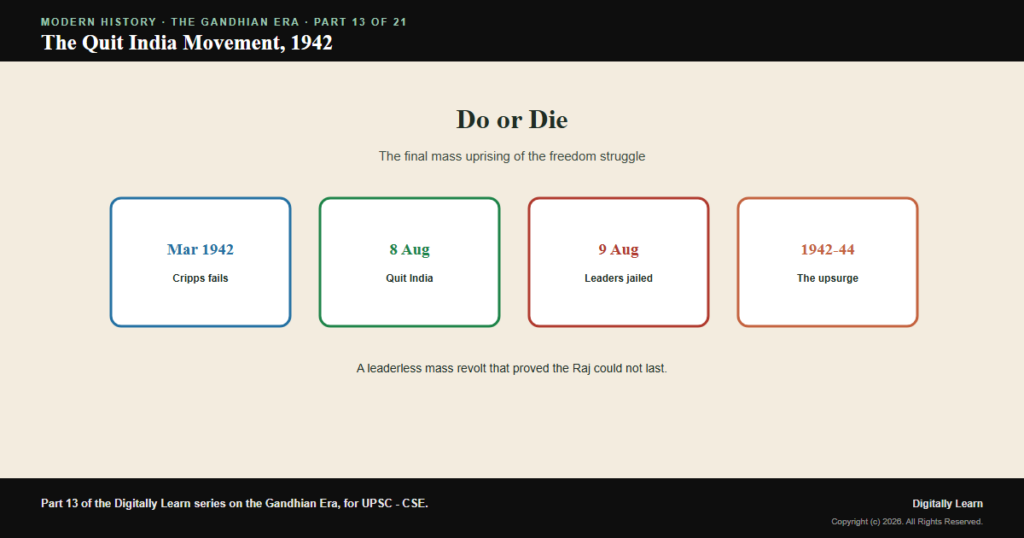
The Quit India Movement of 1942 was the final mass uprising of the Indian freedom struggle. Launched by the All-India Congress Committee at Bombay on 8 August 1942 with Gandhi's call of 'Do or Die', it demanded an immediate end to British rule. The entire Congress leadership was arrested the next morning, so the movement became a largely spontaneous and leaderless mass revolt, with strikes, sabotage and even parallel governments. Though it was crushed within months, it showed that the British could no longer govern India against the will of its people.
Introduction: The Final Mass Uprising of 1942
Why the Quit India Movement Matters
Why this matters: by 1942 the patient, phased struggle of earlier decades gave way to a single, total demand. The Quit India Movement was the freedom struggle's last and most explosive mass campaign, and it left the British in no doubt that their days in India were numbered.
What is the significance of the Quit India Movement: it converted nationalist sentiment into an open, country-wide revolt. Though the Congress preached non-violence, the jailing of every leader turned 1942 into a spontaneous, leaderless rising that the Raj could suppress only with great force, an effort it could not have repeated.
The Geography of the Revolt
Distinguishing where it struck is the place to begin. The movement was launched in Bombay, raged hardest across the eastern United Provinces, Bihar and Bengal, and threw up parallel governments in pockets where British authority briefly collapsed.
What the map shows is the pattern of August 1942: the city where the call was given, the broad belt of the mass upsurge, and the four places, Ballia, Tamluk, Satara and Talcher, where Indians ran their own administrations, as set out below.
The Road to 'Do or Die': Background and the Quit India Resolution
Why the Congress Turned to Mass Struggle
What is the significance of the background to 1942: it explains why a cautious leadership took so bold a step. The failure of the Cripps Mission in the spring of 1942 had shown that Britain would offer nothing more than a promise of dominion status after the war, and the Congress would no longer wait.
Distinguishing the pressures: with Japan advancing through Burma to the very borders of India, wartime prices soaring and food short, the mood was tense and angry. The Congress concluded that an orderly British withdrawal was the only safeguard against chaos, and resolved on an immediate mass struggle, as set out below.
The Bombay Session of 8 August 1942
Observable outcomes followed at Bombay. On 8 August 1942, the All-India Congress Committee, meeting at the Gowalia Tank ground, passed the Quit India Resolution, demanding an immediate end to British rule and sanctioning a mass civil-disobedience struggle under Gandhi.
Distinguishing the call: it was here that Gandhi gave the nation its watchword, 'Do or Die', meaning that the people should either free India or die in the attempt. On the eve of the launch he issued instructions to every section of society, asking the princes, for instance, to accept the sovereignty of their own people, though he did not ask government servants to resign or soldiers to abandon their posts.
The Arrest of the Leadership on 9 August 1942
How the Pre-Dawn Swoop Shaped the Revolt
What is the significance of the arrests: they shaped the entire character of the revolt. In the early hours of 9 August 1942, in a single pre-planned swoop, the authorities arrested Gandhi, the whole Congress Working Committee and the provincial leadership before the movement could even be organised.
Distinguishing the consequence: with the leaders behind bars, there was no central direction at all. The Congress was declared illegal and its funds frozen, and the people were left to act on their own. The result was that Quit India became a spontaneous, leaderless rising, fiercer and more violent than the leadership had intended.
The Nature and Spread: Urban Revolt, Rural Rebellion and the Underground
From Strikes in the Cities to Revolt in the Villages
Distinguishing the phases of 1942 helps make sense of a confused and rapid event. In the first phase the revolt was urban: hartals, strikes and student processions swept the cities, met by lathi-charges and firing.
Observable outcomes then shifted to the countryside. In the second phase the rural areas rose, attacking the visible symbols of British power, railway lines, telegraph wires, post offices and police stations, and in the third phase a scattered underground of sabotage and secret radio carried the struggle on, as the diagram below sets out.
Students, Workers and Usha Mehta's Congress Radio
Distinguishing who carried the movement matters, because the usual leaders were in jail. Students left their schools and colleges, workers struck in the mills, and peasants took to the fields, while a socialist underground led by Jayaprakash Narayan and Ram Manohar Lohia organised sabotage from hiding.
Observable outcomes included some of the most memorable episodes of the struggle. Aruna Asaf Ali hoisted the Congress flag at the Gowalia Tank ground and went underground, and Usha Mehta ran a secret Congress Radio that kept the nationalist message alive, as the list below records.
- The socialist underground: Jayaprakash Narayan and Ram Manohar Lohia organised sabotage and an underground network.
- The Congress Radio: Usha Mehta operated a secret transmitter broadcasting the call of the movement.
- Aruna Asaf Ali: She raised the flag at Gowalia Tank and became the heroine of the underground.
- Targets of attack: Railway lines, telegraph wires, post offices and police stations, the symbols of British authority.
- Women and students: Students abandoned classes and women took a leading part in the protests.
The Parallel Governments: Ballia, Tamluk and Satara
What is the significance of the parallel governments: in a handful of places the revolt did more than disrupt; it replaced the Raj for a time. Where British control collapsed, local people set up their own administrations, collecting revenue, settling disputes and running relief.
Distinguishing the main ones: at Ballia in the eastern United Provinces, Chittu Pandey ran a brief administration in August 1942; at Tamluk in Midnapore the Tamralipta Jatiya Sarkar lasted into 1944; and at Satara in the Bombay province, Nana Patil's Prati Sarkar was the longest-lasting of all, as the table below records.
| Parallel government | Region | When | Led by |
|---|---|---|---|
| Ballia administration | Eastern United Provinces | August 1942 | Chittu Pandey |
| Tamralipta Jatiya Sarkar | Tamluk, Midnapore (Bengal) | 1942 to 1944 | Satish Chandra Samanta |
| Prati Sarkar | Satara (Bombay province) | 1943 to 1946 | Nana Patil |
| Talcher administration | Talcher (Orissa) | 1942 | Local Congress workers |
Government Repression and the Martyrs
Firing, Mass Arrests and Collective Fines
Observable outcomes on the government side were severe. The Raj treated 1942 as a wartime emergency and used the full machinery of repression: police and military firing on crowds, mass arrests running to over a hundred thousand, collective fines on whole villages and the public flogging of suspects.
Distinguishing the human cost: by official British figures 1,028 people were killed and over three thousand wounded in the firing, while nationalist estimates ran much higher. The movement produced many local martyrs, among them Matangini Hazra, the aged peasant woman shot down at Tamluk while leading a procession with the flag in hand, and it was largely suppressed within months, as the timeline below records.
Significance: The Final Mass Uprising and the Weakening of the Raj
What the Revolt of 1942 Achieved
Contemporary linkages run straight from 1942 to 1947. Quit India failed in its immediate aim, for British rule was not overthrown, but it destroyed the moral authority of the Raj and showed that India could be held only by naked force, which a war-weary Britain could not sustain for long.
The larger significance is that the movement brought independence within sight. It carried the freedom struggle to the remotest villages, threw up a fresh generation of leaders from the underground, and convinced the British that they would have to quit. The next part turns to the parallel, armed challenge of the same years, Subhas Chandra Bose and the Indian National Army.
Prelims MCQ practice
Each question below tests one specific concept on the topic. Click to reveal the answer and a full option-wise explanation.
Q1. The Quit India Resolution was adopted by the All-India Congress Committee at:
- Lahore
- Bombay (Gowalia Tank)
- Wardha
- Calcutta
Show answer and explanation
Answer: Bombay (Gowalia Tank)
Explanation.
Option (b) is correct. The AICC adopted the Quit India Resolution at the Gowalia Tank ground in Bombay on 8 August 1942. Hence option (b).
Q2. Gandhi's call of 'Do or Die' was given in connection with the:
- Non-Cooperation Movement
- Civil Disobedience Movement
- Quit India Movement
- Khilafat Movement
Show answer and explanation
Answer: Quit India Movement
Explanation.
Option (c) is correct. Gandhi gave the watchword 'Do or Die' at the launch of the Quit India Movement in August 1942. Hence option (c).
Q3. Consider the following pairs of a parallel government and the leader associated with it:
- Ballia : Chittu Pandey.
- Satara (Prati Sarkar) : Nana Patil.
Which of the pairs given above is/are correctly matched?
- 1 only
- 2 only
- Both 1 and 2
- Neither 1 nor 2
Show answer and explanation
Answer: Both 1 and 2
Explanation.
Both pairs are correct: Chittu Pandey led the brief Ballia administration, and Nana Patil led the Prati Sarkar at Satara. Hence option (c).
Q4. The parallel government set up at Tamluk in Midnapore was known as the:
- Prati Sarkar
- Tamralipta Jatiya Sarkar
- Azad Hind Government
- Swaraj Sabha
Show answer and explanation
Answer: Tamralipta Jatiya Sarkar
Explanation.
Option (b) is correct. The parallel government at Tamluk in Midnapore was the Tamralipta Jatiya Sarkar, which lasted into 1944. Hence option (b).
Q5. Consider the following statements about the Quit India Movement:
- The entire top Congress leadership was arrested on 9 August 1942.
- It became a largely spontaneous and leaderless mass upsurge.
Which of the statements given above is/are correct?
- 1 only
- 2 only
- Both 1 and 2
- Neither 1 nor 2
Show answer and explanation
Answer: Both 1 and 2
Explanation.
Both are correct. The leadership was arrested at dawn on 9 August 1942, and with no central direction the movement became a spontaneous, leaderless upsurge. Hence option (c).
Q6. Which one of the following generally stayed away from the Quit India Movement?
- Jayaprakash Narayan
- Aruna Asaf Ali
- The Muslim League
- Usha Mehta
Show answer and explanation
Answer: The Muslim League
Explanation.
Option (c) is correct. The Muslim League stayed aloof from the Quit India Movement, while Jayaprakash Narayan, Aruna Asaf Ali and Usha Mehta were active in it. Hence option (c).
Sources and Further Reading
- Wikipedia: Quit India Movement
- Wikipedia: Tamralipta Jatiya Sarkar (Tamluk)
- Wikipedia: Usha Mehta
- Wikipedia: Aruna Asaf Ali
- NCERT, India's Struggle for Independence / Themes in Indian History III
- Ministry of Culture: Indian Culture Freedom Archive
- Azadi Ka Amrit Mahotsav (Freedom Movement portal)
- Press Information Bureau, Government of India
- National Portal of India
Editorial Disclaimer
This article is prepared for UPSC examination preparation. Verify key facts and interpretations against standard reference histories before relying on them.