


Overview
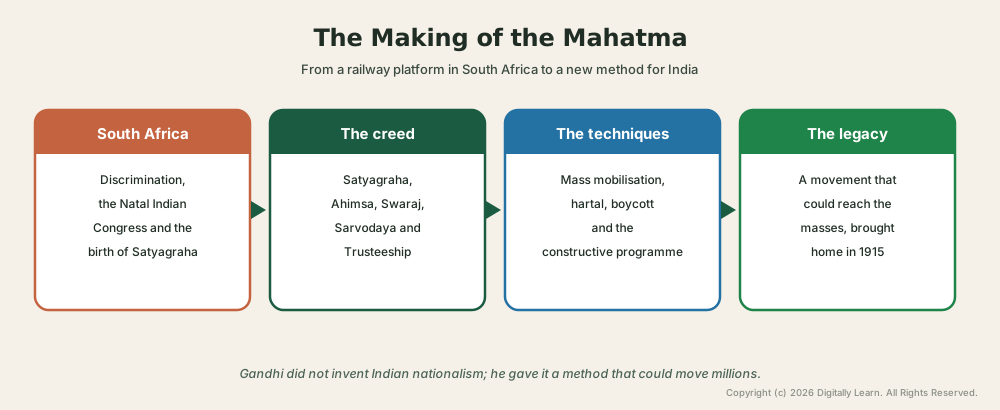
The Gandhian Era is the phase of the Indian national movement, from about 1917 to 1947, in which Mohandas Karamchand Gandhi made nationalism a genuine mass movement. Its method was Satyagraha, the non-violent insistence on truth that Gandhi had forged during two decades in South Africa, and its creed joined Ahimsa, Swaraj, Sarvodaya, Trusteeship and Swadeshi into a single moral vision. This opening part traces the making of the leader and the method, before the mass movements that the rest of the series examines.
Introduction: The Gandhian Era and the Turn to Mass Nationalism
What the Gandhian Era Means
Why this matters: the years from about 1917 to 1947 are called the Gandhian Era because one figure reshaped the whole character of the national movement. Under Mohandas Karamchand Gandhi, nationalism ceased to be the affair of an English-educated elite and became, for the first time, a genuine mass movement drawing in peasants, workers and women.
What is the significance of the Gandhian Era: it gave Indian nationalism both a mass base and a distinctive method, non-violent Satyagraha. Several features marked this new kind of nationalism, set out below, and together they explain why the period is named after the man rather than after a party or a place.
- A mass character: The movement reached far beyond the educated few into the villages.
- Non-violent method: Satyagraha replaced both petition and the bomb.
- Moral and spiritual idiom: Politics was fused with ethics and self-discipline.
- The constructive programme: Khadi, unity and social reform ran alongside agitation.
- Inclusive leadership: Women, peasants and the poor were drawn in as participants.
From the Moderates and Extremists to Mass Politics
Distinguishing the new phase from the old is essential. The earlier Congress, of the Moderates and then the Extremists, had built a national platform, an economic critique and the goal of Swaraj, but its reach was narrow: the Moderates petitioned, and even the Extremists mobilised mainly the urban educated classes.
Gandhi inherited this base and transformed it. Where the Moderates had trusted British justice and the Extremists had relied on the militant few, Gandhi offered a method by which ordinary people could act: a discipline of non-violent resistance that a peasant could practise as readily as a lawyer. The transition from the 1885 to 1916 phase to mass politics is the hinge on which this whole series turns.
Gandhi in South Africa: Discrimination, Awakening and the Birth of Satyagraha
Racial Discrimination and the Political Awakening
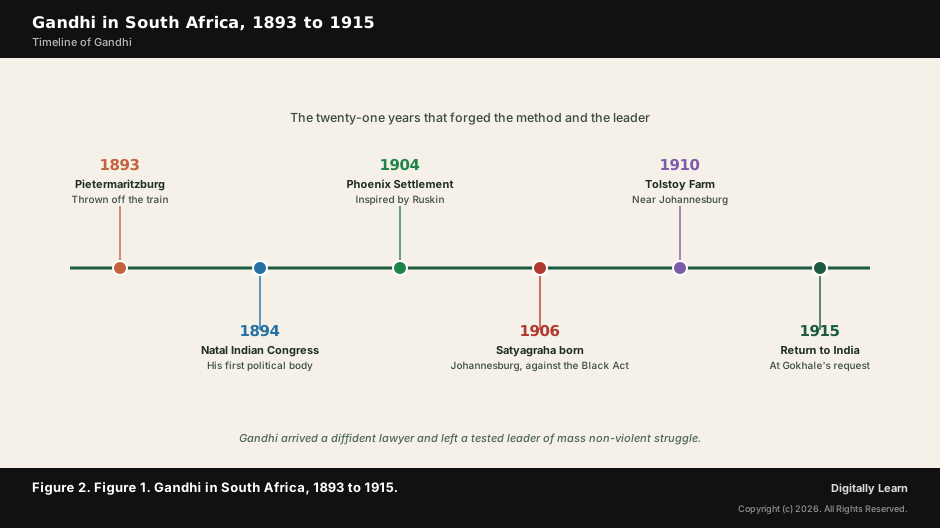
What is the significance of South Africa: it was there, not in India, that Gandhi became a political leader. Born at Porbandar on 2 October 1869 and trained as a barrister in London, he went to South Africa in 1893 on a legal brief and met a wall of racial discrimination against Indians. Being thrown off a first-class railway carriage at Pietermaritzburg in 1893 became the awakening of his political life.
Distinguishing features of his South African work were organisation and the press. He founded the Natal Indian Congress in 1894 to fight discriminatory laws, edited the journal Indian Opinion, and drew on a remarkable set of influences, examined below, that shaped his emerging philosophy.
| Influence | What Gandhi drew from it |
|---|---|
| Leo Tolstoy | The moral power of non-violence and conscience |
| John Ruskin (Unto This Last) | Sarvodaya: the good of all, and the dignity of labour |
| Henry David Thoreau | The idea of civil disobedience to unjust laws |
| Gopal Krishna Gokhale | His Indian political mentor and guide |
| The Bhagavad Gita and Jainism | Selfless action and the ethic of Ahimsa |
The Birth of Satyagraha: Phoenix, Tolstoy Farm and the First Campaigns
Observable outcomes of these years were both a method and the communities to practise it. Gandhi built the Phoenix Settlement near Durban in 1904, inspired by Ruskin, and later Tolstoy Farm near Johannesburg in 1910, as experiments in simple, self-reliant communal living. It was in the campaign against the Transvaal registration law, the so-called Black Act, that he forged and named his method, Satyagraha, in 1906.
These campaigns of non-violent resistance, with their mass courting of arrest, were the rehearsal for everything that followed. When Gandhi finally returned to India in 1915, at the urging of his mentor Gopal Krishna Gokhale, he brought with him a tested technique and a national reputation. The arc of these South African years is shown below.
The Core Principles of Gandhian Thought
Satyagraha and Ahimsa: Truth-Force and Non-Violence
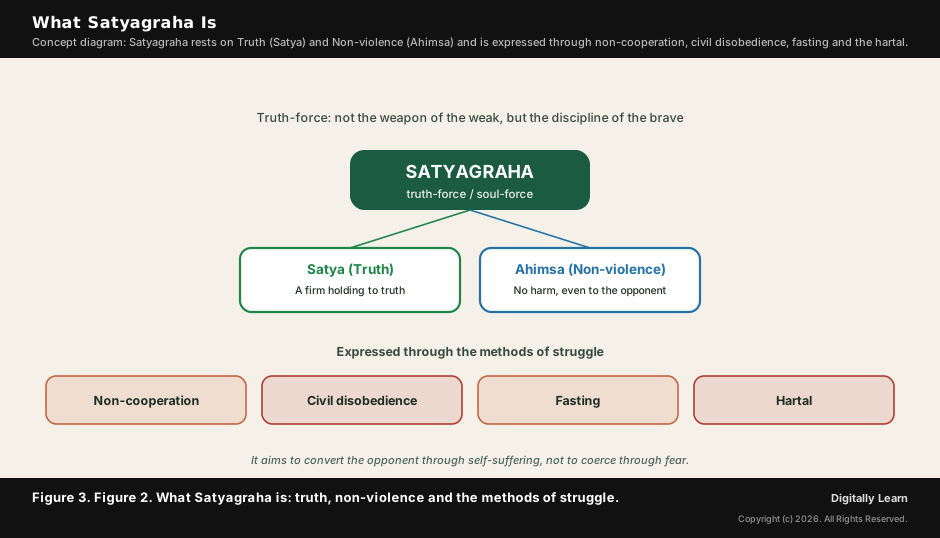
What is the significance of Satyagraha: it was the heart of the whole Gandhian method. The word, which Gandhi coined, means the force born of truth, or soul-force. It was not, he insisted, the weapon of the weak but the discipline of the brave: a refusal to cooperate with injustice, combined with a readiness to suffer for the truth without retaliation.
Its inseparable companion was Ahimsa, non-violence in thought, word and deed, extended even to the opponent. Satyagraha sought to convert the adversary, not to crush him, through the moral pressure of voluntary self-suffering. The structure of the idea is shown below.
Swaraj, Sarvodaya and Trusteeship
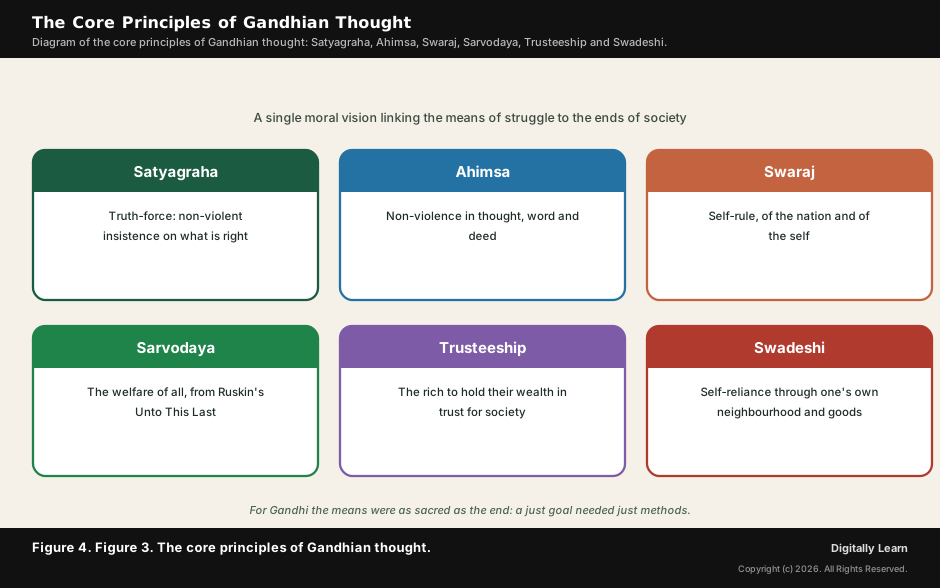
Distinguishing the wider creed shows that Gandhi's was a vision of society, not merely a tactic. Swaraj meant self-rule, both the freedom of the nation and the self-mastery of the individual. Sarvodaya, a word he drew from John Ruskin's Unto This Last, meant the welfare of all, especially the poorest, the conviction that the good of the individual is contained in the good of all.
To this he added Trusteeship, the idea that the rich should hold their wealth in trust for society, and Swadeshi, self-reliance through one's own neighbourhood and its goods. Together these principles, set out below, joined the means of struggle to the ends of a just society.
The Gandhian Political Techniques
Mass Mobilisation, Hartal and Boycott
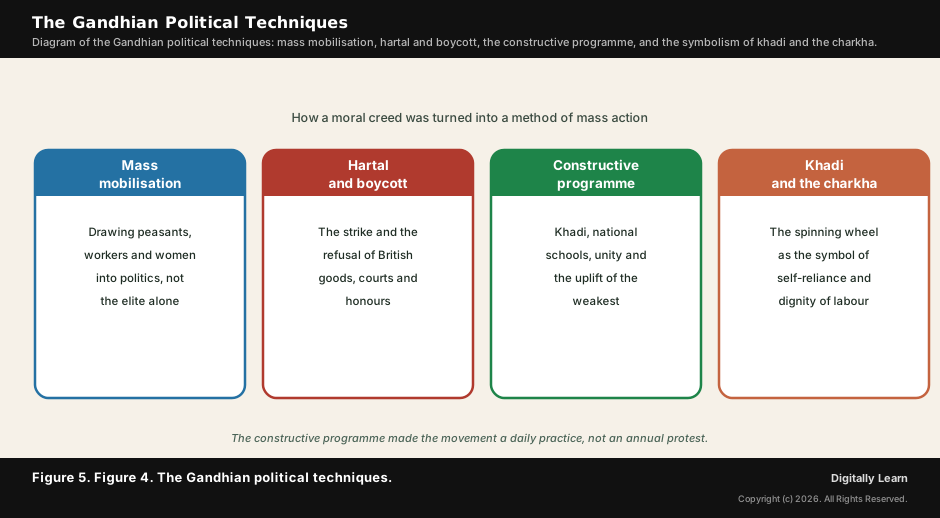
Observable outcomes of the creed appeared in a distinctive set of techniques. The first was mass mobilisation: Gandhi drew peasants, workers and women into politics in numbers the earlier movement had never touched, speaking in a plain idiom and using familiar symbols of religion and labour.
Alongside it came the hartal, the voluntary closure of work and business as a moral protest, and the boycott of British goods, courts, schools and honours. These were weapons of refusal: ways for ordinary people to withdraw their cooperation from an unjust government, peacefully but on a vast scale. The techniques are shown below.
The Constructive Programme and the Symbolism of Khadi
Contemporary linkages between politics and daily life ran through the constructive programme. Gandhi insisted that agitation alone was not enough; the nation had also to build itself through positive work, the spread of khadi and village industries, national education, Hindu-Muslim unity and the removal of untouchability.
At its centre stood the charkha, the spinning wheel, and khadi, hand-spun cloth, which Gandhi made the symbols of self-reliance, the dignity of manual labour and the unity of the nation. The constructive programme turned nationalism from an annual protest into a daily practice, and it kept the movement alive in the years between the great agitations.
Significance: A New Grammar of Politics Enters India
Why Gandhi's Method Changed the Movement
Contemporary linkages run from this foundation through the whole later freedom struggle. Gandhi did not invent Indian nationalism, the Moderates and Extremists had built its base, but he gave it a method that could move millions: a non-violent, moral, mass technique that the existing politics of petition and of the bomb could not match.
The creed and the techniques traced here, forged in South Africa and brought home in 1915, are the foundation on which the Champaran, Non-Cooperation, Civil Disobedience and Quit India movements were all built. The rest of this series follows that method into action, beginning with the early experiments of 1917 and 1918.
Previous Year UPSC-CSE Questions
Previous Year UPSC-CSE Questions By the end you will be able to draft model answers for the following UPSC questions. Each question carries a collapsible framework showing how to approach it in the exam.
- UPSC Mains 2018 GS-IThrow light on the significance of the thoughts of Mahatma Gandhi in the present times.
How to structure the answer in the exam
Introduction: Open with Gandhi's thought as a single moral vision linking means and ends.
Body (sub-themes to develop):
- Ahimsa and Satyagraha: non-violent conflict resolution and civil-society protest today.
- Sarvodaya and Trusteeship: inclusive development and the ethics of wealth.
- Swadeshi and the constructive programme: self-reliance, decentralisation and sustainability.
- Limits: the debate over how far Gandhian methods fit a complex modern state.
Conclusion: Conclude that Gandhi's thought remains a living resource for ethics, non-violence and inclusive development.
- UPSC Prelims 2011 GS Paper IMahatma Gandhi said that some of his deepest convictions were reflected in a book titled "Unto this Last" and the book transformed his life. What was the message from the book that transformed Mahatma Gandhi ?
How to approach this Prelims question
Approach: Recall the message Gandhi took from Ruskin's Unto This Last.
Trap to watch: The book's transforming message was the social ideal of Sarvodaya (the good of all), not celibacy or a generic duty of the educated.
Key facts to recall:
- Unto This Last by John Ruskin
- It gave Gandhi the idea of Sarvodaya
- The good of the individual is contained in the good of all
Answer signal: The good of the individual is contained in the good of all, so option (b).
Sources and Further Reading
- Wikipedia: Mohandas Karamchand Gandhi
- Wikipedia: Satyagraha
- Wikipedia: Sarvodaya
- Wikipedia: Natal Indian Congress
- Wikipedia: Phoenix Settlement
- NCERT, Themes in Indian History III / India's Struggle for Independence
- Ministry of Culture: Indian Culture Freedom Archive
- Azadi Ka Amrit Mahotsav (Freedom Movement portal)
- Press Information Bureau, Government of India
- National Portal of India
Editorial Disclaimer
This article is prepared for UPSC examination preparation. Verify key facts and interpretations against standard reference histories before relying on them.