


Overview
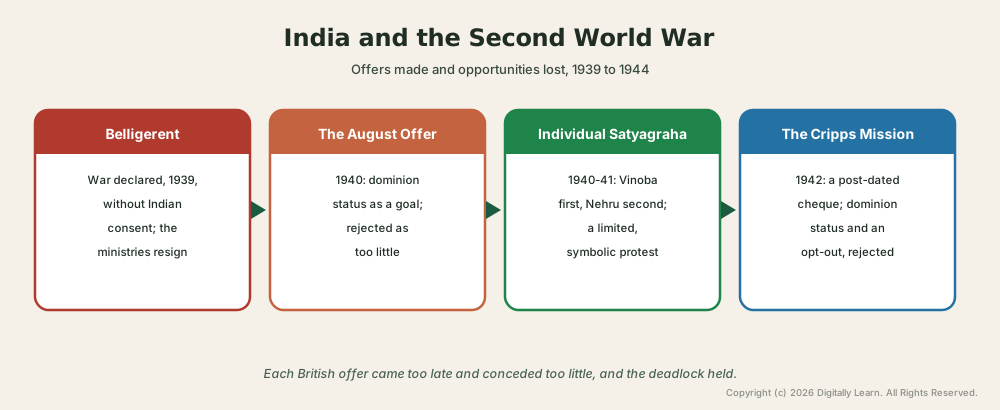
Between 1939 and 1944 the freedom struggle was caught in a wartime deadlock. India was made a belligerent in the Second World War without consent, and a succession of British proposals, the August Offer of 1940 and the Cripps Mission of 1942, failed to win Indian cooperation because each promised much for after the war and conceded too little in the present. The Congress answered with a limited Individual Satyagraha, and the period closed with the failed Rajagopalachari formula and Gandhi-Jinnah talks of 1944.
Introduction: India Dragged into the War (1939-1944)
Why the Wartime Years Matter
Why this matters: the outbreak of the Second World War transformed the politics of the freedom struggle. India was committed to a global war without its consent, and for five years the constitutional question turned on whether Britain would offer enough to win Indian cooperation.
What is the significance of these years: they were a long deadlock of offers and talks. The August Offer, the Cripps Mission and the Gandhi-Jinnah talks all failed, and the period showed how British imperial power, even in wartime, conceded too little too late.
The Wartime Deadlock at a Glance
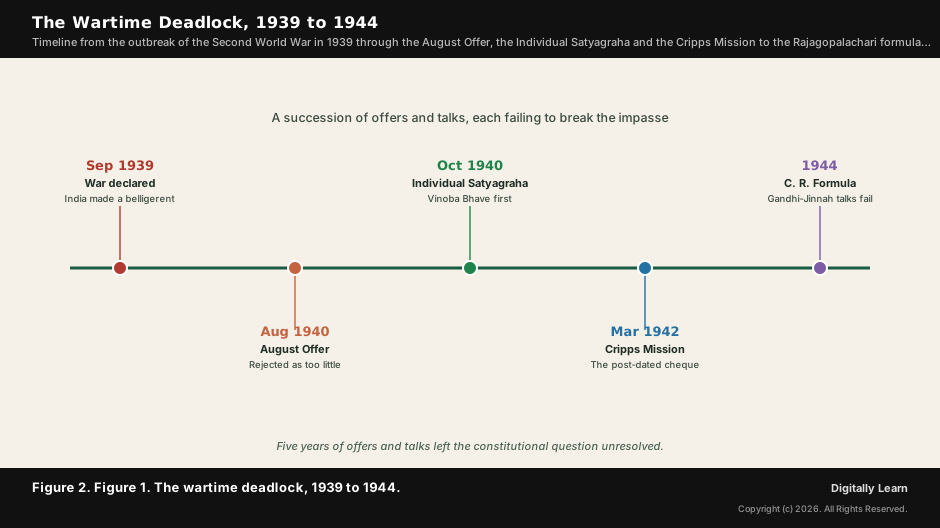
Distinguishing the sequence is the key to a crowded period. The war was declared, the August Offer was made and refused, the Congress launched a limited satyagraha, the Cripps Mission failed, and the period ended with the collapse of the Gandhi-Jinnah talks.
What ties the sequence together is a recurring pattern: each British move promised something for after the war and withheld real power in the present, as the timeline below records.
India and the Second World War: A Belligerent Without Consent
How India Was Taken into the War
What is the significance of the war declaration: it was the spark of the whole wartime conflict. In September 1939 the Viceroy, Lord Linlithgow, declared India a belligerent in the war against Germany without consulting a single Indian leader, treating the country as a possession to be committed to war at will.
Distinguishing the Congress position: the Congress was anti-fascist and had no sympathy for Germany, but it would not support the war as a subject nation. It asked what India was fighting for, demanded a clear commitment to Indian freedom, and when this was refused, its provincial ministries resigned in late 1939.
The August Offer (1940)
Dominion Status as a Distant Goal
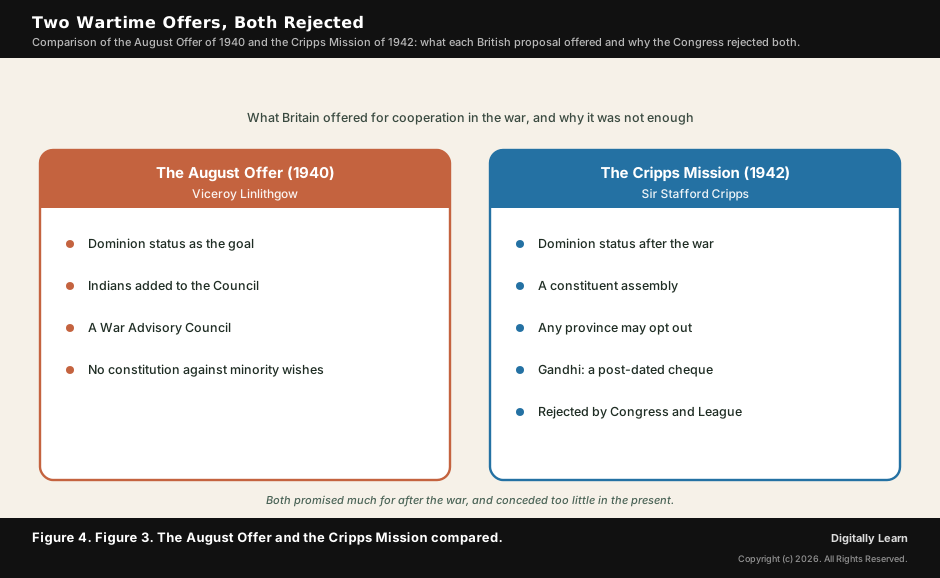
What is the significance of the August Offer: it was Britain's first wartime attempt to break the deadlock. In August 1940, the Viceroy offered dominion status as the eventual goal, the expansion of his Executive Council to include more Indians, a War Advisory Council, and an assurance that no future constitution would be adopted against the wishes of the minorities.
Distinguishing why it failed: the offer gave nothing in the present and made the minority veto a new obstacle to a settlement. The Congress rejected it as far too little, and even the Muslim League was not satisfied, so the deadlock continued.
The Individual Satyagraha (1940-1941)
Vinoba Bhave, Nehru and a Limited Protest
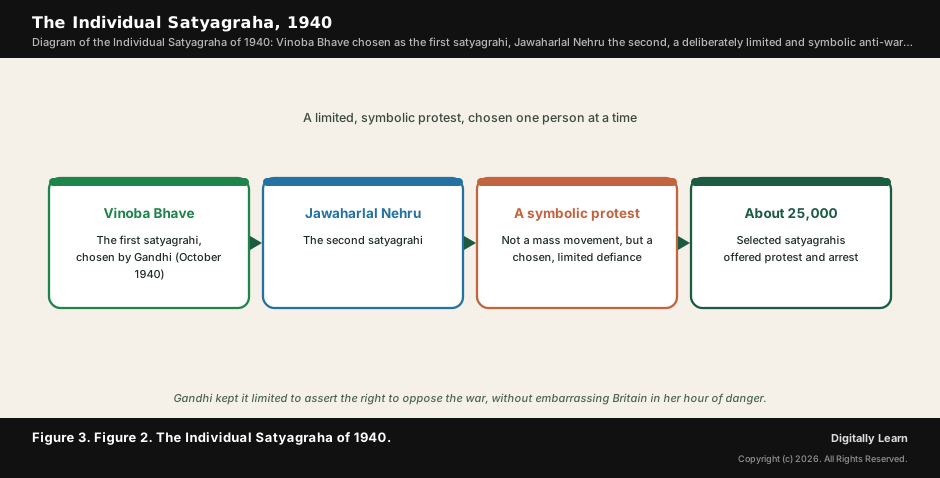
What is the significance of Individual Satyagraha: it asserted the right to oppose the war without launching a mass movement. After the August Offer failed, Gandhi began, in October 1940, a deliberately limited campaign of individual civil disobedience, in which chosen individuals would court arrest by publicly speaking against the war.
Distinguishing its careful design: the first satyagrahi was Vinoba Bhave, the second was Jawaharlal Nehru, and only selected persons followed, as the diagram below shows. Gandhi kept it small on purpose, to register the protest without embarrassing Britain in her hour of military danger.
The Cripps Mission and the 'Post-Dated Cheque' (1942)
What Cripps Offered, and Why It Failed
What is the significance of the Cripps Mission: it was the most serious wartime offer, and its failure led straight to Quit India. With Japan at India's gates in 1942, the Prime Minister Winston Churchill sent Sir Stafford Cripps with a plan: dominion status after the war, a constituent assembly to frame a constitution, and the right of any province to opt out of the new union.
Distinguishing why it was rejected: the offer was for after the war, not now, and the opt-out clause opened the door to Pakistan, as the comparison below sets out. Gandhi famously called it 'a post-dated cheque on a failing bank', and both the Congress and the Muslim League turned it down.
| Initiative | Year | Essence | Outcome |
|---|---|---|---|
| The August Offer | 1940 | Dominion status as a goal; minority veto | Rejected by Congress and League |
| Individual Satyagraha | 1940-41 | A limited, symbolic anti-war protest | Registered the protest; not a mass movement |
| The Cripps Mission | 1942 | Dominion status and an opt-out, after the war | Rejected; a post-dated cheque |
| The C. R. Formula | 1944 | Conceding the partition principle to the League | Gandhi-Jinnah talks failed |
The Rajagopalachari Formula and the Gandhi-Jinnah Talks (1944)
Conceding the Principle of Partition
What is the significance of the C. R. Formula: it was the first Congress-side acceptance of the principle of partition. In 1944, C. Rajagopalachari put forward a formula by which the Muslim League would support independence, and after the war the Muslim-majority areas would decide by plebiscite whether to form a separate state.
Distinguishing the outcome: the formula became the basis of the Gandhi-Jinnah talks of September 1944, but they failed. Jinnah wanted the principle of Pakistan conceded before any cooperation and on his own terms, and the talks broke down, hardening the communal divide further.
Significance: Offers Made and Opportunities Lost
Why the Wartime Offers Failed
Contemporary linkages run from this deadlock into the end-game of British rule. The wartime offers failed for a common set of reasons, set out below, and their failure pushed the Congress towards the mass uprising of Quit India and Britain towards the eventual transfer of power.
- Too little, too late: real power was always promised for after the war.
- The minority veto: the August Offer let the League block any settlement.
- The opt-out clause: Cripps opened the constitutional door to Pakistan.
- Distrust of Britain: a war-time promise from a failing power carried little weight.
- The communal gulf: the Congress-League divide made any agreement harder.
The larger significance is that British imperial power, even when it offered concessions, complicated the transfer of power by conceding too little and by using the communal divide. The next part turns to the explosion that the failure of Cripps produced: the Quit India Movement of 1942.
Previous Year UPSC-CSE Questions
Previous Year UPSC-CSE Questions By the end you will be able to draft model answers for the following UPSC questions. Each question carries a collapsible framework showing how to approach it in the exam.
- UPSC Mains 2019 GS-IAssess the role of British imperial power in complicating the process of transfer of power during the 1940s.
How to structure the answer in the exam
Introduction: Open with the 1940s as the decade Britain bargained while delaying the transfer of power.
Body (sub-themes to develop):
- Too little, too late: the August Offer and the Cripps 'post-dated cheque'.
- Using the communal divide: the minority veto, the opt-out clause, the encouragement of the League.
- Repression alongside negotiation: the response to Quit India.
- The final rush: a hasty Partition and the Radcliffe line under Mountbatten.
Conclusion: Conclude that imperial power both delayed freedom and shaped its tragic, partitioned form.
- UPSC Prelims 2009 GS Paper IIn the ‘Individual Satyagraha’, Vinoba Bhave was chosen as the first Satyagrahi. Who was the second?
How to approach this Prelims question
Approach: Recall the order of the chosen satyagrahis.
Trap to watch: Vinoba Bhave was first; the second was Nehru, not Patel or Rajagopalachari.
Key facts to recall:
- Individual Satyagraha 1940
- Vinoba Bhave the first satyagrahi
- Jawaharlal Nehru the second
Answer signal: Pandit Jawaharlal Nehru, so option (b).
- UPSC Prelims 2016 GS Paper IThe plan of Sir Stafford Cripps envisaged that after the Second World War
How to approach this Prelims question
Approach: Recall what Cripps actually offered.
Trap to watch: Cripps offered dominion status after the war, not complete independence and not partition as such.
Key facts to recall:
- Cripps Mission 1942
- Dominion status after the war
- A constituent assembly and a provincial opt-out
Answer signal: Dominion status, so option (d).
- UPSC Prelims 2009 GS Paper IConsider the following statements. The Cripps Proposals included the provision for:
- Full independence for India.
- Creation of a Constitution-making body.
Which of the statements given above is/are correct?
How to approach this Prelims question
Approach: Test each statement against the Cripps proposals.
Trap to watch: Statement 1 is the trap: Cripps offered dominion status, not full independence; the constituent assembly (statement 2) was offered.
Key facts to recall:
- Cripps = dominion status, not full independence
- A constitution-making body was offered
- Statement 1 false, statement 2 true
Answer signal: 2 only, so option (b).
- UPSC Prelims 2009 GS Paper IWho of the following Prime Ministers sent Cripps Mission to India?
How to approach this Prelims question
Approach: Match the Cripps Mission to the Prime Minister who sent it.
Trap to watch: It was Churchill (1942), not the earlier MacDonald, Baldwin or Chamberlain.
Key facts to recall:
- Cripps Mission 1942
- Sent by PM Winston Churchill
- Stafford Cripps led it
Answer signal: Winston Churchill, so option (d).
Sources and Further Reading
- Wikipedia: Cripps Mission
- Wikipedia: August Offer
- Wikipedia: Individual Satyagraha
- Wikipedia: C. Rajagopalachari
- NCERT, India's Struggle for Independence / Themes in Indian History III
- Ministry of Culture: Indian Culture Freedom Archive
- Azadi Ka Amrit Mahotsav (Freedom Movement portal)
- Press Information Bureau, Government of India
- National Portal of India
Editorial Disclaimer
This article is prepared for UPSC examination preparation. Verify key facts and interpretations against standard reference histories before relying on them.