


Overview
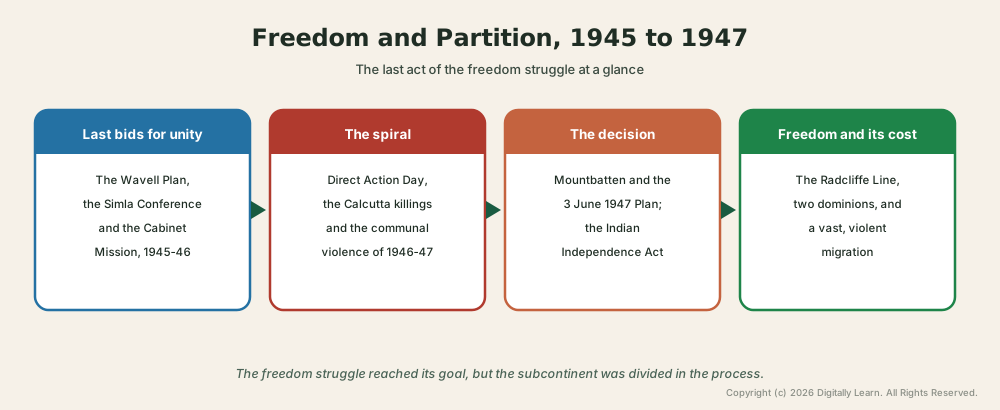
The Partition of India in 1947 ended British rule but divided the subcontinent into two dominions, India and Pakistan. After the Second World War, a Labour government in Britain moved to quit India, and a last attempt at unity, the Cabinet Mission of 1946, failed amid communal violence. Lord Mountbatten, the last Viceroy, then drew up the plan of 3 June 1947 that accepted partition, and the Radcliffe Line divided the Punjab and Bengal. Freedom came on 15 August 1947, but it was accompanied by one of the largest and most violent migrations in history.
Introduction: Freedom at the Price of Partition
Why Partition Matters
Why this matters: the freedom struggle reached its goal in 1947, but not in the form its leaders had hoped. Independence came with partition, the division of British India into two states, and with a human catastrophe that still shapes the subcontinent.
What is the significance of these two years: between 1945 and 1947 the question was no longer whether the British would leave, but how, and at what cost. This part follows the rapid sequence of plans and crises that ended in the two dominions of India and Pakistan.
The Geography of Partition
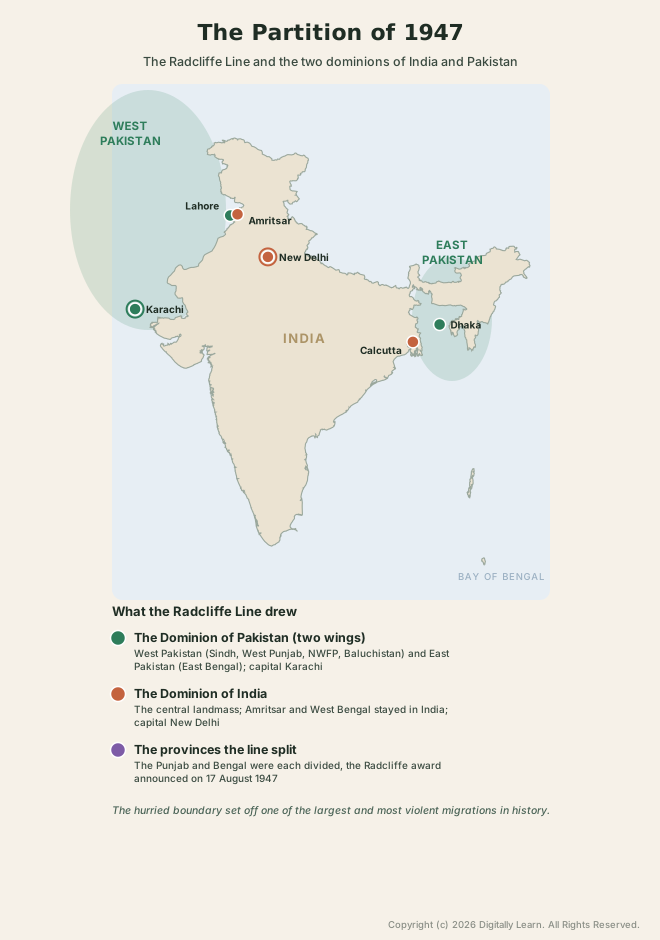
Distinguishing the shape of partition is the place to begin. The new state of Pakistan was made of two wings, a western wing of Sindh, the western Punjab, the North-West Frontier Province and Baluchistan, and an eastern wing of eastern Bengal, with the Dominion of India between them.
What the map shows is the work of the Radcliffe Line: the two provinces of Punjab and Bengal were each cut in two, so that Lahore and Dhaka went to Pakistan while Amritsar and Calcutta stayed in India, as set out below.
The Post-War Shift: Labour, the Wavell Plan and the Simla Conference (1945)
Britain's Change of Heart after the War
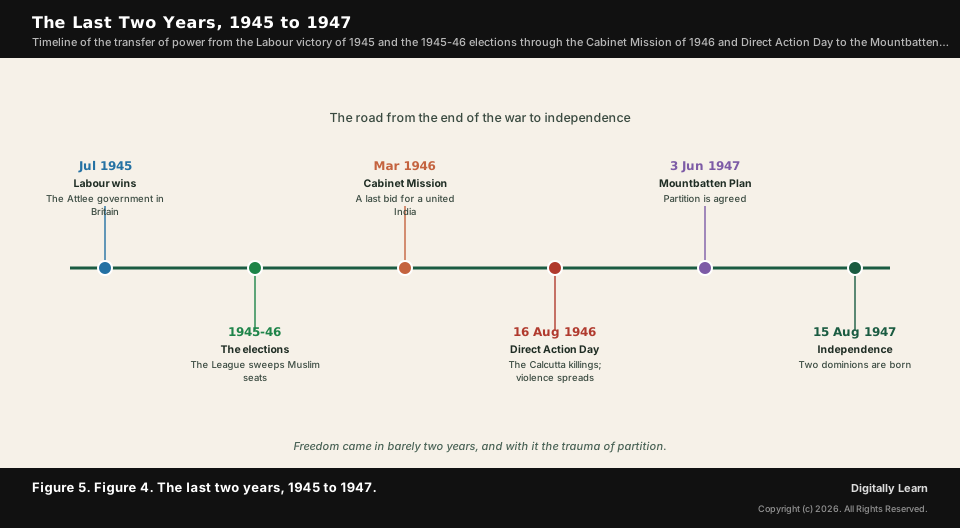
What is the significance of the post-war shift: it made British withdrawal a matter of time. Exhausted by the war and facing a new Labour government under Attlee from 1945, Britain accepted that it could no longer hold India, and the question turned to the terms of departure.
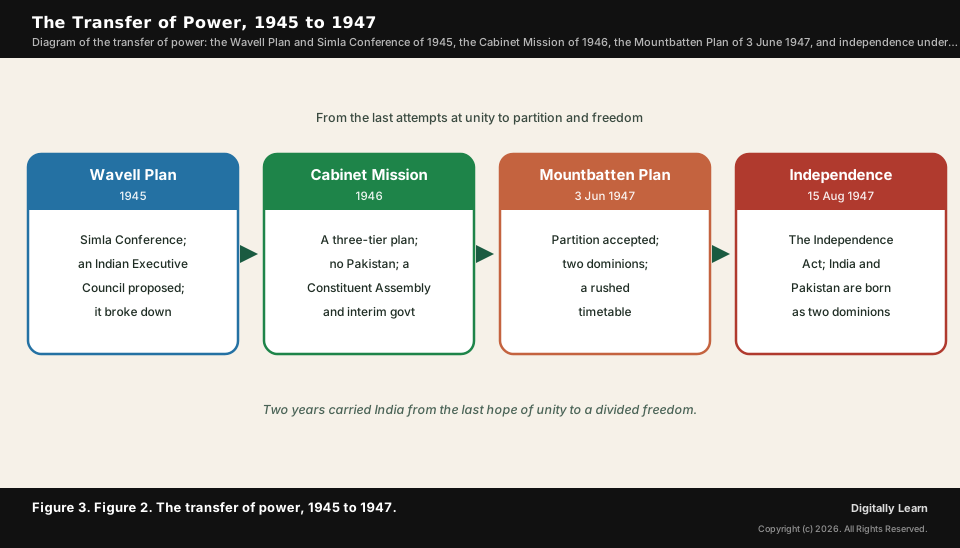
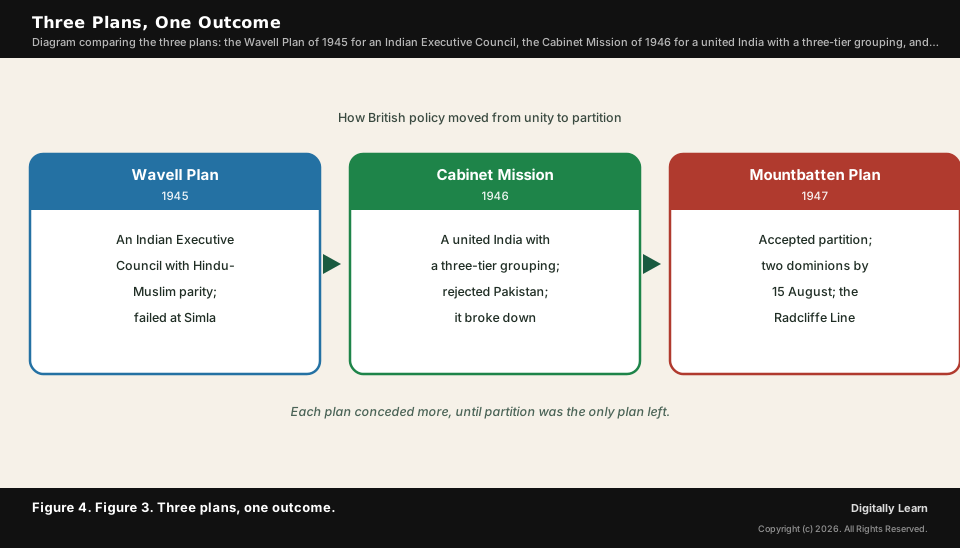
Distinguishing the first move: the Viceroy, Lord Wavell, put forward a plan, discussed at the Simla Conference of 1945, to reconstitute his Executive Council with Indians on a basis of Hindu-Muslim parity. The conference failed when the Muslim League insisted on naming all the Muslim members, a sign of the deadlock to come.
The 1945-46 Elections and the RIN Mutiny
A Polarised Verdict and a Naval Revolt
Observable outcomes appeared in the elections of 1945 to 1946. The Congress swept the general seats and the Muslim League swept the Muslim seats, so the polls confirmed, rather than healed, the communal divide and strengthened the League's claim to speak for Muslims.
Distinguishing the mood: in February 1946 the Royal Indian Navy mutiny broke out at Bombay, when naval ratings revolted over pay, food and racial insult. Though it was soon suppressed, the revolt, coming after the INA trials, warned the British that their Indian forces could no longer be relied on, and added urgency to the talks.
The Cabinet Mission and the Three-Tier Plan (1946)
Grouping the Provinces, and the Interim Government
What is the significance of the Cabinet Mission: it was the last serious attempt to keep India united. Sent in 1946 and made up of Pethick-Lawrence, Stafford Cripps and A.V. Alexander, the mission rejected the demand for a separate Pakistan and proposed instead a single federal union with a weak centre.
Distinguishing the scheme: it offered a three-tier plan, with the provinces grouped into sections under a federal union that controlled only defence, foreign affairs and communications, together with a Constituent Assembly to frame the constitution and an interim government. Both parties first accepted, but the plan collapsed when they read its grouping clauses differently and the League withdrew, as the flow below sets out.
Direct Action Day and the Communal Spiral (1946-1947)
From Calcutta to a Country in Flames
Observable outcomes turned tragic in August 1946. When the talks broke down, the Muslim League called for Direct Action Day on 16 August 1946 to press its demand for Pakistan, and in Calcutta this set off three days of terrible communal killing, remembered as the Great Calcutta Killings.
Distinguishing the spiral: the violence spread to Noakhali, Bihar and the Punjab in a cycle of riot and reprisal that no government seemed able to stop. By early 1947 the communal situation had grown so grave that an orderly, united transfer of power looked impossible, and partition came to seem, to many, the only way to end the bloodshed.
The Mountbatten Plan, the Indian Independence Act and the Radcliffe Line (1947)
The Decision to Divide and the Rush to Freedom
What is the significance of the Mountbatten Plan: it set the date and the method of partition. The last Viceroy, Lord Mountbatten, arrived in 1947 and, judging that delay would mean wider chaos, announced on 3 June 1947 the plan to divide British India into two dominions and to advance the date of departure.
Distinguishing the legal step: the British Parliament then passed the Indian Independence Act in July 1947, which created the two dominions of India and Pakistan and ended British paramountcy over the princely states. The whole transfer was carried out at extraordinary speed, as the comparison below shows.
The Boundary Award and the Birth of the Two Dominions
Observable outcomes followed from the boundary. The task of dividing the Punjab and Bengal fell to a commission under Sir Cyril Radcliffe, who had never been to India and had only a few weeks to draw the line; the Radcliffe award was announced on 17 August 1947, after independence.
Distinguishing the result: Pakistan came into being on 14 August and India on 15 August 1947, as set out below. The hurried, secret boundary left millions on the wrong side of the new line and helped trigger the vast migrations and massacres that followed.
| Feature | Dominion of India | Dominion of Pakistan |
|---|---|---|
| Came into being | 15 August 1947 | 14 August 1947 |
| First leader | Jawaharlal Nehru (Prime Minister) | M.A. Jinnah (Governor-General) |
| Capital | New Delhi | Karachi |
| Divided provinces | East Punjab, West Bengal | West Punjab, East Bengal, Sindh |
Significance: Freedom at the Price of Partition
What Independence Cost, and What It Won
Contemporary linkages run from 1947 into the whole later history of the subcontinent. The transfer of power gave India its freedom and a democratic constitution to come, but partition also left a bitter legacy of displacement, unresolved borders and the Kashmir dispute, the consequences set out below.
- One of the largest migrations in history, with an estimated twelve to twenty million people displaced.
- Communal violence on a vast scale, with estimates of the dead ranging from several hundred thousand to around a million or more.
- The princely states had to accede to one dominion or the other, the subject of the next part.
- The unresolved question of Kashmir, which led to the first war between India and Pakistan.
- A free India, soon to frame its own democratic constitution through the Constituent Assembly.
The larger significance is double-edged. The long struggle had won independence, yet the price was the division of the land and a human tragedy on an immense scale; even Gandhi spent the day of freedom not in celebration but trying to quell the violence in Calcutta. The next part turns to the task of holding the new India together, the integration of the princely states.
Previous Year UPSC-CSE Questions
Previous Year UPSC-CSE Questions By the end you will be able to draft model answers for the following UPSC questions. Each question carries a collapsible framework showing how to approach it in the exam.
- UPSC Mains 2019 GS-IAssess the role of British imperial power in complicating the process of transfer of power during the 1940s.
How to structure the answer in the exam
Introduction: Open with the post-war certainty of British withdrawal and the question of its terms.
Body (sub-themes to develop):
- Complicating: separate electorates and treating the communities as blocs hardened the divide.
- Complicating: the failure of the Wavell Plan and the ambiguous Cabinet Mission grouping clauses.
- Complicating: the rushed timetable, the secret Radcliffe award announced after independence.
- A balanced note: war exhaustion and genuine deadlock also drove the speed of withdrawal.
Conclusion: Conclude that British policy, by accident and design, deepened the divisions it then hurried to leave behind.
- UPSC Prelims 2015 GS Paper IWith reference to the Cabinet Mission, consider the following statements:
- It recommended a federal government.
- It enlarged the powers of the Indian courts.
- It provided for more Indians in the ICS.
Select the correct answer using the code given below.
How to approach this Prelims question
Approach: Test each statement against what the Cabinet Mission actually proposed.
Trap to watch: The Cabinet Mission proposed a federal union (statement 1); it said nothing about the courts or the ICS.
Key facts to recall:
- Cabinet Mission 1946 = federal union, weak centre
- Three-tier grouping
- Not about courts or ICS
Answer signal: 1 only, so option (a).
- UPSC Prelims 2014 GS Paper IThe Radcliffe Committee was appointed to
How to approach this Prelims question
Approach: Recall the one task of the Radcliffe commission.
Trap to watch: Radcliffe drew the boundary line; he did not solve the minorities question or enquire into riots.
Key facts to recall:
- Radcliffe = boundary commission
- Divided Punjab and Bengal
- Award announced 17 August 1947
Answer signal: Delimit the India-Pakistan boundaries, so option (c).
- UPSC Prelims 2008 GS Paper IWhich one of the following suggested the reconstitution of the Viceroy’s Executive Council in which all the portfolios including that of War Members were to be held by the Indian leaders?
How to approach this Prelims question
Approach: Match the Indian-Executive-Council proposal to its forum.
Trap to watch: The Wavell Plan was discussed at the Simla Conference (1945); the Simon Commission and Cripps belong to earlier moments.
Key facts to recall:
- Wavell Plan = Simla Conference 1945
- Indianised Executive Council
- Failed over the League's claim to name all Muslims
Answer signal: Simla Conference, so option (b).
- UPSC Prelims 2007 GS Paper IConsider the following Assertion (A) and Reason (R):
- Assertion (A): According to the Wavell Plan, the number of Hindu and Muslim members in the Executive Council were to be equal.
- Reason (R): Wavell thought that this arrangement would have avoided the partition of India.
Select the correct answer using the code given below.
How to approach this Prelims question
Approach: Judge A and R separately.
Trap to watch: The parity proposal (A) is true; but the plan was about ending the deadlock, not a stated device to avoid partition (R false).
Key facts to recall:
- Wavell Plan = Hindu-Muslim parity in the council
- Aimed to break the deadlock
- Partition not yet formally on the table in 1945
Answer signal: A true but R false, so option (c).
- UPSC Prelims 2017 GS Paper IWith reference to the Indian freedom struggle, consider the following events:
- Mutiny in Royal Indian Navy.
- Quit India Movement launched.
- Second Round Table Conference.
What is the correct chronological sequence of the above events?
How to approach this Prelims question
Approach: Date each event and order them.
Trap to watch: Second RTC 1931, Quit India 1942, RIN mutiny 1946; so 3-2-1.
Key facts to recall:
- RIN mutiny = February 1946
- Quit India = 1942
- Second RTC = 1931
Answer signal: 3-2-1, so option (c).
- UPSC Prelims 2013 GS Paper IWith reference to Indian History, the Members of the Constituent Assembly from the Provinces were
How to approach this Prelims question
Approach: Recall how the Constituent Assembly was constituted.
Trap to watch: Provincial members were elected by the Provincial Legislative Assemblies, not directly by the people or nominated by parties.
Key facts to recall:
- Constituent Assembly set up by the Cabinet Mission plan
- Provincial members elected by Provincial Assemblies
- Indirect election
Answer signal: Elected by the Provincial Legislative Assemblies, so option (c).
Sources and Further Reading
- Wikipedia: Partition of India
- Wikipedia: 1946 Cabinet Mission to India
- Wikipedia: Indian Independence Act 1947
- Wikipedia: Radcliffe Line
- Wikipedia: Direct Action Day
- NCERT, India's Struggle for Independence / Themes in Indian History III
- Ministry of Culture: Indian Culture Freedom Archive
- Azadi Ka Amrit Mahotsav (Freedom Movement portal)
- Press Information Bureau, Government of India
- National Portal of India
Editorial Disclaimer
This article is prepared for UPSC examination preparation. Verify key facts and interpretations against standard reference histories before relying on them.