
Overview
Previous Year UPSC-CSE Questions By the end you will be able to draft model answers for the following UPSC questions. Each question carries a collapsible framework showing how to approach it in the exam.
- UPSC Mains 2017 GS-IHighlight the importance of the new objectives that got added to the vision of Indian Independence since the twenties of the last century.
How to structure the answer in the exam
Introduction: Open with the 1920s as the decade the goal sharpened to full self-rule and an Indian constitution.
Body (sub-themes to develop):
- Complete independence (Purna Swaraj) replacing Dominion Status.
- An Indian-framed constitution: the demand for a Constituent Assembly against the imposed 1935 Act.
- Social and economic justice (the Karachi resolution).
- Mass participation and inclusive nationhood as new objectives.
Conclusion: Conclude that the gap between these objectives and the 1935 Act drove the movement towards full freedom.
- UPSC Prelims 2024 GS Paper IWith reference to the Government of India Act, 1935, consider the following statements:
- It provided for the establishment of an All India Federation based on the union of the British Indian Provinces and Princely States.
- Defence and Foreign Affairs were kept under the control of the federal legislature.
Which of the statements given above is/are correct?
How to approach this Prelims question
Approach: Test each statement against the Act's federal provisions.
Trap to watch: Statement 2 is the trap: defence and foreign affairs were reserved to the Governor-General, not controlled by the federal legislature.
Key facts to recall:
- All-India Federation of provinces and princely states (proposed)
- Defence and foreign affairs reserved to the Governor-General
- Statement 1 true, statement 2 false
Answer signal: 1 only, so option (a).
- UPSC Prelims 2018 GS Paper IIn the Federation established by The Government of India Act of 1935, residuary powers were given to the
How to approach this Prelims question
Approach: Recall where the 1935 Act placed the residuary powers.
Trap to watch: Unlike the later Constitution (residuary powers to the Union Parliament), the 1935 Act gave them to the Governor-General.
Key facts to recall:
- 1935 Act residuary powers = Governor-General
- Defence and foreign affairs also reserved to him
- Contrast with the 1950 Constitution
Answer signal: Governor General, so option (b).
- UPSC Prelims 2010 GS Paper IThe “Instrument of Instructions” contained in the Government of India Act 1935 have been incorporated in the Constitution of India in the year 1950 as
How to approach this Prelims question
Approach: Trace the 1935 Act's Instrument of Instructions into the 1950 Constitution.
Trap to watch: The Instrument of Instructions became the Directive Principles, not the Fundamental Rights.
Key facts to recall:
- Instrument of Instructions (1935 Act)
- Source of the Directive Principles of State Policy
- 1935 Act = blueprint for the Constitution
Answer signal: Directive Principles of State Policy, so option (b).
- UPSC Prelims 2012 GS Paper IThe distribution of powers between the Centre and the States in the Indian Constitution is based on the scheme provided in the:
How to approach this Prelims question
Approach: Match the Constitution's Centre-State distribution to its colonial source.
Trap to watch: It is the 1935 Act (the three lists), not the 1919 Act or the 1947 Independence Act, that supplied the scheme.
Key facts to recall:
- Three lists of the 1935 Act
- Federal, Provincial, Concurrent
- Model for the Constitution's Seventh Schedule
Answer signal: Government of India Act, 1935, so option (c).
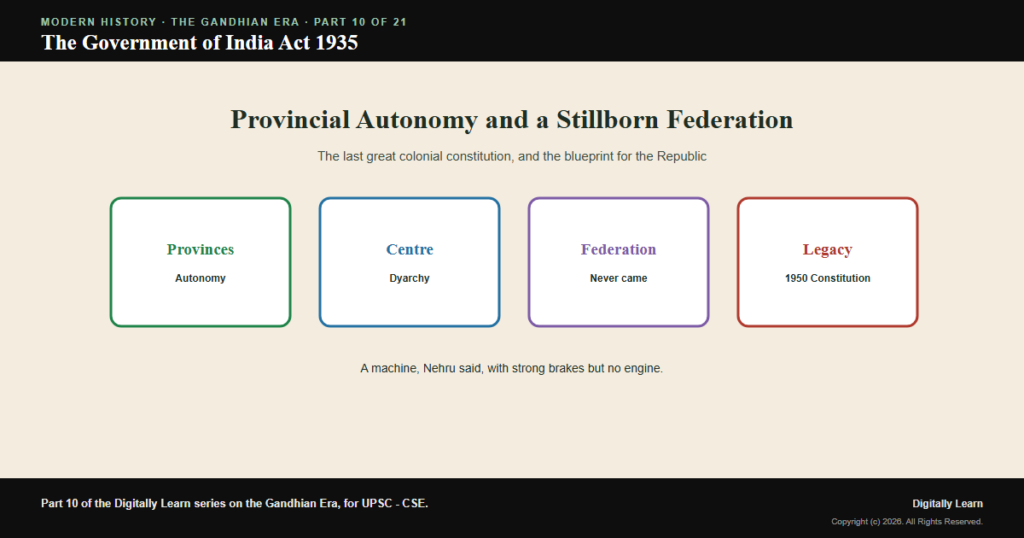
The Government of India Act 1935 was the last great constitutional law the British made for India, and the longest. It granted provincial autonomy, ending dyarchy in the provinces, but introduced dyarchy at the Centre and proposed an All-India Federation of the provinces and the princely states that never came into being. Condemned by Indians as a charter of subjection, it nonetheless created the three legislative lists, the Federal Court and the Reserve Bank, and became the structural blueprint for the Constitution of independent India.
Introduction: From the Simon Report to the Act, the Round Table Legacy
Why the 1935 Act Matters
Why this matters: the long phase of negotiation after Civil Disobedience produced one concrete result, a new constitution. The Government of India Act 1935 was the last great law the British framed for India, and though it was rejected by Indian opinion at the time, it shaped the structure of the country to come.
What is the significance of the Act: it gave the provinces genuine self-government for the first time, and it supplied the constitutional framework, the lists, the courts and the federal idea, on which the Constitution of independent India would later be built.
The Road to the Act: Simon, the Round Table and the White Paper
Distinguishing the making of the Act shows how slowly it came. It grew out of the Simon Commission report, the three Round Table Conferences, a government White Paper of 1933, and the report of a Joint Select Committee of Parliament; only then was it passed in 1935.
A distinguishing feature was its sheer size: it was the longest Act the British Parliament had ever passed. It had two main parts, an All-India Federation and provincial autonomy, of which only the second ever came into force.
Provincial Autonomy and the End of Provincial Dyarchy
The Great Dyarchy Inversion
What is the significance of provincial autonomy: it was the real advance of the Act. The 1935 Act abolished dyarchy in the provinces, the divided system of the 1919 Act, and gave them autonomy: elected Indian ministers, responsible to elected assemblies, now ran the whole provincial administration.
Distinguishing the famous inversion: where the 1919 Act had placed dyarchy in the provinces, the 1935 Act removed it there and introduced dyarchy at the Centre instead, as the diagram below shows. The provinces were freed; the real reservations were moved up to the central government.
The Federal Scheme That Never Was
An All-India Federation and the Reserved Subjects
What is the significance of the federal scheme: it was the great might-have-been of the Act. The Act proposed an All-India Federation uniting the British provinces and the princely states, but it was to come into force only when enough princely states agreed to join, and that agreement was never reached, so the federation never came into being.
Distinguishing the central reservations: even in the proposed federation, the substance of power was withheld. Defence and external affairs were reserved to the Governor-General and kept out of the hands of the ministers, and the residuary powers too lay with him. What the Act gave and what it withheld is set out below.
| Feature | What the 1935 Act provided |
|---|---|
| The provinces | Provincial autonomy; dyarchy abolished |
| The Centre | Dyarchy; defence and foreign affairs reserved |
| The Federation | Proposed, but never came into being |
| Residuary powers | Left with the Governor-General |
| Electorates | Separate electorates retained and extended |
Electoral Reforms, the Lists and the Safeguards
The Three Legislative Lists and the Franchise
Observable outcomes included a new division of powers. The Act distributed subjects between the Centre and the provinces through three lists, a Federal List, a Provincial List and a Concurrent List, set out below, a scheme the Indian Constitution would later adopt almost wholesale.
Distinguishing the electoral changes: the Act extended the franchise from about five million to some thirty-five million people, around a tenth of the population, but it retained and even widened the system of separate communal electorates, hard-wiring communal division into the constitution.
New Institutions and the Safeguards
The Federal Court, the Reserve Bank and the Governor's Powers
What is the significance of the new institutions: some of them have long outlived the Act. It established a Federal Court, which began work in 1937 and was the forerunner of the Supreme Court, and it provided for the Reserve Bank of India as the country's central bank.
Distinguishing the safeguards: alongside these advances ran a dense web of special responsibilities and override powers. The Governor in a province and the Governor-General at the Centre kept sweeping discretionary and emergency powers, so that the autonomy granted could always, in the last resort, be set aside.
A Critical Assessment: A Charter of Subjection and Its Lasting Legacy
Rejected at the Time, Inherited in 1950
Contemporary linkages begin with the verdict of the time, which was harsh. Indian opinion across parties condemned the Act: Jawaharlal Nehru called it a machine with strong brakes but no engine, and Jinnah thought it thoroughly rotten, because it gave the form of self-rule while withholding the substance of power. The balance of the Act is shown below.
The larger significance, set out below, is paradoxical. Rejected as a constitution for a colony, the Act nonetheless became the structural blueprint for the Constitution of free India in 1950.
- Provincial autonomy: the model of responsible provincial government carried over.
- The three lists: the Federal, Provincial and Concurrent lists were adopted almost intact.
- The federal structure: the Centre-province division of powers was inherited.
- The Federal Court: it became the Supreme Court of independent India.
- Emergency and Instrument-of-Instructions provisions: echoes survive in the Constitution.
Prelims MCQ practice
Each question below tests one specific concept on the topic. Click to reveal the answer and a full option-wise explanation.
Q1. The Government of India Act 1935 introduced, in the provinces:
- Dyarchy
- Provincial autonomy
- Direct British rule
- Separate electorates for the first time
Show answer and explanation
Answer: Provincial autonomy
Explanation.
Option (b) is correct. The 1935 Act abolished dyarchy in the provinces and introduced provincial autonomy. Hence option (b).
Q2. With reference to the Government of India Act 1935, consider the following statements:
- It abolished dyarchy in the provinces.
- It introduced dyarchy at the Centre.
Which of the statements given above is/are correct?
- 1 only
- 2 only
- Both 1 and 2
- Neither 1 nor 2
Show answer and explanation
Answer: Both 1 and 2
Explanation.
Both are correct. The Act abolished provincial dyarchy and introduced dyarchy at the Centre, the famous inversion. Hence option (c).
Q3. The All-India Federation proposed by the 1935 Act:
- Came into force in 1937
- Never came into being
- Excluded the princely states
- Was a unitary system
Show answer and explanation
Answer: Never came into being
Explanation.
Option (b) is correct. The federation depended on the accession of the princely states, which never came, so it never came into being. Hence option (b).
Q4. Under the 1935 Act, which body was the forerunner of the Supreme Court of India?
- The Privy Council
- The Federal Court
- The Provincial High Courts
- The Joint Select Committee
Show answer and explanation
Answer: The Federal Court
Explanation.
Option (b) is correct. The Federal Court, established under the 1935 Act (1937), was the forerunner of the Supreme Court of India. Hence option (b).
Q5. The three legislative lists (Federal, Provincial, Concurrent) of the Indian Constitution were modelled on the:
- Morley-Minto Reforms
- Government of India Act 1919
- Government of India Act 1935
- Indian Independence Act 1947
Show answer and explanation
Answer: Government of India Act 1935
Explanation.
Option (c) is correct. The three-list scheme of the 1935 Act was the model for the Constitution's division of powers. Hence option (c).
Q6. Consider the following pairs of a 1935-Act feature and its destination:
- Residuary powers : the Governor-General.
- The Instrument of Instructions : the Directive Principles of State Policy.
Which of the pairs given above is/are correctly matched?
- 1 only
- 2 only
- Both 1 and 2
- Neither 1 nor 2
Show answer and explanation
Answer: Both 1 and 2
Explanation.
Both pairs are correct: residuary powers lay with the Governor-General, and the Instrument of Instructions became the Directive Principles. Hence option (c).
Sources and Further Reading
- Wikipedia: Government of India Act 1935
- Wikipedia: Federal Court of India
- Wikipedia: Provincial autonomy
- NCERT, India's Struggle for Independence / Themes in Indian History III
- Ministry of Culture: Indian Culture Freedom Archive
- Azadi Ka Amrit Mahotsav (Freedom Movement portal)
- Press Information Bureau, Government of India
- National Portal of India
Editorial Disclaimer
This article is prepared for UPSC examination preparation. Verify key facts and interpretations against standard reference histories before relying on them.