


Overview
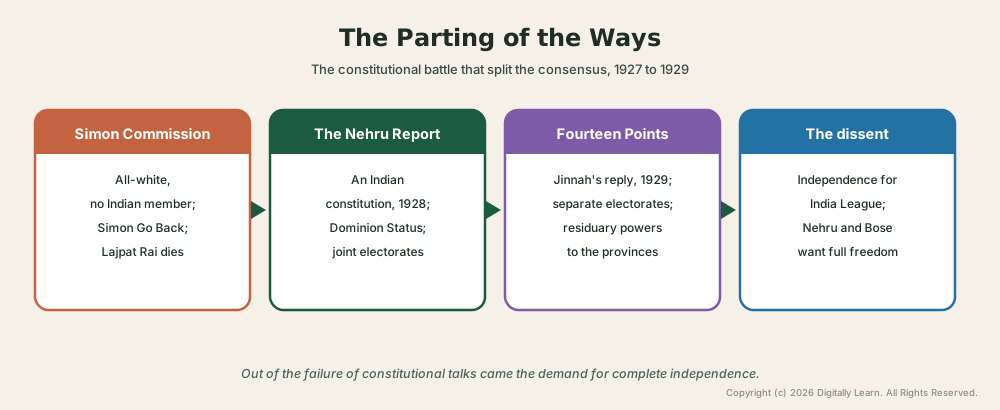
Between 1927 and 1929 the national movement passed through a constitutional crisis that proved a parting of the ways. The all-white Simon Commission was boycotted with the cry of 'Simon Go Back', and the death of Lala Lajpat Rai gave the protest a martyr. Indians answered with the Nehru Report, their own draft constitution proposing Dominion Status, but it split the consensus: Jinnah's Fourteen Points rejected it for the Muslim League, while younger leaders demanded not Dominion Status but full independence.
Introduction: The Constitutional Battle of 1927-1929
Why These Years Were a Parting of the Ways
Why this matters: the lull after Non-Cooperation ended not with a mass movement but with a constitutional crisis. Between 1927 and 1929, three developments, the Simon Commission, the Nehru Report and the Muslim League's reply, together reshaped the politics of the freedom struggle.
What is the significance of these years: they were a double parting of the ways. A communal fault-line opened between the Congress and the Muslim League over the shape of the constitution, and a generational divide opened between the old leaders who wanted Dominion Status and the young who wanted full independence.
The Sequence of Events at a Glance
Distinguishing the sequence helps before the detail. The crisis ran in a clear order: the all-white commission provoked a boycott, the boycott cost a life, Indians drafted their own constitution, and the Muslim League and the radicals each broke from it in turn.
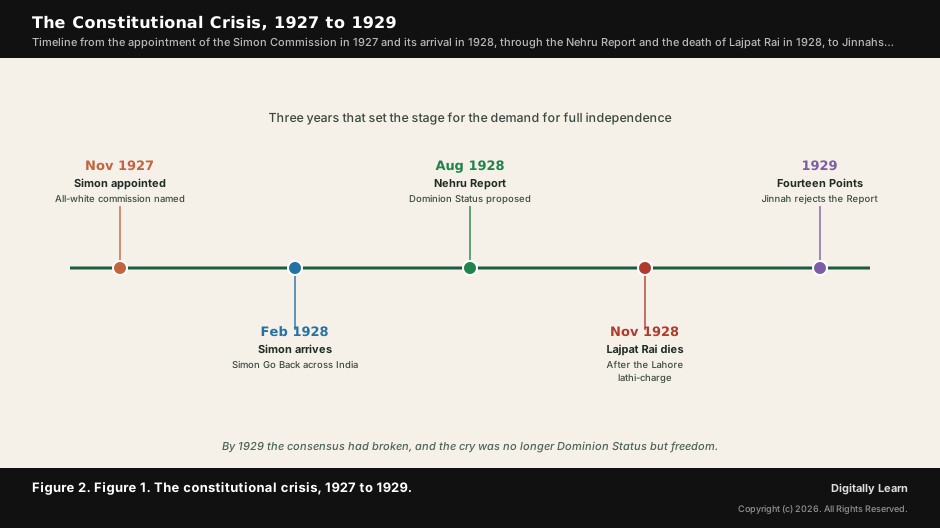
What ties the sequence together is that each step pushed the movement towards a sharper demand. The timeline of these three years is shown below.
The All-White Simon Commission and the Boycott (1927)
An All-White Commission and 'Simon Go Back'
What is the significance of the Simon Commission: it united Indian opinion as little else could. In November 1927 the British appointed the Indian Statutory Commission, under Sir John Simon, to review the working of the 1919 reforms, but it was made up of seven British members and not a single Indian.
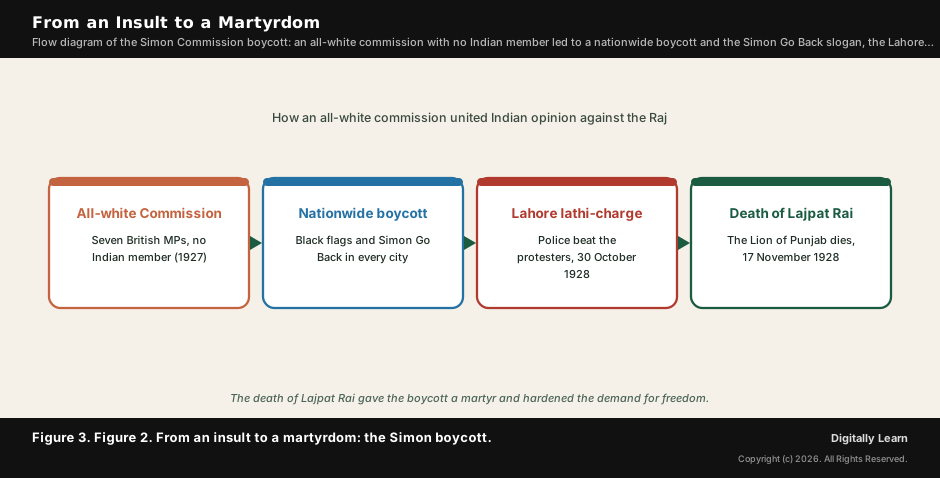
Distinguishing the grievance: the insult was the exclusion. That Indians were thought unfit even to sit in judgement on their own constitution provoked a nationwide boycott; the commission was met with black flags and the cry of 'Simon Go Back' in every city it visited, as the flow below shows.
The Lahore Lathi-Charge and the Death of Lajpat Rai
Observable outcomes turned tragic at Lahore. When Lala Lajpat Rai led a peaceful demonstration against the commission on 30 October 1928, the police charged the protesters with lathis, and the Lion of Punjab was severely injured.
A distinguishing consequence followed his death on 17 November 1928. The boycott now had a martyr; the demand for his avenging fed the revolutionary stream, and across the country the death hardened the resolve that mere review of the reforms would never satisfy India.
The Nehru Report: An Indian Constitution and Dominion Status (1928)
The All-Parties Conference and Motilal Nehru's Committee
What is the significance of the Nehru Report: it was the first Indian attempt to write a constitution for India. Challenged to produce an agreed scheme, the Indian parties met in an All-Parties Conference and appointed a committee under Motilal Nehru, which produced the Nehru Report in 1928.
Distinguishing its proposals shows a complete constitutional vision, set out in the list below. It was a serious, detailed document, the work of Indians for India, and it became the basis of all later constitutional debate.
- Dominion Status: India as a self-governing dominion within the Commonwealth.
- Joint electorates: no separate electorates, with reserved seats for minorities.
- Fundamental rights: a bill of basic rights, including no state religion.
- A strong centre: a largely unitary structure with a powerful union government.
- Responsible government: full responsible government at the centre and in the provinces.
Dominion Status and the Joint-Electorate Question
Observable tensions lay within the Report itself. Its choice of Dominion Status, rather than complete independence, was a compromise to carry the moderates and the Liberals, and it would soon be challenged by the younger nationalists.
Distinguishing the communal question: the Report's rejection of separate electorates, in favour of joint electorates with reserved seats, was meant to build a single nation, but it was exactly the point on which the Muslim League would break away.
The Communal Question: Jinnah's Fourteen Points (1929)
Why the Muslim League Rejected the Nehru Report
What is the significance of the Fourteen Points: they marked the formal break of the Muslim League from the constitutional consensus. Muhammad Ali Jinnah held that the Nehru Report ignored Muslim concerns, and in 1929 he set out his Fourteen Points as the minimum Muslim demands.
Distinguishing the two documents shows how far they had drifted apart, as the comparison below and the table that follows set out. Where the Report wanted joint electorates and a strong centre, the Fourteen Points wanted separate electorates, weightage, and residuary powers left to the provinces.
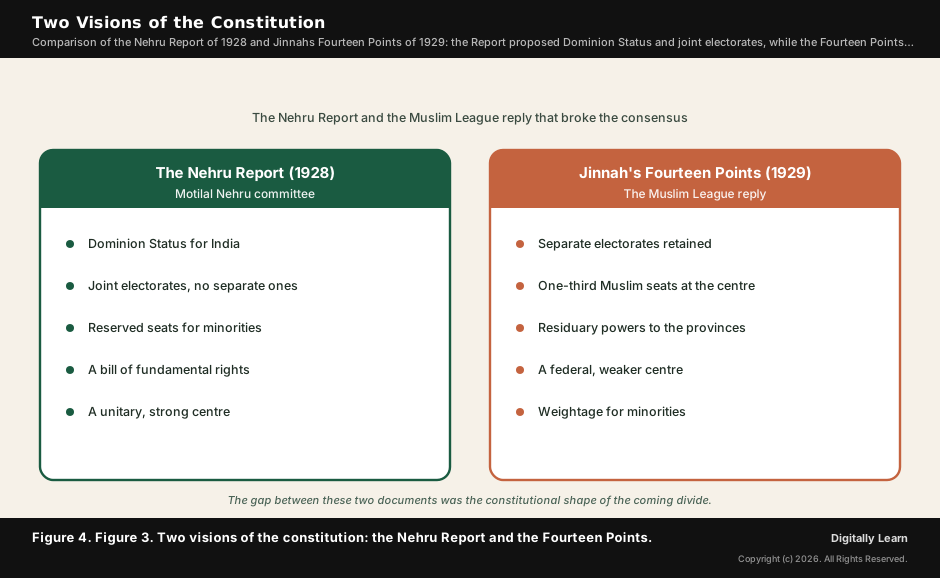
| Issue | The Nehru Report (1928) | Jinnah's Fourteen Points (1929) |
|---|---|---|
| Electorates | Joint, with reserved seats | Separate electorates retained |
| Muslim representation | Proportional reservation | One-third of the central legislature |
| The centre | Strong, largely unitary | Weak; residuary powers to provinces |
| Goal | Dominion Status | Safeguards within any settlement |
The Radical Dissent: The Independence for India League
The Younger Leaders and the Demand for Full Independence
What is the significance of the radical dissent: it changed the very goal of the movement. The Nehru Report's choice of Dominion Status was unacceptable to the younger leaders, and Jawaharlal Nehru and Subhas Chandra Bose founded the Independence for India League in 1928 to press for complete independence.
Distinguishing the new objective: this was a generational revolt within the Congress. The old leaders would have accepted Dominion Status; the young insisted on Purna Swaraj, full independence, and it was their objective that the Congress would adopt at Lahore the following year.
Significance: The Parting of the Ways
The Twin Fractures: Communal and Generational
Contemporary linkages run from these three years into the rest of the freedom struggle. The Simon boycott had united the country, but the constitutional debate that followed opened two fractures: the communal one between the Congress and the League, and the generational one between Dominion Status and full independence.
The larger significance is that the failure of constitutional talks pushed the movement towards a sharper goal. When the Nehru Report's deadline for Dominion Status passed unmet, the Congress turned to complete independence. The next part follows that turn, through the Lahore Congress and the Salt Satyagraha of 1929 to 1931.
Previous Year UPSC-CSE Questions
Previous Year UPSC-CSE Questions By the end you will be able to draft model answers for the following UPSC questions. Each question carries a collapsible framework showing how to approach it in the exam.
- UPSC Mains 2017 GS-IHighlight the importance of the new objectives that got added to the vision of Indian Independence since the twenties of the last century.
How to structure the answer in the exam
Introduction: Open with the 1920s as the decade the goal sharpened from self-rule to full freedom.
Body (sub-themes to develop):
- Complete independence (Purna Swaraj) replacing Dominion Status, via the Independence for India League and Lahore 1929.
- Social and economic justice entering the vision (the Karachi resolution, the socialist strand).
- Secular, inclusive nationhood, tested against the communal fault-line.
- Mass participation as a defining new objective of the movement.
Conclusion: Conclude that these new objectives widened the freedom struggle from a constitutional demand into a vision of a free, just nation.
- UPSC Prelims 2013 GS Paper IThe people of India agitated against the arrival of Simon Commission because
How to approach this Prelims question
Approach: Identify the real reason for the boycott.
Trap to watch: The recommendations (abolition of dyarchy) came later, in the 1930 report; the boycott in 1927-28 was over the all-white composition.
Key facts to recall:
- Simon Commission 1927, all-white
- No Indian member = the insult
- 'Simon Go Back'
Answer signal: There was no Indian member, so option (c).
- UPSC Prelims 2011 GS Paper IWith reference to the period of Indian freedom struggle, which of the following was/were recommended by the Nehru Report?
- Complete Independence for India.
- Joint electorates for reservation of seats for minorities.
- Provision of fundamental rights for the people of India in the Constitution.
Select the correct answer using the codes given below.
How to approach this Prelims question
Approach: Test each item against the Report's actual proposals.
Trap to watch: Statement 1 is the trap: the Report proposed Dominion Status, not complete independence, so 1 is wrong. Joint electorates and fundamental rights (2 and 3) are correct.
Key facts to recall:
- Nehru Report = Dominion Status, not full independence
- Joint electorates with reserved seats
- A bill of fundamental rights
Answer signal: 2 and 3 only, so option (b).
- UPSC Prelims 1995 GS Paper IThe radical wing of the Congress Party, with Jawaharlal Nehru as one of its main leaders, founded the ‘Independence for India League’ in opposition to
How to approach this Prelims question
Approach: Identify what the radicals opposed in the Report.
Trap to watch: The Gandhi-Irwin Pact (1931) and the Montford reforms (1919) are the wrong era; the League opposed the 1928 Nehru Report's Dominion-Status goal.
Key facts to recall:
- Independence for India League, 1928
- Jawaharlal Nehru and Subhas Bose
- Opposed the Nehru Report's Dominion Status
Answer signal: The Nehru Report, so option (c).
Sources and Further Reading
- Wikipedia: Simon Commission
- Wikipedia: Nehru Report
- Wikipedia: Fourteen Points of Jinnah
- Wikipedia: Lala Lajpat Rai
- NCERT, India's Struggle for Independence / Themes in Indian History III
- Ministry of Culture: Indian Culture Freedom Archive
- Azadi Ka Amrit Mahotsav (Freedom Movement portal)
- Press Information Bureau, Government of India
- National Portal of India
Editorial Disclaimer
This article is prepared for UPSC examination preparation. Verify key facts and interpretations against standard reference histories before relying on them.