


Overview
The Government of India Act, 1935, was the law of the British Parliament that substantially reorganised the government of British India. It received royal assent on 2 August 1935 and was a lengthy, detailed document of 321 sections and 10 schedules. The Act had two great parts. Its provincial part replaced the dyarchy (double rule; also written diarchy) of 1919 with provincial autonomy, under which, from 1 April 1937, every provincial department was placed under Indian ministers answerable to elected assemblies. Its federal part planned an All-India Federation of the British provinces and the princely states, with dyarchy at the Centre, but the princes never joined and the federation was never formed.
Making of the Government of India Act, 1935 (1927‑1935)
Simon Commission, Round Table Conferences and Communal Award (1927‑1932)
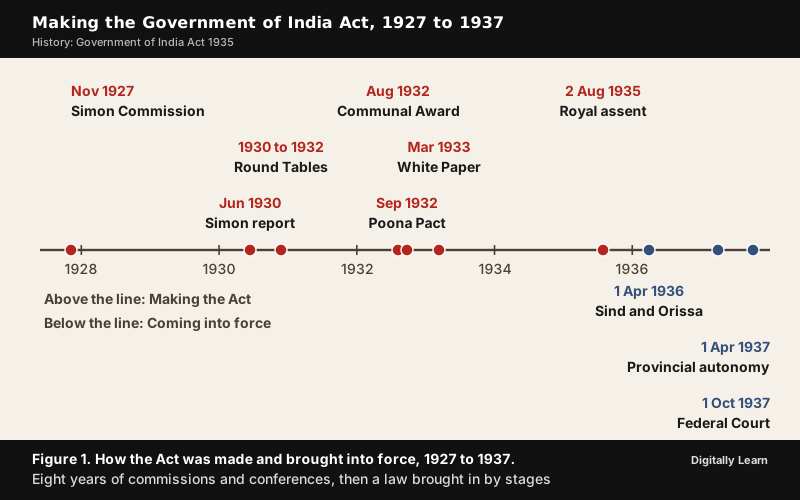
The Act grew out of a review of the reforms of 1919 that the Government of India Act, 1919, had itself promised after ten years. In November 1927 the British Government appointed a seven-member statutory commission under Sir John Simon, two years ahead of schedule; since every member was British, all the parties joined in the boycott of the Simon Commission. The Commission's report of June 1930 recommended abolishing dyarchy, extending responsible government in the provinces and forming a federation of British India and the princely states, while keeping communal electorates.
To consider these proposals, the British Government called three Round Table Conferences in London between November 1930 and December 1932. They agreed in principle on a federation of the provinces and the willing princely states, but the Congress and the Muslim representatives could not agree on the details of the federation. With no agreement reached, the British Prime Minister Ramsay MacDonald announced the Communal Award in August 1932. It continued separate electorates for Muslims, Sikhs, Indian Christians, Anglo-Indians and Europeans and extended them to the depressed classes (today's Scheduled Castes). Gandhi's fast against that extension ended in the Poona Pact of 24 September 1932, and the Third Round Table Conference met without the Congress in November and December 1932.
White Paper, Joint Select Committee and Royal Assent (1933‑1935)
With the conferences over, the Conservative-dominated National Government in London drafted its own scheme. The stages that followed turned that scheme into law:
- March 1933: The government published its proposals as a White Paper on constitutional reform.
- April 1933 to November 1934: A Joint Select Committee of the British Parliament, chaired by Lord Linlithgow, examined the White Paper amid opposition from Winston Churchill and other Conservative backbenchers.
- December 1934: The House of Commons approved the Joint Select Committee's report.
- 2 August 1935: The Government of India Bill, framed on the White Paper, received royal assent after a passage through Parliament in which, to satisfy the Conservative diehards, its safeguards were strengthened and indirect election was restored for the lower house of the central legislature.
Sir Samuel Hoare, Secretary of State for India in the early 1930s, was the Act's chief author, and it was passed while Lord Willingdon was Viceroy (1931‑1936). Lord Linlithgow, who had chaired the Joint Select Committee, succeeded Willingdon as Viceroy (1936‑1943) and was sent out to bring the Act into effect. The Labour Party opposed the Bill's third reading because it held no specific promise of dominion status. The Act also carried no preamble of its own; it kept the preamble of the 1919 Act while repealing the rest of that Act.
Main Features of the Government of India Act, 1935, and Their Fate
Provisions That Worked and Provisions That Never Did
The features of the Act fall into two groups, those that came into force and those that stayed on paper. The provincial part came into force on 1 April 1937, while the federal part was to begin only when enough princely states had joined, which never happened. Until 1946 the central government went on in the form set up under the 1919 Act.
| Feature | What the Act provided | Did it come into force? |
|---|---|---|
| All-India Federation | A federation of the provinces and the princely states as units | No; the princes did not join |
| Dyarchy at the Centre | Federal subjects divided into reserved and transferred subjects | No |
| Three lists | Federal List of 59 items, Provincial List of 54 items, Concurrent List of 36 items | Yes, for provincial legislation from 1937 |
| Provincial autonomy | Ministers responsible to provincial legislatures in charge of all provincial subjects | Yes, from 1 April 1937 |
| Bicameral provinces | Legislative councils in six of the 11 provinces | Yes |
| Franchise | Electorate raised from about 50 lakh to about 3.5 crore | Yes, first used in the 1937 elections |
| Communal representation | Separate electorates and reserved seats as settled by the Communal Award and the Poona Pact | Yes |
| Federal Court | Original and appellate jurisdiction | Yes, from 1 October 1937 |
| Public service commissions | A Federal Public Service Commission and provincial commissions | Yes, from 1 April 1937 |
| Council of India | Abolished; the Secretary of State for India given a team of advisers | Yes |
| New provinces and separations | Sind and Orissa created; Burma and Aden separated from India | Yes, in 1936 and 1937 |
All-India Federation and Dyarchy at the Centre
Units of the Federation and the Conditions for Princely Accession
The All-India Federation was to unite the British Indian provinces, the chief commissioner's provinces and the Indian princely states. Each princely state would join only by its own choice. The federation was to begin when two conditions were met:
- Seats: States entitled to 52 of the seats in the proposed upper house, the Council of State, had to agree to join.
- Population: Those acceding states had to hold half the total population of all the Indian states.
The terms offered to the princes were generous. Each ruler would choose his state's representatives in the federal legislature, and no ruler faced any pressure to introduce elections or democratic government inside his state. The princely states held about a quarter of India's population, yet they were to fill 40 per cent of the upper house and one-third of the lower house.
Federal Legislature: Council of State and Federal Assembly
The Act planned a bicameral federal legislature:
- Council of State: An upper house of 260 members, 156 elected from British India and 104 nominated by the rulers of the princely states; it was to be a permanent body with one-third of its members retiring every third year.
- Federal Assembly: A lower house of 375 members, 250 elected by the legislative assemblies of the provinces and 125 nominated by the rulers; its term was five years.
Election to the upper house was to be direct and election to the lower house indirect, an unusual arrangement. Ministers could face a vote of no-confidence in the Federal Assembly but not in the Council of State, and at least 80 per cent of federal expenditure was to be non-votable, so the legislature could vote only on what remained.

Dyarchy at the Centre: Reserved and Transferred Subjects
The Act proposed dyarchy at the Centre, under which federal subjects were split into two groups:
- Reserved subjects: Defence, foreign affairs, tribal areas and ecclesiastical affairs, run by the Governor-General on the advice of executive councillors who were not responsible to the federal legislature.
- Transferred subjects: All other federal subjects, run by the Governor-General on the advice of ministers chosen from the legislature and bound to resign on losing its confidence.
The Governor-General was the pivot of the whole scheme. Under it the British Government, through the Secretary of State for India and the Governor-General, was to keep control of India's financial obligations, defence and foreign affairs, and to make the key appointments to the Reserve Bank of India and the Railway Board. No finance bill could be placed before the central legislature without the Governor-General's consent.
The Governor-General also held the residuary powers, the power to legislate on subjects named in none of the three lists, and in matters of his special responsibilities, such as the security and tranquillity of India, he could act in his individual judgement. He could restore cuts in grants, certify bills that the legislature rejected, issue ordinances and veto legislation. Since this dyarchy belonged to the federal part, it never came into operation.
Why the Federation Never Came into Being
The federation failed because too few princes chose to accede. The princes were not a united group, and each ruler bargained for the best terms for his own state, in money and in autonomy. The Congress had begun to press for democratic reforms inside the princely states, which the rulers saw as a threat to their personal rule: If the states' representatives ever came to be elected, they might in time be Congressmen. No significant group in India accepted the federal part either. Lord Linlithgow, after the 1937 elections, tried to secure enough accessions, but the princes rejected the scheme, and the federation was postponed indefinitely after the Second World War began in 1939.
Division of Powers: Federal, Provincial and Concurrent Lists
Three Legislative Lists and Residuary Powers
The Act divided legislative power between the Centre and the units through three lists. The Federal List, of 59 items, was for the Centre; the Provincial List, of 54 items, was for the provinces; and the Concurrent List, of 36 items, was open to both. The provincial legislatures could make laws on subjects in the Provincial and Concurrent Lists.
The three lists set the 1935 Act apart from the earlier reforms. The 1919 Act had separated central and provincial subjects but kept the structure of government centralised and unitary, and the Morley-Minto Reforms of 1909 had enlarged the legislative councils and introduced separate electorates for Muslims. The Constitution of India kept the three-list pattern in its Seventh Schedule, as the Union List, the State List and the Concurrent List, but it gave the residuary power to Parliament under Article 248, not to the head of the executive.
| Point of comparison | Government of India Act, 1935 | Constitution of India, 1950 |
|---|---|---|
| Central list | Federal List, 59 items | Union List (List I) |
| Unit list | Provincial List, 54 items | State List (List II) |
| Shared list | Concurrent List, 36 items | Concurrent List (List III) |
| Residuary powers | The Governor-General | Parliament (Article 248) |
Provincial Autonomy: Provisions for the Governors' Provinces
Responsible Ministries in the Provinces
Provincial autonomy was the part of the Act that worked. Dyarchy in the provinces was abolished, and all provincial portfolios were placed in charge of a council of ministers headed by a premier, which needed the support of the provincial legislature and could be removed by its adverse vote. The provinces gained a separate legal identity: They were freed from the superintendence and direction of the Secretary of State and the Governor-General, drew their authority directly from the British Crown, received independent financial powers and could borrow money on their own security. The provincial executive, which the 1919 Act had made only partly responsible to the legislature, now became almost entirely responsible to it.
The new system first operated after the provincial elections of 1937, in which the Congress came to power in eight of the 11 provinces and governed until its ministries resigned in 1939.
Governor's Special Responsibilities and Discretionary Powers
The Governor, the Crown's nominee in each province, was the brake on this autonomy. He was to accept his ministers' advice unless, in his view, it touched his special responsibilities, such as preventing any grave menace to the peace or tranquillity of the province and safeguarding the legitimate interests of minorities. His special responsibilities also covered the rights of civil servants, British business interests, the partially excluded areas and the princely states. The Governor could:
- Withhold assent: Refuse assent to a bill passed by the provincial legislature.
- Legislate himself: Promulgate ordinances and enact Governor's Acts.
- Control the budget: Keep about 40 per cent of the provincial budget outside the legislature's vote.
- Take over the province: In a political breakdown, under the Viceroy's supervision, assume the whole administration and run it indefinitely.
That last power was used. After the Congress ministries resigned in 1939, the Governors ruled the former Congress provinces directly through the Second World War. The Crown also issued the Governor-General and each Governor an Instrument of Instructions, a set of directions on how he was to use his powers.
Reorganisation of British India: Sind, Orissa, Burma and Aden
New Provinces and the Separation of Burma and Aden
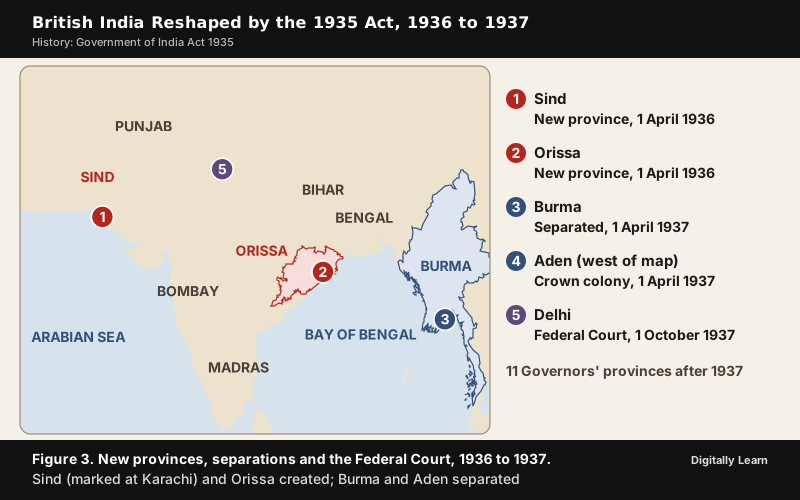
The Act also redrew the map of British India. Two new provinces were carved out on 1 April 1936, and two territories left India a year later:
- Sind: Sind Division was separated from the Bombay Presidency and made a province, with Karachi as its capital.
- Orissa: The province of Bihar and Orissa was split into the separate provinces of Bihar and Orissa; parts of the Madras Presidency and the Central Provinces were added to Orissa, whose territory corresponds to present-day Odisha.
- Burma: Burma was separated from British India on 1 April 1937 and received its own legislature, elected in 1936.
- Aden: Aden, governed until then as part of British India, became a separate Crown colony of the United Kingdom on 1 April 1937.
With these changes, British India had 11 Governors' provinces: Madras, Bombay, Bengal, the United Provinces, Bihar, the Central Provinces, Assam, Orissa, the North-West Frontier Province, Punjab and Sind. Six of them, Bengal, Bombay, Madras, Bihar, Assam and the United Provinces, received a bicameral legislature, with a legislative council above the legislative assembly; the other five had a single house.
Franchise and Communal Representation under the 1935 Act
Wider Franchise and Its Limits
The 1919 Act had given the vote, on property and tax qualifications, to about 50 lakh people, including for the first time a limited number of women in certain provinces. The 1935 Act widened the electorate to about 3.5 crore. Property and land-ownership thresholds were lowered so that more women and members of the depressed classes could vote. The franchise still rested on property qualifications, and it reached no more than 10 to 15 per cent of the adult population; there was no universal adult franchise.

Separate Electorates under the Communal Award and the Poona Pact
The Act wrote the settlement of 1932 into law. Muslims, Sikhs, Indian Christians, Anglo-Indians and Europeans kept their separate electorates, and seats in the provincial assemblies were also reserved for tribals, women, landholders, universities, and representatives of commerce and labour. Women thus received reserved seats in the provincial legislatures.
The depressed classes did not receive a separate electorate. Under the Poona Pact, seats for the depressed classes were reserved within the general Hindu constituencies of the provincial assemblies, and their members were elected by the common Hindu electorate. The Pact settled on 148 reserved seats, more than twice the 71 that the Communal Award had offered. This wider system of communal and class electorates promoted separatist tendencies that culminated in the partition of India.
Institutions under the 1935 Act: Federal Court, Public Service Commissions and Reserve Bank
Federal Court of India (1937‑1950)
The Federal Court was set up under the Act and began work on 1 October 1937 in the Chamber of Princes in the Parliament building in Delhi. It started with a Chief Justice, Sir Maurice Gwyer, and two puisne judges, Sir Shah Muhammad Sulaiman and M. R. Jayakar. Its two working jurisdictions were original and appellate:
- Original jurisdiction: Exclusive power to decide any dispute between the Central Government and the provinces.
- Appellate jurisdiction: Appeals from the provincial High Courts in cases involving the interpretation of the 1935 Act, widened from 5 January 1948 to cases that did not involve the Act.
The Federal Court was not the final court of appeal, since appeals lay from it to the Judicial Committee of the Privy Council in London. It sat in the Chamber of Princes for 12 years, from 1937 to 1950. The Supreme Court of India was inaugurated in the same chamber on 28 January 1950, and under Article 374 of the Constitution the judges of the Federal Court became judges of the Supreme Court, while every case pending before the Federal Court passed to the Supreme Court.
Federal Public Service Commission and Provincial Commissions
The Act, in Sections 264 to 268, provided for a Public Service Commission for the Federation and a provincial Public Service Commission for each province or group of provinces. These sections came into force on 1 April 1937, and the Public Service Commission at the Centre, set up on 1 October 1926 under the 1919 Act, became the Federal Public Service Commission. When the Constitution came into force on 26 January 1950, the Federal Public Service Commission received constitutional status and became the Union Public Service Commission, its Chairman and members continuing in office under Article 378.
Reserve Bank of India and Control of Currency
The Reserve Bank of India was set up on the recommendations of the Hilton Young Commission, with the Reserve Bank of India Act, 1934, as its statutory basis, and it commenced operations on 1 April 1935. The 1935 Act kept the Bank under British control, since under its federal scheme the key appointments to the Bank were to be made through the Governor-General. The Bank also served Burma as its central bank after Burma was separated from India in 1937.
Reactions to the 1935 Act: Congress, Muslim League, Princes and British Critics
Indian Opposition to the Federal Scheme
Indian opinion condemned the Act, and above all its federal part. Jawaharlal Nehru called it "a machine with strong brakes but no engine" and a "Charter of Slavery". Muhammad Ali Jinnah called it "thoroughly rotten, fundamentally bad and totally unacceptable". The Congress rejected the Act as a whole, and its alternative was a constitution framed by a Constituent Assembly elected on adult franchise. In the Central Legislative Assembly, Bhulabhai Desai objected that the Act left defence, foreign affairs and currency outside Indian hands and conferred no real power at the Centre.
Not every group refused to work it. The Liberals, such as Tej Bahadur Sapru, were willing, though without enthusiasm, to work the Act, and the Congress and the Muslim League both contested the 1937 provincial elections held under it. The princes, for their part, never accepted the federation and so kept it from coming into being.
British Aims and Conservative Opposition
The federal part of the Act was designed to serve the aims of the Conservative Party, which led the British government. Those aims included winning the moderate nationalists with the promise of an eventual dominion, keeping British control of the army, finances and foreign relations for another generation, winning Muslim support by conceding most of Jinnah's Fourteen Points, and drawing in the princes. The weight given to the princes and to separate electorates was meant to ensure that the Congress could never rule alone at the Centre.
Provincial autonomy carried a further calculation: Office in the provinces, it was hoped, would turn the Congress into a set of provincial parties and weaken its central leadership. The opposite happened, since the Congress High Command controlled its provincial ministries and called them out of office in 1939.
In Britain the Act was attacked from the other side. Winston Churchill had campaigned against Indian self-government since 1929, and when the Bill passed he called it "a gigantic quilt of jumbled crochet work, a monstrous monument of shame built by pygmies". The Act was thus too little for Indian opinion and too much for the British Conservative right.
Federal Character of the 1935 Act: An Assessment
Federal Features and Unitary Limits
The Act was federal in its design but not in its working. It divided legislative power between the Centre and the units through three lists, gave the provinces their own legal identity and finances, and set up a Federal Court to decide disputes between them; these are the marks of a federal constitution. Against these features stood the limits that kept the system unitary in practice.
| Federal feature | Limit on it |
|---|---|
| Division of powers through three lists | Residuary powers lay with the Governor-General, not with any legislature |
| Provinces drawing authority directly from the Crown | Governors held special responsibilities, ordinance powers and the power to take over a province |
| A federation of provinces and princely states | Accession was voluntary for the princes, and the federation never came into being |
| A federal legislature of two houses | Princes nominated 40 per cent of the upper house and one-third of the lower, and at least 80 per cent of federal expenditure was non-votable |
| A Federal Court to settle Centre-province disputes | Appeals lay to the Privy Council in London |
| A written constitution dividing power | Only the British Parliament could amend it; neither the Centre nor the units had any share in changing it |
The way the Act was made limited its federal character further. It was enacted by the colonial government without Indian debate, carried no preamble of its own and left defence, foreign affairs, currency and the final say in the provinces with officials answerable to London. The Centre itself was never federal at all, since it went on in its 1919 form until 1946. The Act laid down a federal structure in law, but it did not establish a working federal government.
Legacy of the Government of India Act, 1935, in the Constitution of India
Interim Constitution from 1947 to 1950
The Act outlived British rule. The Indian Independence Act, 1947, provided that each dominion and its provinces would be governed by the Government of India Act, 1935, until new constitutions were framed, and allowed the dominions to modify it. With relatively few amendments, the 1935 Act became the working interim constitution of both India and Pakistan; Pakistan used it until its constitution of 1956.
The Constituent Assembly itself grew out of the Act's institutions, since its members were chosen by indirect election by the members of the provincial legislative assemblies established under the 1935 Act. Article 395 of the Constitution finally repealed the Government of India Act, 1935, together with the Indian Independence Act, 1947, when the Constitution came into force on 26 January 1950.
Provisions Carried into the Constitution
The Constituent Assembly directed that in certain matters the provisions of the Government of India Act, 1935, should be followed, and the Act became one of the main sources of the Constitution. Its provisions passed into the new text in several ways:
- Division of powers: The Federal, Provincial and Concurrent Lists became the Union, State and Concurrent Lists of the Seventh Schedule.
- Courts: The Federal Court's judges became judges of the Supreme Court under Article 374, and its pending cases passed to the new court.
- Public services: The Federal Public Service Commission became the Union Public Service Commission under Article 378.
- Directive Principles: B. R. Ambedkar compared the Directive Principles of State Policy to the Instrument of Instructions issued under the 1935 Act, saying "What are called Directive Principles is merely another name for Instrument of Instructions. The only difference is that they are instructions to the Legislature and the Executive."
- Experience of government: The working of parliamentary government in the provinces under the Acts of 1919 and 1935 gave the framers practical knowledge of how an executive could be controlled by elected representatives.
In the Constituent Assembly on 4 November 1948, Ambedkar met the charge that about half the Draft Constitution had been copied from the 1935 Act with a plain reply: "There is nothing to be ashamed of in borrowing." He added that the provisions taken from it related mostly to details of administration.
The framers also departed from the Act on the points that mattered most. The colonial Acts had not been debated or formulated by Indians, the 1935 electorate reached no more than 10 to 15 per cent of adults, and the Act carried no bill of rights. The Constitution, framed by Indians, provided for elections on the basis of adult suffrage under Article 326 and for Fundamental Rights, and Ambedkar wanted a Centre "much stronger than the Centre we had created under the Government of India Act of 1935".
Previous Year UPSC‑CSE Questions
Each Prelims question is explained option by option, and each Mains question comes with an answer outline.
- UPSC Prelims 2024With reference to the Government of India Act, 1935, consider the following statements:
- It provided for the establishment of an All India Federation based on the union of the British Indian Provinces and Princely States.
- Defence and Foreign Affairs were kept under the control of the federal legislature.
Which of the statements given above is/are correct?
How to approach this Prelims question
Approach: Test each statement against the federal part of the Act, keeping apart what the Act provided and who controlled each subject.
- Statement 1: The Act provided for an All-India Federation with the provinces and the princely states as units, although the federation never came into being; it is correct.
- Statement 2: Defence and foreign affairs were reserved subjects, run by the Governor-General on the advice of executive councillors not responsible to the federal legislature; it is incorrect.
Only statement 1 is correct.
Trap to watch: Students who remember that a federal legislature was planned assume it controlled every federal subject, but defence and foreign affairs were the reserved subjects kept out of its control.
Why each option is right or wrong:
- (a) 1 only: Correct. The Act provided for the federation, and defence and foreign affairs lay with the Governor-General, not the legislature.
- (b) 2 only: Wrong. Statement 2 is false because defence and foreign affairs were reserved to the Governor-General, and statement 1 is true.
- (c) Both 1 and 2: Wrong. Statement 2 is false.
- (d) Neither 1 nor 2: Wrong. Statement 1 is true, since the Act did provide for an All-India Federation.
Answer: (a) 1 only. The Act provided for a federation of provinces and princely states, but it reserved defence and foreign affairs to the Governor-General.
- UPSC Prelims 2021Consider the following statements :
- The Montagu-Chelmsford Reforms of 1919 recommended granting voting rights to all the women above the age of 21.
- The Government of India Act of 1935 gave women reserved seats in legislature.
Which of the statements given above is/are correct?
How to approach this Prelims question
Approach: Check what each reform actually did for women.
- Statement 1: The 1919 reforms gave the vote on property and tax qualifications to about 50 lakh people, and only a limited number of women in certain provinces could vote; there was no grant to all women above 21, so it is incorrect.
- Statement 2: The 1935 Act made new reservations in the provincial assemblies for women, among other groups, in line with the Communal Award; it is correct.
Only statement 2 is correct.
Trap to watch: The age of 21 makes statement 1 sound like a real provision, but the 1919 franchise rested on property and tax, not on age alone.
Why each option is right or wrong:
- (a) 1 only: Wrong. The 1919 reforms did not give the vote to all women above 21.
- (b) 2 only: Correct. The 1935 Act gave women reserved seats in the provincial assemblies, and statement 1 is false.
- (c) Both 1 and 2: Wrong. Statement 1 is false.
- (d) Neither 1 nor 2: Wrong. Statement 2 is true.
Answer: (b) 2 only. The 1935 Act reserved seats for women in the provincial assemblies, while the 1919 franchise gave the vote only to a limited number of propertied women.
- UPSC Prelims 2018In the Federation established by The Government of India Act of 1935, residuary powers were given to the
How to approach this Prelims question
Approach: Recall which authority the Act gave the power over subjects named in none of the three lists. The Act vested residuary powers in the Governor-General, not in any legislature; the Constitution later gave them to Parliament under Article 248. Each option names a body, so test each against that rule.
Trap to watch: Students carry Article 248 back to 1935 and choose the federal legislature, but under the Act no legislature held the residuary power.
Why each option is right or wrong:
- (a) Federal Legislature: Wrong. The federal legislature legislated on the Federal and Concurrent Lists only; the residuary power lay outside it.
- (b) Governor General: Correct. The Act vested residuary powers in the Governor-General.
- (c) Provincial Legislature: Wrong. Provincial legislatures could legislate only on the Provincial and Concurrent Lists.
- (d) Provincial Governors: Wrong. Governors held special responsibilities in the provinces, not the residuary power of the federation.
Answer: (b) Governor General. The 1935 Act gave the residuary powers to the Governor-General.
- UPSC Prelims 2012The distribution of powers between the Centre and the States in the Indian Constitution is based on the scheme provided in the:
How to approach this Prelims question
Approach: Identify which law first divided legislative subjects into lists for the Centre and the units. The Seventh Schedule's Union, State and Concurrent Lists follow the Federal, Provincial and Concurrent Lists of the 1935 Act. Each of the other laws did something different.
Trap to watch: The 1919 Act also separated central and provincial subjects, which tempts students towards option (b), but it kept a centralised, unitary structure and had no three-list scheme.
Why each option is right or wrong:
- (a) Morley-Minto Reforms, 1909: Wrong. The 1909 Act enlarged the councils and introduced separate electorates for Muslims; it did not divide powers.
- (b) Montagu-Chelmsford Act, 1919: Wrong. It separated central and provincial subjects but left the government centralised and unitary, without three lists.
- (c) Government of India Act, 1935: Correct. Its Federal, Provincial and Concurrent Lists became the three lists of the Seventh Schedule.
- (d) Indian Independence Act, 1947: Wrong. It ended British rule and provided that the 1935 Act would govern the dominions until new constitutions were framed.
Answer: (c) Government of India Act, 1935. The Constitution's three lists follow the Federal, Provincial and Concurrent Lists of the Government of India Act, 1935.
- UPSC Prelims 2010The "Instrument of Instructions" contained in the Government of India Act 1935 have been incorporated in the Constitution of India in the year 1950 as
How to approach this Prelims question
Approach: Ask which part of the Constitution consists of instructions to the government on how to use its powers. Ambedkar told the Constituent Assembly that the Directive Principles are "merely another name for Instrument of Instructions", the difference being that they are addressed to the Legislature and the Executive. The other options are rights or operative provisions on executive power.
Trap to watch: Option (c) and option (d) sound administrative and close to "instructions", but they are operative articles of the Constitution, not guidance on policy.
Why each option is right or wrong:
- (a) Fundamental Rights: Wrong. The 1935 Act had no bill of rights; the Fundamental Rights were a new creation of the Constitution.
- (b) Directive Principles of State Policy: Correct. Ambedkar called them another name for the Instrument of Instructions.
- (c) Extent of executive power of State: Wrong. This is Article 162, which extends a State's executive power to matters on which its legislature may make laws.
- (d) Conduct of business of the Government of India: Wrong. This is Article 77, under which all executive action of the Government of India is expressed to be taken in the name of the President.
Answer: (b) Directive Principles of State Policy. The Directive Principles of State Policy are the Constitution's counterpart of the Instrument of Instructions issued under the 1935 Act.
- UPSC Prelims 2002The real intention of the British to include the princely states in the Federal Union proposed by the India Act of 1935 was to
How to approach this Prelims question
Approach: Look at what the federal scheme gave the princes and what it asked of them. They were to nominate 40 per cent of the upper house and one-third of the lower house, chosen by the rulers themselves, while their internal rule was left untouched and accession was voluntary. Such weight in the legislature, held by the rulers' own nominees, served to offset the nationalist members elected from British India and to ensure that the Congress could never rule alone.
Trap to watch: Options (a) and (c) assume the British wanted more control over the states, but the Act left the rulers' internal autocracy untouched and made joining voluntary.
Why each option is right or wrong:
- (a) exercise more and direct political and administrative control over the princely states: Wrong. The rulers kept their internal rule and faced no pressure to change it.
- (b) involve the princes actively in the administration of the colony: Wrong. The princes' role was a nominated bloc in the federal legislature, not the administration of British India.
- (c) finally effect the complete political and administrative take-over of all the princely states by the British: Wrong. Accession was voluntary, and the states remained under their rulers.
- (d) use the princes to counter-balance the anti-imperialist doctrines of the nationalist leaders: Correct. The princes' large share of seats was meant to ensure that the Congress could never rule alone at the Centre.
Answer: (d) use the princes to counter-balance the anti-imperialist doctrines of the nationalist leaders. The princes' nominated bloc in the federal legislature was designed to offset the nationalist members elected from British India.
- UPSC Prelims 2000Which one of the following is not a feature of the Government of India Act of 1935?
How to approach this Prelims question
Approach: Check each option against the Act and pick the one it did not contain. The Act planned dyarchy at the Centre but abolished it in the provinces, replacing it there with provincial autonomy. It provided for a bicameral federal legislature and bicameral legislatures in six provinces, and it proposed an All-India Federation.
Trap to watch: The words "dyarchy at the Centre" are a real feature of the Act, so the option looks correct until "as well as in the provinces" is read.
Why each option is right or wrong:
- (a) Diarchy at the Centre as well as in the provinces: Correct. The Act abolished dyarchy in the provinces, so this was not a feature.
- (b) A bicameral legislature: Wrong. The Act provided a two-house federal legislature and two-house legislatures in six provinces.
- (c) Provincial autonomy: Wrong. Provincial autonomy was the central feature of the provincial part.
- (d) An All-India Federation: Wrong. The Act provided for a federation of provinces and princely states, although it never came into being.
Answer: (a) Diarchy at the Centre as well as in the provinces. The 1935 Act abolished dyarchy in the provinces and planned it only at the Centre.
- UPSC Mains 2016 GS‑IIDid the Government of India Act, 1935 lay down a federal constitution? Discuss.
Answer outline
The outline sets out what the question asks, the main arguments, relevant examples and the direction of the conclusion; it is not a full model answer.
Introduction: The Government of India Act, 1935, proposed an All-India Federation of the British provinces and the princely states, with dyarchy at the Centre and autonomy in the provinces.
Body (sub-themes to develop):
- Federal features: The Act divided legislative power through the Federal, Provincial and Concurrent Lists, and the Federal Court had exclusive original jurisdiction over disputes between the Centre and the provinces.
- Provincial identity: The provinces drew their authority directly from the Crown, gained their own finances and could borrow on their own security.
- Unitary limits: Residuary powers lay with the Governor-General, the Governors held special responsibilities and could take over a province, and at least 80 per cent of federal expenditure was non-votable.
- Federation on paper: Accession was voluntary for the princes, who were to nominate 40 per cent of the upper house and one-third of the lower, and the federation never came into being.
- Imposed constitution: The British Parliament alone could amend the Act, it had no bill of rights, and the Centre went on in its 1919 form until 1946.
Conclusion: The Act laid down a federal structure in law but not a federal government in practice; its lists and Federal Court nonetheless became the federal frame of the Constitution of 1950.
- UPSC Mains 2015 GS‑IIt would have been difficult for the Constituent Assembly to complete its historic task of drafting the Constitution for Independent India in just three years but for the experience gained with the Government of India Act, 1935. Discuss.
Answer outline
Introduction: The Government of India Act, 1935, was a lengthy, detailed document of 321 sections and 10 schedules, and after 1947 it served as the working interim constitution.
Body (sub-themes to develop):
- Ready framework: The Federal, Provincial and Concurrent Lists, the Federal Court and the Federal Public Service Commission passed into the Constitution as the Seventh Schedule, the Supreme Court and the Union Public Service Commission.
- Directed borrowing: The Constituent Assembly directed that in certain matters the 1935 Act be followed, and Ambedkar defended the borrowing of its administrative details.
- Practical experience: Parliamentary government in the provinces under the Acts of 1919 and 1935 taught the framers how an elected legislature controls the executive, and the Assembly itself was elected by the provincial assemblies created under the 1935 Act.
- New work: The colonial Acts were not debated by Indians, the 1935 franchise reached no more than 10 to 15 per cent of adults and the Act had no bill of rights, so Fundamental Rights, adult franchise and a stronger Centre were the Assembly's own creation.
Conclusion: The 1935 Act shortened the Assembly's task by supplying a tested administrative frame, while the democratic substance of the Constitution was built anew.
Sources
- Legislative Department, Ministry of Law and Justice: The Constitution of India
- Lok Sabha Digital Library: Constituent Assembly Debates, 4 November 1948
- NCERT: Indian Constitution at Work, Class 11, Chapter 1, Constitution: Why and How
- NCERT: Indian Constitution at Work, Class 11, Chapter 4, Executive
- NCERT: Themes in Indian History, Class 12, Book 3, Chapter 4, Framing the Constitution
- Reserve Bank of India: Brief History
- Supreme Court of India: History
- Wikipedia: Government of India Act 1935
- Wikipedia: Simon Commission
- Wikipedia: Round Table Conferences
- Wikipedia: Communal Award
- Wikipedia: Poona Pact
- Wikipedia: Federal Court of India
- Wikipedia: Sind Province
- Wikipedia: Orissa Province
- Wikipedia: British rule in Burma
- Wikipedia: Colony of Aden
- Wikipedia: 1937 Indian provincial elections
- Wikipedia: Reserve Bank of India
- Wikipedia: Union Public Service Commission
- Wikipedia: Directive Principles
- UPSC: Civil Services Examination question papers
Editorial Disclaimer
Facts are drawn from the official texts, the current NCERT textbooks and the other sources cited. Where accounts give different figures, the official text is used.
See more of our UPSC articles in Google Search
Add to Preferred Sources