


Overview
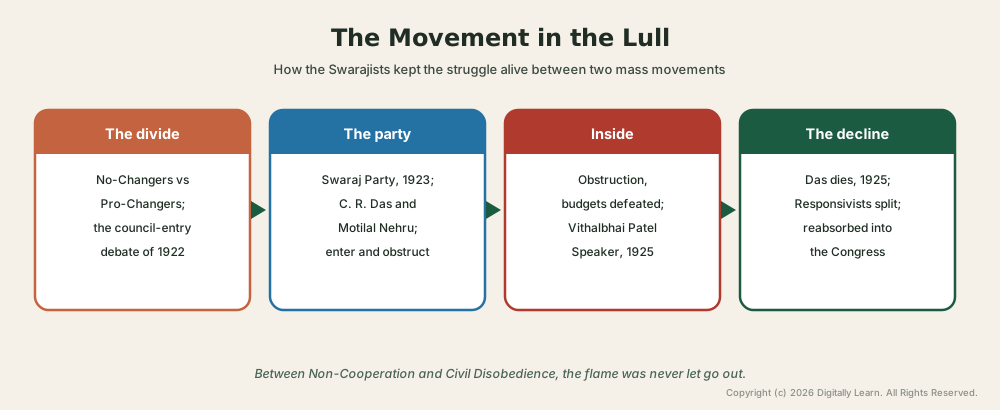
The Swaraj Party, founded on 1 January 1923 by Chittaranjan (C. R.) Das and Motilal Nehru, was the answer of one wing of the Congress to the lull that followed the withdrawal of Non-Cooperation. Rejecting the boycott of the legislatures, the Swarajists chose to enter the councils and obstruct the Raj from within. The council-entry years of 1922 to 1928 kept the national movement alive between two great mass struggles, before the party declined after Das's death in 1925.
Introduction: The Movement in the Lull (1922-1928)
Why the Council-Entry Years Matter
Why this matters: the sudden withdrawal of Non-Cooperation in 1922, followed by Gandhi's imprisonment, left the national movement leaderless and dispirited. The council-entry years of 1922 to 1928 were the lull between two great mass struggles, and how the Congress used that lull shaped the movement that followed.
What is the significance of these years: they kept the Congress active and visible when mass agitation was not possible. One wing, the Swarajists, carried the fight into the legislatures, while the other pursued the constructive programme in the villages, and the two responses are set out below.
The Two Responses to the Withdrawal
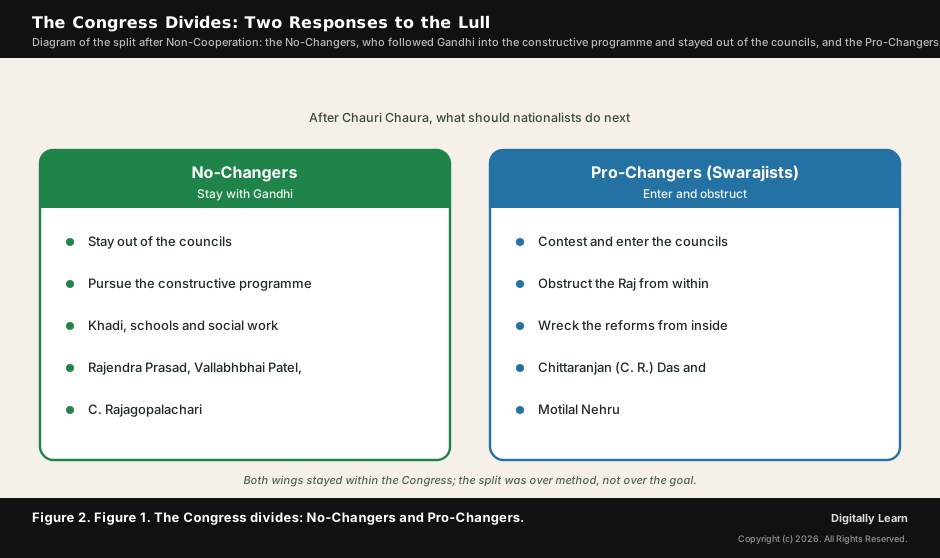
Distinguishing the two camps is the key to this period. After Chauri Chaura, the Congress divided over a single question: should nationalists boycott the new legislative councils, as Non-Cooperation demanded, or enter them to fight from within?
The split was over method, not goal. Both wings stayed within the Congress and both wanted Swaraj; they differed only on how to pursue it in the lull. The division is shown below.
The No-Changers and Pro-Changers: The Council-Entry Debate
The Gaya Congress and the Great Divide (1922)
What is the significance of the Gaya Congress: it brought the divide to a head. At the Gaya session of December 1922, over which C. R. Das presided, the Congress majority, the No-Changers, rejected the proposal to enter the councils, holding that it would betray the spirit of Non-Cooperation.
Distinguishing the two positions shows two honest answers to defeat, as the table below sets out. The No-Changers would build the nation from below; the Pro-Changers would harry the Raj from within its own legislatures.
| Question | No-Changers | Pro-Changers (Swarajists) |
|---|---|---|
| The councils | Boycott them, as Non-Cooperation demanded | Enter them to obstruct from within |
| The main work | The constructive programme in the villages | Resistance carried into the legislatures |
| Leaders | Rajendra Prasad, Vallabhbhai Patel, Rajagopalachari | C. R. Das and Motilal Nehru |
| The goal | Swaraj, through self-reliant nation-building | Swaraj, by exposing and wrecking the reforms |
The Case for Entering the Councils
Observable reasoning lay behind the Swarajist case. C. R. Das and Motilal Nehru argued that an empty boycott of the councils in a time of lull would simply hand the legislatures to loyalists and moderates, and that nationalists could do more by entering to obstruct and expose the reforms from within.
Distinguishing their aim: this was not cooperation with the Raj but resistance carried onto new ground. They would enter the councils not to work them, but to make them unworkable, and to keep the demand for self-government before the public eye.
The Swaraj Party: Formation, C. R. Das and Motilal Nehru (1923)
The Founding and the Leaders
What is the significance of the founding: it gave the Pro-Changers an organised vehicle. When the Gaya Congress rejected council-entry, Das and Motilal Nehru resigned their Congress offices and founded the Swaraj Party on 1 January 1923, formally the Congress-Khilafat Swarajya Party, with Das as president and Motilal Nehru as secretary.
A distinguishing point of caution is worth making for the examination. The Swaraj Party, a constitutional party of council-entry, should not be confused with the armed revolutionary organisations of the same era, the Abhinav Bharat Society of V. D. Savarkar, the Anushilan Samiti linked to Aurobindo Ghosh, and the Ghadar Party of Lala Hardayal, whose very different methods are examined in Part 9.
The 1923 Elections and the Swarajist Entry
Observable outcomes came quickly at the polls. In the 1923 elections to the new councils, the Swarajists did remarkably well for a party only months old, winning about forty-five of the seats in the Central Legislative Assembly and forming the largest single group or a strong opposition in several provinces.
Distinguishing the result: it gave them a real platform. With this strength the Swarajists could move resolutions, defeat government measures, and turn the councils, meant to showcase the reforms, into a stage for nationalist protest.
Inside the Councils: Obstruction, Budgets and Vithalbhai Patel
Obstruction from Within
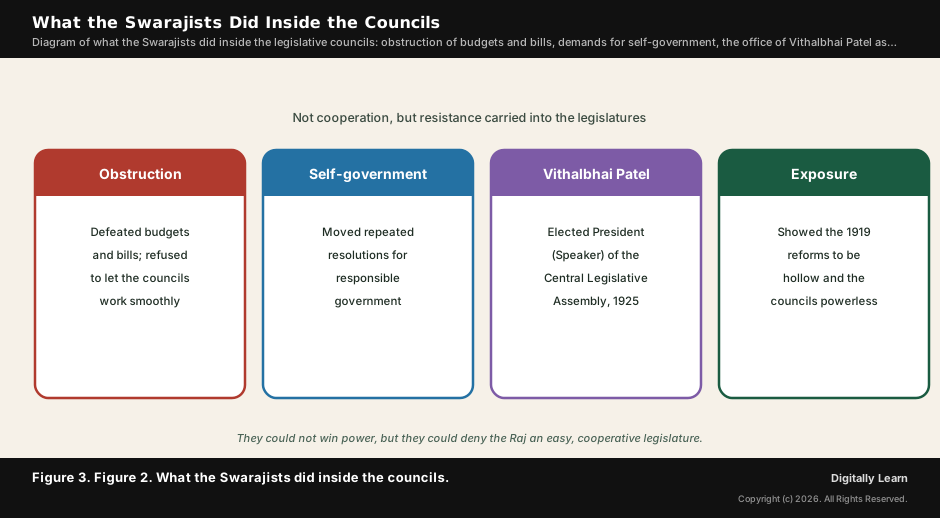
What is the significance of the obstruction: it denied the Raj a tame legislature. The Swarajists used their numbers to defeat budgets and bills, to walk out in protest, and to move repeated resolutions for responsible government, as the list below records and the diagram that follows shows.
Distinguishing obstruction from cooperation is essential. The Swarajists did not enter the councils to work the reforms; they entered to make them unworkable, voting down government demands and using every debate to press the case for self-government before the country.
- Defeated budgets and bills: government measures were voted down or stalled.
- Resolutions for self-government: demands for responsible government were pressed.
- Walkouts and protest: the Swarajists dramatised the powerlessness of the councils.
- Exposure of the reforms: they showed the 1919 councils to be hollow.
- A national platform: the legislatures became a stage for nationalist argument.
Vithalbhai Patel and the Central Legislative Assembly
Observable outcomes reached even the chair of the legislature. In 1925, the Swarajist leader Vithalbhai Patel, the elder brother of Vallabhbhai, was elected President, that is the Speaker, of the Central Legislative Assembly, the first Indian to hold the office.
Distinguishing the achievement: it was both symbolic and practical. An Indian nationalist now presided over the central legislature, a sign of how far the Swarajists had carried the struggle into the heart of the constitutional system.
Decline: Das's Death, the Responsivists and Reabsorption
The Death of C. R. Das and the Responsivist Split
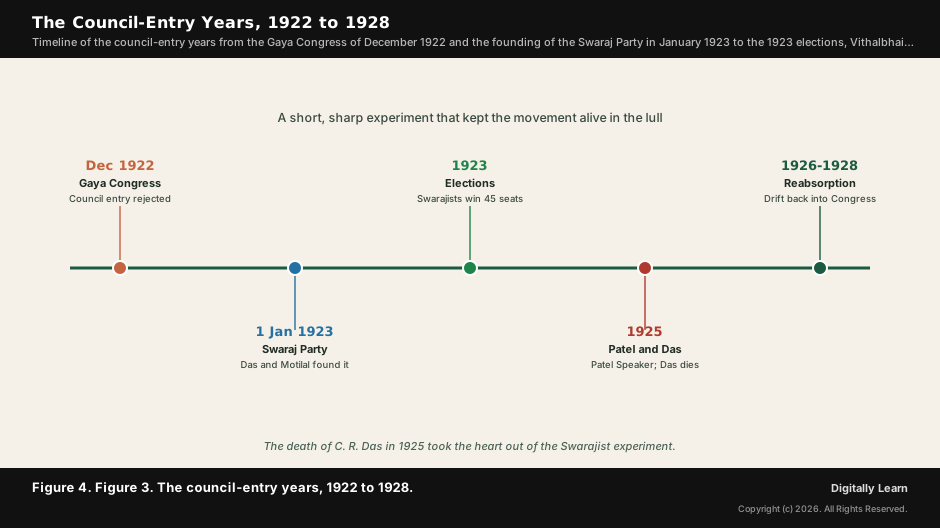
What is the significance of 1925: it took the heart out of the experiment. The death of C. R. Das in 1925 robbed the Swaraj Party of its ablest leader, and without him the party began to lose its unity and its drive, as the timeline below records.
Distinguishing the split: a section known as the Responsivists, including Madan Mohan Malaviya, Lala Lajpat Rai and N. C. Kelkar, broke away to cooperate with the government on Hindu-communal lines, while others drifted back towards the Congress mainstream. By 1926, Motilal Nehru too was returning to the Congress fold.
Significance: Keeping the Movement Alive in the Lull
What the Swarajists Achieved
Contemporary linkages run from the Swarajist years into the next mass phase. The Swarajists could not win power, and their council work brought no Swaraj, but they kept the Congress active and in the public eye when no mass movement was possible, and they exposed the 1919 reforms as hollow.
The larger significance is that the lull was not wasted. When the Simon Commission arrived in 1927 and the demand for full independence revived, the Congress was still a living force, ready to lead again. The next part follows that revival, through the Simon Commission, the Nehru Report and the communal fault-line of 1927 to 1929.
Previous Year UPSC-CSE Questions
Previous Year UPSC-CSE Questions By the end you will be able to draft model answers for the following UPSC questions. Each question carries a collapsible framework showing how to approach it in the exam.
- UPSC Mains 2020 GS-ISince the decade of the 1920s, the national movement acquired various ideological strands and thereby expanded its social base. Discuss.
How to structure the answer in the exam
Introduction: Open with the 1920s as the decade nationalism diversified into many strands.
Body (sub-themes to develop):
- The Gandhian mass strand: constructive programme and the No-Changers.
- The constitutional strand: the Swaraj Party's council-entry and obstruction.
- The revolutionary strand (HSRA, Bhagat Singh) and the socialist strand (Nehru, Bose).
- The peasant and worker movements that widened the social base.
Conclusion: Conclude that the 1920s turned a single nationalism into a broad, multi-strand movement.
- UPSC Prelims 1996 GS Paper IMatch List I (organisation) with List II (associated leader):
- I. Abhinav Bharat Society
- II. Anushilan Samiti
- III. Ghadar Party
- IV. Swaraj Party
- A) Sri Aurobindo Ghosh
- B) Lala Hardayal
- C) C. R. Das
- D) V. D. Savarkar
Select the correct answer using the codes given below.
How to approach this Prelims question
Approach: Pair each organisation with its associated leader.
Trap to watch: Do not swap Savarkar (Abhinav Bharat) with Aurobindo (Anushilan Samiti); the Swaraj Party is the constitutional party of C. R. Das, not a revolutionary body.
Key facts to recall:
- Abhinav Bharat = V. D. Savarkar
- Anushilan Samiti = Aurobindo Ghosh
- Ghadar Party = Lala Hardayal
- Swaraj Party = C. R. Das
Answer signal: I-D, II-A, III-B, IV-C, so option (d).
Sources and Further Reading
- Wikipedia: Swaraj Party
- Wikipedia: Chittaranjan Das
- Wikipedia: Motilal Nehru
- Wikipedia: Vithalbhai Patel
- NCERT, India's Struggle for Independence / Themes in Indian History III
- Ministry of Culture: Indian Culture Freedom Archive
- Azadi Ka Amrit Mahotsav (Freedom Movement portal)
- Press Information Bureau, Government of India
- National Portal of India
Editorial Disclaimer
This article is prepared for UPSC examination preparation. Verify key facts and interpretations against standard reference histories before relying on them.