


Overview
The land revenue systems of British India were the arrangements by which the colonial state assessed and collected the tax on farmland, its chief source of income. Three such systems took shape. The ryotwari system settled the demand directly with each cultivator, the ryot, in the Madras and Bombay presidencies. The mahalwari system made a village or estate, the mahal, jointly answerable in the North-Western Provinces and Punjab. The Permanent Settlement of 1793 fixed the demand for ever with the zamindars of Bengal and Bihar. Each decided who held the land, who paid the tax and how much of the risk of a bad season the farmer carried.
Land Settlements of British India from 1765 to 1885
Three Strands: Settlement, Debt and Protest
Which system applied to a district depended on when the Company acquired it and on the ideas of the officials who framed the settlement. Bengal came first, in 1793, the south and west followed in the 1800s and 1820s, and the north-west from 1822. Everywhere the demand was in cash, and everywhere it was high, which is why the same chain of debt, mortgage and lost land appears under all three.
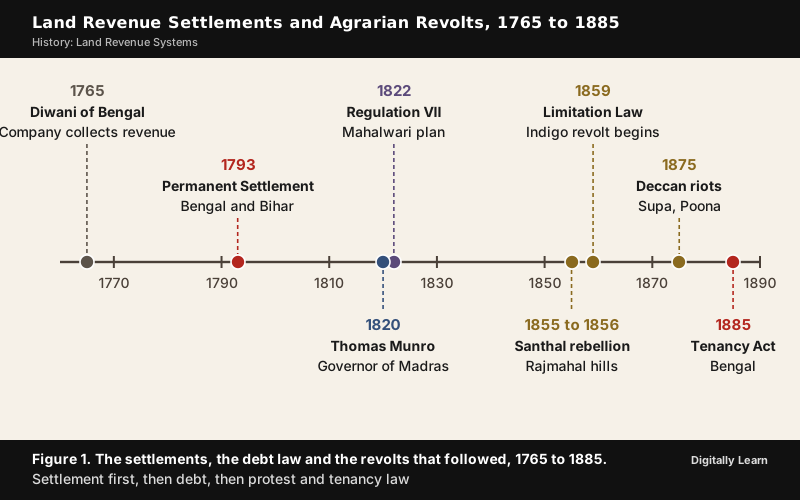
The years from 1765 to 1885 carry three overlapping strands. The first is the making of the settlements and their revision in the 1830s and 1850s. The second is the weight of debt and cash cropping that followed, from the Limitation Law of 1859 to the cotton boom and bust of the 1860s. The third is the protest and the law that answered it, from the Santhal rebellion of 1855‑56 to the Tenancy Act of 1885.
Revenue Before 1793: Diwani, Famine and Tax Farming
Diwani of Bengal and the Revenue Crisis from 1765
In 1765 the East India Company acquired the Diwani of Bengal, the right to collect its land revenue. The Company found itself short of trained administrators familiar with local custom and law, so landholders worked with little supervision. By the 1770s the rural economy of Bengal was in crisis, with recurrent famines and falling output. The famine of 1770 showed the officials in Calcutta how badly revenue officers needed supervision.
Warren Hastings tried a system of five-yearly inspections and temporary tax farmers. Tax farming is the practice of handing the collection of a revenue to a contractor in return for fixed periodic payments. The scheme offered no incentive for good conduct, and many of these contractors absconded with as much revenue as they could between inspections. In 1784 the British Prime Minister William Pitt the Younger directed the Calcutta administration to change the arrangement, and in 1786 Charles Cornwallis was sent out to reform the Company's practices.
Why the Company Wanted a Fixed Demand
Company officials believed that agriculture, trade and the revenue itself would all grow if property rights were secured and the demand was fixed permanently. A fixed demand promised the Company a regular flow of revenue. It also assured those who put money into land of a steady return, because the state could not raise its claim later. The officials hoped for a class of yeomen farmers and rich landowners with the capital and enterprise to improve agriculture, loyal to the Company that had created them.
The Court of Directors first proposed a permanent settlement in 1786. Between 1786 and 1790 Cornwallis and Sir John Shore debated it, and Shore doubted that zamindars would trust a settlement called permanent. The difficulty lay in finding people who could both improve the land and promise a fixed payment for ever, and after long debate the settlement was made with the rajas and taluqdars of Bengal. A ten-year settlement was issued in 1790 and was made permanent in 1793.
The Permanent Settlement of 1793 in Bengal and Bihar
Terms of the Permanent Settlement: Zamindars and a Fixed Demand
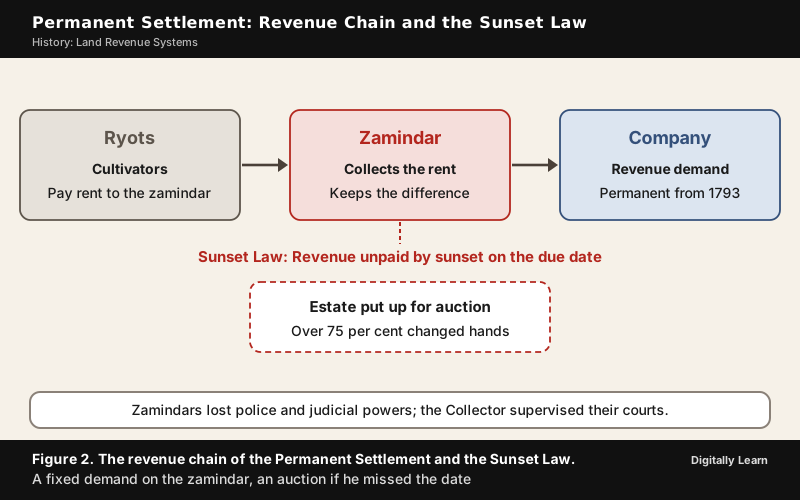
The rajas and taluqdars of Bengal were now classified as zamindars, and the revenue demand on them was fixed in perpetuity. A zamindar might have several villages under him, sometimes as many as 400. The villages within one zamindari formed one revenue estate, and the Company fixed the total demand over the whole estate. The zamindar collected rent from the villages, paid the revenue and kept the difference as his income.
His legal position had two sides. The Company treated him as the landowner of the estate as long as he paid punctually, yet its own calculation made him a contractor for the state's revenue, and the estate was liable to be auctioned if he failed. The state's share was by far the larger part of the rent.
The settlement belonged to a wider body of regulations, the Cornwallis Code of 1793, which divided the Company's service into revenue, judicial and commercial branches. The same code deprived zamindars of magisterial and police functions. Their troops were disbanded, customs duties they collected were abolished and their courts, the cutcheries, came under the supervision of a Collector appointed by the Company.
Zamindars were also required to give their cultivators pattas, written deeds of their holdings. Many failed to do so, because no official checked how zamindars treated their cultivators.
Sunset Law, Default and the Auction of Estates
Three features made the new demand hard to meet. The initial demand was set high, because the Company feared it could never claim a share of later gains once the sum was fixed. It was imposed in the 1790s, when agricultural prices were depressed, so the ryots found it hard to pay their rent to the zamindar. Moreover, the revenue did not vary with the harvest. Under the Sunset Law, a zamindar who had not paid by sunset on the appointed day saw his zamindari put up for auction.
The result was a land market that had not existed before. Over 75 per cent of the zamindaris changed hands after the Permanent Settlement. At a sale of the Burdwan raja's estates in 1797, over 95 per cent of the sale was fictitious. The buyers were the raja's own servants and agents. Between 1793 and 1801 four large zamindaris, Burdwan among them, made such fictitious (benami) purchases that together yielded as much as 30 lakh rupees, and over 15 per cent of the total sales at auctions were fictitious. Outsiders who bought an estate could not always take possession, because the former zamindar's lathyals, his armed retainers, attacked their agents and ryots sometimes resisted the newcomers.
Jotedars, New Landlords and the Peasant
While many zamindars were in difficulty, a class of rich peasants consolidated its position in the villages. In Dinajpur in North Bengal these jotedars had by the early nineteenth century acquired vast areas, sometimes several thousand acres. They controlled local trade and moneylending, and a large part of their land was cultivated by sharecroppers, called adhiyars or bargadars, who handed half the produce to the jotedar. Jotedars lived in the villages, so their power over poor cultivators was more direct than the zamindar's. They resisted attempts to raise the village jama, the revenue demand on the village, and delayed payment to the zamindar, and in auctions they were often among the buyers.
By 1815 half the total land in Bengal had passed into new hands. The new zamindars turned to land-grabbing and sub-infeudation. A longer chain of intermediaries meant absentee landlordism and a heavier burden on the peasant, and zamindars resorted to summary evictions, illegal dues and begar, or unpaid labour. As the demand for land grew, its price rose, and so did the peasant's liabilities. Historians have argued that the settlement created a commercial land market in Bengal and changed the social background of the landholding class from local lineages and chiefs to civil servants, merchants and bankers.
Ryotwari System of Madras and Bombay
Origins of the Ryotwari System: Read and Munro
The ryotwari system was developed by Alexander Read at Baramahal in 1792 and systematised by Thomas Munro in the Madras presidency. Munro spent seven years administering part of the territory captured from Tipu Sultan, learning the principles of revenue survey and assessment that he later applied across the Madras presidency. From 1800 to 1807 he was in charge of the Ceded Districts, where he introduced the ryotwari system. He was Governor of Madras from 1820 to 1827. The system was afterwards extended to the Bombay presidency.
How the Ryotwari Assessment Worked
The ryotwari system dispensed with the zamindar. The settlement was made directly with the ryot, and the steps of the Bombay Deccan settlement show how it worked.
- The land was surveyed and the average income from different types of soil was estimated.
- The revenue-paying capacity of the ryot was assessed.
- A proportion of that capacity was fixed as the share of the state.
- The ryot paid the sum, in money, directly to the state, holding a patta, the written deed of his holding.
- The land was resurveyed every 30 years and the rates were increased, so the demand was never permanent.
The registered holder was recognised as the proprietor of his holding. He could sublet it, give it away, sell it or mortgage it, and he could not be ejected while he paid the assessment. Each year he could increase or reduce his holding, or give it up. Munro lowered the rate of tax from one half to one third of the gross produce, a rate that was still excessive.
Ricardo's Theory and the Bombay Deccan Settlement
The officials who framed the Bombay Deccan settlement were influenced by economic theory. By the 1820s the economist David Ricardo was celebrated in England, and the colonial officials had learnt his ideas in college. In his view a landowner should have a claim only to the average rent, and any surplus above it should be taxed by the state; if it was not, cultivators would turn into rentiers. Many officials thought Bengal confirmed this, since its zamindars seemed to have become rentiers living on rental income.
The first revenue settlement in the Bombay Deccan was made in the 1820s, and the demand was so high that in many places peasants deserted their villages. In areas of poor soil and uncertain rain the problem was acute. Collectors, anxious to show efficiency, extracted payment with great severity. Crops were seized, and a fine could be imposed on the whole village. Prices fell sharply after 1832 and did not recover for over a decade and a half, and a famine struck the Deccan from 1832 to 1834.
By the 1840s officials found alarming levels of indebtedness everywhere. By the mid-1840s many of them admitted that the settlements of the 1820s had been harsh, and the demand was moderated. After 1845 agricultural prices recovered steadily.
The next settlement, in the 1860s, raised the demand dramatically. The demand rose by 50 to 100 per cent; one account puts the rise ordered in 1867 at 50 per cent.
Mahalwari System of the North-Western Provinces and Punjab
Regulation VII of 1822 and the Mahal as the Unit
The mahalwari system was framed by Holt Mackenzie in 1822, on the basis of a plan of 1819. Its unit was the mahal, a community made up of one or more villages. A village headman, the lambardar, represented the village and was responsible for the survey, the records of land rights, the settlement of the demand in the mahal and the collection of the revenue. Landlords and village communities were jointly answerable for payment, and no individual was singled out. The revenue was fixed on the produce of the mahal, and the land under the system covered everything in the villages, including forest and pasture. Regulation VII of 1822 gave Mackenzie's plan legal sanction.
The system took shape in territory that came to the Company in stages. In 1801 the Nawab of Awadh surrendered the districts of Allahabad, and the Yamuna and Ganga valleys were won after the Second Anglo-Maratha War. Where cultivators held an estate in common tenancy, the state demand was fixed at 95 per cent of the rental, but the system broke down because the demand was large and rigid and the cultivators could not afford what they were asked to pay.
Bird's Settlement of 1833 and the Saharanpur Rules of 1855
Bentinck, Governor-General from 1828 to 1835, revised the Regulation of 1822 after seeing the misery that followed it. After long consultation his government passed a new regulation in 1833. Under Robert Merttins Bird the scheme became more flexible. The estimation of produce and rents was simplified, average rents were fixed for different classes of soil, and the methods of measuring land and assessing soil quality were improved. The state demand was fixed at 66 per cent of the rental value and the settlement was made for 30 years.
A demand of two-thirds of the rental still proved heavy. The Saharanpur Rules of 1855 reduced the share to 50 per cent under Governor-General Dalhousie, but British officers paid little attention to these rules, and the discontent among the cultivators remained. The mahalwari system was in use in the North-Western Provinces, parts of Central India and Punjab.
The Three Land Revenue Systems Compared
Whom the State Settled With, the Unit and the Region
The three systems differ on three points, namely whom the state settled with, the unit on which the revenue was assessed and whether the demand could later be raised. The Permanent Settlement fixed the demand on a landlord for ever, while the ryotwari and mahalwari settlements were temporary and revised at each resurvey; the first was made with the individual cultivator, the second with the village community.
| System | Settled with | Unit of assessment | Demand | Region | Names linked |
|---|---|---|---|---|---|
| Permanent Settlement | The zamindar (the former rajas and taluqdars) | The estate of many villages | Fixed in perpetuity from 1793 | Bengal and Bihar; later Banaras and northern districts of Madras | Cornwallis |
| Ryotwari | The ryot, directly | The individual holding | Revised on resurvey, every 30 years in the Bombay Deccan | Madras and Bombay presidencies | Read, Munro |
| Mahalwari | The village community through its lambardar | The mahal, a village or group of villages | Revised in cycles; 66 per cent of rental fixed for 30 years in 1833 | North-Western Provinces, Punjab, parts of Central India | Mackenzie, Bird |
Why Britain Used Three Systems
The Permanent Settlement was rarely extended beyond Bengal. After 1810 agricultural prices rose, which raised the income of the Bengal zamindars, but because the demand had been fixed the state could claim no share of the gain. The Company wanted to enlarge its financial resources, so territories annexed in the nineteenth century received temporary settlements. Contemporary economic theory pointed the same way, since Ricardo's idea of a surplus rent to be taxed made officials distrust a class of landlords living on rents.
The three systems therefore reflect the order of conquest, the experience of the Bengal settlement and the revenue needs of the Company. None was designed to improve the cultivator's lot. The Government's interest lay in maximising rents and securing its share of revenue, and it spent little on improving land productivity.
Peasant Debt, Land Alienation and the Moneylender
The Cash Demand and the Cycle of Debt
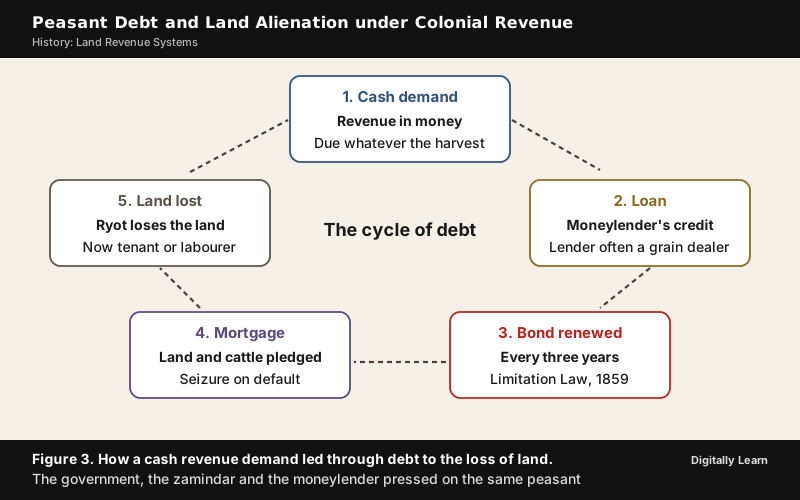
The land revenue had to be paid in cash and on time whatever the harvest. In the late eighteenth century the Company began to require payment in cash instead of kind, which cultivators often could not meet, and which exposed them to the demands of moneylenders when crops failed. In the Deccan, revenue could rarely be paid without a loan from a moneylender, and once a loan was taken the ryot found it hard to repay.
The peasant was caught between three claimants, namely the Government, the zamindar and the moneylender. The moneylender was often also the village grain merchant and forced the farmer to sell his produce at low prices to clear dues. He could also use the courts and the law in his favour. Hardship was greatest in famine and scarcity, in zamindari areas as much as in ryotwari and mahalwari areas.
When debts mounted the farmer mortgaged his land and cattle, and the moneylender sometimes seized them. Gradually, over large areas, the actual cultivators were reduced to tenants-at-will, sharecroppers and landless labourers.
Bonds, Deeds and the Limitation Law of 1859
The customary rule had been that interest on a loan could not exceed the principal. Under colonial rule that norm broke down. In one case recorded after the Deccan riots of 1875, a moneylender had charged over 2,000 rupees as interest on a loan of 100 rupees.
In 1859 the British passed a Limitation Law under which loan bonds between moneylenders and ryots stayed valid for only three years. The law was intended to prevent interest from accumulating over time. Moneylenders circumvented it by forcing the ryot to sign a fresh bond every three years, with the unpaid balance of principal and interest entered as the new principal. Ryots also signed deeds of hire for their own carts and bullocks after handing them over for debt.
Peasants learned to fear the written word, because they put thumb impressions on bonds whose clauses they did not understand, and moneylenders would not lend without a legal bond.
The Deccan Riots of 1875 and the Commission of Enquiry
On 12 May 1875 ryots from the villages around Supa, in Poona district, gathered and attacked the shopkeepers and moneylenders of the market village. They demanded the bahi khatas, or account books, and the debt bonds, and burned them. The revolt spread from Poona to Ahmednagar and over two months covered an area of 6,500 square kilometres, with more than 30 villages affected. Troops were called in and 951 people were arrested.
The Government of India, worried by the memory of 1857, pressed Bombay to set up a commission of enquiry, and its report was presented to the British Parliament in 1878. The commission reported that the revenue demand was not the cause of the peasants' anger and that the moneylenders were to blame, in keeping with the colonial tendency to deny that popular discontent arose from government action. As a conciliatory measure the Deccan Agriculturists Relief Act was passed in 1879.
Commercialisation of Agriculture and the Cash Crop Economy
What Commercialisation Meant for the Peasant
Until the second half of the nineteenth century agriculture had been a way of life, not a business. Specialised crops now began to be grown for sale in national and even international markets. Cotton, jute, groundnut, oilseeds, sugarcane and tobacco paid better than foodgrains. Commercialisation reached its highest level in the plantation sector, in tea, coffee, rubber and indigo, which was mostly owned by Europeans.
The spread of a money economy, the replacement of custom by competition and contract, the growth of internal trade and better roads and railways encouraged the change. For the Indian peasant it seemed a forced process. He had little surplus to invest in commercial crops, and commercialisation tied him to the swings of international markets.
The Cotton Boom and Bust in the Deccan
Before the 1860s three-fourths of Britain's raw cotton imports came from America. When the American Civil War broke out in 1861, the imports fell from over 20 lakh bales that year to 55,000 bales in 1862. Urgent appeals were sent to India to increase cotton exports.
Bombay merchants advanced money to urban sahukars, who passed credit to the village moneylenders. Ryots in the Deccan were offered 100 rupees as an advance for every acre planted with cotton. Between 1860 and 1864 cotton acreage doubled, and by 1862 over 90 per cent of Britain's cotton imports came from India. Some rich peasants gained, but for the large majority the expansion meant heavier debt.
By 1865 the boom had ended. As American production revived, Indian cotton exports to Britain declined, merchants and sahukars restricted advances and demanded repayment, and the revenue demand rose in the next settlement. The high prices of the 1860s mostly benefited intermediaries, and the slump of 1866 hit the cultivators hardest, bringing heavy indebtedness, famine and the agrarian riots of the Deccan in the 1870s.
Indigo Planters, the Tinkathia System and the 1859 Revolt
In Bengal the indigo planters, nearly all Europeans, forced peasants to grow indigo on their lands in place of rice, which paid them better. They gave advances, called dadon, at very high rates of interest and used fraudulent contracts against the peasants. In 1859 peasants led by Digambar Biswas and Bishnu Biswas of Nadia district decided not to grow indigo under duress. They refused to pay enhanced rents, took legal action and found support among the Bengali intelligentsia. Dinabandhu Mitra's play Nil Darpan, published in 1860, told the story of the planters' oppression.
The Government appointed an Indigo Commission in 1860. In November 1860 the Government announced that ryots could not be compelled to grow indigo. The planters had already begun to close factories, and indigo cultivation was virtually wiped out from Bengal by the end of 1860.
The tinkathia system is best known from Champaran in Bihar. European planters forced peasants to grow indigo on 3/20 of the total land. Towards the end of the nineteenth century German synthetic dyes replaced indigo, and the planters demanded high rents and illegal dues to make their profits before the peasants could shift to other crops. Raj Kumar Shukla, an indigo cultivator of Champaran, brought the planters' abuses to Gandhi's notice, and Gandhi came to Champaran in 1917. The inquiry committee that followed made the complete abolition of the tinkathia system its principal recommendation, the Government accepted it, and the Champaran Agrarian Act was passed on 4 March 1918.
Opium, Jute and the Plantation Crops
Opium shows commercialisation under a state monopoly. In India the cultivation of opium and its manufacture and trade to China were a strict monopoly of the East India Company, with an extensive system of Company agencies to supervise production and distribution. Bengal opium was highly prized in the China trade.
Jute was based in Bengal, where the first jute mill came up in 1855 at Rishra. Foreign capital flowed into India in the second half of the century partly because of ready markets abroad for Indian exports such as tea, jute and manganese.
Agrarian Revolts and Tenancy Laws from 1855 to 1885
Santhal Rebellion and the Santhal Pargana
The British persuaded the Santhals to settle in the foothills of the Rajmahal hills. By 1832 a large area had been demarcated as Damin-i-Koh and declared the land of the Santhals. From 40 Santhal villages in the area in 1838 the number rose to 1,473 by 1851, and the population grew from about 3,000 to over 82,000. As cultivation expanded, more revenue flowed into the Company's treasury.
The Santhals then began to lose their land. The state taxed the land they had cleared, moneylenders called dikus charged high interest and took the land when debts went unpaid, and zamindars asserted control over the Damin area. The Santhals rebelled from 1855 to 1856 against zamindars, moneylenders and the colonial state. After the rebellion the Santhal Pargana was created from 5,500 square miles (about 14,200 square kilometres) of the districts of Bhagalpur and Birbhum, and special laws were applied within it. Later tenancy laws for the Santhal Pargana protected tribal land and barred its transfer to non-tribals.
Pabna Agrarian Leagues and Tenant Rights in Bengal
In the 1870s and 1880s large parts of Eastern Bengal saw agrarian unrest. Zamindars charged enhanced rents beyond legal limits and prevented tenants from acquiring occupancy rights under a rent Act of 1859, using forcible eviction, seizure of cattle and crops and costly litigation. Peasants of Yusufshahi Pargana in the Pabna district formed an agrarian league, held a rent strike and raised funds for court cases. The struggle was largely legal, with very little violence.
Many peasants gained occupancy rights and resisted enhanced rents, and the Government promised legislation to protect tenants from the worst aspects of zamindari oppression. The Bengal Tenancy Act was passed in 1885. Bankim Chandra Chatterjee, R.C. Dutt and the Indian Association under Surendranath Banerjee supported the peasants.
Order of the Revolts: Santhal, Indigo and Deccan
Four of the risings of this period fall in a clear order. The Santhal rebellion of 1855 to 1856 came first, then the revolt of 1857, then the indigo revolt of 1859 to 1860, and last the Deccan riots of 1875. The Pabna leagues belong to the 1870s and 1880s. Each of the four arose from a different grievance, namely tribal land and debt, the colonial order as a whole, forced cropping and moneylenders' bonds.
Legacy of the Colonial Land Systems in Independent India
Abolition of Intermediaries After 1947
After independence the first step of land reform was the abolition of intermediaries. The zamindari and other intermediary tenures were abolished. Of the three colonial systems, the zamindari system had been the most exploitative of the peasants. Land reform was given priority, but it was implemented unevenly for want of strong political will.
The Constitution protected these laws. Article 31A saves a law providing for the acquisition by the State of any estate, or the extinguishment or modification of rights in it, from being struck down as inconsistent with the rights in Articles 14 and 19. Article 31B validates the Acts listed in the Ninth Schedule. Both were inserted by the First Amendment Act of 1951. The Ninth Schedule begins with the Bihar Land Reforms Act, 1950, and it also lists the Madras Estates (Abolition and Conversion into Ryotwari) Act, 1948, and the Uttar Pradesh Zamindari Abolition and Land Reforms Act, 1950.
Assessing the Colonial Land Settlements
The peasant was the ultimate sufferer under the triple burden of the Government, the zamindar and the moneylender, and Indian agriculture was drawn into commercial crops without being improved. The cultivator had neither the means nor the incentive to invest, the zamindar had no roots in the village, and the Government spent little on agricultural, technical or mass education. Together with the fragmentation of land, this kept productivity low.
Previous Year UPSC‑CSE Questions
Each question is explained option by option.
- UPSC Prelims 2020Indigo cultivation in India declined by the beginning of the 20th century because of
How to approach this Prelims question
Approach: Towards the end of the nineteenth century German synthetic dyes replaced indigo, and the fall in demand made the crop unprofitable. The revolt of 1859 to 1860 had already ended compulsory indigo in much of Bengal, but planters in Champaran still forced it on peasants until 1917, so the revolt does not explain the decline by 1900.
Trap to watch: Choosing peasant resistance because the indigo revolt is the better-known event.
Why each option is right or wrong:
- (a) peasant resistance to the oppressive conduct of planters: Wrong. Planters in Champaran were still forcing indigo on peasants in the early twentieth century.
- (b) its unprofitability in the world market because of new inventions: Correct. German synthetic dyes replaced indigo.
- (c) national leaders' opposition to the cultivation of indigo: Wrong. Gandhi took up the planters' abuses in 1917, after the decline had begun.
- (d) Government control over the planters: Wrong. Government measures did not cause the decline in the world market.
Answer: (b) its unprofitability in the world market because of new inventions. German synthetic dyes made natural indigo unprofitable.
- UPSC Prelims 2018After the Santhal Uprising subsided, what was/were the measure/measures taken by the colonial government?
- The territories called 'Santhal Paraganas' were created.
- It became illegal for a Santhal to transfer land to a non-Santhal.
Select the correct answer using the code given below:
How to approach this Prelims question
Approach: After the revolt of 1855 to 1856 the Santhal Pargana was created from the districts of Bhagalpur and Birbhum, so statement 1 is true. Later tenancy laws for the Santhal Pargana barred the transfer of tribal land to non-tribals, so statement 2 is also true.
Trap to watch: Rejecting statement 2 because the bar on land transfer came through later tenancy laws, not at the moment the revolt ended.
Why each option is right or wrong:
- (a) 1 only: Wrong. Statement 2 is also a measure taken after the uprising.
- (b) 2 only: Wrong. Statement 1 is also true.
- (c) Both 1 and 2: Correct. The Santhal Pargana was created and the transfer of tribal land to non-tribals was barred.
- (d) Neither 1 nor 2: Wrong. Both measures were taken.
Answer: (c) Both 1 and 2. Both measures followed the rebellion.
- UPSC Prelims 2017Who among the following was/were associated with the introduction of Ryotwari Settlement in India during the British rule ?
- Lord Cornwallis
- Alexander Read
- Thomas Munro
Select the correct answer using the code given below :
How to approach this Prelims question
Approach: Match each name to a system. Cornwallis made the Permanent Settlement of 1793 in Bengal. The ryotwari system was developed by Alexander Read at Baramahal in 1792 and systematised by Thomas Munro, who introduced it in the Ceded Districts and governed Madras from 1820 to 1827. So 2 and 3 are right.
Trap to watch: Adding Cornwallis because he is the best-known revenue reformer of the period.
Why each option is right or wrong:
- (a) 1 only: Wrong. Cornwallis is linked with the Permanent Settlement, not the ryotwari.
- (b) 1 and 3 only: Wrong. It includes Cornwallis and leaves out Read.
- (c) 2 and 3 only: Correct. Read developed the ryotwari system and Munro systematised it.
- (d) 1, 2 and 3: Wrong. Cornwallis does not belong with the ryotwari settlement.
Answer: (c) 2 and 3 only. Alexander Read developed the ryotwari settlement and Thomas Munro extended it.
- UPSC Prelims 2012With reference to Ryotwari Settlement, consider the following statements:
- The rent was paid directly by the peasants to the Government.
- The Government gave Pattas to the Ryots.
- The lands were surveyed and assessed before being taxed.
Which of the statements given above is/are correct?
How to approach this Prelims question
Approach: Compare each statement with the ryotwari procedure. The settlement was made directly with the ryot, with no zamindar in between, so statement 1 is true. The ryot held a patta, the written deed of his holding, so statement 2 is true. The land was surveyed and the average income from each type of soil estimated before the state's share was fixed, so statement 3 is true.
Trap to watch: Treating the patta as a feature of the Permanent Settlement only.
Why each option is right or wrong:
- (a) 1 only: Wrong. Statements 2 and 3 are also true.
- (b) 1 and 2 only: Wrong. Statement 3 is also true, since land was surveyed and assessed.
- (c) 1, 2 and 3: Correct. Direct payment, pattas and survey with assessment were all features of the system.
- (d) None: Wrong. All three statements are true.
Answer: (c) 1, 2 and 3. The ryot paid the state directly, held a patta and had his land surveyed before assessment.
- UPSC Prelims 2001Under the Permanent Settlement, 1793, the zamindars were required to issue pattas to the farmers which were not issued by many of the zamindars. The reason was
How to approach this Prelims question
Approach: The Permanent Settlement required zamindars to give pattas, written deeds of their holdings, to their cultivators. The Company did not supervise how zamindars dealt with the ryots, so with no official check many of them did not issue the pattas.
Trap to watch: Choosing a reason about the farmers when the failure lay with unsupervised zamindars.
Why each option is right or wrong:
- (a) the zamindars were trusted by the farmers: Wrong. Trust is not the reason; the lack of supervision is.
- (b) there was no official check upon the zamindars: Correct. Nobody checked how zamindars treated their cultivators, so the duty was neglected.
- (c) it was the responsibility of the British Government: Wrong. The duty was placed on the zamindar.
- (d) the farmers were not interested in getting pattas: Wrong. A patta protected the cultivator, so he had every reason to want it.
Answer: (b) there was no official check upon the zamindars. No official supervised how zamindars dealt with their cultivators.
- UPSC Prelims 1999Consider the following events:
- I. Indigo Revolt
- II. Santhal Rebellion
- III. Deccan Riot
- IV. Mutiny of the Sepoys
The correct chronological sequence of these events is:
How to approach this Prelims question
Approach: Put each event in its year. The Santhal rebellion was in 1855 to 1856, the Mutiny of the Sepoys in 1857, the indigo revolt in 1859 to 1860 and the Deccan riots in 1875. The order is II, IV, I, III.
Trap to watch: Placing 1857 first because it is the best-known date.
Why each option is right or wrong:
- (a) IV, II, I, III: Wrong. It puts the Mutiny of 1857 before the Santhal rebellion of 1855 to 1856.
- (b) IV, II, III, I: Wrong. It repeats that error and puts the Deccan riots of 1875 before the indigo revolt.
- (c) II, IV, III, I: Wrong. It puts the Deccan riots of 1875 before the indigo revolt of 1859 to 1860.
- (d) II, IV, I, III: Correct. Santhal 1855‑56, Mutiny 1857, Indigo 1859‑60, Deccan 1875.
Answer: (d) II, IV, I, III. The Santhal rebellion came first, then the Mutiny, the indigo revolt and the Deccan riots.
Sources
- NCERT: Class 12 Themes in Indian History Book 3, Chapter 1
- NCERT: Class 12 Geography: India People and Economy, Chapter 3
- Wikipedia: Permanent Settlement
- Wikipedia: Ryotwari
- Wikipedia: Mahalwari
- Wikipedia: Thomas Munro
- Wikipedia: Cornwallis Code
- Wikipedia: Warren Hastings
- Wikipedia: Tax farming
- Wikipedia: Bengal famine of 1770
- Wikipedia: Zamindar
- Wikipedia: Taluqdar
- Wikipedia: Jotedar
- Wikipedia: Deccan Riots
- Wikipedia: Indigo revolt
- Wikipedia: Nil Darpan
- Wikipedia: Champaran Satyagraha
- Wikipedia: Santhal rebellion
- Wikipedia: Santhal Pargana division
- Wikipedia: Opium trade
- Wikipedia: Economic history of India
- Legislative Department, Government of India: The Constitution of India (Articles 31A and 31B, Ninth Schedule)
- Press Information Bureau: Hundred years of Champaran Satyagraha
- West Champaran District Administration: History
- UPSC: Civil Services Examination question papers
Editorial Disclaimer
This article draws on the current NCERT textbooks and the other sources listed above. Where accounts give different figures, NCERT's are used.
See more of our UPSC articles in Google Search
Add to Preferred Sources