


Overview
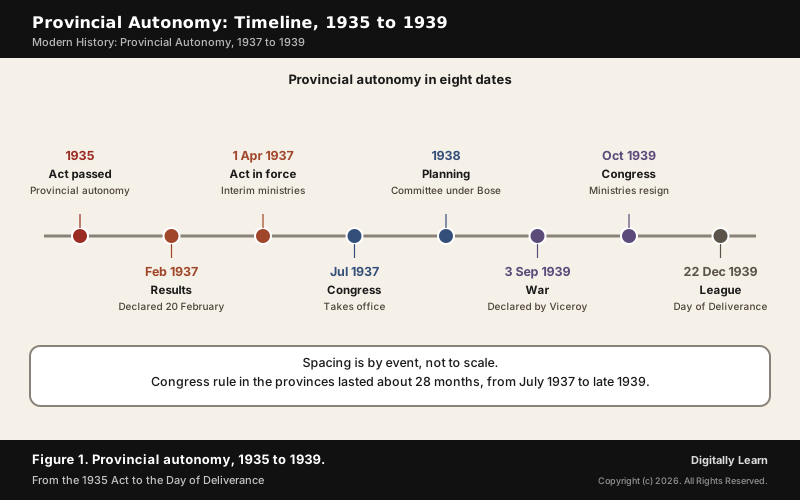
Provincial autonomy was the system, introduced by the Government of India Act 1935 and in force from 1 April 1937, under which dyarchy in the provinces was abolished and ministers answerable to elected legislatures ran all provincial subjects. After the 1937 elections the Congress formed ministries in most provinces and governed for about 28 months, until it resigned in October 1939 over India's entry into the Second World War.
Provincial Autonomy Under the Government of India Act 1935
What Is Provincial Autonomy? Meaning and the Act That Introduced It
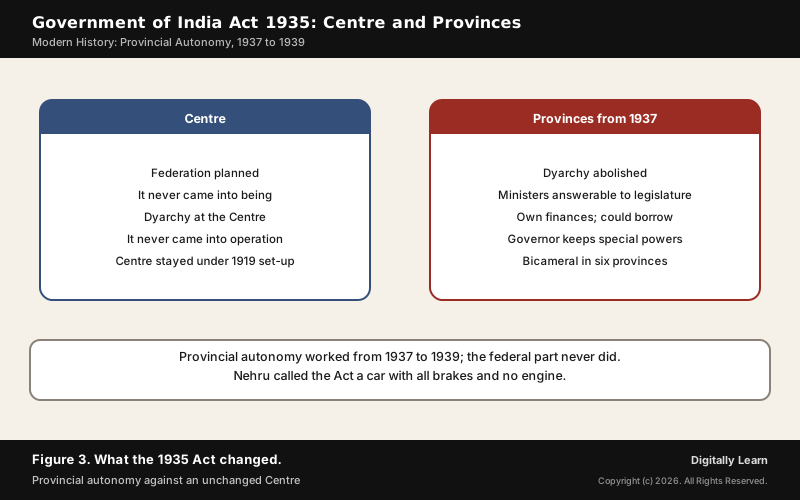
Provincial autonomy was introduced by the Government of India Act 1935. It abolished dyarchy in the provinces and allowed them to act as autonomous units of administration in their own spheres. The provincial part of the Act came into operation on 1 April 1937.
- Separate legal identity: Provinces were freed from the superintendence and direction of the secretary of state and the governor-general, and derived their authority directly from the British Crown.
- Own finances: Provinces had independent financial powers and resources and could borrow on their own security.
- Responsible government: The governor was to act on the advice of ministers responsible to the provincial legislature, and ministers could be removed by its adverse vote.
- Short life: This came into effect in 1937 and was discontinued in 1939.
Governor's Powers, Legislatures and the Franchise Under the 1935 Act
Autonomy came with strong brakes. The governor, the Crown's nominee in each province, kept special powers over minorities, the rights of civil servants, law and order and British business interests, and could take over and run the administration indefinitely.
- Bicameral provinces: Bengal, Bombay, Madras, Bihar, Assam and the United Provinces got a legislative council as well as an assembly.
- Separate electorates: Communal representation was extended to depressed classes, women and labour.
- Franchise: Only about 10 to 12 per cent of the population could vote in 1937.
- The Centre untouched: The federation the Act planned never came into being, and until 1947 the Centre worked under the relevant provisions of the 1919 Act.
The Congress rejected the Act and demanded a Constituent Assembly elected by adult franchise. Jawaharlal Nehru called it a car with all brakes and no engine, while the Viceroy, Lord Linlithgow, said Britain framed it as the best way of maintaining British influence in India.
The 1937 Provincial Elections
Office Acceptance Debate Before the 1937 Elections
Everyone in the Congress agreed that the 1935 Act had to be opposed, but not on whether to take office after the elections. Nehru, Subhas Bose, the Congress socialists and the communists opposed office acceptance: it would mean responsibility without power and would blunt the movement.
- The other side: Supporters argued that office was a short-term tactic when no mass movement was possible, and that ministries could promote constructive work.
- Gandhi: He first opposed office acceptance, but by early 1936 was willing to give Congress ministries a trial.
- Decision deferred: At Lucknow in 1936 the Congress decided to fight the elections and settle office acceptance afterwards.
- British strategy: The British hoped that once Congressmen tasted power they would be reluctant to return to the politics of sacrifice, and that provincial autonomy would create powerful provincial leaders and weaken the central leadership.
- Manifesto: It rejected the 1935 Act and promised release of prisoners, removal of caste and gender disabilities, lower rent and revenue, scaled-down rural debts and the right to form unions.
Gandhi did not attend a single election meeting. After the results, the Congress Working Committee formally decided on 1 July 1937 to form governments, after the Viceroy said the British would work with the Congress within the Act.
1937 Provincial Elections Results: The Congress Sweep
The 1937 provincial elections were held in the winter of 1936 to 1937 in all eleven governors' provinces, and the results were declared on 20 February 1937. The Congress contested 716 of 1,161 seats and won an absolute majority in five of the eleven provinces, forming governments in seven.
| Province | Congress seats | Outcome |
|---|---|---|
| Madras | 159 | Congress majority; Justice Party 21 |
| United Provinces | 133 of 228 | Congress majority; League 27 of 64 Muslim seats |
| Bombay | 86 of 175 | Congress with small allies |
| Assam | 33 of 108 | Largest party; office from 1938 |
| NWFP | 19 of 50 | Ministry with minor-party support |
| Sind | 5 of 60 | Sind United Party largest |
- Where it fell short: Bengal, Assam, Punjab, Sind and the NWFP, though it was the largest party in Bengal, Assam and the NWFP.
- Muslim League: It polled only 4.4 per cent of the Muslim vote and formed no government on its own.
- United Provinces: The League wanted a joint government; the Congress, with a majority, rejected the offer, which some scholars see as convincing the League that Muslims would struggle for power in a united India.
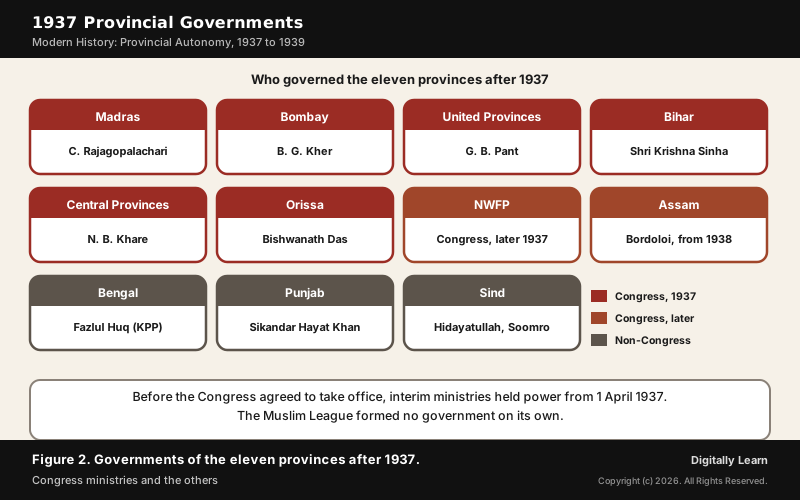
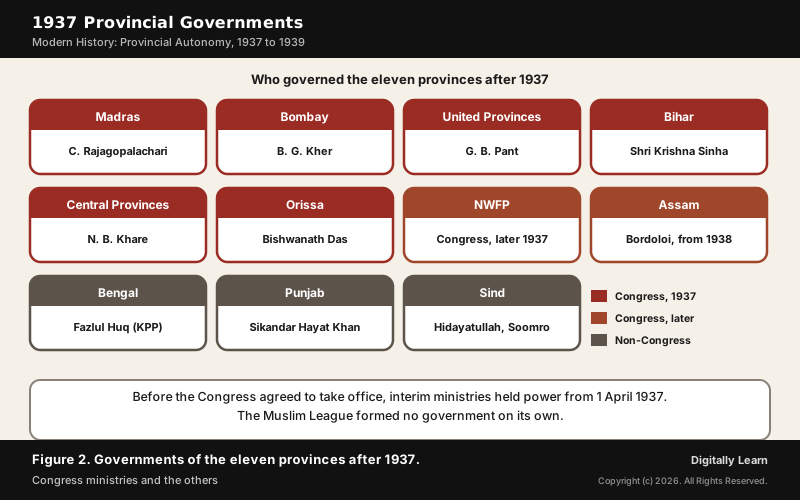
- Non-Congress governments: Fazlul Huq of the Krishak Praja Party led a coalition in Bengal, and Sikandar Hayat Khan of the Unionist Party governed Punjab.
Congress Ministries of 1937 to 1939
Formation of the Congress Ministries and the Interim Ministries
Congress ministries were formed in Bombay, Madras, the Central Provinces, Orissa, the United Provinces and Bihar, and later in the NWFP and Assam. Eventually eight of the eleven provinces had a Congress premier working under a British governor.
- Interim ministries: Because the Congress at first refused office, governors swore in others on 1 April 1937, such as the Maharaja of Paralakhemundi in Orissa and the Nawab of Chhatari in the United Provinces.
- Orissa: Its interim ministry held office from 1 April to 13 July 1937, when Bishwanath Das took over.
- United Provinces ministry: The first Congress ministry, under Govind Ballabh Pant, was formed in July 1937, and the assembly first met on 29 July 1937.
- Madras and Bombay: C. Rajagopalachari and B. G. Kher became premiers.
Gandhi advised Congressmen to hold office lightly, not tightly. The offices were crowns of thorns, accepted to see whether they sped the march to freedom, and were to be used in ways the British had not intended.
Work and Limits of the Congress Ministries, 1937 to 1939
The ministries showed that the Congress could use state power for the people. Their work fell under four heads.
- Civil liberties: Emergency laws were repealed, bans on organisations such as the Hindustan Seva Dal lifted, press restrictions ended and political prisoners released.
- Agrarian reform: Laws on land reform, debt relief, forest grazing fees, arrears of rent and land tenures were passed.
- Labour: The ministries tried to advance workers’ interests while keeping industrial peace, through arbitration before strikes.
- Social welfare: Prohibition in some areas, temple entry and scholarships for Harijans, attention to primary, technical and higher education, khadi and prison reform.
Planning began here too. A National Planning Committee was set up in 1938 under the Congress President, Subhas Bose, and the Congress ran mass literacy campaigns, Congress panchayats and grievance committees outside the legislatures.
The ministries worked within tight limits. They lacked adequate powers and money, since the Government of India took the lion's share of revenue, and landlord-dominated upper houses in five provinces had to be conciliated.
- Uneven gains: Most agrarian benefits went to statutory and occupancy tenants; sub-tenants gained little and agricultural labourers nothing.
- Civil liberties blemishes: The Madras government arrested socialists such as S. S. Batliwala, and the Bombay Home Minister K. M. Munshi used the CID against leftists.
- Labour unrest: Militant strikes were treated as law and order problems, with Section 144 and arrests.
- League charges: The Muslim League accused the ministries of bias in documents such as the Pirpur Report of 1938.
Resignation of the Congress Ministries in 1939
Why the Congress Ministries Resigned in 1939
The Second World War ended provincial autonomy. On 3 September 1939 the Viceroy, Lord Linlithgow, declared India at war with Germany without consulting Indian leaders. The Congress offered support if Britain promised independence after the war and formed a national government at the centre.
- The refusal: The Viceroy’s answer was judged wholly unsatisfactory, and in October 1939 the Congress Working Committee called on all Congress ministries to resign.
- Resignation: The Congress ministries resigned in October 1939.
- Differing views: Nehru backed the resignations; Gandhi was less sure, fearing they would strengthen the League and free the British to militarise India.
- Day of Deliverance: Jinnah asked Muslims to observe 22 December 1939 as a Day of Deliverance from Congress rule.
Significance: From Provincial Autonomy to the Constitution
Significance of the Congress Ministries and the Legacy of the 1935 Act
The 28 months of Congress rule mattered well beyond 1939. They confirmed that Indian self-government was needed for social change, and showed that a movement could use state power without being co-opted by the colonial state.
- Proof of capacity: Administrative work by Indians weakened the myth that Indians were not fit to rule.
- Communal order: The ministries were able to control communal riots, and council work neutralised many hostile landlords.
- A preview: People could see the shape of things to come if independence was won.
The 1935 Act itself lived on. The structural part of the Constitution of India is, to a large extent, derived from it, and the Federal Court it created was set up in 1937. Leaders who had run provinces under it brought that experience to the Constituent Assembly.
Previous Year UPSC-CSE Questions
Previous Year UPSC-CSE Questions By the end you will be able to draft model answers for the following UPSC questions. Each question carries a collapsible framework showing how to approach it in the exam.
- UPSC Mains 2015 GS-IIt would have been difficult for the Constituent Assembly to complete its historic task of drafting the Constitution for Independent India in just three years but for the experience gained with the Government of India Act, 1935. Discuss.
Answer outline: how to structure the answer
What the question asks, the main arguments, relevant examples and the direction of the conclusion. This is not a full model answer.
Introduction: The Government of India Act 1935 was the most detailed constitutional document India had before 1950.
Body (sub-themes to develop):
- Structural borrowing: federal and provincial lists, governors, Federal Court, public service commissions.
- Provincial autonomy from 1937: responsible government in the provinces.
- Experience: Congress ministries in eight provinces, 1937 to 1939.
- Limits: the federation and central dyarchy never worked, so the Assembly still had new ground to cover.
Conclusion: Conclude that a ready framework and practical experience together made the Assembly's three years possible.
- UPSC Prelims 2005 Prelims-GSIn which one of the following provinces was a Congress Ministry not formed under the Act of 1935?
How to approach this Prelims question
Approach: Recall where the Congress governed after 1937.
Trap to watch: Bihar, Madras and Orissa all had Congress ministries.
Key facts to recall:
- (a) Bihar: wrong. The Congress formed a ministry in Bihar after the 1937 elections.
- (b) Madras: wrong. The Congress formed a ministry in Madras.
- (c) Orissa: wrong. The Congress formed a ministry in Orissa, under Bishwanath Das.
- (d) Punjab: right. Punjab was governed by Sikandar Hayat Khan of the Unionist Party, not by the Congress.
Answer signal: Punjab had no Congress ministry, so the answer is option (d).
- UPSC Prelims 2008 Prelims-GSAssertion (A): The Congress Ministries in all the provinces resigned in the year 1939. Reason (R): The Congress did not accept the decision of the Viceroy to declare war against Germany in the context of the Second World War.
How to approach this Prelims question
Approach: Check each statement, then whether the reason explains the assertion.
Trap to watch: Both are true, and the reason does explain the assertion.
Key facts to recall:
- (a) Both true, R explains A: right. The ministries resigned in October 1939 because the Congress rejected the Viceroy's declaration of war of 3 September 1939, made without consulting Indian leaders.
- (b) Both true, R does not explain A: wrong. The war declaration is the very reason the ministries resigned.
- (c) A true, R false: wrong. The Congress did reject the Viceroy's decision to declare war.
- (d) A false, R true: wrong. The Congress ministries did resign in 1939.
Answer signal: Both statements are true and the reason explains the assertion, so the answer is option (a).
- UPSC Prelims 2012 Prelims-GSThe Congress ministries resigned in the seven provinces in 1939, because
How to approach this Prelims question
Approach: Eliminate reasons that are not the cause.
Trap to watch: Left-wing pressure and communal riots were not the reason.
Key facts to recall:
- (a) Could not form ministries in other provinces: wrong. The Congress governed most provinces; the resignation followed the war declaration, not its absence from the others.
- (b) Rise of a left wing: wrong. Leftists were a source of friction, but they were not why the ministries resigned.
- (c) Communal disturbances: wrong. The ministries were able to control communal riots; riots were not the reason.
- (d) None of the above: right. The ministries resigned because the Viceroy declared India at war without consulting Indian leaders.
Answer signal: None of the three listed reasons is correct, so the answer is option (d).
- UPSC Prelims 2005 Prelims-GSConsider the following statements : The Government of India Act, 1935 provided for
- The provincial autonomy
- The establishment of Federal Court
- All India Federation at the centre
Which of the statements given above is/are correct?
How to approach this Prelims question
Approach: Check each provision against the Act.
Trap to watch: The federation was provided for even though it never came into being.
Key facts to recall:
- (a) 1 and 2: wrong. It leaves out the All-India Federation, which the Act also provided for.
- (b) 2 and 3: wrong. It leaves out provincial autonomy, the Act's central provincial reform.
- (c) 1 and 3: wrong. It leaves out the Federal Court, which the Act provided for and which was set up in 1937.
- (d) 1, 2 and 3: right. The Act provided for provincial autonomy, a Federal Court and an All-India Federation, though the federation never came into being.
Answer signal: All three statements are correct, so the answer is option (d).
Sources and Further Reading
- NCERT: Our Pasts III (Class VIII), The Making of the National Movement, 1870s to 1947
- NCERT: Themes in Indian History Part III (Class XII), Mahatma Gandhi and the Nationalist Movement; Understanding Partition
- Uttar Pradesh Legislative Assembly: About Us (history of the legislature)
- Odisha Review (Government of Odisha): The First Interim Ministry of Odisha, 1937
- Rajya Sabha: Practice and Procedure, Introduction and Historical Background
- Wikipedia: 1937 Indian provincial elections
- Wikipedia: Government of India Act 1935
- Wikipedia: Day of Deliverance
- UPSC: Previous year question papers
Editorial Disclaimer
This article explains provincial autonomy and the Congress ministries for UPSC preparation. Dates, figures and attributions reflect the cited sources.