
Overview
Previous Year UPSC-CSE Questions By the end you will be able to draft model answers for the following UPSC questions. Each question carries a collapsible framework showing how to approach it in the exam.
- UPSC Mains 2020 GS-ISince the decade of the 1920s, the national movement acquired various ideological strands and thereby expanded its social base. Discuss.
How to structure the answer in the exam
Introduction: Open with the 1920s-30s as the decades nationalism diversified into many strands.
Body (sub-themes to develop):
- Gandhian mass satyagraha (Civil Disobedience).
- The constitutional strand (Swarajists, Round Table) and the depressed-classes settlement.
- The revolutionary and socialist strand: the HSRA, Bhagat Singh, the Bengal revolutionaries.
- Peasant, worker and women's movements widening the base.
Conclusion: Conclude that the multiple strands, the revolutionary one among them, turned a narrow nationalism into a broad movement.
- UPSC Prelims 2001 GS Paper IWho among the following organised the famous Chittagong armoury raid?
How to approach this Prelims question
Approach: Match the Chittagong raid to its leader.
Trap to watch: Batukeshwar Dutt was Bhagat Singh's comrade in the Assembly bomb, not Chittagong; Laxmi Sehgal belongs to the INA.
Key facts to recall:
- Chittagong Armoury Raid, 1930
- Led by Surya Sen (Masterda)
- Bengal revolutionary stream
Answer signal: Surya Sen, so option (b).
- UPSC Prelims 1997 GS Paper IMatch List I (event) with List II (associated revolutionary):
- I. Chittagong Armoury Raid
- II. Kakori Conspiracy
- III. Lahore Conspiracy
- IV. Ghadar Party
- A) Lala Hardayal
- B) Jatin Das
- C) Surya Sen
- D) Ram Prasad Bismil
- E) Vasudev Phadke
Select the correct answer using the codes given below.
How to approach this Prelims question
Approach: Pair each event with its associated revolutionary.
Trap to watch: Keep Surya Sen (Chittagong), Bismil (Kakori) and Jatin Das (Lahore Conspiracy) distinct; the Ghadar Party belongs to the earlier Lala Hardayal.
Key facts to recall:
- Chittagong = Surya Sen
- Kakori = Ram Prasad Bismil
- Lahore Conspiracy = Jatin Das
- Ghadar = Lala Hardayal
Answer signal: I-C, II-D, III-B, IV-A, so option (c).
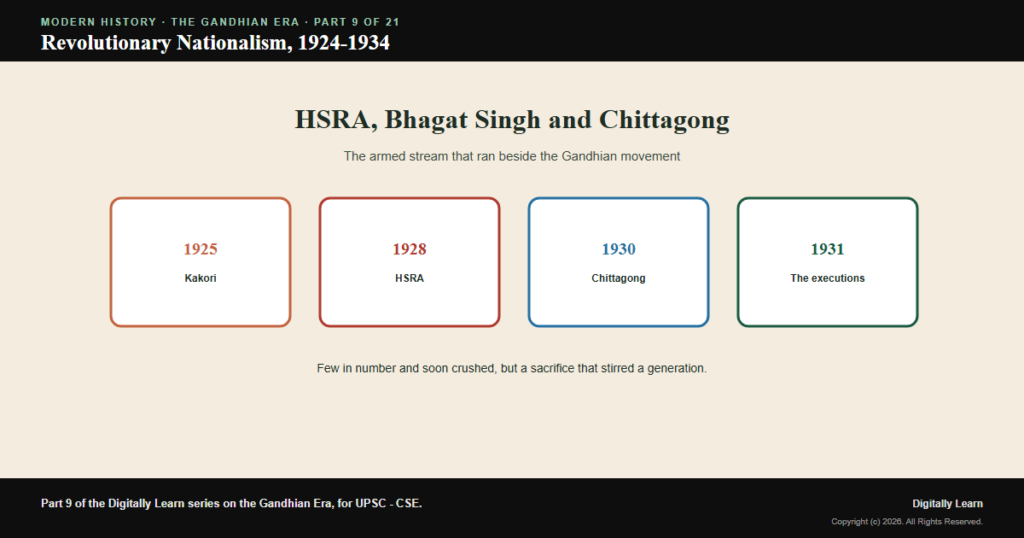
Revolutionary nationalism was the armed stream of the freedom struggle that ran beside the Gandhian mass movement in the 1920s and 1930s. Revived by the Hindustan Republican Association and the Kakori conspiracy, it took a socialist turn in the Hindustan Socialist Republican Association under Bhagat Singh and Chandrashekhar Azad, and flared in Bengal in the Chittagong Armoury Raid of Surya Sen. Few in number and soon crushed, the revolutionaries could not free India by the gun, but their sacrifice stirred a generation.
Introduction: The Armed Stream Beside the Mass Movement (1924-1934)
Why Revolutionary Nationalism Matters
Why this matters: not every nationalist believed in Gandhian non-violence. Beside the great mass movements there ran an armed stream, the revolutionary nationalists, who held that British rule could be ended only by force and sacrifice. In the 1920s and 1930s this stream revived with a new ideology.
What is the significance of this stream: it gave the freedom struggle some of its most famous martyrs, and in Bhagat Singh it produced a thinker who joined the demand for independence to a vision of social and economic justice. It must be judged, though, for both its courage and its limits.
The Two Revolutionary Streams at a Glance
Distinguishing the geography helps. Revolutionary nationalism ran in two main streams: a north-Indian stream around the HSRA, from Kanpur and Kakori to Lahore, Delhi and Allahabad, and a Bengal stream, centred on Chittagong in undivided East Bengal.
What ties them together is a shared method of armed action and self-sacrifice, even as their organisation and reach differed. The geography of the two streams is shown below.
The Revival: The HRA, Kakori and the Reorganisation (1924-25)
The Hindustan Republican Association and the Kakori Conspiracy
What is the significance of the revival: it brought the revolutionaries back after the lull. In 1924 Sachindra Nath Sanyal, Ram Prasad Bismil and others founded the Hindustan Republican Association to work for an armed republic, and to fund it they staged the famous Kakori train robbery in 1925.
Observable outcomes were swift and harsh. The government broke the conspiracy, and Bismil, Ashfaqulla Khan and two others were hanged in 1927. The key organisations and events of the decade are set out below.
| Organisation or event | Year | Key figures |
|---|---|---|
| Hindustan Republican Association (HRA) | 1924 | Sachindra Nath Sanyal, Ram Prasad Bismil |
| Kakori conspiracy (train robbery) | 1925 | Bismil, Ashfaqulla Khan (hanged 1927) |
| Hindustan Socialist Republican Association (HSRA) | 1928 | Bhagat Singh, Chandrashekhar Azad |
| Chittagong Armoury Raid | 1930 | Surya Sen (Masterda) |
The HSRA and the Socialist Turn: Bhagat Singh and His Comrades
The Saunders Killing and the Assembly Bomb (1928-29)
What is the significance of the HSRA: it gave revolutionary nationalism an ideology. In 1928, at Feroz Shah Kotla in Delhi, the revolutionaries reorganised as the Hindustan Socialist Republican Association, adding the word socialist, and under Bhagat Singh and Chandrashekhar Azad they aimed not merely to expel the British but to build a socialist republic.
Observable outcomes followed in two famous acts. To avenge the death of Lala Lajpat Rai, the HSRA shot the police officer Saunders at Lahore in December 1928; and in April 1929 Bhagat Singh and Batukeshwar Dutt threw a bomb at the empty benches of the Central Legislative Assembly, not to kill but, in their words, to make the deaf hear. These acts are set out below.
The Lahore Conspiracy Case, Jatin Das and the Executions (1929-31)
Observable outcomes turned the courtroom into a platform. Arrested after the bomb, Bhagat Singh and his comrades used the Lahore Conspiracy Case trial to propagate their ideas, and the revolutionary Jatin Das died in 1929 after a sixty-three-day hunger strike against the treatment of prisoners.
Distinguishing the climax: Bhagat Singh, Rajguru and Sukhdev were hanged on 23 March 1931, and Chandrashekhar Azad shot himself rather than be taken, at Allahabad in February 1931. Their courage made them national heroes even among those who rejected their methods.
Revolutionary Bengal Revived: Surya Sen and the Chittagong Armoury Raid (1930)
Masterda and the Raid
What is the significance of Chittagong: it was the boldest action of the Bengal stream. On 18 April 1930, a group of revolutionaries led by Surya Sen, known as Masterda, raided the armouries at Chittagong in East Bengal, hoping to seize arms and spark a wider rising.
Observable outcomes were heroic but doomed. The raiders could not find the ammunition, and after a stand on Jalalabad hill they scattered; Surya Sen was eventually captured and hanged in 1934. The raid failed in its aim, but its daring became a legend of the Bengal revolutionary tradition.
Revolutionary Nationalism and Youth Politics
The Women Revolutionaries: Pritilata, Bina Das and Comilla
What is the significance of the women revolutionaries: they showed that the armed stream, like the Gandhian movement, drew in women. Pritilata Waddedar led the attack on the Pahartali European Club in 1932 and took poison rather than be captured, and Kalpana Dutt was among the Chittagong revolutionaries.
Distinguishing the wider youth politics: at Comilla in 1931 the schoolgirls Shanti Ghosh and Suniti Choudhury shot a British magistrate, and Bina Das fired at the Governor at a Calcutta convocation in 1932. These were the actions of a militant youth, and the chronology of the whole decade is shown below.
Significance: Ideology, Sacrifice and the Limits of the Method
What the Revolutionaries Achieved and Why They Failed
Contemporary linkages require a balanced judgement, not celebration. The revolutionaries achieved real things: they gave the struggle its martyrs, they kept alive a spirit of defiance, and in Bhagat Singh they offered a socialist vision that influenced the later left wing of the Congress. Their achievements and their limits are set out below.
- A socialist ideology: Bhagat Singh moved revolutionary nationalism towards socialism.
- Martyrdom and inspiration: their sacrifice stirred the youth and the wider movement.
- Defiance kept alive: they showed the Raj that resistance had not died.
- No mass base: small secret groups could not mobilise the millions.
- Easily crushed: the state’s superior force broke them within a decade.
The larger significance is that revolutionary nationalism was morally powerful but militarily futile. It could not free India by the gun, and most of its leaders judged, in the end, that only a mass movement could. The next part turns to the constitutional track and the Government of India Act of 1935.
Prelims MCQ practice
Each question below tests one specific concept on the topic. Click to reveal the answer and a full option-wise explanation.
Q1. The Hindustan Socialist Republican Association (HSRA) was formed in 1928 under the influence of:
- Surya Sen
- Bhagat Singh and Chandrashekhar Azad
- Ram Prasad Bismil
- Khan Abdul Ghaffar Khan
Show answer and explanation
Answer: Bhagat Singh and Chandrashekhar Azad
Explanation.
Option (b) is correct. The HSRA (1928) marked the socialist turn under Bhagat Singh and Chandrashekhar Azad. Hence option (b).
Q2. The Kakori conspiracy (train robbery) of 1925 was associated with:
- The Ghadar Party
- The Hindustan Republican Association
- The Anushilan Samiti
- The Indian National Army
Show answer and explanation
Answer: The Hindustan Republican Association
Explanation.
Option (b) is correct. The Kakori train robbery (1925) was carried out by the Hindustan Republican Association. Hence option (b).
Q3. With reference to Bhagat Singh, consider the following statements:
- He and Batukeshwar Dutt threw a bomb in the Central Legislative Assembly in 1929.
- He was hanged, with Rajguru and Sukhdev, in 1931.
Which of the statements given above is/are correct?
- 1 only
- 2 only
- Both 1 and 2
- Neither 1 nor 2
Show answer and explanation
Answer: Both 1 and 2
Explanation.
Both are correct. Bhagat Singh and Dutt threw the Assembly bomb in 1929, and Bhagat Singh, Rajguru and Sukhdev were hanged in 1931. Hence option (c).
Q4. The Saunders killing at Lahore in 1928 was carried out by the revolutionaries to avenge the death of:
- Jatin Das
- Lala Lajpat Rai
- Chandrashekhar Azad
- Ram Prasad Bismil
Show answer and explanation
Answer: Lala Lajpat Rai
Explanation.
Option (b) is correct. The HSRA shot Saunders to avenge Lala Lajpat Rai, who had died after a lathi-charge during the Simon boycott. Hence option (b).
Q5. Pritilata Waddedar, a woman revolutionary, was associated with:
- The Kakori conspiracy
- The Chittagong revolutionaries
- The Swaraj Party
- The Khudai Khidmatgars
Show answer and explanation
Answer: The Chittagong revolutionaries
Explanation.
Option (b) is correct. Pritilata Waddedar was a Chittagong revolutionary who led the attack on the Pahartali European Club in 1932. Hence option (b).
Q6. Consider the following pairs of a revolutionary and the event with which they are associated:
- Surya Sen : the Chittagong Armoury Raid.
- Ram Prasad Bismil : the Kakori conspiracy.
Which of the pairs given above is/are correctly matched?
- 1 only
- 2 only
- Both 1 and 2
- Neither 1 nor 2
Show answer and explanation
Answer: Both 1 and 2
Explanation.
Both pairs are correct: Surya Sen led the Chittagong raid and Bismil led the Kakori conspiracy. Hence option (c).
Sources and Further Reading
- Wikipedia: Hindustan Socialist Republican Association
- Wikipedia: Bhagat Singh
- Wikipedia: Chittagong armoury raid
- Wikipedia: Surya Sen
- NCERT, India's Struggle for Independence / Themes in Indian History III
- Ministry of Culture: Indian Culture Freedom Archive
- Azadi Ka Amrit Mahotsav (Freedom Movement portal)
- Press Information Bureau, Government of India
- National Portal of India
Editorial Disclaimer
This article is prepared for UPSC examination preparation. Verify key facts and interpretations against standard reference histories before relying on them.