
Overview
Previous Year UPSC-CSE Questions By the end you will be able to draft model answers for the following UPSC questions. Each question carries a collapsible framework showing how to approach it in the exam.
- UPSC Mains 2021 GS-IAssess the main administrative issues and socio-cultural problems in the integration process of Indian Princely States.
How to structure the answer in the exam
Introduction: Open with the more than five hundred states and the lapse of paramountcy in 1947.
Body (sub-themes to develop):
- Administrative issues: lapse of paramountcy, the States Department, the Instrument of Accession, standstill and merger agreements.
- Socio-cultural problems: ruler-versus-people mismatches, communal anxieties, the fate of small states.
- Case studies: Junagadh (plebiscite), Hyderabad (Operation Polo), Kashmir (accession and dispute).
- Assessment: a largely peaceful, rapid integration, with Kashmir the unresolved exception.
Conclusion: Conclude that the integration was a remarkable administrative success, though it left the Kashmir question open.
- UPSC Prelims 2018 GS Paper IWhich one of the following statements does not apply to the system of Subsidiary Alliance introduced by Lord Wellesley ?
How to approach this Prelims question
Approach: Identify which feature the Subsidiary Alliance did not have.
Trap to watch: The Subsidiary Alliance established paramountcy and maintained an army at the states' expense; it did not aim to secure a fixed income for the Company.
Key facts to recall:
- Subsidiary Alliance built up paramountcy
- Army at the states' expense
- No fixed-income aim
Answer signal: Securing a fixed income, so option (c).
- UPSC Prelims 2024 GS Paper IWith reference to the Government of India Act, 1935, consider the following statements:
- It provided for the establishment of an All India Federation based on the union of the British Indian Provinces and Princely States.
- Defence and Foreign Affairs were kept under the control of the federal legislature.
Which of the statements given above is/are correct?
How to approach this Prelims question
Approach: Test each statement against the 1935 Act.
Trap to watch: The federation did include the princely states (statement 1 true); but defence and foreign affairs were reserved to the Governor-General, not the legislature (statement 2 false).
Key facts to recall:
- 1935 federation = provinces and princely states
- Federation never came (states did not accede)
- Defence and foreign affairs reserved to the GG
Answer signal: 1 only, so option (a).
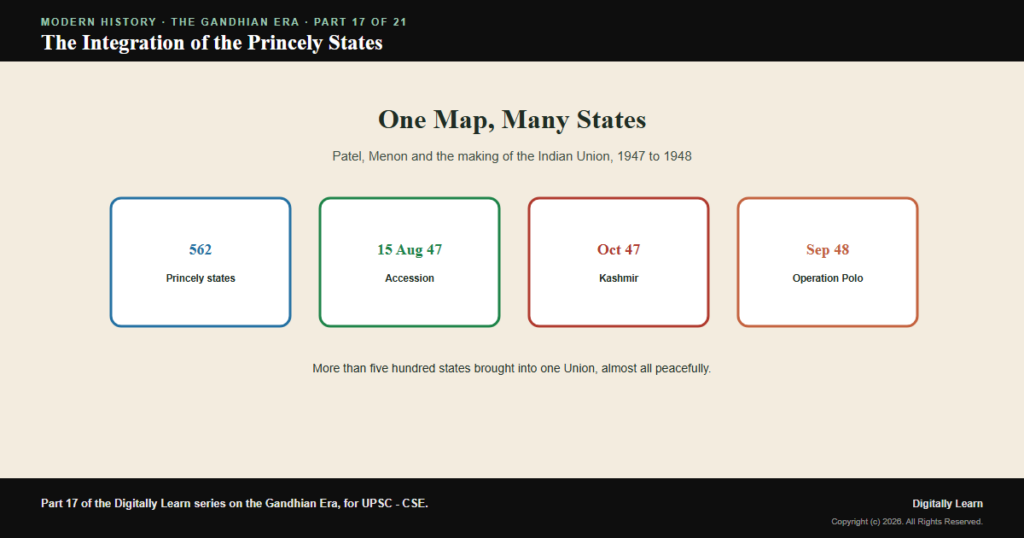
The integration of the princely states was the task of bringing the hundreds of states that lay outside British India into the new Indian Union after 1947. When British paramountcy lapsed at independence, more than five hundred states became technically free to join India or Pakistan or stay apart. Through the Instrument of Accession, and the patient work of Sardar Patel and V.P. Menon, almost all acceded to India by 15 August 1947. Only three, Junagadh, Hyderabad and Kashmir, held out, and each was brought in by 1948, completing the territorial map of the Union.
Introduction: Making One Union from Many States
Why the Integration of the States Matters
Why this matters: the India that became free in 1947 was not yet the India of the map we know. Outside British India lay hundreds of princely states, and unless they joined, the new country risked breaking into fragments.
What is the significance of the integration: it gave free India its territorial shape. The quiet, rapid bringing-in of the states, mostly by agreement, was one of the great achievements of the first year of independence, and it is closely tied to the name of Sardar Patel.
The Geography of Accession
Distinguishing the pattern is the place to begin. Most of the states, scattered across the country from Jaipur to Travancore, acceded to India by the day of independence, while only three large states held out.
What the map shows is the geography of those three holdouts: Junagadh in the west, Hyderabad in the Deccan and Jammu and Kashmir in the north, as set out below.
The Problem of the Princely States and the Lapse of Paramountcy
The Scale of the Problem in 1947
What is the significance of the lapse of paramountcy: it created the problem in the first place. British supremacy over the states, or paramountcy, had been built up since the days of the Subsidiary Alliance under Wellesley, and when the British left it simply lapsed, leaving the states legally free.
Distinguishing the danger: there were more than five hundred states, large and small, and the Government of India Act 1935 had once envisaged a federation they would join, which never came. Now, if many chose to stay out, India might be left a patchwork of independent enclaves, so their integration became urgent.
Patel, Menon and the Instrument of Accession
How Most States Acceded by 15 August 1947
Observable outcomes followed from a deliberate strategy. A new States Department was set up under Sardar Vallabhbhai Patel, with V.P. Menon as its secretary, to win the states over before independence rather than after.
Distinguishing the instrument: the states were asked to sign an Instrument of Accession ceding only three subjects, defence, external affairs and communications, to the Union, a limited demand that most rulers found acceptable. By a mix of appeal to patriotism and firm pressure, almost all the states had acceded by 15 August 1947, as the flow below sets out.
The Three Holdouts and How They Were Resolved
Junagadh's Accession and Hyderabad's Resistance
What is the significance of the holdouts: in three states the ruler and the people did not agree, and these became the hardest cases. In Junagadh, a small state on the Saurashtra coast, the Muslim ruler acceded to Pakistan although most of his people were Hindu and the state had no land link to Pakistan.
Distinguishing how Junagadh was resolved: amid popular agitation the ruler fled, and a plebiscite in February 1948 went almost unanimously for India. Hyderabad, the largest state, in the heart of the Deccan, was the other great holdout: its Nizam wished to stay independent, as the cards below set out.
Operation Polo and the Kashmir Accession
Observable outcomes in Hyderabad came to a head in 1948. After a standstill agreement broke down and an armed militia, the Razakars, grew powerful, the Indian government sent in the army in September 1948 in a police action code-named Operation Polo, after which the Nizam acceded.
Distinguishing the Kashmir case: Jammu and Kashmir had a Hindu ruler, Maharaja Hari Singh, and a Muslim majority. When tribal raiders invaded from Pakistan in October 1947, the Maharaja signed the Instrument of Accession to India and sought military help, as the table below records; the dispute over the state has continued since.
| Holdout | The mismatch | How it joined India |
|---|---|---|
| Junagadh | Muslim ruler, Hindu-majority people | Ruler acceded to Pakistan; a plebiscite in 1948 brought it to India |
| Hyderabad | Muslim Nizam, Hindu-majority people | Held out for independence; acceded after Operation Polo, September 1948 |
| Jammu and Kashmir | Hindu ruler, Muslim-majority people | Acceded to India in October 1947 after a tribal invasion from Pakistan |
Significance: Completing the Map of the Union
What the Integration Achieved
Contemporary linkages run from this achievement into the India of today. The integration completed the territorial map of the Union, turned a patchwork of states into provinces of one country, and won Sardar Patel the title of the Iron Man of India.
The larger significance is that it secured the unity of the new nation almost as soon as it was born. The states were later merged and reorganised, paving the way for the linguistic reorganisation of the 1950s, while the unfinished Kashmir question remained a source of dispute, the consequences set out below. The next part turns from territory to society, to Gandhi and the cause of social reform.
- More than five hundred states were brought into the Union, almost all of them peacefully.
- The Instrument of Accession became the legal device through which the states joined.
- Sardar Patel, aided by V.P. Menon, earned the title of the Iron Man of India.
- The states were later merged and reorganised, leading on to the linguistic reorganisation of the 1950s.
- The Kashmir accession left a dispute with Pakistan that has continued since.
Prelims MCQ practice
Each question below tests one specific concept on the topic. Click to reveal the answer and a full option-wise explanation.
Q1. At independence, British paramountcy over the princely states:
- passed to the Dominion of India
- passed to the Dominion of Pakistan
- lapsed, leaving the states free to choose
- was continued for ten more years
Show answer and explanation
Answer: lapsed, leaving the states free to choose
Explanation.
Option (c) is correct. At independence British paramountcy lapsed, so the states were legally free to accede to India or Pakistan or remain apart. Hence option (c).
Q2. The States Department that handled the integration of the princely states was headed by:
- Jawaharlal Nehru
- Sardar Vallabhbhai Patel
- Lord Mountbatten
- C. Rajagopalachari
Show answer and explanation
Answer: Sardar Vallabhbhai Patel
Explanation.
Option (b) is correct. The States Department was headed by Sardar Vallabhbhai Patel, with V.P. Menon as its secretary. Hence option (b).
Q3. Consider the following statements about the Instrument of Accession:
- Most acceding states ceded only defence, external affairs and communications to the Union.
- Most of the states had acceded by 15 August 1947.
Which of the statements given above is/are correct?
- 1 only
- 2 only
- Both 1 and 2
- Neither 1 nor 2
Show answer and explanation
Answer: Both 1 and 2
Explanation.
Both are correct. The Instrument of Accession ceded only three subjects, and most states had signed it by 15 August 1947. Hence option (c).
Q4. Operation Polo of September 1948 was the police action that integrated:
- Junagadh
- Hyderabad
- Jammu and Kashmir
- Travancore
Show answer and explanation
Answer: Hyderabad
Explanation.
Option (b) is correct. Operation Polo was the police action of September 1948 that brought Hyderabad into India. Hence option (b).
Q5. Consider the following pairs of a holdout state and how it joined India:
- Junagadh : a plebiscite in 1948.
- Jammu and Kashmir : the Instrument of Accession, 1947.
Which of the pairs given above is/are correctly matched?
- 1 only
- 2 only
- Both 1 and 2
- Neither 1 nor 2
Show answer and explanation
Answer: Both 1 and 2
Explanation.
Both pairs are correct: Junagadh joined India after a plebiscite in 1948, and Jammu and Kashmir acceded by the Instrument of Accession in October 1947. Hence option (c).
Q6. The administrative counterpart to Sardar Patel in the integration of the states was:
- V.P. Menon
- K.M. Munshi
- N. Gopalaswami Ayyangar
- B.R. Ambedkar
Show answer and explanation
Answer: V.P. Menon
Explanation.
Option (a) is correct. V.P. Menon, as secretary of the States Department, was Patel's chief administrative aide in the integration. Hence option (a).
Sources and Further Reading
- Wikipedia: Political integration of India
- Wikipedia: Instrument of Accession
- Wikipedia: Operation Polo (annexation of Hyderabad)
- Wikipedia: Vallabhbhai Patel
- Wikipedia: Annexation of Junagadh
- NCERT, India's Struggle for Independence / Politics in India since Independence
- Ministry of Culture: Indian Culture Freedom Archive
- Azadi Ka Amrit Mahotsav (Freedom Movement portal)
- Press Information Bureau, Government of India
- National Portal of India
Editorial Disclaimer
This article is prepared for UPSC examination preparation. Verify key facts and interpretations against standard reference histories before relying on them.