
Overview
Previous Year UPSC-CSE Questions By the end you will be able to draft model answers for the following UPSC questions. Each question carries a collapsible framework showing how to approach it in the exam.
- UPSC Mains 2018 GS-I‘Communalism arises either due to power struggle or relative deprivation.’ Argue by giving suitable illustrations.
How to structure the answer in the exam
Introduction: Open by defining communalism as the political use of religious identity, then state the two proposed causes.
Body (sub-themes to develop):
- Power struggle: separate electorates (1909), the League's bid for power-sharing, the contest over the 1937 ministries.
- Relative deprivation: Muslim fears of permanent minority status and of Hindu-majority domination.
- Illustrations from both sides: the League and the Hindu Mahasabha or Sangh.
- Synthesis: the two causes reinforced each other on the road to the Lahore Resolution and Partition.
Conclusion: Conclude that both causes operated together, as the 1906-1947 record illustrates.
- UPSC Prelims 2012 GS Paper IThe Lahore Session of the Indian National Congress (1929) is very important in history, because:
- The Congress passed a resolution demanding complete independence.
- The rift between the extremists and moderates was resolved in that Session.
- A resolution was passed rejecting the two-nation theory in that Session.
Select the correct answer using the codes given below.
How to approach this Prelims question
Approach: Test each statement against the date.
Trap to watch: The two-nation theory dates from 1940, not 1929; the extremist-moderate rift was settled in 1916, not 1929; only the complete-independence resolution belongs to Lahore 1929.
Key facts to recall:
- Lahore 1929 = Purna Swaraj
- Two-nation theory = Lahore Resolution 1940
- Extremist-moderate reunion = 1916
Answer signal: 1 only, so option (a).
- UPSC Prelims 2014 GS Paper IThe Partition of Bengal made by Lord Curzon in 1905 lasted until
How to approach this Prelims question
Approach: Recall when the 1905 partition of Bengal was reversed.
Trap to watch: The partition of Bengal was annulled in 1911 at the Delhi Durbar, not at independence in 1947.
Key facts to recall:
- Bengal partitioned 1905 (Curzon)
- Annulled 1911 (Delhi Durbar, George V)
- Fed Muslim and Hindu political mobilisation
Answer signal: King George V in 1911, so option (b).
- UPSC Prelims 2001 GS Paper IA London branch of the All-India Muslim League was established in 1908 under the presidency of
How to approach this Prelims question
Approach: Separate the London branch from the main League.
Trap to watch: The Aga Khan was the first president of the League itself; the London branch of 1908 was under Syed Ameer Ali.
Key facts to recall:
- League founded 1906 (Dacca)
- London branch 1908 = Ameer Ali
- Aga Khan = first president of the League
Answer signal: Ameer Ali, so option (b).
The Muslim League's demand for a separate state of Pakistan was the political force that, alongside the freedom struggle, led to the partition of India in 1947. Founded in 1906, the League came to argue, through the two-nation theory, that Hindus and Muslims were two distinct nations. Encouraged by separate electorates and hardened by the failure of power-sharing, this idea culminated in the Lahore Resolution of 1940, the explicit demand for Pakistan. A parallel Hindu-nationalist politics grew on the other side, and the communal divide widened until partition seemed unavoidable.
Introduction: The Communal Divide and the Road to Partition
Why the Communal Divide Matters
Why this matters: the freedom struggle ended not in one free India but in two states. To understand 1947 we have to follow a second story running beside the national movement, the slow growth of a communal politics that turned religion into a basis for nationhood.
What is the significance of the communal divide: it produced the demand for Pakistan and, with it, the partition of the subcontinent. This part traces that demand from the founding of the Muslim League in 1906 to the eve of independence, treating it as a historical process with many causes rather than the work of any single villain.
The Geography of the Demand
Distinguishing the geography of the demand makes the rest clearer. The areas claimed for Pakistan lay in two blocs: a North-Western zone of Punjab, Sindh, the North-West Frontier Province and Baluchistan, and an Eastern zone of Bengal.
What the map shows is also the tragedy built into the demand: Punjab and Bengal held very large non-Muslim minorities, so these two provinces would themselves have to be partitioned in 1947, as set out below.
The Rise of the Muslim League and the Roots of Separatism (1906-1916)
From the Simla Deputation to a Separate Party
What is the significance of the League's founding: it gave Muslim politics a separate organisation. It came soon after the 1905 partition of Bengal by Lord Curzon, which, though annulled in 1911, had already sharpened communal feeling. In October 1906 a deputation of Muslim leaders, the Simla Deputation, met the Viceroy Lord Minto to ask for separate political representation, and in December 1906 the All-India Muslim League was founded at Dacca.
Distinguishing its early character: the League began as a loyalist body of landlords and notables, with the Aga Khan as its first president, anxious to protect Muslim interests under British rule rather than to oppose it, as the milestones below record.
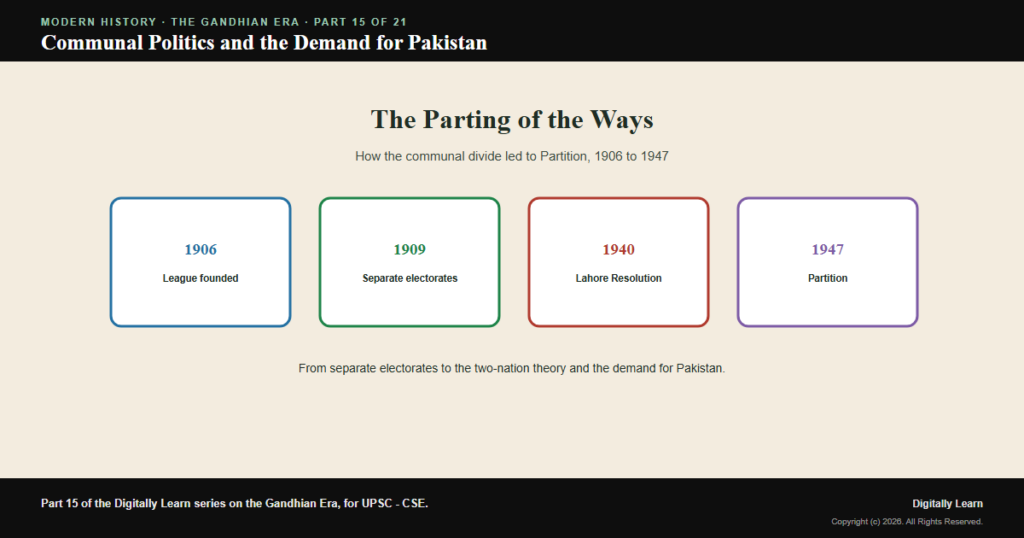
| Year | Development | Effect on the divide |
|---|---|---|
| 1906 | Muslim League founded at Dacca | A separate Muslim political platform |
| 1909 | Separate electorates (Morley-Minto) | Communal representation written into law |
| 1916 | Lucknow Pact | The Congress accepts separate electorates |
| 1932 | Communal Award | Separate electorates widened (see Part 8) |
| 1940 | Lahore Resolution | The explicit demand for Pakistan |
Separate Electorates and Why They Mattered
Observable outcomes followed quickly. The Morley-Minto Reforms of 1909 granted Muslims separate electorates, by which Muslim voters elected Muslim members from reserved seats. This made religion a permanent category in representative politics, a step whose consequences ran right up to Partition.
Distinguishing the Congress response: in the Lucknow Pact of 1916, the Congress, then seeking Muslim co-operation, accepted separate electorates, and Syed Ameer Ali had already founded the London Muslim League in 1908. The principle of communal representation, once conceded, proved very hard to undo.
The Two-Nation Theory and the Lahore Resolution (1940)
Jinnah and the Claim of a Separate Nationhood
What is the significance of the two-nation theory: it recast a demand for safeguards as a demand for a separate nation. Its argument, set out below, was that Hindus and Muslims were not two communities within one nation but two distinct nations, by religion, culture, history and law.
Distinguishing the stages of the idea: the poet Muhammad Iqbal had spoken in 1930 of a consolidated Muslim state in the north-west, the name 'Pakistan' was coined by Choudhary Rahmat Ali in 1933, and after the Congress ministries of 1937 deepened Muslim fears, Jinnah made the two-nation theory the League's official creed, as the contrast below sets out.
The Demand Declared at Minto Park
Observable outcomes came at Lahore. At the League's session at Minto Park on 23 March 1940, the Lahore Resolution, moved by A.K. Fazlul Huq, demanded that the Muslim-majority areas of the north-west and the east be grouped into independent states.
Distinguishing its terms: the resolution did not yet use the word Pakistan, but the press soon called it the Pakistan Resolution, and from 1940 the demand for a separate state was the League's central goal, as the list below records.
- Muslim-majority areas in the North-Western and Eastern zones to be grouped into ‘independent states’.
- The constituent units of those states to be autonomous and sovereign.
- Adequate safeguards for the minorities within these areas.
- Moved by A.K. Fazlul Huq at Minto Park, Lahore, on 23 March 1940.
- Soon known as the Pakistan Resolution, though the word Pakistan did not appear in the text.
Hindu Mahasabha Politics and the Sangh
The Other Side: Hindutva and the Sangh
What is the significance of the Hindu-nationalist bodies: communal politics was never one-sided. Alongside the League grew a Hindu-nationalist politics, expressed through the Hindu Mahasabha and, from 1925, the Rashtriya Swayamsevak Sangh.
Distinguishing the two: the Hindu Mahasabha, which from the 1930s emerged as a distinct party under V.D. Savarkar, drew on his idea of Hindutva and, strikingly, advanced its own version of the two-nation idea; the RSS, founded by K.B. Hedgewar at Nagpur in 1925, built a cultural-nationalist volunteer movement, as the cards below set out.
Communal Tensions, Riots and the Hardening of Identities
Why the Two Communities Drew Apart in the 1940s
Observable outcomes in the 1940s were grim. As the League's demand grew, so did communal tension, with periodic riots, rival processions and a press on both sides that traded in fear, each community coming to see the other as a threat to its future.
Distinguishing the deeper causes: historians point to several at once, the long habit of separate electorates, the failure of the Congress and the League to share power after 1937, Muslim fears of permanent minority status, the rise of mass communal mobilisation, and a British readiness to treat the communities as separate blocs. No single cause explains the hardening; together they made compromise ever harder.
Significance: How the Demand for Pakistan Became Unstoppable
The Point of No Return for a United India
Contemporary linkages run from this divide straight to 1947. After the Lahore Resolution the League turned the demand for Pakistan into a mass movement, winning most Muslim seats in the elections of 1945 to 1946 and pressing its case by mass mobilisation, the events of 1946 that the next part takes up.
The larger significance is that, by the mid-1940s, the gap between a Congress committed to one India and a League committed to Pakistan had become almost unbridgeable. The communal divide, decades in the making, set the stage for the partition and independence of 1947, the subject of the next part.
Prelims MCQ practice
Each question below tests one specific concept on the topic. Click to reveal the answer and a full option-wise explanation.
Q1. The All-India Muslim League was founded in 1906 at:
- Lahore
- Dacca
- Aligarh
- Lucknow
Show answer and explanation
Answer: Dacca
Explanation.
Option (b) is correct. The All-India Muslim League was founded at Dacca in December 1906. Hence option (b).
Q2. Separate electorates for Muslims were first granted by the:
- Indian Councils Act 1892
- Morley-Minto Reforms of 1909
- Montagu-Chelmsford Reforms of 1919
- Government of India Act 1935
Show answer and explanation
Answer: Morley-Minto Reforms of 1909
Explanation.
Option (b) is correct. Separate electorates for Muslims were introduced by the Morley-Minto Reforms (Indian Councils Act) of 1909. Hence option (b).
Q3. The Lahore Resolution of the Muslim League was passed in:
- 1930
- 1937
- 1940
- 1946
Show answer and explanation
Answer: 1940
Explanation.
Option (c) is correct. The Lahore Resolution, later called the Pakistan Resolution, was passed on 23 March 1940. Hence option (c).
Q4. Consider the following statements about the Lahore Resolution of 1940:
- It was moved by A.K. Fazlul Huq.
- It used the word 'Pakistan' in its text.
Which of the statements given above is/are correct?
- 1 only
- 2 only
- Both 1 and 2
- Neither 1 nor 2
Show answer and explanation
Answer: 1 only
Explanation.
Only statement 1 is correct. The resolution was moved by A.K. Fazlul Huq but did not use the word 'Pakistan'; the press later called it the Pakistan Resolution. Hence option (a).
Q5. The Rashtriya Swayamsevak Sangh (RSS) was founded in 1925 at:
- Pune
- Nagpur
- Wardha
- Delhi
Show answer and explanation
Answer: Nagpur
Explanation.
Option (b) is correct. The RSS was founded by K.B. Hedgewar at Nagpur in 1925. Hence option (b).
Q6. Consider the following statements about communal politics before 1947:
- The Lucknow Pact of 1916 saw the Congress accept separate electorates.
- The two-nation theory became the Muslim League's official position only in 1940.
Which of the statements given above is/are correct?
- 1 only
- 2 only
- Both 1 and 2
- Neither 1 nor 2
Show answer and explanation
Answer: Both 1 and 2
Explanation.
Both are correct. The Congress accepted separate electorates in the Lucknow Pact of 1916, and the two-nation theory became the League's creed with the Lahore Resolution of 1940. Hence option (c).
Sources and Further Reading
- Wikipedia: All-India Muslim League
- Wikipedia: Lahore Resolution
- Wikipedia: Two-nation theory
- Wikipedia: Hindu Mahasabha
- Wikipedia: Rashtriya Swayamsevak Sangh
- NCERT, India's Struggle for Independence / Themes in Indian History III
- Ministry of Culture: Indian Culture Freedom Archive
- Azadi Ka Amrit Mahotsav (Freedom Movement portal)
- Press Information Bureau, Government of India
- National Portal of India
Editorial Disclaimer
This article is prepared for UPSC examination preparation. Verify key facts and interpretations against standard reference histories before relying on them.