
Overview
Previous Year UPSC-CSE Questions By the end you will be able to draft model answers for the following UPSC questions. Each question carries a collapsible framework showing how to approach it in the exam.
- UPSC Mains 2015 GS-IHow difficult would have been the achievement of Indian independence without Mahatma Gandhi? Discuss.
How to structure the answer in the exam
Introduction: Open with Gandhi as the figure who turned nationalism into a mass movement through a new method.
Body (sub-themes to develop):
- His unique contribution: Satyagraha as a mass, non-violent technique (proven first at Champaran, Ahmedabad, Kheda).
- Reach: he drew peasants, workers and women into politics as the earlier leadership had not.
- Counter-view: structural forces (war, economy, global decolonisation) and other leaders also mattered.
- Balance: freedom may have come regardless, but its mass, non-violent character was distinctly Gandhian.
Conclusion: Conclude that independence might have come without him, but not in the same mass, non-violent form.
- UPSC Prelims 2018 GS Paper IWhich one of the following is a very significant aspect of the Champaran Satyagraha?
How to approach this Prelims question
Approach: Identify what was new about Champaran as a national-movement event, not just a local win.
Trap to watch: All-India lawyer/student/women participation belongs to Non-Cooperation; Dalit/tribal mass involvement is later. Champaran's novelty was linking the peasantry to the movement.
Key facts to recall:
- Champaran 1917 = first satyagraha in India
- Indigo peasants and the tinkathia system
- It tied peasant unrest to the national movement
Answer signal: Joining of peasant unrest to the National Movement, so option (c).
- UPSC Prelims 2010 GS Paper IConsider the following statements:
- Dr. Rajendra Prasad persuaded Mahatma Gandhi to come to Champaran to investigate the problem of peasants.
- Acharya J. B. Kripalani was one of Mahatma Gandhi's colleagues in his Champaran investigation.
Which of the statements given above is/are correct?
How to approach this Prelims question
Approach: Test each statement against who invited Gandhi and who assisted him.
Trap to watch: It was the peasant Raj Kumar Shukla, not Rajendra Prasad, who persuaded Gandhi to come; so statement 1 is false. Kripalani did assist, so statement 2 is true.
Key facts to recall:
- Raj Kumar Shukla invited Gandhi to Champaran
- Rajendra Prasad and J. B. Kripalani were among his colleagues
- Statement 1 false, statement 2 true
Answer signal: Only statement 2 is correct, so option (b).
- UPSC Prelims 2009 GS Paper IWho of the following founded the Ahmedabad Textile Labour Association?
How to approach this Prelims question
Approach: Connect the 1918 Ahmedabad mill strike to the union that grew from it.
Trap to watch: N. M. Joshi is linked to the wider trade-union movement (AITUC), not the Ahmedabad union; the Ahmedabad Textile Labour Association is associated with Gandhi.
Key facts to recall:
- 1918 Ahmedabad mill strike
- Ahmedabad Textile Labour Association founded with Gandhi (1920)
- Anasuya Sarabhai its long-serving president
Answer signal: Mahatma Gandhi, so option (a).
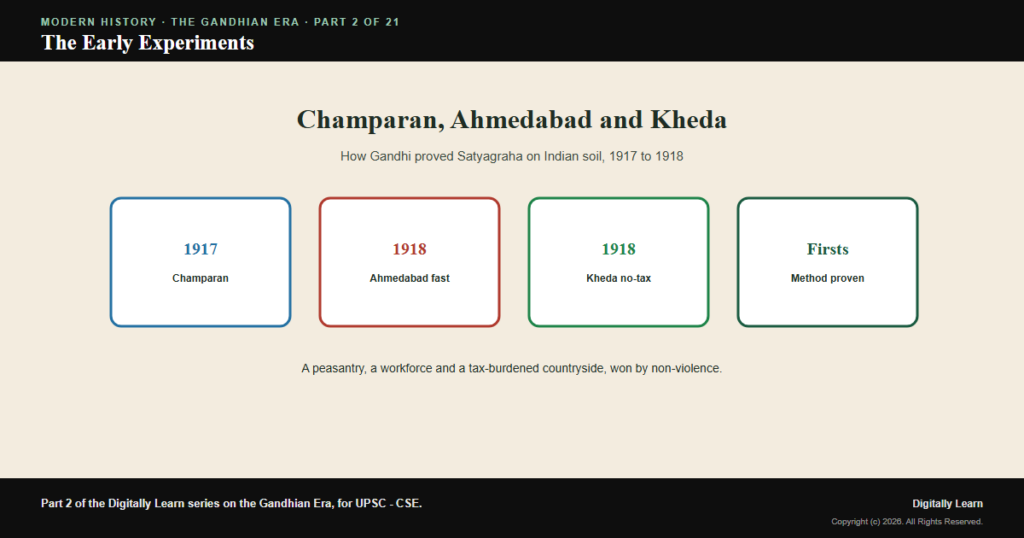
The early experiments of 1917 and 1918, at Champaran in Bihar and at Ahmedabad and Kheda in Gujarat, were the first occasions on which Mohandas Karamchand Gandhi applied his method of Satyagraha on Indian soil. A peasant grievance over indigo, an industrial wage dispute and a revenue revolt were each settled by non-violent pressure. Together they proved the method, drew a new generation of leaders to Gandhi, and supplied the template for the mass movements that followed.
Introduction: From South Africa to Indian Soil (1917-1918)
Why the Early Experiments Matter
Why this matters: when Gandhi returned to India in 1915 he had a tested method but no Indian victories to his name. On the advice of his mentor Gokhale he spent his first year travelling and observing, and held back from national politics. The early experiments of 1917 and 1918 were where he first put Satyagraha to work on Indian soil.
What is the significance of these campaigns: they were small, local and specific, yet each was a genuine victory, and together they did three things. They proved the method in Indian conditions, they drew a new layer of leaders to Gandhi, and they gave the national movement a template it would soon use on a vast scale.
The Three Sites at a Glance
Distinguishing the three is straightforward once the grievance is clear. Champaran, in the indigo districts of Bihar, was a peasant struggle against a coercive tenancy. Ahmedabad, a textile city in Gujarat, was an industrial dispute between mill workers and mill owners. Kheda, a farming district of Gujarat, was a revenue revolt by cultivators hit by crop failure.
What ties them together is the method, not the grievance. In each case Gandhi began from a concrete injustice, paired non-violent pressure with patient inquiry, and refused to let the protest turn violent. The geography of the three is shown below.
Champaran Satyagraha: The Indigo Peasants and the Tinkathia System (1917)
The Tinkathia System and Raj Kumar Shukla's Appeal
What is the significance of Champaran: it was Gandhi's first satyagraha in India. The grievance lay in the tinkathia system, under which an indigo tenant in Champaran had to plant three of every twenty parts of his holding (about fifteen per cent) with indigo for the European planter, for little or no payment. When synthetic dye collapsed the indigo market, the planters squeezed the peasants harder with illegal cesses and enhanced rents.
Distinguishing the trigger: Gandhi did not seek out Champaran; he was brought there. The local cultivator Raj Kumar Shukla followed Gandhi from the 1916 Lucknow Congress and pressed him until he agreed to investigate. The mechanics of the tinkathia burden are shown below.
The Inquiry, the Agrarian Committee and the Abolition of Tinkathia (1918)
Observable outcomes followed from method, not confrontation. When officials ordered Gandhi to leave Champaran, he refused and offered to face the penalty, and the case was withdrawn. He then gathered detailed testimony from thousands of peasants, assisted by a remarkable group of helpers, among them Rajendra Prasad, Brajkishore Prasad, Mahadev Desai and Acharya J. B. Kripalani.
The result was official inquiry rather than agitation. Gandhi was appointed to the Champaran Agrarian Committee, and the Champaran Agrarian Act of 1918 abolished the tinkathia system and ordered the planters to refund a part of the money they had illegally taken. It was, importantly, the joining of a peasant grievance to the national movement that made Champaran historic.
The Ahmedabad Mill Strike and Gandhi's First Hunger Strike (1918)
The Plague-Bonus Dispute and Anasuya Sarabhai
What is the significance of Ahmedabad: it was Gandhi's first major intervention in an industrial dispute, and the occasion of his first hunger strike. The quarrel was over a wartime plague bonus that the mill owners wished to withdraw while prices were still high; the workers, in turn, demanded a substantial rise in wages.
A distinguishing feature was the personal drama at its centre. The workers were organised and supported by Anasuya Sarabhai, a social worker whose own brother, Ambalal Sarabhai, was among the leading mill owners. Gandhi advised the workers, drew up a pledge, and addressed daily mass meetings under a tree on the Sabarmati bank.
The Fast, the 35 Per Cent Award and Organised Labour
Observable outcomes turned on Gandhi's own body. When the workers' resolve flagged, Gandhi undertook his first fast to hold them to their pledge, a moral pressure that fell as much on the mill owners, his own friends, as on the workers. The dispute went to arbitration, and the workers won a thirty-five per cent increase in wages.
A lasting result was institutional. Out of this struggle grew the Ahmedabad Textile Labour Association, which Gandhi helped found in 1920 and which became one of India's most disciplined trade unions. Ahmedabad showed that Satyagraha could speak for industrial labour, not peasants alone.
The Kheda Satyagraha: India's First No-Tax Campaign (1918)
Crop Failure and the Demand for Revenue Suspension
What is the significance of Kheda: it was India's first no-tax campaign of the Gandhian era. In 1918 the Kheda district of Gujarat suffered a severe crop failure, worsened by plague, and under the revenue code the cultivators were entitled to a suspension of the land revenue when the yield fell below a set share. The administration, however, refused to suspend the demand and pressed for full collection.
Distinguishing the campaign: the peasants, advised by Gandhi, took a pledge of non-payment of the revenue, accepting the seizure of their property rather than submit. It was a disciplined withholding, not a riot, and it drew the poorer cultivators into open defiance of the state.
Patel, Indulal Yagnik and the Outcome
Observable outcomes included a new leader as much as a settlement. It was at Kheda that a young Ahmedabad lawyer, Vallabhbhai Patel, gave up his practice to work with Gandhi, alongside Indulal Yagnik; the campaign was the making of the future Sardar. The struggle ended in a quiet compromise: the government privately instructed that revenue be recovered only from those who could pay, suspending it for the poorest.
A measured verdict is fair here. Kheda was not a clean triumph; the relief was partial and discreet. But it proved that the better-off peasantry could be mobilised in disciplined civil resistance, and it gave the movement a leader, Patel, who would organise its greatest campaigns.
What the Three Experiments Taught: The Template for Mass Struggle
A Common Method, Three Grievances
Distinguishing the pattern across the three campaigns shows a single method applied to very different injustices. The comparison below sets each grievance against its method and its outcome, and the common shape is clear: a real local wrong, non-violent pressure, and a negotiated gain.
| Campaign (year) | Grievance | Method | Outcome |
|---|---|---|---|
| Champaran (1917) | Indigo tinkathia, illegal cesses | Inquiry and refusal to leave | Tinkathia abolished; part-refund (Act 1918) |
| Ahmedabad (1918) | Plague-bonus and wage dispute | Pledge and Gandhi's first fast | Arbitration; 35 per cent wage rise |
| Kheda (1918) | Revenue not suspended in famine | Pledge of non-payment | Revenue recovered only from those able to pay |
What the table reveals is the portability of the method. The grievance changed from indigo to wages to revenue, and the social group from tenant to worker to cultivator, yet the Satyagraha shape held in every case. This is what made the three campaigns a template rather than three isolated successes.
The Template That Non-Cooperation Would Use
Observable outcomes of the three years went well beyond the local settlements. The experiments fixed a working method for the movement, set out below, and they gave Gandhi a tested band of lieutenants and a national reputation for winning real gains by non-violent means.
- Begin from a real grievance: a concrete, local injustice that ordinary people feel.
- Pair pressure with inquiry: non-violent defiance backed by patient fact-finding.
- Keep it non-violent: discipline, the pledge and a readiness to suffer.
- Build leadership: draw in and train new organisers such as Patel and Rajendra Prasad.
- Scale the method: a pattern that could be repeated, region by region, across India.
The forward link is direct. Within two years the Non-Cooperation Movement would apply this very pattern on a national scale. The structure of the template is shown below, followed by the timeline of these crowded two years.
Significance: The Method Proven on Indian Soil
Why These Campaigns Were a Turning Point
Contemporary linkages run from these local victories into the whole later struggle. The early experiments converted Gandhi from a returning expatriate with a foreign reputation into the trusted leader of Indian peasants and workers. They showed a sceptical political class that Satyagraha was not merely an idea but a method that delivered results.
The larger significance is that the freedom struggle now had a way to reach the masses. Where the earlier politics of petition and of the bomb had stayed narrow, Champaran, Ahmedabad and Kheda proved that ordinary people could be organised in disciplined, non-violent action. The next part follows that method into its first national test, the Rowlatt and Khilafat agitations of 1919 and 1920.
Prelims MCQ practice
Each question below tests one specific concept on the topic. Click to reveal the answer and a full option-wise explanation.
Q1. Gandhi's first satyagraha in India, in 1917, was launched at:
- Kheda
- Champaran
- Ahmedabad
- Bardoli
Show answer and explanation
Answer: Champaran
Explanation.
Option (b) is correct. Champaran (1917), against the indigo tinkathia system, was Gandhi's first satyagraha in India. Hence option (b).
Q2. Under the tinkathia system in Champaran, an indigo tenant had to grow indigo on:
- The whole of his holding
- Three of every twenty parts of his holding
- Half of his holding
- One-tenth of his holding
Show answer and explanation
Answer: Three of every twenty parts of his holding
Explanation.
Option (b) is correct. Tinkathia (teen-kathia) required three kathas of every twenty (about fifteen per cent) to be planted with indigo for the planter. Hence option (b).
Q3. With reference to the Ahmedabad mill strike of 1918, consider the following statements:
- It was the occasion of Gandhi's first hunger strike.
- The workers were awarded a thirty-five per cent increase in wages.
Which of the statements given above is/are correct?
- 1 only
- 2 only
- Both 1 and 2
- Neither 1 nor 2
Show answer and explanation
Answer: Both 1 and 2
Explanation.
Both are correct. Gandhi undertook his first fast during the Ahmedabad dispute, and arbitration awarded the workers a 35 per cent wage increase. Hence option (c).
Q4. The Kheda Satyagraha of 1918 is best described as:
- A strike by mill workers
- India's first no-tax (no-revenue) campaign
- A boycott of foreign cloth
- A protest against the Rowlatt Act
Show answer and explanation
Answer: India's first no-tax (no-revenue) campaign
Explanation.
Option (b) is correct. Kheda (1918) was a no-tax campaign: peasants hit by crop failure pledged not to pay the land revenue. Hence option (b).
Q5. Which leader gave up his legal practice to work with Gandhi during the Kheda Satyagraha?
- Rajendra Prasad
- Vallabhbhai Patel
- J. B. Kripalani
- C. R. Das
Show answer and explanation
Answer: Vallabhbhai Patel
Explanation.
Option (b) is correct. Vallabhbhai Patel, the future Sardar, joined Gandhi at Kheda, alongside Indulal Yagnik. Hence option (b).
Q6. Consider the following pairs of the early satyagrahas and their 'firsts':
- Champaran : Gandhi's first satyagraha in India.
- Ahmedabad : Gandhi's first fast (hunger strike).
Which of the pairs given above is/are correctly matched?
- 1 only
- 2 only
- Both 1 and 2
- Neither 1 nor 2
Show answer and explanation
Answer: Both 1 and 2
Explanation.
Both pairs are correct: Champaran (1917) was the first satyagraha in India, and Ahmedabad (1918) saw Gandhi's first fast. Hence option (c).
Sources and Further Reading
- Wikipedia: Champaran Satyagraha
- Wikipedia: Kheda Satyagraha
- Wikipedia: Anasuya Sarabhai
- Wikipedia: Vallabhbhai Patel
- Wikipedia: Mohandas Karamchand Gandhi
- NCERT, India's Struggle for Independence / Themes in Indian History III
- Ministry of Culture: Indian Culture Freedom Archive
- Azadi Ka Amrit Mahotsav (Freedom Movement portal)
- Press Information Bureau, Government of India
- National Portal of India
Editorial Disclaimer
This article is prepared for UPSC examination preparation. Verify key facts and interpretations against standard reference histories before relying on them.