


Overview
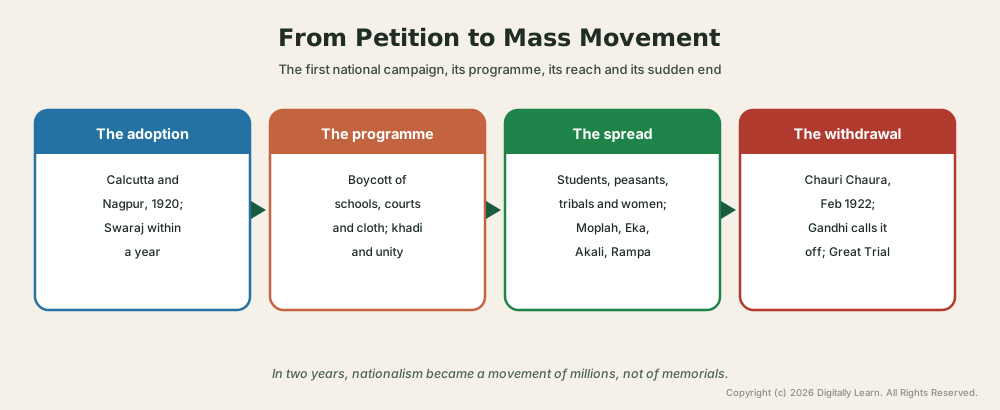
The Non-Cooperation Movement of 1920 to 1922 was the first all-India mass movement of the Gandhian era. Adopted by the Congress at Calcutta and Nagpur in 1920, it called on Indians to withdraw their cooperation from the Raj, by boycotting its schools, courts, councils, titles and foreign goods, while building a parallel national life of khadi, national schools and Hindu-Muslim unity. It spread across the provinces before Gandhi withdrew it after the violence at Chauri Chaura in 1922.
Introduction: From Convergence to National Campaign (1920)
Why Non-Cooperation Was the Turning Point
Why this matters: the grievances of 1919, the Rowlatt Act, Jallianwala Bagh and the Khilafat question, had broken Indian faith in British justice. The Non-Cooperation Movement of 1920 to 1922 was the first time that anger was turned into a single, organised, all-India campaign.
What is the significance of Non-Cooperation: it converted the Congress from a debating body into a mass movement, gave it a method that ordinary people could practise, and drew students, peasants, tribals and women into politics. Its reach and its sudden end are traced below.
The Spread of the Movement at a Glance
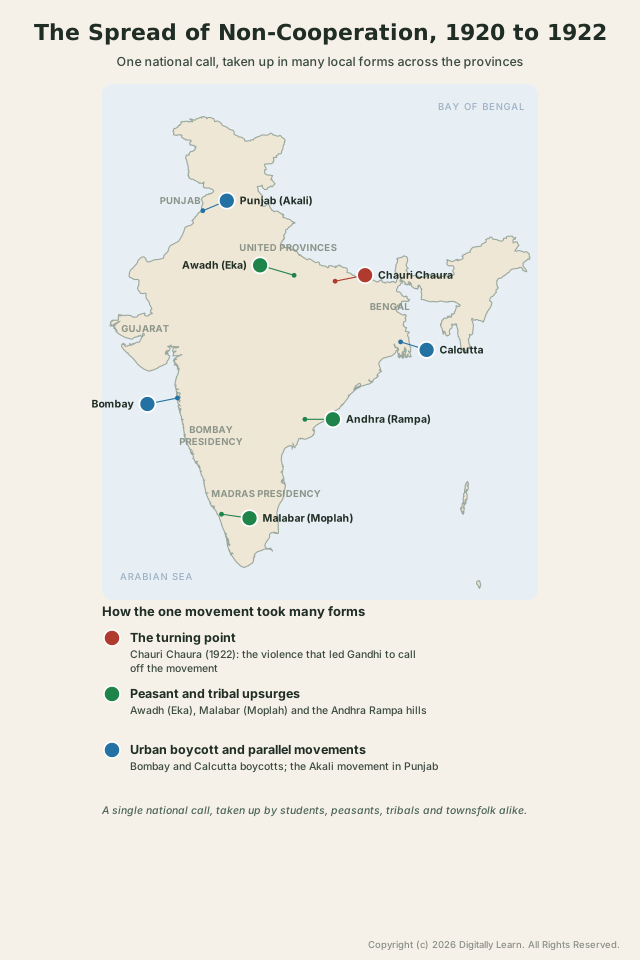
Distinguishing the geography of the movement is the key to understanding it. A single national call was taken up in very different local forms: a peasant upsurge in Awadh, a Moplah rising in Malabar, the Akali movement in Punjab, and tribal defiance in the Andhra hills.
What ties them together is that all marched under the one banner of Swaraj, even as each carried its own grievance. The spread of the movement is shown below, before we turn to how it began.
The Causes and the Adoption: Calcutta and Nagpur (1920)
The Causes: Punjab, Khilafat and the Demand for Swaraj
What is the significance of the causes: they gave the movement a Hindu and a Muslim grievance at once. Gandhi built Non-Cooperation on three wrongs: the Punjab wrong of Jallianwala Bagh, the Khilafat wrong over the Caliphate, and the failure of the reforms to grant real self-rule, so that only Swaraj would satisfy the nation.
Distinguishing the new mood: where the Moderates had petitioned and the Extremists had agitated in the towns, Gandhi now offered a programme of active withdrawal of cooperation, peaceful but total, that could be practised across the country.
Adopting the Programme and Reorganising the Congress
Observable outcomes came in two Congress sessions. At the special session in Calcutta in September 1920, the Congress adopted Gandhi's Non-Cooperation programme, and at the Nagpur session of December 1920 it was confirmed and the Congress itself was reorganised for mass work, with provincial committees on a linguistic basis.
A distinguishing promise framed the whole campaign: Gandhi pledged that Swaraj would come within one year if the programme was fully carried out. The Congress was now committed, for the first time, to extra-constitutional mass action.
The Two-Limb Programme: Boycott and the Constructive Agenda
The Boycott: Schools, Courts, Councils, Titles and Foreign Goods
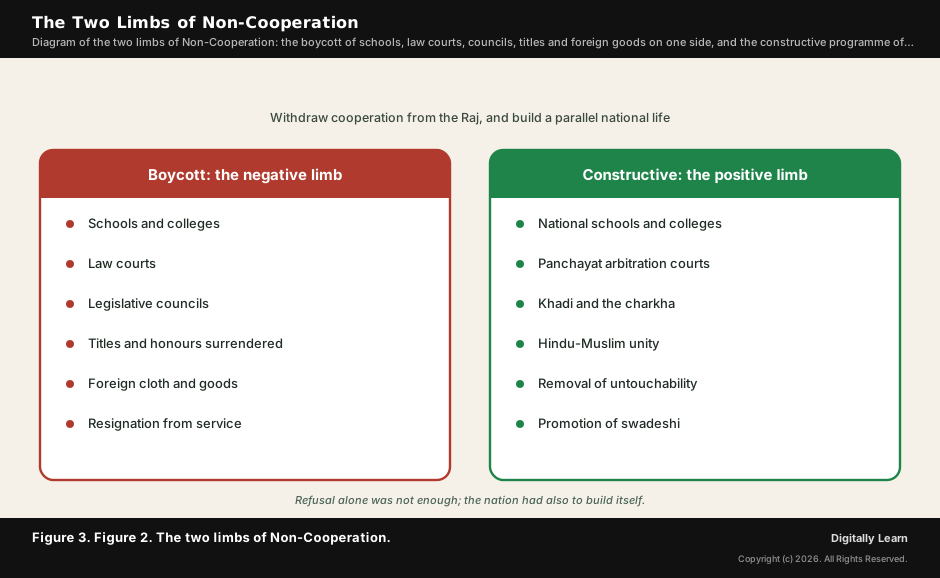
What is the significance of the boycott: it was the negative limb, the withdrawal of Indian cooperation from every arm of the Raj. Indians were asked to surrender titles and honours, to boycott government schools, law courts and the new legislative councils, to resign from official service, and above all to boycott foreign cloth.
Distinguishing the forms of the boycott shows how wide it reached, as the list below sets out, and the diagram that follows pairs it with the constructive limb.
- Schools and colleges: students left government institutions in large numbers.
- Law courts: lawyers such as C. R. Das and Motilal Nehru gave up their practice.
- Legislative councils: the new councils were boycotted at the elections.
- Titles and honours: titles conferred by the Raj were surrendered.
- Foreign cloth: bonfires of foreign cloth became the symbol of the movement.
Swadeshi, Khadi and National Education
Observable outcomes appeared in the positive, constructive limb. Refusal alone was not enough; the nation had to build itself. National schools and colleges such as the Jamia Millia Islamia and the Kashi Vidyapith were founded, panchayat courts settled disputes, and Hindu-Muslim unity and the removal of untouchability were pressed as national duties.
At its centre stood khadi. The spinning wheel and hand-spun cloth became the symbols of self-reliance and the dignity of labour, and the boycott of foreign cloth was matched by the positive promotion of swadeshi. The constructive programme made the movement a daily practice, not merely a protest.
Not everyone agreed with the boycott of schools. Rabindranath Tagore feared it would harm a generation of students and warned against a narrow, exclusive nationalism, a reservation that marked his wider difference with Gandhi over both education and the very idea of the nation.
The Spread and the Social Base
Students, Peasants, Tribals and Women
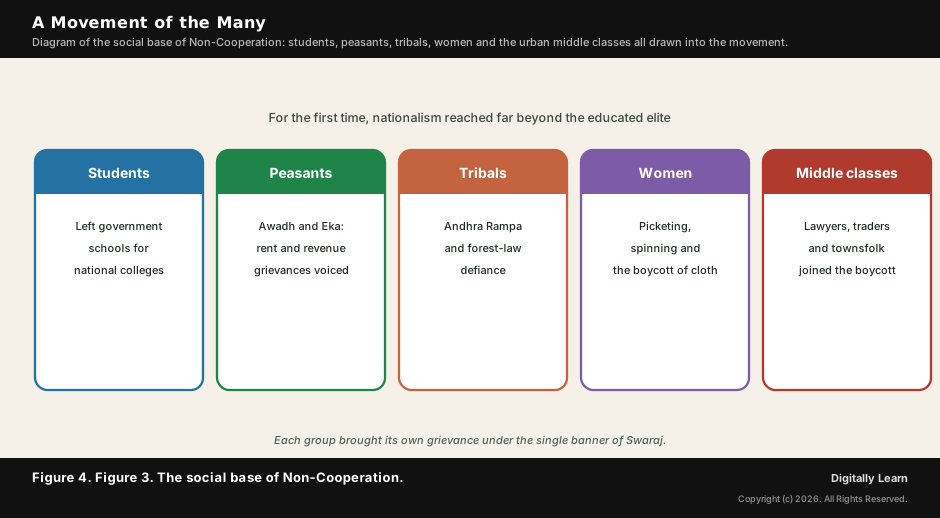
What is the significance of the social base: it was far wider than anything the movement had known before. Students left government schools, peasants in Awadh voiced their grievances over rent, tribals in the Andhra hills defied the forest laws, and women took part in picketing and spinning for the first time on a large scale.
Distinguishing the groups shows how each brought its own concern under the single banner of Swaraj, as the diagram below sets out. The urban middle classes joined the boycott, but it was the entry of the masses that made the movement new.
The Regional Upsurges: Awadh, Malabar, Andhra and Punjab
Observable outcomes took strikingly different regional forms. The national call merged with local struggles, and in some places it spilled beyond Gandhi's strict non-violence, as the table below records.
| Region | Form of the struggle | Character |
|---|---|---|
| Awadh (United Provinces) | Eka and the Kisan Sabha movement | Peasant grievances over rent and eviction |
| Malabar (Madras) | The Moplah rising of 1921 | A peasant revolt that turned communal and violent |
| Andhra (Rampa) | Forest-law defiance and the Rampa rebellion | Tribal resistance, partly armed |
| Punjab | The Akali (Gurdwara reform) movement | A non-violent struggle for control of the Sikh shrines |
A measured note is needed here. Some of these upsurges, especially the Moplah rising, took a violent and communal turn that Gandhi could not control, a sign of how far the movement had outrun its leadership.
Chauri Chaura and the Withdrawal (1922)
The Violence and Gandhi's Decision
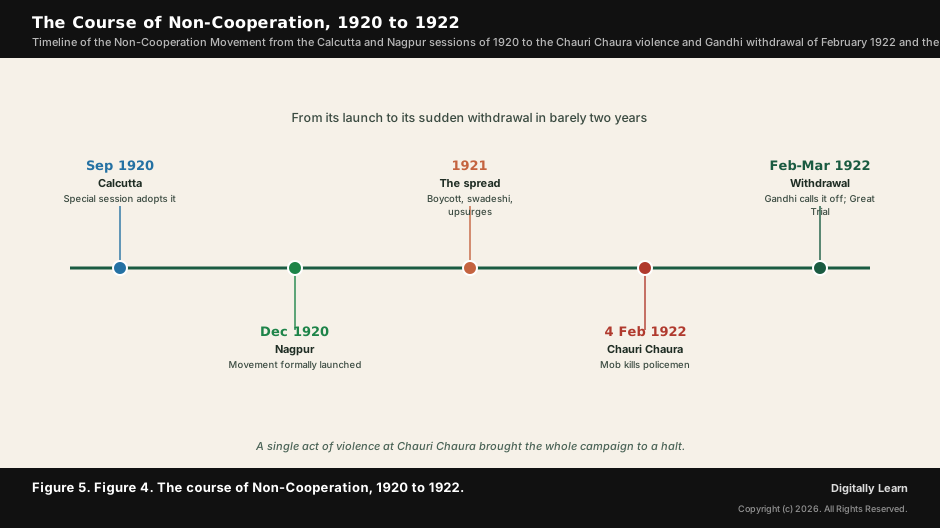
What is the significance of Chauri Chaura: it ended the movement at its height. On 4 February 1922, at Chauri Chaura in the Gorakhpur district of the United Provinces, a procession of protesters clashed with the police, and an angry mob set fire to the police station, killing some twenty-two policemen inside.
Distinguishing Gandhi's response: for him, the violence was decisive. He held that the country was not yet ready for non-violent mass action, and he withdrew the movement in February 1922, accepting the criticism rather than let the struggle turn violent. The course of these two years is shown below.
The Great Trial and the Criticism
Observable outcomes followed swiftly. In March 1922 Gandhi was tried for sedition in the famous Great Trial, pleaded guilty, and was sentenced to six years imprisonment. The withdrawal left many younger nationalists, and leaders such as Motilal Nehru and C. R. Das, dismayed at the halt when the movement was at its peak.
A balanced verdict is fair. The critics argued that a single local outrage should not have stopped a national movement; Gandhi answered that means and ends were inseparable, and that a movement built on non-violence could not survive a turn to violence. The debate over the withdrawal has continued ever since.
Significance: From Middle-Class Petition to Mass Movement
Why Non-Cooperation Changed the Movement
Contemporary linkages run from Non-Cooperation through the whole later struggle. It transformed the Congress from a body of the educated middle class into a genuine mass organisation, gave nationalism the weapons of boycott and swadeshi, and proved that millions could be moved by a single moral call.
The larger significance is that, even in apparent defeat, the movement changed Indian politics for good. The masses had entered the national stage and would not leave it. The next part follows what the Congress did in the lull that followed, in the Swaraj Party and the council-entry years of 1922 to 1928.
Previous Year UPSC-CSE Questions
Previous Year UPSC-CSE Questions By the end you will be able to draft model answers for the following UPSC questions. Each question carries a collapsible framework showing how to approach it in the exam.
- UPSC Mains 2023 GS-IWhat was the difference between Mahatma Gandhi and Rabindranath Tagore in their approach towards education and nationalism?
How to structure the answer in the exam
Introduction: Open with both as towering figures who nonetheless differed on means and on nationalism.
Body (sub-themes to develop):
- Education: Gandhi's Nai Talim and boycott of government schools vs Tagore's universalist Visva-Bharati.
- Nationalism: Gandhi's mass political nationalism vs Tagore's critique of narrow, aggressive nationalism.
- The Non-Cooperation moment: Tagore's reservations about the boycott of schools.
- Common ground: both anti-colonial, both valued moral and spiritual freedom.
Conclusion: Conclude that the difference was of method and emphasis, not of the goal of a free, humane India.
- UPSC Prelims 2025 GS Paper IConsider the following subjects with regard to the Non-Cooperation Programme:
- Boycott of law-courts and foreign cloth.
- Observance of strict non-violence.
- Retention of titles and honours without using them in public.
- Establishment of Panchayats for settling disputes.
How many of the above were parts of the Non-Cooperation Programme?
How to approach this Prelims question
Approach: Check each item against the actual programme.
Trap to watch: Item III is the trap: titles were to be surrendered, not retained-without-using. Items I, II and IV were all part of the programme, so three are correct.
Key facts to recall:
- Boycott of courts and foreign cloth (yes)
- Strict non-violence (yes)
- Panchayat arbitration courts (yes)
- Titles surrendered, not retained (so III is wrong)
Answer signal: Three of the four, so option (c).
- UPSC Prelims 2025 GS Paper IConsider the following statements in respect of the Non-Cooperation Movement:
- The Congress declared the attainment of 'Swaraj' by all legitimate and peaceful means to be its objective.
- It was to be implemented in stages, with civil disobedience and non-payment of taxes only as a later stage if 'Swaraj' did not come within a year and the Government resorted to repression.
Which of the statements given above is/are correct?
How to approach this Prelims question
Approach: Test each statement against the Nagpur programme.
Trap to watch: Both are correct: the peaceful-Swaraj objective and the staged design (civil disobedience and no-tax only later) are both accurate.
Key facts to recall:
- Swaraj by peaceful means = the objective
- Swaraj within a year was the promise
- Civil disobedience and no-tax were a later stage
Answer signal: Both statements are correct, so option (c).
- UPSC Prelims 1998 GS Paper IConsider the following statement and reason:
- Assertion (A): Gandhi stopped the Non-cooperation Movement in 1922.
- Reason (R): Violence at Chauri-Chaura led him to stop the movement.
Select the correct answer using the code given below.
How to approach this Prelims question
Approach: Judge A and R, then whether R explains A.
Trap to watch: Both are true and R genuinely explains A: the Chauri Chaura violence was Gandhi's stated reason for the withdrawal.
Key facts to recall:
- Gandhi withdrew NCM February 1922
- Chauri Chaura violence (4 Feb 1922) was the cause
- Means and ends inseparable for Gandhi
Answer signal: Both A and R true and R explains A, so option (a).
Sources and Further Reading
- Wikipedia: Non-cooperation movement (1919-1922)
- Wikipedia: Chauri Chaura incident
- Wikipedia: Moplah rebellion
- Wikipedia: Mohandas Karamchand Gandhi
- NCERT, India's Struggle for Independence / Themes in Indian History III
- Ministry of Culture: Indian Culture Freedom Archive
- Azadi Ka Amrit Mahotsav (Freedom Movement portal)
- Press Information Bureau, Government of India
- National Portal of India
Editorial Disclaimer
This article is prepared for UPSC examination preparation. Verify key facts and interpretations against standard reference histories before relying on them.