


Overview
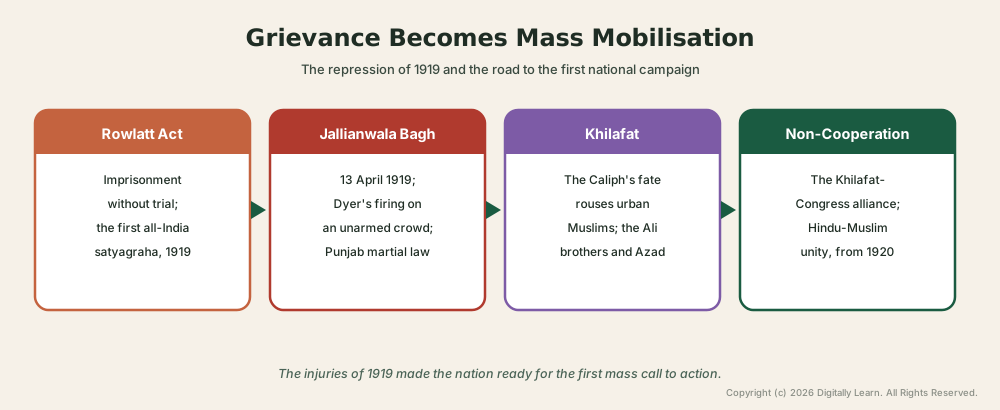
The years 1919 and 1920 turned Indian nationalism into a mass movement. Three grievances converged: the repressive Rowlatt Act, the massacre at Jallianwala Bagh in Amritsar, and the Khilafat cause that roused Indian Muslims over the fate of the Ottoman Caliph. Gandhi fused them into the first all-India satyagraha and a Hindu-Muslim alliance, and from this came the Non-Cooperation Movement. This part traces how repression and grievance became national mass mobilisation.
Introduction: From Local Experiments to the First National Storm (1919-1920)
Why 1919 and 1920 Were the Turning Point
Why this matters: the local experiments of 1917 and 1918 had proved Gandhi's method, but they were small and regional. The years 1919 and 1920 were when Indian nationalism first became a genuine all-India mass movement, and it was repression, not reform, that lit the fire.
What is the significance of these two years: three separate grievances, the Rowlatt Act, the Jallianwala Bagh massacre and the Khilafat question, converged in quick succession. Gandhi drew them together into the first national satyagraha and a remarkable Hindu-Muslim alliance, set out below.
The Punjab and the All-India Hartal at a Glance
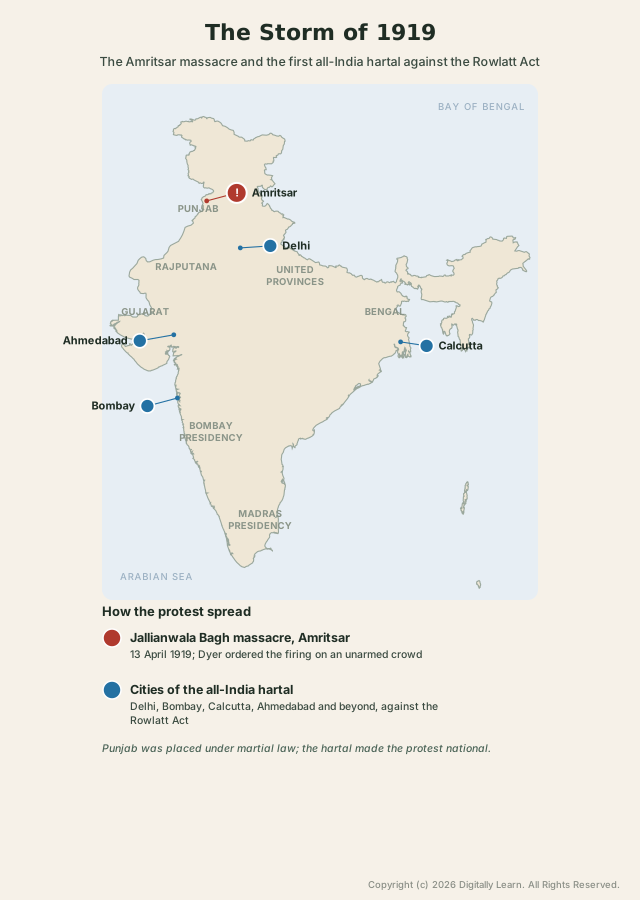
Distinguishing the geography of 1919 helps. The massacre fell on Amritsar in Punjab, which was then placed under martial law, while the protest against the Rowlatt Act took the form of an all-India hartal in Delhi, Bombay, Calcutta, Ahmedabad and many other cities.
What ties them together is that a single repressive law produced a national response. For the first time a protest reached simultaneously across the provinces, as the map below shows.
The Rowlatt Act and the First All-India Satyagraha
The Rowlatt Act: Imprisonment Without Trial
What is the significance of the Rowlatt Act: it broke the wartime hope of reform. Indians had supported Britain in the First World War expecting self-government; instead, in 1919, the government passed the Rowlatt Act, formally the Anarchical and Revolutionary Crimes Act, on the recommendations of the Sedition (Rowlatt) Committee.
Distinguishing what it did: the Act allowed the government to imprison suspects without trial for up to two years, with no appeal. It was assented to under the Viceroy, Lord Chelmsford, in March 1919, and Indians called it the Black Act, a law of 'no appeal, no vakil, no daleel'.
The Rowlatt Satyagraha and the Hartal of April 1919
Observable outcomes came at once. Gandhi formed a Satyagraha Sabha and, drawing on the existing networks of the Home Rule League, called for a nationwide hartal, a voluntary suspension of work and business, as a moral protest. The hartal of 6 April 1919 was the first all-India satyagraha, and it drew in towns across the country.
A distinguishing feature was its reach and its limits. The protest was vast, but in some places it spilled into violence, and the government answered with force, nowhere more terribly than in Punjab. The Rowlatt Satyagraha was the spark; Jallianwala Bagh was the explosion.
The Jallianwala Bagh Massacre and Martial Law in Punjab
Baisakhi at Amritsar: Dyer, the Firing and the Casualty Debate
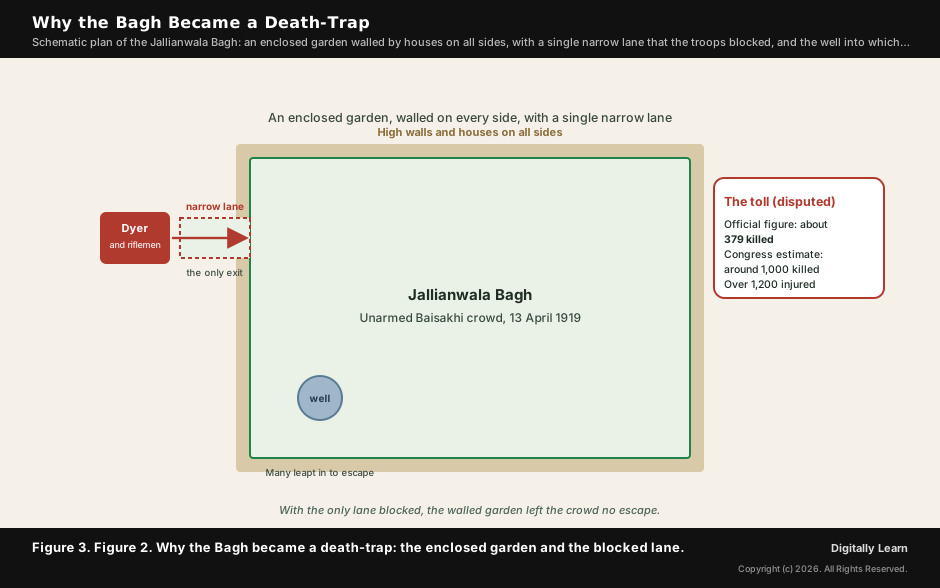
What is the significance of Jallianwala Bagh: it was the moment Indian faith in British justice collapsed. On 13 April 1919, the festival of Baisakhi, a large unarmed crowd gathered in the Jallianwala Bagh, an enclosed garden in Amritsar walled on all sides with a single narrow lane.
Distinguishing the act matters for the examination. Brigadier-General Reginald Dyer marched in troops, blocked the only exit, and ordered firing without warning until the ammunition ran low. He must not be confused with Michael O'Dwyer, the Lieutenant-Governor of Punjab who approved the action and was later shot by Udham Singh in 1940. The casualty figures are disputed, as the plan below records.
The Hunter Commission and Tagore's Renunciation of the Knighthood
Observable outcomes followed the outrage. The government appointed the Hunter Commission, formally the Disorders Inquiry Committee, which censured Dyer's conduct, though he faced no real punishment and was lionised by sections of British opinion. The official death toll was about 379, while the Congress estimate was closer to a thousand.
A distinguishing response came from the country's conscience. Rabindranath Tagore renounced his knighthood in protest in 1919, and Gandhi later returned the Kaiser-i-Hind medal in 1920. The massacre, and the failure to punish Dyer, convinced even moderate Indians that cooperation with the Raj had become impossible.
The Khilafat Movement: The Caliphate Question and Indian Muslims
The Ottoman Defeat and the Three Demands
What is the significance of the Khilafat question: it brought urban Muslims into the national movement on a mass scale. After the First World War, the Ottoman Sultan, who was also the Caliph (Khalifa), the spiritual head of Sunni Islam, faced the dismemberment of his empire by the victorious Allies. Indian Muslims feared for the Caliphate and the holy places of Islam.
Distinguishing the demands: the movement asked Britain to preserve the Caliph's authority, his control over the Muslim holy places, and the territorial integrity of the Ottoman empire. The specific demands are set out below.
- The Caliph: the Ottoman Sultan-Caliph should retain his position and authority.
- The holy places: the Caliph must keep control over the sacred sites of Islam.
- Territorial integrity: the Ottoman empire should not be stripped of its lands.
- A moral appeal: Britain should honour its wartime assurances to Indian Muslims.
The Ali Brothers, Azad and the Khilafat Committee
Observable outcomes took organised form. The All India Khilafat Committee was founded in 1919, and the cause was led by the Ali brothers, Mohammad Ali and Shaukat Ali, together with Maulana Abul Kalam Azad and Hakim Ajmal Khan. In 1920 the movement issued the Khilafat Manifesto.
A distinguishing feature was its mass religious idiom, which gave it a reach the constitutional politics of the past had lacked. The Khilafat leaders were ready for direct action, and they found in Gandhi a partner who could turn their cause into a joint national campaign.
The Khilafat-Congress Alliance and the Road to Non-Cooperation
Why Gandhi Embraced the Khilafat Cause
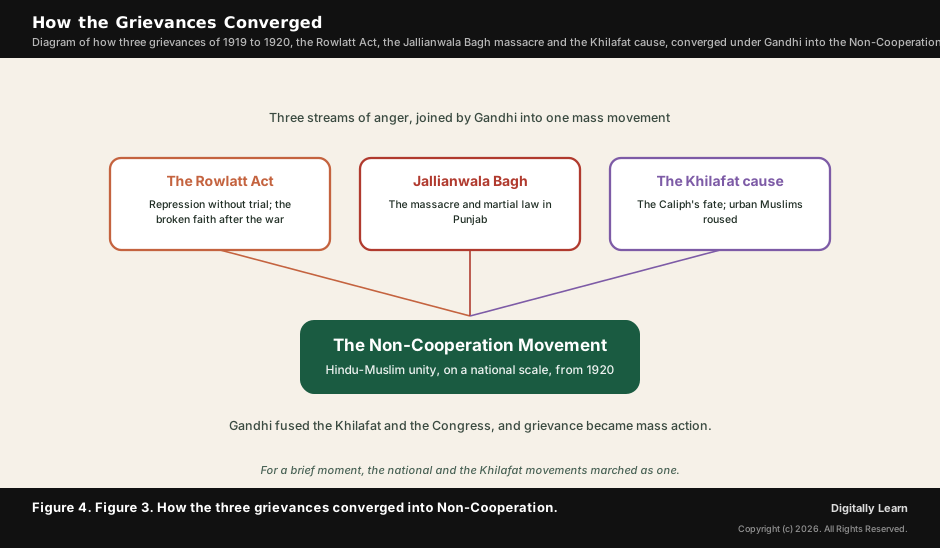
What is the significance of the alliance: it produced the most genuine moment of Hindu-Muslim unity in the whole freedom struggle. Gandhi saw in the Khilafat cause a chance to join Hindus and Muslims in a single movement and to widen nationalism into a mass campaign, and he made the Khilafat wrong one of the grievances of Non-Cooperation.
Distinguishing the convergence: the Punjab wrong (Jallianwala Bagh), the Khilafat wrong, and the demand for Swaraj were the three planks on which Gandhi built the movement. The way these grievances flowed together is shown below.
| Grievance | Who it roused | What it demanded |
|---|---|---|
| The Rowlatt Act (1919) | The political nation, Hindu and Muslim | Repeal of repression; the right to a fair trial |
| Jallianwala Bagh (1919) | All of India; especially Punjab | Justice for Amritsar; redress for the Punjab wrong |
| The Khilafat cause (1919-1920) | Urban Muslims across India | Protection of the Caliphate and the holy places |
The Eighteen Months That Made a Movement
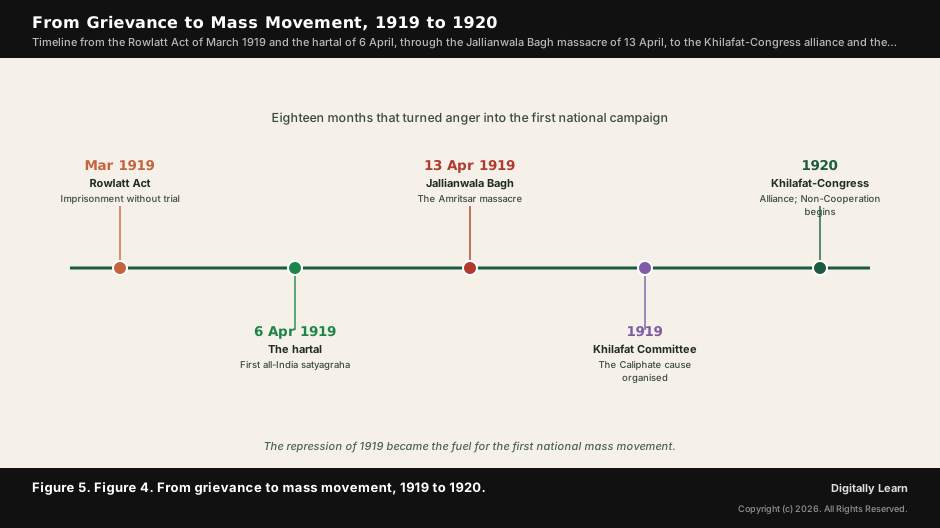
Observable outcomes can be read in the sequence of events. In barely eighteen months, a repressive law, a massacre and a religious cause were turned into the first national mass campaign, as the timeline below records.
The forward link is direct: the Khilafat and Congress leaders agreed to act together, and at the Calcutta and Nagpur sessions of 1920 the Congress adopted Non-Cooperation. The decline came later, after the Khilafat cause itself collapsed when Mustafa Kemal Ataturk abolished the Caliphate in 1924, but in 1920 the alliance was the engine of the movement.
Significance: Grievance Becomes Mass Mobilisation
How 1919 and 1920 Expanded the Social Base
Contemporary linkages run from these two years into the whole mass phase of the freedom struggle. The repression of 1919 destroyed the moderate faith in petition, and the Khilafat alliance drew urban Muslims into nationalist politics as never before, widening the movement's social base far beyond the educated Hindu middle class.
The larger significance is that grievance had become mass mobilisation. From a railway platform in South Africa, through three local experiments, Gandhi now stood ready to lead a national campaign. The next part follows that campaign, the Non-Cooperation Movement of 1920 to 1922, from its programme to its sudden withdrawal at Chauri Chaura.
Previous Year UPSC-CSE Questions
Previous Year UPSC-CSE Questions By the end you will be able to draft model answers for the following UPSC questions. Each question carries a collapsible framework showing how to approach it in the exam.
- UPSC Mains 2020 GS-ISince the decade of the 1920s, the national movement acquired various ideological strands and thereby expanded its social base. Discuss.
How to structure the answer in the exam
Introduction: Open with the 1920s as the decade nationalism became a genuine mass movement.
Body (sub-themes to develop):
- Gandhian mass satyagraha after 1919 (Rowlatt hartal, Non-Cooperation) drew in peasants and the towns.
- The Khilafat-Congress alliance brought urban Muslims into the national movement.
- Later strands: the Swarajists, socialists, revolutionaries, and peasant and worker movements.
- Result: a base far wider than the educated middle class of the Moderate era.
Conclusion: Conclude that the 1920s converted a narrow nationalism into a broad, multi-strand mass movement.
- UPSC Prelims 2015 GS Paper IWith reference to Rowlatt Satyagraha, which of the following statements is/are correct?
- The Rowlatt Act was based on the recommendations of the 'Sedition Committee'.
- In Rowlatt Satyagraha, Gandhiji tried to utilize the Home Rule League.
- Demonstrations against the arrival of Simon Commission coincided with Rowlatt Satyagraha.
Select the correct answer using the code given below.
How to approach this Prelims question
Approach: Test each statement against the facts of 1919.
Trap to watch: Statement 3 is the trap: the Simon Commission came in 1928, nine years later, so it could not coincide with the 1919 Rowlatt Satyagraha. Statements 1 and 2 are correct.
Key facts to recall:
- Rowlatt Act = Sedition (Rowlatt) Committee
- Gandhi used the Home Rule League network in 1919
- Simon Commission = 1928, not 1919
Answer signal: Statements 1 and 2 only, so option (b).
- UPSC Prelims 2008 GS Paper IWho was the Viceroy of India when the Rowlatt Act was passed?
How to approach this Prelims question
Approach: Match the Rowlatt Act (1919) to the Viceroy of the day.
Trap to watch: Lord Irwin (Civil Disobedience era) and Lord Reading came later; Wavell was a 1940s Viceroy.
Key facts to recall:
- Rowlatt Act 1919
- Viceroy Lord Chelmsford (1916-1921)
- Montagu-Chelmsford reforms also 1919
Answer signal: Lord Chelmsford, so option (c).
- UPSC Prelims 2001 GS Paper IThe Hunter Commission was appointed after the
How to approach this Prelims question
Approach: Connect the Hunter Commission to the event it investigated.
Trap to watch: The Black Hole and the 1857 Uprising are far earlier; the Partition of Bengal (1905) had its own agitation, not the Hunter Commission.
Key facts to recall:
- Hunter Commission = Disorders Inquiry Committee
- Appointed after Jallianwala Bagh (1919)
- It censured Dyer's conduct
Answer signal: Jallianwala Bagh massacre, so option (b).
- UPSC Prelims 1998 GS Paper IConsider the following statement and reason:
- Assertion (A): The Khilafat movement did bring the urban Muslims into the fold of the National Movement.
- Reason (R): There was a predominant element of anti-imperialism in both the National and Khilafat Movements.
Select the correct answer using the code given below.
How to approach this Prelims question
Approach: Judge the truth of A and R, then whether R explains A.
Trap to watch: Both are true and R genuinely explains A: shared anti-imperialism was why the Khilafat cause could merge with the national movement.
Key facts to recall:
- Khilafat drew in urban Muslims
- Both movements were anti-imperial
- Shared anti-imperialism enabled the alliance
Answer signal: Both A and R true and R explains A, so option (a).
Sources and Further Reading
- Wikipedia: Rowlatt Act
- Wikipedia: Jallianwala Bagh massacre
- Wikipedia: Khilafat Movement
- Wikipedia: Non-cooperation movement
- Wikipedia: Mohandas Karamchand Gandhi
- NCERT, India's Struggle for Independence / Themes in Indian History III
- Ministry of Culture: Indian Culture Freedom Archive
- Azadi Ka Amrit Mahotsav (Freedom Movement portal)
- Press Information Bureau, Government of India
- National Portal of India
Editorial Disclaimer
This article is prepared for UPSC examination preparation. Verify key facts and interpretations against standard reference histories before relying on them.