
Overview
Previous Year UPSC-CSE Questions By the end you will be able to draft model answers for the following UPSC questions. Each question carries a collapsible framework showing how to approach it in the exam.
- UPSC Mains 2015 GS-IMahatma Gandhi and Dr. B R Ambedkar, despite having divergent approaches and strategies, had a common goal of amelioration of the downtrodden. Elucidate.
How to structure the answer in the exam
Introduction: Open with the shared aim of uplifting the downtrodden pursued by two very different routes.
Body (sub-themes to develop):
- Common goal: the dignity and upliftment of the depressed classes.
- Gandhi: reform within Hinduism, a change of heart, the Harijan Sevak Sangh, joint electorate.
- Ambedkar: caste as a structural evil, political and legal safeguards, separate representation.
- The Poona Pact (1932): the clash and the compromise on reserved seats.
Conclusion: Conclude that, for all their differences, both advanced the cause of the oppressed and shaped modern India.
- UPSC Prelims 2019 GS Paper IConsider the following pairs of an organisation or movement and its leader:
- All India Anti-Untouchability League : Mahatma Gandhi.
- All India Kisan Sabha : Swami Sahajanand Saraswati.
- Self-Respect Movement : E.V. Ramaswami Naicker.
Which of the pairs given above is/are correctly matched?
How to approach this Prelims question
Approach: Check each pair; here all three are correct.
Trap to watch: Gandhi did found the Anti-Untouchability League (1932); Swami Sahajanand led the Kisan Sabha and Periyar the Self-Respect Movement.
Key facts to recall:
- Gandhi = All India Anti-Untouchability League (1932)
- Swami Sahajanand = Kisan Sabha
- Periyar = Self-Respect Movement
Answer signal: All three matched, so option (d).
- UPSC Prelims 2012 GS Paper IWhich of the following parties were established by Dr. B. R. Ambedkar?
- The Peasants and Workers Party of India.
- The All India Scheduled Castes Federation.
- The Independent Labour Party.
Select the correct answer using the code given below.
How to approach this Prelims question
Approach: Recall Ambedkar's political parties.
Trap to watch: Ambedkar founded the Independent Labour Party and the Scheduled Castes Federation, not the Peasants and Workers Party.
Key facts to recall:
- Independent Labour Party (1936) = Ambedkar
- Scheduled Castes Federation = Ambedkar
- Peasants and Workers Party = not Ambedkar
Answer signal: 2 and 3 only, so option (b).
- UPSC Prelims 2020 GS Paper IWhich one of the following categories of Fundamental Rights incorporates protection against untouchability as a form of discrimination?
How to approach this Prelims question
Approach: Place the abolition of untouchability in the right Fundamental Right.
Trap to watch: Untouchability is abolished by Article 17, which is part of the Right to Equality, not the Right against Exploitation.
Key facts to recall:
- Article 17 abolishes untouchability
- It falls under the Right to Equality
- The legacy of the anti-untouchability campaign
Answer signal: Right to Equality, so option (d).
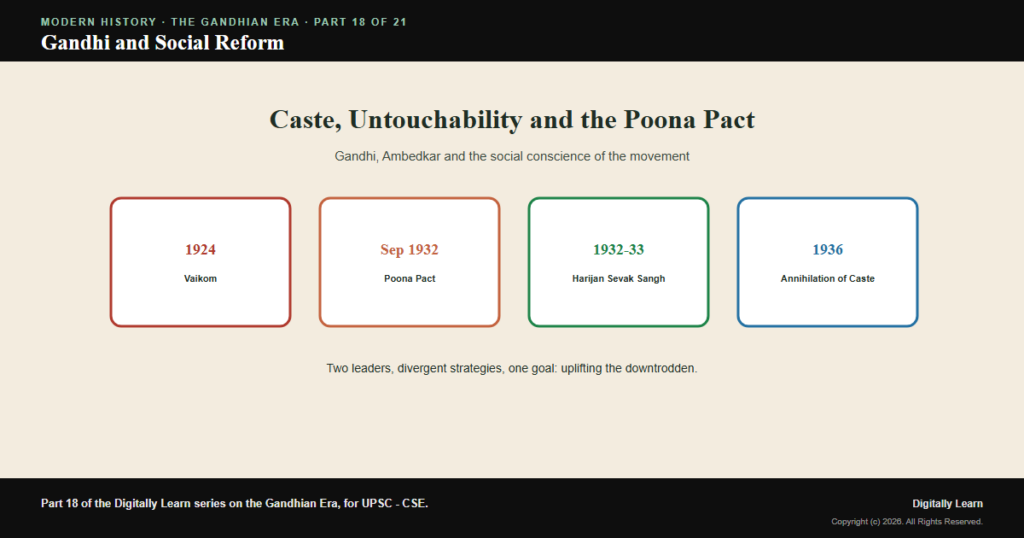
Gandhi's campaign against untouchability made social reform a central part of the national movement. He held that India could not be free while it kept millions in degradation, called the so-called untouchables Harijans, and founded the Harijan Sevak Sangh to work for their upliftment. His approach, reform within Hinduism by a change of heart, was challenged by Dr B.R. Ambedkar, who saw caste as a structural evil and pressed for political safeguards. Their clash over the 1932 Communal Award was settled by the Poona Pact, and the debate shaped the place of caste in modern India.
Introduction: The Social Conscience of the National Movement
Why Gandhi's Social Reform Matters
Why this matters: for Gandhi the struggle for freedom was inseparable from the struggle to reform Indian society. He believed that swaraj would be hollow if it left untouchability and caste oppression untouched, and he made their removal one of his great causes.
What is the significance of this theme: it brought the question of social justice into the heart of the national movement, and it produced one of the defining debates of modern India, between Gandhi and Ambedkar over how the oppressed were to be uplifted.
Gandhi on the Caste System and the Meaning of 'Harijan'
From Defending Varna to Fighting Untouchability
Distinguishing Gandhi's position is important, for it changed over time. In his early years he defended varnashrama, the fourfold order, as a division of labour rather than of rank, but he was always uncompromising in his condemnation of untouchability, which he called a sin and a blot on Hinduism.
What is the significance of the term Harijan: Gandhi renamed the so-called untouchables Harijans, meaning the children of God, to affirm their dignity. The term became widely used, though Ambedkar and many in the community later rejected it as patronising, preferring the term Dalit, a difference of outlook that matters to this debate.
The Campaign Against Untouchability and the Temple-Entry Movements
The League, the Sangh and the Harijan Weekly
Observable outcomes took organised form in 1932. Gandhi founded the All India Anti-Untouchability League on 30 September 1932, soon renamed the Harijan Sevak Sangh, with the industrialist G.D. Birla as president and Amritlal Thakkar as secretary, to work for the upliftment of the depressed classes.
Distinguishing the means: from 1933 Gandhi published the weekly Harijan to carry the message, undertook tours for the cause, and pressed caste Hindus to give up untouchability in daily life. The campaign treated the evil as a religious and moral wrong to be rooted out, as the diagram below sets out.
From Vaikom to the Travancore Proclamation
What is the significance of the temple-entry movements: they carried the fight to the most visible sites of exclusion, the temples and their approach roads. The Vaikom Satyagraha of 1924-25 in Travancore demanded the right of all to use the roads around a temple, and won wide support.
Distinguishing the later landmarks: the Guruvayur Satyagraha of the early 1930s pressed for temple entry, and the movement culminated in the Temple Entry Proclamation of 1936 in Travancore, which opened the state's temples to all Hindus, as the table below records.
| Movement | Place and year | Aim or outcome |
|---|---|---|
| Vaikom Satyagraha | Travancore, 1924-25 | The right of all to use the temple roads |
| Guruvayur Satyagraha | Malabar, 1931-32 | Temple entry for the depressed classes |
| Temple Entry Proclamation | Travancore, 1936 | The state's temples opened to all Hindus |
The Gandhi-Ambedkar Debate and the Poona Pact (1932)
Two Approaches to the Same Goal
What is the significance of the Gandhi-Ambedkar debate: it set out two very different routes to the same end, the upliftment of the downtrodden. Gandhi sought reform from within Hinduism, by a change of heart among caste Hindus, while Ambedkar, himself from the depressed classes, held that caste was a structural evil that no appeal to conscience could remove.
Distinguishing the means: Ambedkar called for political and legal safeguards, separate representation and the self-organisation of the oppressed, founding the Independent Labour Party in 1936 and later the Scheduled Castes Federation, and in 1936 he set out his case in 'Annihilation of Caste'. The two are contrasted below, sharing the goal but not the method.
The Communal Award, the Fast and the Settlement
Observable outcomes came to a head over representation. When the Communal Award of August 1932 granted the depressed classes separate electorates, Gandhi, fearing this would split them off from the rest of Hindu society, went on a fast unto death at Yerwada in September 1932.
Distinguishing the settlement: Ambedkar, under the pressure of the fast and the public mood, agreed to the Poona Pact of 24 September 1932, which replaced separate electorates with a joint electorate and a larger number of seats reserved for the depressed classes. The crisis, set out below, was the sharpest moment of the debate, and each side won part of its case.
The Harijan Sevak Sangh and the Constructive Pivot (1932-1934)
Gandhi's Turn from Agitation to Social Service
What is the significance of the constructive pivot: after the Poona Pact, and as the Civil Disobedience Movement waned, Gandhi turned much of his energy from political agitation to social service, above all the removal of untouchability.
Distinguishing the work: through the Harijan Sevak Sangh and the Harijan weekly, he made the anti-untouchability campaign a sustained, nationwide effort of constructive work, opening schools, wells and temples to the depressed classes and pressing reform on caste Hindus. It was a deliberate shift from contesting British power to reforming Indian society.
Significance: Reform from Within and the Road Beyond
What the Social-Reform Effort Achieved
Contemporary linkages run from this effort into independent India. The campaign made untouchability a national issue, not merely a matter of private conscience, and the Poona Pact's principle of reserved seats fed directly into the reservations of the Constitution and the abolition of untouchability under Article 17.
The larger significance is that the freedom struggle was also a struggle to reform society from within. Gandhi's appeal to conscience and Ambedkar's demand for structural change were two enduring answers to the question of caste, as the timeline and the points below set out, and that debate continues to shape India today. The next part turns to Gandhi's constructive programme and his economic thought.
- Untouchability was made an issue of the national movement, not just of private conscience.
- The Harijan Sevak Sangh carried on a sustained programme of anti-untouchability work.
- Ambedkar’s stand secured political safeguards and reserved seats for the depressed classes.
- The Poona Pact’s principle fed into the Constitution’s reservations and Article 17.
- The deeper question, reform from within or the annihilation of caste, has endured.
Prelims MCQ practice
Each question below tests one specific concept on the topic. Click to reveal the answer and a full option-wise explanation.
Q1. Gandhi used the term 'Harijan' to refer to the:
- Peasants
- So-called untouchables
- Industrial workers
- Tribal communities
Show answer and explanation
Answer: So-called untouchables
Explanation.
Option (b) is correct. Gandhi used 'Harijan', meaning children of God, for the so-called untouchables or depressed classes. Hence option (b).
Q2. The All India Anti-Untouchability League, later renamed the Harijan Sevak Sangh, was founded in:
- 1920
- 1932
- 1942
- 1947
Show answer and explanation
Answer: 1932
Explanation.
Option (b) is correct. Gandhi founded the All India Anti-Untouchability League in 1932, soon renamed the Harijan Sevak Sangh. Hence option (b).
Q3. Gandhi's fast unto death in September 1932 was directed against the:
- Rowlatt Act
- separate electorates for the Depressed Classes under the Communal Award
- Government of India Act 1935
- partition of Bengal
Show answer and explanation
Answer: separate electorates for the Depressed Classes under the Communal Award
Explanation.
Option (b) is correct. Gandhi fasted against the separate electorates granted to the Depressed Classes by the Communal Award, leading to the Poona Pact. Hence option (b).
Q4. Consider the following statements about the Poona Pact of 1932:
- It was an agreement between Gandhi and Ambedkar.
- It replaced separate electorates for the Depressed Classes with a joint electorate and reserved seats.
Which of the statements given above is/are correct?
- 1 only
- 2 only
- Both 1 and 2
- Neither 1 nor 2
Show answer and explanation
Answer: Both 1 and 2
Explanation.
Both are correct. The Poona Pact between Gandhi and Ambedkar replaced separate electorates with a joint electorate and reserved seats for the Depressed Classes. Hence option (c).
Q5. The book 'Annihilation of Caste' (1936) was written by:
- Mahatma Gandhi
- B.R. Ambedkar
- Jyotiba Phule
- Periyar
Show answer and explanation
Answer: B.R. Ambedkar
Explanation.
Option (b) is correct. 'Annihilation of Caste' (1936) was written by B.R. Ambedkar. Hence option (b).
Q6. The Temple Entry Proclamation of 1936, opening temples to all Hindus, was issued in:
- Mysore
- Travancore
- Hyderabad
- Baroda
Show answer and explanation
Answer: Travancore
Explanation.
Option (b) is correct. The Temple Entry Proclamation of 1936 was issued in Travancore, opening its temples to all Hindus. Hence option (b).
Sources and Further Reading
- Wikipedia: Harijan Sevak Sangh
- Wikipedia: B. R. Ambedkar
- Wikipedia: Poona Pact
- Wikipedia: Vaikom Satyagraha
- Wikipedia: Temple Entry Proclamation
- NCERT, India's Struggle for Independence / Themes in Indian History III
- Ministry of Culture: Indian Culture Freedom Archive
- Azadi Ka Amrit Mahotsav (Freedom Movement portal)
- Press Information Bureau, Government of India
- National Portal of India
Editorial Disclaimer
This article is prepared for UPSC examination preparation. Verify key facts and interpretations against standard reference histories before relying on them.