


Overview
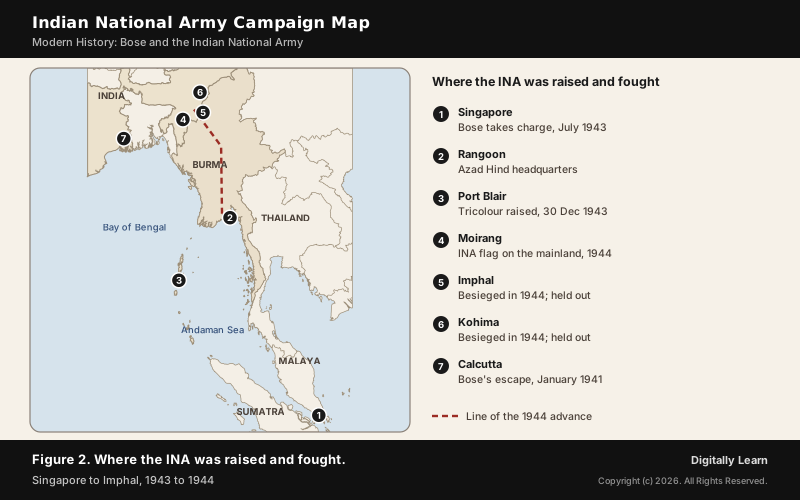
The Indian National Army (INA), or Azad Hind Fauj, was an army of Indian prisoners of war and Indians living in South-East Asia, raised with Japanese help during the Second World War to free India from British rule. Mohan Singh first organised it in Malaya in 1942; Subhas Chandra Bose revived it in Singapore in 1943. It fought at Imphal and Kohima in 1944, and the trials of its officers at the Red Fort in 1945 roused the whole country.
Subhas Chandra Bose and His Break with the Congress
Tripuri Crisis, the Forward Bloc and the 1939 War Debate
Subhas Chandra Bose was born on 23 January 1897 in Cuttack. He qualified in the first Indian Civil Service examination but chose nationalism over the service. By 1938 he was a leader of national stature and became Congress President. He stood for unqualified swaraj, including the use of force against the British, which set him against Gandhi.
In 1939 Bose was elected president again, defeating Gandhi's preferred candidate, Pattabhi Sitaramayya. Manoeuvres in the Congress Working Committee soon forced him to resign. On 22 June 1939 he organised the All India Forward Bloc, a faction within the Congress meant to consolidate the political left; its main strength was in Bengal.
When war broke out in 1939, the Congress split over what to do. A coalition of leftist groups, Bose and his Forward Bloc, the Congress Socialist Party, the Communist Party and the Royists, called it an imperialist war that gave an opportunity to win freedom through an all-out struggle. They urged the Congress to launch an immediate mass struggle, and Bose even proposed a parallel Congress to organise one.
- Gandhi’s view: The Allied cause was just, communal tension could turn a struggle into riots, the Congress organisation was in shambles, and the masses were not ready.
- His alternative: Tone up the organisation, carry on political work and negotiate until every chance of a settlement was exhausted.
- Ramgarh, March 1940: The Congress would resort to civil disobedience only when its organisation was fit or circumstances precipitated a crisis.
Bose organised protests in Calcutta for the removal of the Holwell Monument. He was jailed, released after a seven-day hunger strike, and his house was kept under watch by the CID.
Bose's Escape from India and the Road to South-East Asia, 1941 to 1943
Escape from Calcutta, Berlin and the Free India Legion
In January 1941 Bose slipped out of his Elgin Road house in Calcutta, disguised as a Pathan. He travelled through Peshawar and Kabul, reached Moscow on an Italian passport in the name of Count Orlando Mazzotta, and was flown on to Berlin.
- Azad Hind Radio: He broadcast to India on the German-sponsored station.
- Free India Centre: He set it up in Berlin.
- Indian Legion: He raised it from Indian prisoners of war captured in North Africa while fighting for the British; it is also called the Free India Legion.
- Hitler, May 1942: At their only meeting Hitler refused Bose’s requests and arranged a submarine voyage to East Asia instead.
In February 1943 Bose boarded a German submarine. Off Madagascar he was transferred to a Japanese submarine, the only civilian transfer between submarines of two navies in the war, and landed in Japanese-held Sumatra in May 1943. His meeting with the Japanese Premier, Tojo, on 10 June 1943 won him Japan's backing.
Indian National Army: Founding, Revival and the Azad Hind Government
Who Founded the Indian National Army? Mohan Singh and the First INA
The Indian National Army was founded by Mohan Singh, an officer of the British Indian Army who chose not to retreat with the British in Malaya and turned to the Japanese for help. The Japanese intelligence officer Iwaichi Fujiwara worked with him, and some accounts call the INA Fujiwara's brainchild. Subhas Chandra Bose did not found the INA; he revived and led it from 1943.
- Recruits: The Japanese handed Indian prisoners of war to Mohan Singh; after the fall of Singapore he brought 45,000 into his sphere of influence, and by the end of 1942 some 40,000 men were ready to join.
- First division: Formed in September 1942 with 16,300 men; the Quit India Movement gave the INA a fillip.
- Aims: It would act only on the invitation of the Congress and the people of India, and many saw it as a check on Japanese misconduct towards Indians.
- Break-up: The Japanese wanted a token force of 2,000; Mohan Singh wanted 2,00,000. The first INA was disbanded in December 1942 and Mohan Singh was taken into custody.
Bose Takes Command: Azad Hind Fauj, 'Dilli Chalo' and the Rani of Jhansi Regiment
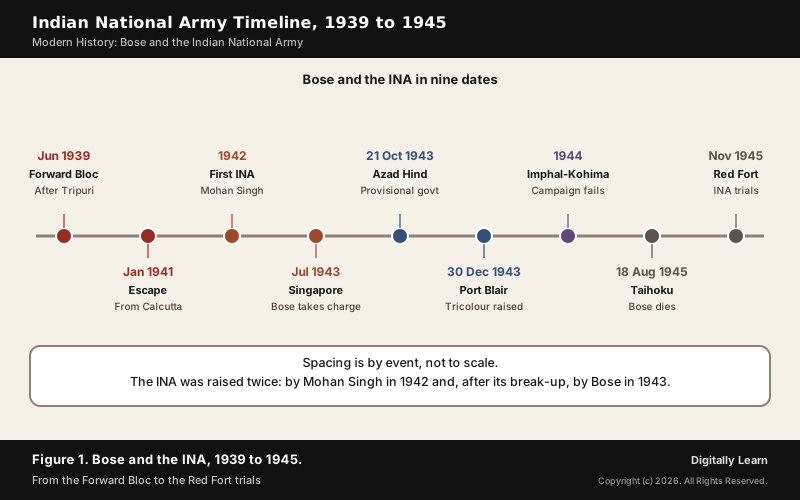
Bose reached Singapore in July 1943, where Rash Behari Bose handed over the Indian Independence League and the army to him. He renamed the INA the Azad Hind Fauj, the Army of Free India. Its strength rose to 30,000, with plans to recruit 20,000 more, largely from British Indian soldiers held as prisoners of war.
- Mass support: Indians living in South-East Asia enlisted and gave money in answer to Bose’s call for sacrifice.
- Slogans: ‘Dilli Chalo’ (On to Delhi) was the call Bose gave the INA’s soldiers; at a rally in Burma on 4 July 1944 Bose said, ‘Give me blood, and I shall give you freedom!’
- Rani of Jhansi Regiment: Announced on 12 July 1943 and named after Rani Lakshmi Bai, the women’s regiment was led by Captain Lakshmi Swaminathan, later Lakshmi Sahgal.
Provisional Government of Azad Hind, 21 October 1943
On 21 October 1943 Bose proclaimed the Provisional Government of Azad Hind in Singapore, with 11 ministers and eight representatives of the INA. Bose was Head of State, Prime Minister and Minister for War and Foreign Affairs, and Supreme Commander of the INA. The government had headquarters at Rangoon and Singapore, and it declared war on Britain and America in October 1943.
- Recognition: Nine Axis states recognised it, among them Germany, Japan, the Italian Social Republic, Croatia, Burma’s provisional government, Manchukuo and the Japanese-controlled Philippines.
- Attributes of a state: It produced its own currency, postage stamps, court and civil code.
- Andaman and Nicobar Islands: On 6 November 1943 Japan declared that the islands would be transferred to it; the islands were renamed Shaheed and Swaraj, though the Japanese Navy kept real control.
- Port Blair, 30 December 1943: During his visit of 29 to 31 December, Bose hoisted the tricolour, declaring the islands the first Indian territory freed from colonial rule.
Imphal-Kohima Campaign, Retreat and the Death of Bose
Imphal and Kohima Campaign of 1944
The INA's first major action was the Japanese offensive towards Manipur in 1944, code-named Operation U-Go. INA brigades named after Gandhi and Nehru fought beside Japanese divisions, and one battalion under Shah Nawaz Khan advanced towards Imphal and Kohima. A special unit took Moirang in early April, where the Indian tricolour was raised for the first time on the Indian mainland.
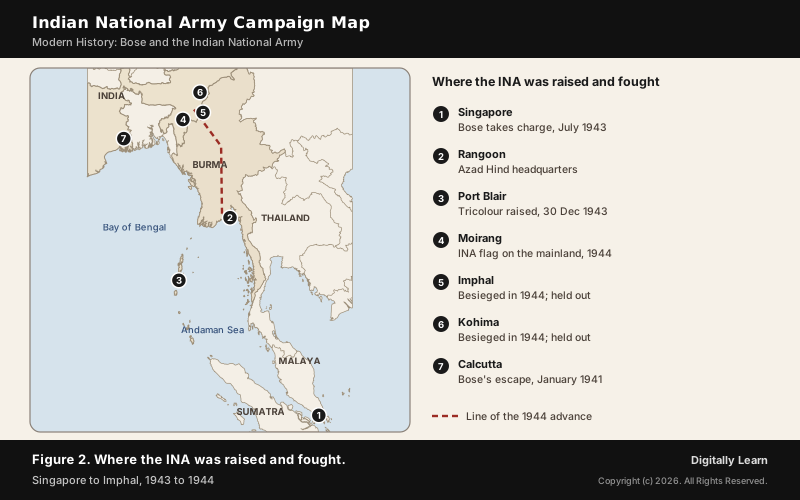
- The sieges failed: Commonwealth forces held Imphal and Kohima for months, then counter-attacked and drove the Japanese and the INA back into Burma.
- Japanese treatment: INA units were denied rations and arms and made to do menial work, which demoralised them.
- Losses: Fully half of the INA contingent that took part was killed.
- Collapse: After Rangoon fell in May 1945 the INA more or less ceased to exist; 16,000 of its 43,000 recruits were captured.
During the campaign, on 6 July 1944, Bose spoke on Azad Hind Radio from Singapore, called Gandhi the Father of the Nation and asked for his blessings for the war. It was the first time Gandhi was given that title.
Death of Subhas Chandra Bose in 1945 and the Inquiry Commissions
Subhas Chandra Bose died on 18 August 1945, aged 48, of third-degree burns after his plane crashed on take-off at Taihoku in Japanese-ruled Formosa, now Taiwan. His ashes are kept at the Renkoji Temple in Tokyo. Many of his supporters, especially in Bengal, refused to believe that he had died.
- Figgess Report, 1946: The Allied command in South-East Asia had Colonel John Figgess investigate the death; his report was submitted on 25 July 1946 and kept confidential.
- Shah Nawaz Committee, 1956: A three-member committee headed by Shah Nawaz Khan interviewed survivors of the crash.
- Khosla Commission, 1970: It agreed with the earlier findings on the main facts of the death.
- Mukherjee Commission, 1999 to 2005: Appointed after a court order, it rejected the crash account; its report was tabled in Parliament on 17 May 2006, and the Government rejected its findings.
INA Trials at the Red Fort, 1945 to 1946
INA Trials: Sahgal, Dhillon and Shah Nawaz Khan
The INA trials, also called the Red Fort trials, were courts-martial of INA officers held between November 1945 and May 1946. The British first planned public trials of several hundred prisoners and held the first at the Red Fort in Delhi in November 1945, putting in the dock together a Hindu, Prem Kumar Sehgal, a Muslim, Shah Nawaz Khan, and a Sikh, Gurbaksh Singh Dhillon.
- The charge: The three were charged with waging war against the King-Emperor, as well as murder and abetment of murder.
- The defence: The Congress declared its support for the INA cause, and Bhulabhai Desai, Tej Bahadur Sapru, Kailash Nath Katju, Jawaharlal Nehru and Asaf Ali defended the accused.
- The verdict: All three were sentenced to deportation for life, but public pressure forced the Commander-in-Chief, Claude Auchinleck, to release them.
- The slogan: ‘Laal quile se aayi aawaz, Sahgal, Dhillon, Shahnawaaz’ rang out across the country.
INA Agitation and the Upsurges of 1945 to 1946
The campaign for the release of INA prisoners was conducted with an intensity never seen before. The Viceroy's own phrase for the period was the edge of a volcano. The central question became Britain's right to decide a matter concerning Indians, so the issue took on an Indian versus British colour.
- INA Day and INA Week: INA Day fell on 12 November 1945, and INA Week ran from 5 to 11 November.
- Broad support: The Muslim League, the Communist Party, the Unionists, the Akalis, the Justice Party, the Rashtriya Swayamsevak Sangh, the Hindu Mahasabha and the Sikh League backed the INA cause alongside the Congress.
- Inside the Raj: Government employees collected funds, and men of the armed forces attended meetings, some in uniform.
| Date | Place | Upsurge |
|---|---|---|
| 21 November 1945 | Calcutta | Over the INA trials |
| 11 February 1946 | Calcutta | Against the seven-year sentence on INA officer Rashid Ali |
| 18 February 1946 | Bombay | Strike by the Royal Indian Navy ratings |
Gandhi and Bose Compared, and the Legacy of the INA
Gandhi and Bose: Differences in Their Approach to Freedom
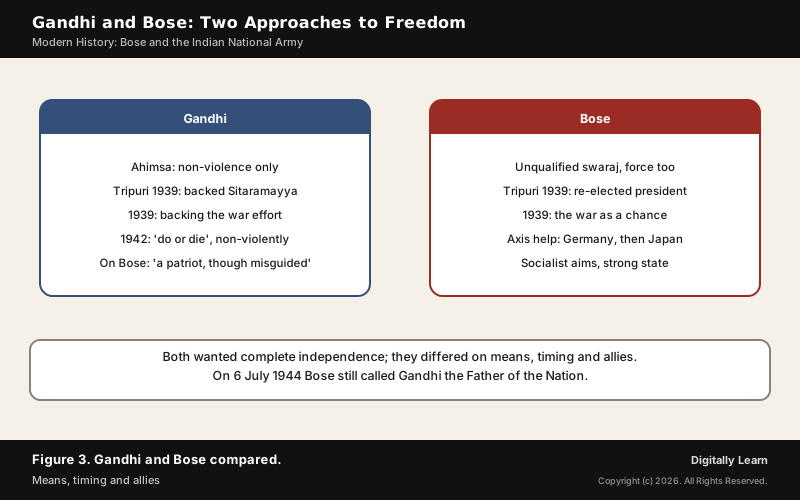
Gandhi and Bose shared the goal of complete independence and respected each other; Bose did not share Gandhi's ideal of ahimsa, but still honoured him as the Father of the Nation. They differed on means, timing and allies. Bose also wanted a socialist regime and a strong central government for some years after freedom.
| Question | Gandhi | Bose |
|---|---|---|
| Method | Non-violent mass struggle; in 1942 'do or die', but non-violently | Unqualified swaraj, including the use of force |
| The war of 1939 | Allied cause just; masses not ready; negotiate first | An imperialist war and an opportunity; strike at once |
| Allies | Saw the Allied cause as just | Sought help from Germany, then Japan |
| Party politics | Backed Pattabhi Sitaramayya at Tripuri | Re-elected president; formed the Forward Bloc |
| On each other | Called Bose 'a patriot, though misguided' | Called Gandhi the Father of the Nation |
Significance and Legacy of Bose and the Indian National Army
The INA did not free India by arms, and the Raj was never seriously threatened by it. Its larger effect came after the war. The trials turned the INA's cause into a national one and drew sympathy even from men of the armed forces, and the upsurges they set off prompted the British to extend some concessions.
- Remembering Netaji: The Government declared 23 January Parakram Diwas by a notification of January 2021, the 125th birth anniversary year.
- Islands: In 2018 Ross Island was renamed Netaji Subhas Chandra Bose Dweep, and Neil and Havelock became Shaheed and Swaraj Dweep.
- Memorials: A museum on Bose and the INA opened at the Red Fort in 2019, and a 28-foot granite statue of Netaji was unveiled at India Gate on 8 September 2022.
Previous Year UPSC-CSE Questions
Previous Year UPSC-CSE Questions By the end you will be able to draft model answers for the following UPSC questions. Each question carries a collapsible framework showing how to approach it in the exam.
- UPSC Mains 2016 GS-IHighlight the differences in the approach of Subhash Chandra Bose and Mahatma Gandhi in the struggle for freedom.
Answer outline: how to structure the answer
What the question asks, the main arguments, relevant examples and the direction of the conclusion. This is not a full model answer.
Introduction: Gandhi and Bose both sought complete independence but chose very different paths to it.
Body (sub-themes to develop):
- Method: ahimsa against unqualified swaraj with force.
- Timing in 1939: negotiate first against an immediate mass struggle.
- Allies: no outside help against Germany and Japan.
- Organisation: the Tripuri crisis and the Forward Bloc.
- Vision: socialist aims and a strong central state in Bose's thinking.
Conclusion: Conclude that the two streams were complementary: Bose called Gandhi the Father of the Nation in 1944.
- UPSC Prelims 2005 Prelims-GSWhich party was founded by Subhash Chandra Bose in the year 1939 after he broke away from the Congress?
How to approach this Prelims question
Approach: Step 1: in 1939 Bose won the Congress presidency again, was forced to resign, and on 22 June 1939 organised the All India Forward Bloc to consolidate the left. Step 2: the Azad Hind Fauj was the army he led from 1943, not a party, and the other two names are not parties he founded.
Trap to watch: The Azad Hind Fauj was the army of 1943, not a party.
Key facts to recall:
- (a) Indian Freedom Party: wrong. Bose founded no party of that name; his party of 1939 was the Forward Bloc.
- (b) Azad Hind Fauj: wrong. It was the army Bose led from 1943, not a party.
- (c) Revolutionary Front: wrong. No such party was founded by Bose.
- (d) Forward Bloc: correct. Bose organised it on 22 June 1939 after resigning as Congress President.
Answer signal: Forward Bloc: option (d).
- UPSC Prelims 2000 Prelims-GSThe Indian National Army (INA) came into existence in 1943 in
How to approach this Prelims question
Approach: Step 1: Mohan Singh first organised the INA in Malaya in 1942. Step 2: Bose reached Singapore in July 1943, took over the army from Rash Behari Bose, renamed it the Azad Hind Fauj and proclaimed the Provisional Government there on 21 October 1943.
Trap to watch: The first INA was conceived in Malaya in 1942; the question asks about 1943.
Key facts to recall:
- (a) Japan: wrong. Japan backed the INA, but the army of 1943 was formed in Singapore, not in Japan.
- (b) Burma: wrong. The INA later fought from Burma towards Imphal in 1944; it was not founded there.
- (c) Singapore: correct. Bose revived the INA and proclaimed Azad Hind in Singapore in 1943.
- (d) Malaya: wrong. Malaya saw Mohan Singh's first INA of 1942, not the army of 1943.
Answer signal: Singapore: option (c).
- UPSC Prelims 2008 Prelims-GSDuring the Indian Freedom Struggle, who of the following raised an army called ‘Free Indian Legion’?
How to approach this Prelims question
Approach: Step 1: before reaching South-East Asia, Bose raised the Free Indian Legion in Germany from Indian prisoners of war. Step 2: the other three are linked to other movements: Hardayal to the Ghadar Party, Rash Behari Bose to the Indian Independence League in South-East Asia, Savarkar to Abhinav Bharat.
Trap to watch: Rash Behari Bose led the Indian Independence League in East Asia, not the legion in Germany.
Key facts to recall:
- (a) Lala Hardayal: wrong. He was the ideologue of the Ghadar Party and died in March 1939, before the war.
- (b) Rashbehari Bose: wrong. He led the Indian Independence League in South-East Asia and handed the INA to Subhas Bose in 1943.
- (c) Subhas Chandra Bose: correct. He raised the Free Indian Legion in Germany before he led the INA.
- (d) V. D. Savarkar: wrong. He founded the revolutionary society Abhinav Bharat in 1904 and raised no army.
Answer signal: Subhas Chandra Bose: option (c).
- UPSC Prelims 2021 Prelims-GSIn the context of Colonial India, Shah Nawaz Khan, Prem Kumar Sehgal and Gurbaksh Singh Dhillon are remembered as
How to approach this Prelims question
Approach: Step 1: Shah Nawaz Khan, Prem Kumar Sehgal and Gurbaksh Singh Dhillon were INA officers tried together at the Red Fort in November 1945. Step 2: the trial roused the whole country and became one of the upsurges of 1945 and 1946.
Trap to watch: Shah Nawaz Khan later headed the 1956 committee, but he is remembered as an INA officer.
Key facts to recall:
- (a) Leaders of the Swadeshi and Boycott movement: wrong. That movement belongs to 1905 to 1908, decades earlier.
- (b) Members of the Interim Government of 1946: wrong. That government was formed of political leaders after the Cabinet Mission.
- (c) Members of the Drafting Committee: wrong. They were soldiers, not members of the Constituent Assembly.
- (d) Officers of the Indian National Army: correct. They were the three officers tried together at the Red Fort in 1945.
Answer signal: Officers of the INA: option (d).
- UPSC Prelims 1999 Prelims-GSWhich Indian nationalist leader looked upon a war between Germany and Britain as a god-sent opportunity which would enable Indians to exploit the situation to their advantage?
How to approach this Prelims question
Approach: Step 1: when the war broke out in 1939, a coalition of leftist groups led by Bose called it an imperialist war that gave an opportunity to win freedom through an all-out struggle. Step 2: Gandhi and the Congress leadership preferred to wait and negotiate.
Trap to watch: Nehru saw the war as imperialist but was against taking advantage of Britain's difficulties.
Key facts to recall:
- (a) C. Rajagopalachari: wrong. He did not lead the call for an all-out struggle; he later became the last Governor-General of India.
- (b) M. A. Jinnah: wrong. He led the Muslim League, which did not seek a struggle against Britain in the war.
- (c) Subhas Chandra Bose: correct. He led the left coalition that saw the war as the moment to strike.
- (d) Jawaharlal Nehru: wrong. The call for an immediate struggle came from the left coalition under Bose, not from Nehru.
Answer signal: Subhas Chandra Bose: option (c).
- UPSC Prelims 1998 Prelims-GSWhat is the correct sequence of the following events?
- I. The August Offer
- II. The I.N.A. trial
- III. The Quit India Movement
- IV. The Royal Indian Naval Ratings’ Revolt Select the correct answer using the codes given below:
How to approach this Prelims question
Approach: Step 1: date each event: the August Offer, August 1940; the Quit India Movement, August 1942; the INA trial, November 1945; the Royal Indian Navy revolt, February 1946. Step 2: the order is I, III, II, IV.
Trap to watch: The RIN revolt came after the INA trial, not before.
Key facts to recall:
- (a) I, III, II, IV: correct. 1940, 1942, November 1945, February 1946.
- (b) III, I, II, IV: wrong. The August Offer (1940) came before Quit India (1942).
- (c) I, III, IV, II: wrong. The INA trial (November 1945) came before the naval revolt (February 1946).
- (d) II, IV, I, III: wrong. It starts with the latest events and reverses the order.
Answer signal: I, III, II, IV: option (a).
Sources and Further Reading
- NCERT: Our Pasts III (Class VIII), The Making of the National Movement, 1870s to 1947
- NCERT: Politics in India since Independence (Class XII), India's External Relations
- PIB (Ministry of Culture): Anniversary of the formation of the Azad Hind Government, 2021
- PIB (Ministry of Culture): 23 January to be celebrated as Parakram Diwas, 2021
- PIB: Statue of Netaji Subhas Chandra Bose unveiled at India Gate, 2022
- Utsav (Ministry of Tourism): Commemoration of First Flag Hoisting by Netaji, Port Blair
- Odisha Review (Government of Odisha): Azad Hind Fauj, A Saga of Netaji, 2008
- Odisha Review (Government of Odisha): Re-Reading Netaji Subhas in the Context of the Imphal Expedition, 2016
- Wikipedia: Subhas Chandra Bose
- Wikipedia: Indian National Army
- Wikipedia: Indian National Army trials
- Wikipedia: Death of Subhas Chandra Bose
- Wikipedia: Rani of Jhansi Regiment
- UPSC: Previous year question papers
Editorial Disclaimer
This article explains Subhas Chandra Bose and the Indian National Army for UPSC preparation. Dates, figures and attributions reflect the cited sources.