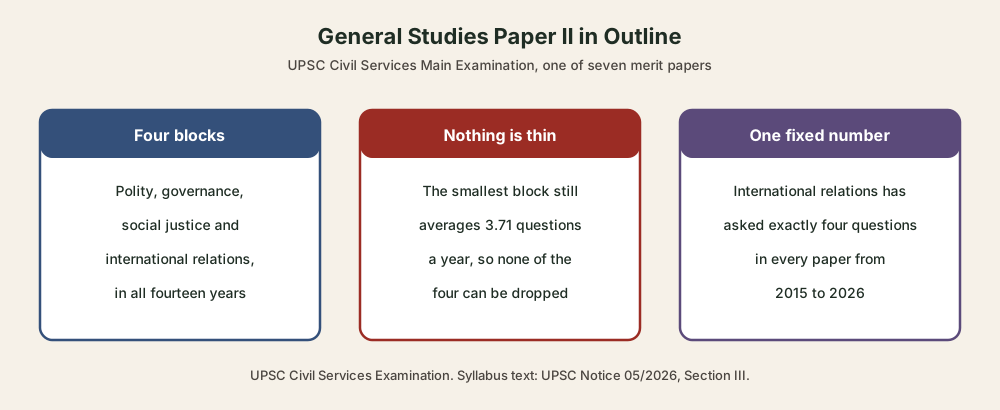
The GS 2 syllabus of UPSC Mains covers polity and the Constitution, governance, social justice and international relations in twenty topics. GS Paper 2 asks twenty compulsory questions for 250 marks in three hours. This guide gives the full syllabus and the subject-wise weightage of 285 questions from 2013 to 2026.
What Is GS Paper 2 in UPSC Mains? Pattern and Marks
GS Paper 2 at a Glance: 20 Questions, 250 Marks, Three Hours
General Studies Paper II, usually called GS 2 or GS2, is the paper on governance, the Constitution, polity, social justice and international relations. In the notice's own numbering it is Paper III of the Main Examination, because the Essay is Paper I and the four General Studies papers follow as Papers II to V. This page gives the full UPSC GS 2 syllabus and shows how much each part of it is actually asked.
- Questions: Twenty, all compulsory.
- Marks and words: Questions 1 to 10 carry 10 marks each with a 150-word limit; questions 11 to 20 carry 15 marks each with a 250-word limit.
- Total: 250 marks in three hours, one of the seven papers that count for the rank.
- Timing: About nine minutes an answer, including the time to read the question.
The Official GS Paper 2 Syllabus in Full
Twenty Syllabus Topics and the Four Subjects They Form
The notice sets out the GS 2 syllabus as twenty topics, reproduced below in its own words. There is no separate syllabus PDF for this paper; the text sits in Examination Notice 05/2026, Section III, which is itself a PDF.
- Indian Constitution: Historical underpinnings, evolution, features, amendments, significant provisions and basic structure.
- Functions and responsibilities of the Union and the States, issues and challenges pertaining to the federal structure, devolution of powers and finances up to local levels and challenges therein.
- Separation of powers between various organs dispute redressal mechanisms and institutions.
- Comparison of the Indian constitutional scheme with that of other countries.
- Parliament and State legislatures: Structure, functioning, conduct of business, powers & privileges and issues arising out of these.
- Structure, organization and functioning of the Executive and the Judiciary: Ministries and Departments of the Government; pressure groups and formal/informal associations and their role in the Polity.
- Salient features of the Representation of People's Act.
- Appointment to various Constitutional posts, powers, functions and responsibilities of various Constitutional Bodies.
- Statutory, regulatory and various quasi-judicial bodies.
- Government policies and interventions for development in various sectors and issues arising out of their design and implementation.
- Development processes and the development industry: the role of NGOs, SHGs, various groups and associations, donors, charities, institutional and other stakeholders.
- Welfare schemes for vulnerable sections of the population by the Centre and States and the performance of these schemes; mechanisms, laws, institutions and Bodies constituted for the protection and betterment of these vulnerable sections.
- Issues relating to development and management of Social Sector/Services relating to Health, Education, Human Resources.
- Issues relating to poverty and hunger.
- Important aspects of governance, transparency and accountability, e-governance- applications, models, successes, limitations, and potential; citizens charters, transparency & accountability and institutional and other measures.
- Role of civil services in a democracy.
- India and its neighborhood- relations.
- Bilateral, regional and global groupings and agreements involving India and/or affecting India's interests.
- Effect of policies and politics of developed and developing countries on India's interests, Indian diaspora.
- Important International institutions, agencies and fora- their structure, mandate.
The twenty topics fall into four subjects, and the rest of this page follows them:
- Polity and the Constitution: Topics 1 to 9 (nine topics).
- Governance: Topics 10, 11, 15 and 16 (four topics).
- Social justice: Topics 12 to 14 (three topics).
- International relations: Topics 17 to 20 (four topics).
GS 2 Syllabus Weightage: What Previous Year Questions Show
Questions by Subject, 2013 to 2026
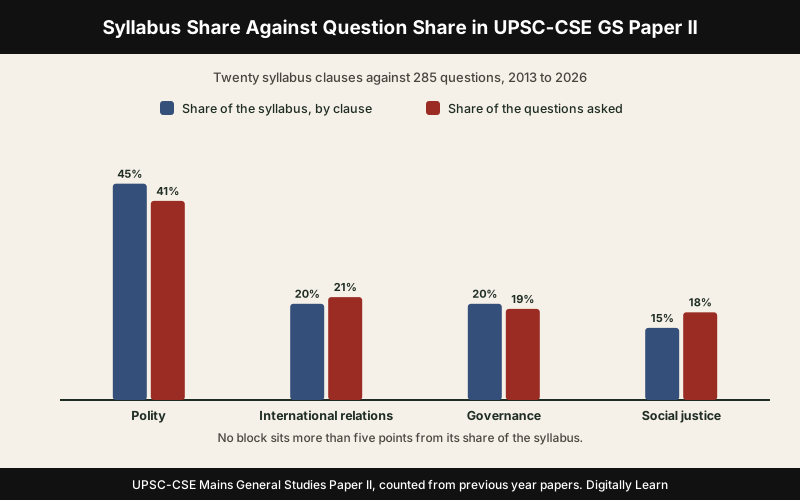
All 285 questions of the 14 GS Paper 2 papers from 2013 to 2026 are sorted here by subject, one subject per question, and every subject has appeared in every paper. Polity holds nine of the twenty topics and has produced 41 per cent of the questions; the other three subjects each hold three or four topics and produce about a fifth each.
| Subject | Questions (share) | A year, then to now |
|---|---|---|
| Polity and the Constitution (9 of 20 topics) | 118 (41%) | 6.75 to 9.25 |
| International relations (4 of 20 topics) | 61 (21%) | 5.25 to 4.00 |
| Governance (4 of 20 topics) | 54 (19%) | 5.75 to 3.25 |
| Social justice (3 of 20 topics) | 52 (18%) | 3.50 to 3.50 |
Polity Has Grown to Nearly Half of GS Paper 2
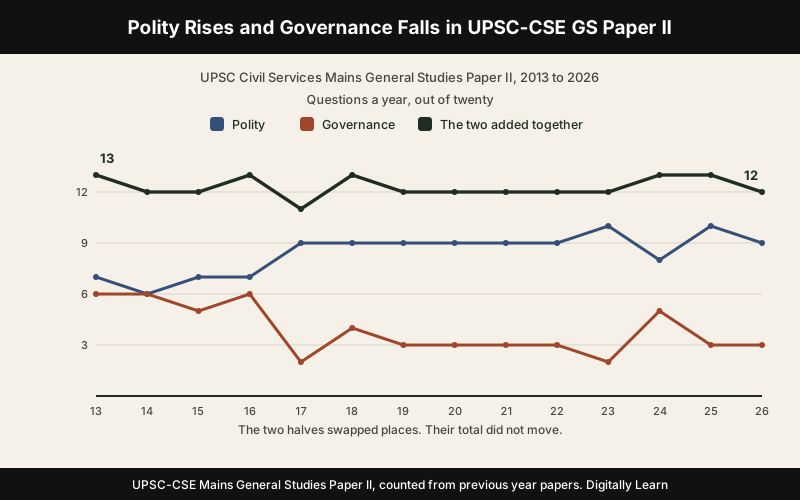
Polity has risen from 6.75 questions a year in 2013 to 2016 to 9.25 in the last four papers, close to half the paper. Over the same years governance fell from 5.75 to 3.25. Added together the two have stayed at exactly 12.5 questions a year, so the paper has not grown more political overall; the weight has moved inside that half.
International Relations: Four Questions in Every Paper Since 2015
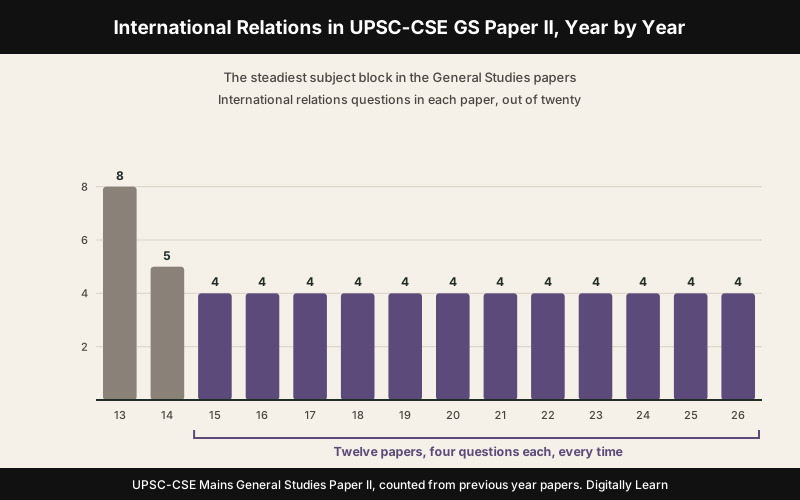
The international relations subject has asked exactly four questions in each of the last twelve papers, from 2015 to 2026, and averages 4.36 a year over the whole period. No other subject in GS Papers 1 to 3 has held one count for so long; the next longest run is six papers, for the economy in GS Paper 3.
GS Paper 2 Syllabus Subject by Subject
Polity and the Constitution: Nine Topics, the Largest Subject
The nine polity topics run from the Constitution's history, features, amendments and basic structure, through federalism and the devolution of powers and finances, separation of powers, comparison with other constitutions, Parliament and state legislatures, the executive and judiciary, and the Representation of the People Act, to constitutional posts and bodies and statutory, regulatory and quasi-judicial bodies. Recent questions ask how an office or a provision works in practice, and often compare India with another country.
- Constitution and amendments: Features, the basic structure and how amendments are made (asked in 2025).
- Federalism: Centre-state relations, the Governor's role and fiscal federalism (asked in 2025 and 2026).
- Parliament and legislatures: Powers, privileges, the Speaker and the anti-defection law (asked in 2026).
- Judiciary: Appointments, the collegium, judicial review and judge-made law (asked in 2025 and 2026).
- Elections and bodies: The Representation of the People Act, the Election Commission and constitutional and statutory bodies (asked in 2025 and 2026).
Build the base from the Constitution itself and NCERT's Class XI text, then follow Supreme Court judgments and the working of constitutional bodies. Comparative questions, such as India against the United States on pardons or the separation of powers, need a few clear points of contrast rather than a survey.
Governance: Policy Design, Civil Society, Transparency and the Civil Services
The four governance topics cover government policies and the issues in their design and implementation; the role of NGOs, self-help groups and other stakeholders in development; transparency and accountability, e-governance and citizens' charters; and the role of the civil services in a democracy. Questions are usually evaluative: they ask whether an arrangement works and what would make it work better.
- Policy design and delivery: Why schemes succeed or fail between design and implementation.
- Civil society: NGOs, self-help groups and civil society organisations, and their relationship with the state.
- Transparency and e-governance: Accountability tools, citizens' charters and the limits of technology-led projects.
- Civil services: Their role in a democracy, and debates on the generalist structure and reform.
The reports of the Second Administrative Reforms Commission are a standard source, alongside current debates on civil services reform. Keep examples of e-governance that succeeded and failed, since questions now ask for both.
Social Justice: Welfare Schemes, Health, Education, Poverty and Hunger
The three social justice topics cover welfare schemes for vulnerable sections and the institutions that protect them; health, education and human resources; and poverty and hunger. In this paper it is the steadiest subject after international relations, at 3.50 questions a year in the first four papers and 3.50 in the last four.
- Vulnerable sections: Schemes and protective bodies for women, children, Scheduled Castes and Scheduled Tribes.
- Health and nutrition: Malnutrition as a question of equity as well as health (asked in 2026).
- Education and human resources: Education as welfare and as investment (asked in 2026).
- Poverty and inequality: Ownership of resources and the paradox of poverty (asked in 2025).
Questions often frame a welfare issue as a question of equity and governance, not only of health or schooling. Pair each scheme you study with the body that oversees it, such as the national commissions for children, women, Scheduled Castes and Scheduled Tribes.
International Relations: Neighbours, Groupings, Diaspora and Global Institutions
The four international relations topics are India and its neighbourhood; bilateral, regional and global groupings and agreements; the effect of other countries' policies on India's interests, and the Indian diaspora; and important international institutions, their structure and mandate. Recent papers pair a grouping or an institution with India's interests, and often open with a quoted claim to be examined.
- Neighbourhood: Each neighbour, and China's Belt and Road Initiative in South Asia (asked in 2026).
- Groupings: BRICS, the Quad and regional groupings, with India's aims in each (asked in 2026).
- India's interests abroad: Energy security and West Asia, Africa, and the diaspora (asked in 2025 and 2026).
- Global institutions: The United Nations and its reform, and other bodies' structure and mandate (asked in 2025).
Read the Ministry of External Affairs briefs on each neighbour and grouping, and keep a short note on India's position in BRICS, the Quad and the United Nations reform debate. For Indo-Pacific maritime questions, see the guide to maritime security and piracy.
How GS 2 Questions Are Framed
Directive Words and What Each Word Limit Allows
Discuss is the commonest instruction, in 93 of the 285 questions, followed by examine (38), explain (28) and critically (25). Critically appears more often here than in GS Paper 3 (15 times there), which fits a paper about institutions: it asks you to weigh strengths against weaknesses and reach a judgement.
| Directive | Questions containing it |
|---|---|
| Discuss | 93 |
| Examine | 38 |
| Explain | 28 |
| Critically | 25 |
| Comment | 20 |
| Suggest | 13 |
| Evaluate | 12 |
| Analyse | 10 |
- 150 words (10 marks): A one-line context, three developed points and a close. A polity question usually wants the provision, how it works in practice, and one issue.
- 250 words (15 marks): Room for both sides, a judgment or report as evidence, and a way forward.
- Quoted claims: Many questions open with a quotation to be examined. Say whether it holds, and why, before adding detail.
How to Prepare for GS Paper 2
Preparing the Four Subjects in Proportion
Of GS Papers 1 to 3, this is the one whose syllabus best matches its questions: no subject here is more than 3.6 points from its share of the topics, against 6.6 in GS Paper 3 and 12.1 for geography in GS Paper 1. That makes the plan simple.
- Polity first: Nine topics and close to half the recent questions; the Constitution, landmark judgments and constitutional bodies come first.
- International relations to a fixed target: Four questions every paper; prepare India's neighbours, the main groupings and the key institutions.
- Governance with polity: Prepare them together, since questions move between the two.
- Social justice through schemes and institutions: Link every scheme to the body that oversees it and to its results.
Where Current Affairs Matter Most in GS 2
Polity and international relations move fastest: judgments, amendments, elections, summits and new agreements often become questions within a year or two. Governance and social justice change through new schemes and reports, and a settled base of the main institutions carries most of their questions.
The Study Library is organised by these subjects, and the other Mains papers feed this one: GS Paper 4 for the ethics of public office, GS Paper 3 for the economy behind welfare and federal finance, and the Essay paper for writing at length.
Common Questions About the UPSC GS 2 Syllabus
What is the syllabus of GS Paper 2 in UPSC Mains?
The GS2 syllabus has twenty topics in four subjects: polity and the Constitution, governance, social justice and international relations. The full text is in the Commission's examination notice and is reproduced on this page.
How many questions come in UPSC Mains GS Paper 2?
Twenty, all compulsory: ten of 10 marks with a 150-word limit and ten of 15 marks with a 250-word limit, for 250 marks in three hours.
Which subject has the most weightage in GS 2?
Polity, with 118 of 285 questions from 2013 to 2026 and about 9 a year in the last four papers. International relations has asked exactly four questions in every paper since 2015.
Is there a GS 2 syllabus PDF?
Not as a separate file. The syllabus is part of the Commission's examination notice, which is published as a PDF each year; the 2026 notice is linked in the sources below.
Official Sources
- Union Public Service Commission: Examination Notice No. 05/2026-CSE, Civil Services Examination 2026
- Union Public Service Commission: Civil Services (Main) Examination 2026, General Studies Paper II question paper
- Union Public Service Commission: Civil Services (Main) Examination 2025, General Studies Paper II question paper
- Union Public Service Commission: previous years' question papers
- Legislative Department, Ministry of Law and Justice: The Constitution of India
- Ministry of External Affairs: bilateral and multilateral relations documents
- Union Public Service Commission: Civil Services Examination 2025, minimum qualifying marks
- Union Public Service Commission: online registration and application portal
- National Council of Educational Research and Training: Class XI Indian Constitution at Work and Class XII Politics in India since Independence
- Wikipedia: Civil Services Examination
Editorial Disclaimer
The syllabus is reproduced from the current examination notice of the Commission, with its dashes replaced by commas for readability. Sorting past questions by subject is Digitally Learn's own reading and is not published by the Commission. The notice in the Gazette of India is the final authority.