


Overview
The Regulating Act of 1773 was the first step taken by the British Parliament to control and regulate the affairs of the East India Company in India. Over the next 85 years Parliament turned a trading company into an agent of the British state and then removed it from government. The Government of India Act of 1858 placed India directly under the Crown. Together these Acts built the colonial constitutional framework through which Britain governed India.
Company Rule in Bengal and the Need for Parliamentary Control
Diwani of 1765, Dual Government and the Company's Crisis of 1773
The Company became a territorial power when the Mughal emperor granted it the Diwani, the right to collect and administer the revenues of Bengal, Bihar and Orissa (now Odisha), in 1765. Under the dual government that followed, the Company collected the revenue while the Nawab retained administrative control, so that power and responsibility lay in different hands. The Company's servants enriched themselves through private trade, revenue was extracted harshly, and the Company itself slid towards bankruptcy.
The human cost was severe. In the famine of 1770 to 1772, harsh revenue demands imposed on top of two years of crop failure killed nearly one-third of Bengal's population, an estimated 1 crore people. By 1773 the Company was also in deep financial trouble; it owed money to both the Bank of England and the government and asked the government for a loan. A private company that ruled millions, mismanaged them and then sought public money gave Parliament both the reason and the opening to step in. Lord North's government answered with the Regulating Act.
The Regulating Act of 1773: Provisions, Defects and the Amending Act of 1781
Governor-General of Bengal, Council of Four and the Supreme Court at Calcutta
The Act recognised, for the first time, that the Company had political and administrative functions, and it laid the foundation of a central administration. Its main provisions were these:
- New office: The Governor of Bengal became the Governor-General of Bengal, and Warren Hastings was named as the first holder of the office.
- Council of Four: An executive council of four members, named in the Act as John Clavering, George Monson, Richard Barwell and Philip Francis, was to govern with him; decisions went by majority, and the Governor-General had only a casting vote in a tie.
- Control over the other presidencies: The governors of Bombay and Madras were made subordinate to the Governor-General of Bengal, whereas the three presidencies had earlier been independent of one another.
- Supreme Court at Calcutta: A Supreme Court of Judicature was set up at Fort William in Calcutta in 1774, with one chief justice and three other judges; Sir Elijah Impey was its first Chief Justice.
- Conduct of Company servants: Servants of the Company were forbidden to engage in private trade or to accept presents or bribes from Indians.
- Reporting to the British Government: The Court of Directors, the Company's governing body in London, had to report on the Company's revenue, civil and military affairs in India.
- Court of Directors: Directors were now elected for four years instead of one year.
The Act did not take the government of India away from the Company. It only regulated how the Company governed, which is why it is called a "regulating" Act.
Defects of the Regulating Act and the Amending Act of 1781
The Regulating Act soon showed its weaknesses. The Governor-General had no veto, so the three councillors who opposed Warren Hastings (Clavering, Monson and Francis) could outvote him, and their quarrel with him began soon after they reached Calcutta in October 1774. The bitterness came to a head in the case of Maharaja Nandakumar, who accused Hastings of corruption and was then tried for forgery before the Supreme Court and hanged in 1775.
The Act also left the Supreme Court's jurisdiction undefined. The Court claimed authority over every person living in Bengal, Bihar and Orissa, and this clashed with the powers of the Governor-General in Council. The Governor-General's authority over Bombay and Madras was just as vague and caused many disputes.
Parliament answered the jurisdiction quarrel with the Amending Act of 1781, also known as the Act of Settlement. It made these changes:
- Limited jurisdiction: The Supreme Court's jurisdiction was restricted to the residents of Calcutta and to British subjects in Bengal, Bihar and Orissa.
- Personal law: Within Calcutta, the Court was to apply the personal law of the defendant.
- Official acts: Servants of the government were immune for acts done while discharging their duties.
- Social and religious usages: The social and religious usages of the people were to be respected.
Pitt's India Act of 1784 and the Act of 1786
Board of Control and the System of Dual Control
Pitt's India Act of 1784, introduced in Parliament by the Prime Minister, William Pitt the Younger, set out to remove the defects of the Regulating Act. It drew a line between the Company's commercial and political functions. The Court of Directors kept the management of commerce, while a new body, the Board of Control, was to "superintend, direct and control" the civil and military government and the revenues of the Company's possessions. This arrangement is known as dual control, or double government, and it lasted until 1858.
The Board of Control consisted of not more than six Privy Counsellors, among them a Secretary of State and the Chancellor of the Exchequer, and its President soon became, in effect, the minister in charge of the Company's affairs. In India the Act reduced the Governor-General's council to three members, one of whom was the Commander-in-Chief, and the Governor-General kept his casting vote in a tie. The presidencies of Bombay and Madras were placed firmly under the Governor-General.
Pitt's India Act also changed the Company's standing. The Company's territories in India were called the "British possessions in India" for the first time, and the British Government gained supreme control over the Company's affairs and its administration in India. The Act also declared that schemes of conquest and extension of dominion in India were repugnant to the wish, the honour and the policy of the British nation, a principle that later Governors-General often set aside.

| Feature | Board of Control | Court of Directors |
|---|---|---|
| Represented | The British Government | The East India Company |
| Members | Not more than six Privy Counsellors | 24 directors |
| Main charge | Political, civil, military and revenue affairs | Commerce and appointments |
| Abolished | 1858 | 1858 |
Act of 1786: Cornwallis and the Power to Override the Council
Lord Cornwallis accepted the office of Governor-General on his own terms. He had insisted on holding the supreme military command in addition to civil control, and in February 1786 he was appointed both Governor-General and Commander-in-Chief. The Act of 1786 allowed him to override the decision of his council, provided he took responsibility for the decision himself.
This power was later extended to every Governor-General, and the Charter Act of 1793 confirmed it. With the override and the military command in one person's hands, the Governor-General became the real head of the Company's government in India, a position Cornwallis used to carry out his reforms of the civil service, the courts and land revenue.
The Charter Acts of 1793, 1813, 1833 and 1853
Charter Renewals and the Charter Act of 1793
The Charter Acts were the four Acts by which the British Parliament renewed the East India Company's charter in 1793, 1813, 1833 and 1853. The first three each extended the Company's rule for 20 years; the last named no period at all. Each renewal gave Parliament the chance to change the terms on which the Company traded and governed, and the renewals of 1813 and 1833 took away the Company's trade while the Governor-General's power grew.
The Charter Act of 1793 renewed the Company's charter and its trade monopoly for a further 20 years, with only modest changes to the system of government. The salaries of the members and staff of the Board of Control in London were now to be paid out of Indian revenues, since they were treated as officials of a government rather than as servants of a merchant company. The Governor-General's power to overrule his council, first given to Cornwallis, was confirmed for all his successors, and his authority over Madras and Bombay was strengthened.
The Act also required royal approval for the appointment of the Governor-General, the governors and the Commander-in-Chief. The higher posts were reserved for the covenanted servants of the Company, which in practice shut Indians out of the higher services.
Charter Act of 1813: End of the Trade Monopoly and Crown Sovereignty
The Charter Act of 1813 ended the Company's monopoly of trade with India, although the Company kept its monopoly of the trade in tea and the trade with China. British business interests had pressed for this change, moved by the spirit of laissez-faire and by Napoleon's Continental System, which had closed European ports to Britain. After 1813 British factory-made textiles entered the Indian market and took away much of the home market of Indian handloom weavers.
The Act renewed the Company's hold over its territories and revenue for 20 more years, "without prejudice" to the sovereignty of the Crown. It thus asserted, for the first time, the Crown's sovereignty over the Company's territories in India. The Board of Control's powers were further enlarged. The Act also provided:
- Education: A sum of one lakh rupees a year was set aside for the revival and promotion of literature and the encouragement of learning and science among Indians, an important early statement of the state's responsibility for education.
- Missionaries: Christian missionaries were permitted to enter India and preach.
- Church: The Bishop of Calcutta was given authority over the Anglican Church in India.
Charter Act of 1833: Governor-General of India and the Centralisation of Law-Making
The Charter Act of 1833 was the final step towards centralisation in British India. It renamed the Governor-General of Bengal the Governor-General of India, with power over all civil and military affairs, and for the first time the government he headed was called the Government of India. Lord William Bentinck became the first Governor-General of India. The Act ended the Company's monopoly of the China and tea trade, so that the Company ceased to be a commercial body and became a purely administrative one, holding its territories "in trust for His Majesty".
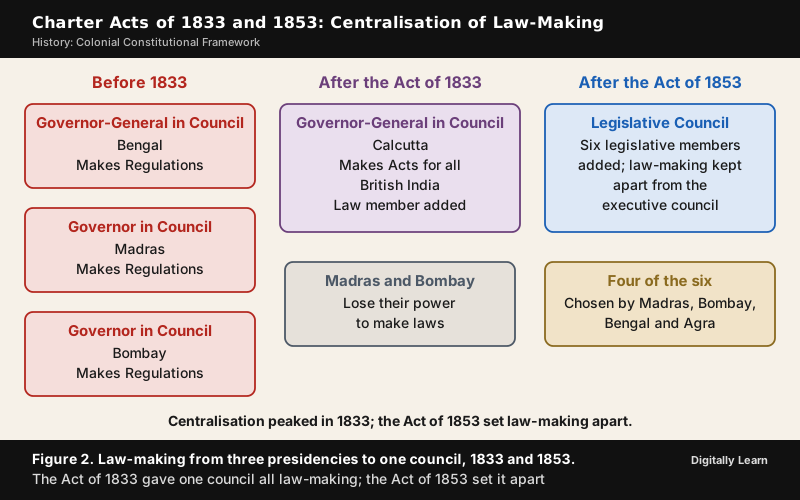
The Act concentrated law-making in a single authority. The governors of Bombay and Madras lost their legislative powers, and the Governor-General in Council received exclusive legislative power for the whole of British India. Laws made earlier had been called Regulations; laws made under this Act were called Acts. A law member was added to the Governor-General's council, and Thomas Babington Macaulay was the first to hold the office. The Act also provided for the codification and consolidation of Indian laws. The First Law Commission, with Macaulay as its chairman, produced a draft Penal Code in 1837, which later became the Indian Penal Code of 1860.
Its other provisions were these:
- Employment: No Indian was to be denied any place, office or employment under the Company by reason of religion, place of birth, descent or colour, although in practice the higher posts stayed in British hands.
- Open competition: The Act tried to introduce open competition for the selection of civil servants, but the provision was dropped after the Court of Directors opposed it.
- Slavery: The government was directed to improve the condition of slaves and to end slavery, which was abolished in 1843.
- European settlement: Restrictions on European immigration and on the purchase of property in India were lifted.
When short titles were given to older Acts in 1896, this one was named the Government of India Act 1833. In 1948 it was retitled the Saint Helena Act 1833, because almost all of it had been repealed except the provision that transferred the island of Saint Helena from the Company to the Crown.
Charter Act of 1853: Legislative Council and Open Competition for the Civil Service
The Charter Act of 1853 was the last of the Charter Acts. It renewed the Company's rule but, unlike the earlier charters, set no period for it, a clear sign that Parliament could end Company rule whenever it chose. The number of directors in the Court of Directors was reduced to 18.
For the first time, the Act separated the legislative and executive functions of the Governor-General's council. Six new members, called legislative councillors, were added to the council when it sat to make laws, and four of them were appointed by the local governments of Madras, Bombay, Bengal and Agra. This enlarged body came to be known as the Indian (Central) Legislative Council, and it worked like a small parliament, adopting procedures modelled on those of the British Parliament. The law member became a full member of the executive council.
The Act also ended the directors' patronage over appointments to the covenanted civil service. Until 1853 the directors had nominated civil servants, who were trained at the East India College at Haileybury in England. Henceforth recruitment was to be through open competition, and the service was in principle opened to Indians. A committee under Macaulay was appointed in 1854, a Civil Service Commission was set up in London the same year, and the first competitive examinations were held in 1855. The examination was held only in London, with a maximum age of 23 and a syllabus in which European classics carried most of the marks, and this made it very difficult for Indian candidates to succeed.
Government of India Act of 1858: From Company Rule to the Crown
Secretary of State, Council of India and the Viceroy
The Government of India Act of 1858, passed on 2 August 1858 in the wake of the Revolt of 1857, ended the rule of the East India Company. It transferred the Company's powers of government, its territories and its revenues to the British Crown, and India was henceforth governed by, and in the name of, the Queen. The system of double government ended, since both the Board of Control and the Court of Directors were abolished. The Company's property, its army and its responsibilities under treaties and contracts passed to the Crown.
The Act set up a new chain of command:
- Secretary of State for India: A member of the British cabinet, answerable to Parliament, received the powers and duties of the Court of Directors and complete authority over Indian administration; Edward Stanley, later the 15th Earl of Derby, was the first to hold the office.
- Council of India: A council of 15 members in London advised the Secretary of State, who chaired it and kept the final decision; the Secretary of State-in-Council was made a body corporate that could sue and be sued in India and in England.
- Viceroy: The Governor-General, now appointed by the Crown, was also styled Viceroy as the Crown's direct representative in India, and Lord Canning, the Governor-General at the time, became the first Viceroy.
- Civil service: The Indian Civil Service was placed under the control of the Secretary of State.
The change of 1858 was more a change of master in London than of government in India. The Act improved the machinery by which the Indian government was supervised from England, but it did not substantially alter the system that worked inside India. The Company itself lingered without any governing role until it was formally dissolved on 1 June 1874. In November 1858 Queen Victoria's proclamation announced the end of Company rule and promised non-interference in religious matters and a greater place for Indians in the administration.

Parliamentary Control and Centralisation from 1773 to 1858
Three Trends That Run Through the Acts
The Acts from 1773 to 1858 are easiest to remember as three lines of change that ran side by side.
- London's control grew: The Regulating Act made the directors report to the British Government, Pitt's India Act gave the Board of Control supreme control over political affairs, the 1813 Act asserted the Crown's sovereignty, and the 1858 Act removed the Company altogether.
- The Company's trade shrank: The Company lost its monopoly of trade with India in 1813 and all its remaining trade in 1833, after which it was only an administrator holding India in trust for the Crown.
- Central power grew: The Governor-General of Bengal gained authority over Bombay and Madras in 1773 and the right to override his council from 1786, and in 1833 he became the Governor-General of India with sole power to make laws for all British India.
Indians had no share in any of this. The Act of 1833 declared that no Indian should be barred from office by religion, birth, descent or colour, and the Act of 1853 opened the civil service to competition, but the higher posts of the covenanted civil service stayed with British civil servants.
The first change came after the Revolt of 1857. The Indian Councils Act of 1861 allowed the Viceroy to nominate some Indians to his legislative council and restored legislative powers to Bombay and Madras, reversing the centralising tendency that began with the Regulating Act and reached its climax in 1833.
The Supreme Court at Calcutta, set up under the Regulating Act, gave way to the High Court of Judicature at Fort William, opened on 1 July 1862.
| Act | Year | Governing structure it created or changed | The Company's trade |
|---|---|---|---|
| Regulating Act | 1773 | Governor-General of Bengal with a council of four; Supreme Court at Calcutta | Monopoly kept |
| Amending Act (Act of Settlement) | 1781 | Supreme Court's jurisdiction limited | Monopoly kept |
| Pitt's India Act | 1784 | Board of Control; dual control; council of three | Monopoly kept; commerce left to the directors |
| Act of 1786 | 1786 | Governor-General may override his council | Monopoly kept |
| Charter Act | 1793 | Charter renewed for 20 years; Board's salaries paid from Indian revenue | Monopoly renewed for 20 years |
| 1813 | Crown sovereignty asserted; one lakh rupees a year for education | Monopoly of trade with India ended; tea and China trade kept | |
| 1833 | Governor-General of India; sole law-making power; law member | All trade ended; Company purely administrative | |
| 1853 | Legislative functions separated; six legislative members; open competition | No trade | |
| Government of India Act | 1858 | Crown rule; Secretary of State; Council of India; Viceroy | No trade |
Previous Year UPSC‑CSE Questions
Each question is explained option by option.
- UPSC Prelims 2023By which one of the following Acts was the Governor General of Bengal designated as the Governor General of India?
How to approach this Prelims question
Approach: Trace the title of the office through the Acts in order. The Regulating Act of 1773 created the title Governor-General of Bengal. Pitt's India Act of 1784 created the Board of Control and did not change the title. The Charter Act of 1793 renewed the charter and kept the title. The Charter Act of 1833 renamed the office Governor-General of India.
Trap to watch: The Regulating Act is the best-known of the four, but it created the Governor-General of Bengal, not of India.
Why each option is right or wrong:
- (a) The Regulating Act: Wrong. It created the office of Governor-General of Bengal in 1773.
- (b) The Pitt's India Act: Wrong. It set up the Board of Control in 1784 and left the title unchanged.
- (c) The Charter Act of 1793: Wrong. It renewed the charter for 20 years and confirmed the Governor-General's power to overrule his council, but kept the Bengal title.
- (d) The Charter Act of 1833: Correct. It renamed the Governor-General of Bengal as the Governor-General of India.
Answer: (d) The Charter Act of 1833. It renamed the Governor-General of Bengal the Governor-General of India.
- UPSC Prelims 2019Consider the following statements about 'the Charter Act of 1813':
- It ended the trade monopoly of the East India Company in India except for trade in tea and trade with China.
- It asserted the sovereignty of the British Crown over the Indian territories held by the Company.
- The revenues of India were now controlled by the British Parliament.
Which of the statements given above are correct?
How to approach this Prelims question
Approach: Test each statement against what the Act of 1813 changed and what it left with the Company.
- Statement 1: The Act ended the monopoly of trade with India but kept the tea and China trade with the Company; correct.
- Statement 2: It renewed the Company's hold "without prejudice" to the Crown's sovereignty, the first assertion of that sovereignty; correct.
- Statement 3: The Company kept the possession of its territories and their revenue for 20 more years, and the revenues passed to the Crown only in 1858; wrong.
Trap to watch: The Act enlarged the Board of Control's powers, which tempts students to read statement 3 as true, but the Board supervised the Company; it did not take the revenues away from it.
Why each option is right or wrong:
- (a) 1 and 2 only: Correct. The Act ended the monopoly except for tea and China and asserted the Crown's sovereignty, while revenue stayed with the Company.
- (b) 2 and 3 only: Wrong. Statement 3 is wrong, and statement 1 is correct.
- (c) 1 and 3 only: Wrong. Statement 3 is wrong, and statement 2 is correct.
- (d) 1, 2 and 3: Wrong. Indian revenues came under the Crown only with the Act of 1858.
Answer: (a) 1 and 2 only. The Act of 1813 ended the monopoly except tea and China and asserted Crown sovereignty, but the revenues stayed with the Company until 1858.
- UPSC Prelims 2007Consider the following statements:
- Robert Clive was the first Governor-General of Bengal.
- William Bentinck was the first Governor-General of India.
Which of the statements given above is/are correct?
How to approach this Prelims question
Approach: Match each office to the Act that created it and its first holder.
- Statement 1: The Regulating Act of 1773 created the office of Governor-General of Bengal and named Warren Hastings to it; Clive had been Governor of Bengal before that; wrong.
- Statement 2: The Charter Act of 1833 renamed the office Governor-General of India, and Bentinck was its first holder; correct.
Trap to watch: Clive founded British power in Bengal and was its Governor, so his name feels right for statement 1, but the office of Governor-General did not exist in his time.
Why each option is right or wrong:
- (a) 1 only: Wrong. Statement 1 is wrong, because Warren Hastings, not Clive, was the first Governor-General of Bengal.
- (b) 2 only: Correct. Bentinck became the first Governor-General of India under the Charter Act of 1833.
- (c) Both 1 and 2: Wrong. Statement 1 is wrong.
- (d) Neither 1 nor 2: Wrong. Statement 2 is correct.
Answer: (b) 2 only. Bentinck was the first Governor-General of India, and the first Governor-General of Bengal was Warren Hastings, not Clive.
- UPSC Prelims 2006Consider the following statements:
- The Charter Act 1853 abolished East India Company's monopoly of Indian trade.
- Under the Government of India Act, 1858, the British Parliament abolished the East India Company altogether and undertook the responsibility of ruling India directly.
Which of the statements given above is/are correct?
How to approach this Prelims question
Approach: Date each change before judging the statements.
- Statement 1: The Company lost its monopoly of trade with India in 1813 and its remaining trade in 1833, so by 1853 it had no monopoly left to lose; wrong.
- Statement 2: The Act of 1858 abolished the Board of Control and the Court of Directors and transferred the Company's powers, territories and revenues to the Crown, so the Company ceased to govern, although its formal dissolution came only on 1 June 1874; correct.
Trap to watch: The Charter Act of 1853 is remembered as the last Charter Act, which tempts students to credit it with the end of the monopoly, but its changes were the legislative council and open competition.
Why each option is right or wrong:
- (a) 1 only: Wrong. The monopoly of Indian trade ended in 1813, not 1853.
- (b) 2 only: Correct. The Act of 1858 ended the Company's rule and transferred the government of India to the Crown.
- (c) Both 1 and 2: Wrong. Statement 1 is wrong.
- (d) Neither 1 nor 2: Wrong. Statement 2 is correct.
Answer: (b) 2 only. The monopoly of Indian trade ended in 1813, and the Act of 1858 ended Company rule and placed India under the Crown.
- UPSC Prelims 2004Which one of the following pairs is not correctly matched?
How to approach this Prelims question
Approach: Place each measure in the term of the Governor-General or Viceroy under whom it came, and find the one that is wrong. Pitt's India Act was passed in 1784, while Warren Hastings was Governor-General, so that pair is correct. The Doctrine of Lapse is the annexation policy associated with Dalhousie, Governor-General from 1848 to 1856, so that pair is correct. The Vernacular Press Act was passed in 1878 under Lytton as Viceroy, so that pair is wrong. The Ilbert Bill was introduced in 1883 under Lord Ripon, so that pair is correct.
Trap to watch: Curzon's name sits easily beside an unpopular measure, but the Vernacular Press Act of 1878 was Lytton's.
Why each option is right or wrong:
- (a) Pitt's India Act - Warren Hastings: Wrong. The pair is correct, since the Act was passed in 1784 during Hastings's term.
- (b) Doctrine of Lapse - Dalhousie: Wrong. The pair is correct, since the policy is associated with Dalhousie (1848 to 1856).
- (c) Vernacular Press Act - Curzon: Correct. The pair is wrong, since the Act was passed in 1878 under Lytton.
- (d) Ilbert Bill - Ripon: Wrong. The pair is correct, since the Bill was introduced in 1883 under Ripon.
Answer: (c) Vernacular Press Act - Curzon. The Vernacular Press Act of 1878 was Lytton's measure, not Curzon's.
- UPSC Prelims 2003Which one of the following provisions was NOT made in the Charter Act of 1833?
How to approach this Prelims question
Approach: Check each option against the provisions of the Act and pick the one it did not make. The Act ended the Company's trade, renamed the office Governor-General of India and gave the Governor-General in Council exclusive power to legislate. It added a law member to the council, but it made no rule that he must be an Indian, and the first law member was Macaulay.
Trap to watch: The Act did create a new law member, so option (d) looks half right; the false part is the word "Indian".
Why each option is right or wrong:
- (a) The trading activities of the East India Company were to be abolished: Wrong. The Act did make this provision; it ended the China and tea trade and left the Company purely administrative.
- (b) The designation of the supreme authority was to be changed as the Governor General of India in Council: Wrong. The Act did make this provision; it created the title Governor-General of India.
- (c) All law-making powers to be conferred on Governor General in Council: Wrong. The Act did make this provision; Bombay and Madras lost their legislative powers.
- (d) An Indian was to be appointed as a Law Member in the Governor-General's Council: Correct. The Act made no such provision, and the first law member was Macaulay.
Answer: (d) An Indian was to be appointed as a Law Member in the Governor-General's Council. The Act created a law member but did not require an Indian to hold the post, and the first law member was Macaulay.
- UPSC Prelims 2002Match List I (Acts of Colonial Government of India) with List II (Provisions) and select the correct answer using the codes given below the lists:List I (Acts)
- A. Charter Act, 1813
- B. Regulating Act
- C. Act of 1858
- D. Pitt's India Act
List II (Provisions)
- 1. Set up a Board of Control in Britain to fully regulate the East India Company's affairs in India
- 2. Company's trade monopoly in India was ended
- 3. The power to govern was transferred from the East India Company to the British Crown
- 4. The Company's directors were asked to present to the British government all correspondence and documents pertaining to the administration of the company
Codes:
How to approach this Prelims question
Approach: Fix the one defining change of each Act, then read the codes. The Charter Act of 1813 ended the Company's trade monopoly in India, so A‑2 is correct. The Regulating Act required the directors to report the Company's revenue, civil and military affairs to the British Government, so B‑4 is correct. The Act of 1858 transferred the power to govern to the Crown, so C‑3 is correct. Pitt's India Act set up the Board of Control, so D‑1 is correct. Only option (a) has A‑2, B‑4, C‑3 and D‑1.
Trap to watch: Provision 1 speaks of regulating the Company, which tempts students to pair it with the Regulating Act, but the Board of Control came with Pitt's India Act.
Why each option is right or wrong:
- (a) A‑2, B‑4, C‑3, D‑1: Correct. Each Act is matched with its own provision.
- (b) A‑1, B‑3, C‑4, D‑2: Wrong. It gives the Board of Control to the 1813 Act and the transfer to the Crown to the Regulating Act.
- (c) A‑2, B‑3, C‑4, D‑1: Wrong. It gives the transfer to the Crown to the Regulating Act and the reporting rule to the Act of 1858.
- (d) A‑1, B‑4, C‑3, D‑2: Wrong. It gives the Board of Control to the 1813 Act and the end of the monopoly to Pitt's India Act.
Answer: (a) A‑2, B‑4, C‑3, D‑1. The 1813 Act ended the monopoly, the Regulating Act made the directors report to the government, the 1858 Act transferred power to the Crown and Pitt's India Act set up the Board of Control.
Sources
- NCERT: Class 12 Themes in Indian History Book 3, Chapter 1
- NCERT: Class 8 Exploring Society: India and Beyond Book 1, Chapter 4
- Press Information Bureau: Backgrounder, Constitution Day, 26 November 2021
- Union Public Service Commission: History of the Commission, Historical Perspective
- Law Commission of India: Early Beginnings
- Calcutta High Court: History
- Wikipedia: Regulating Act 1773
- Wikipedia: Supreme Council of Bengal
- Wikipedia: Supreme Court of Judicature at Fort William
- Wikipedia: Pitt's India Act
- Wikipedia: India Board
- Wikipedia: Cornwallis in India
- Wikipedia: Charter Act 1793
- Wikipedia: Charter Act 1813
- Wikipedia: Government of India Act 1833
- Wikipedia: Indian Civil Service
- Wikipedia: East India Company College
- Wikipedia: Government of India Act 1858
- Wikipedia: Council of India
- Wikipedia: Governor-General of India
- Wikipedia: East India Company
- Wikipedia: Robert Clive
- Wikipedia: Vernacular Press Act, 1878
- Wikipedia: Doctrine of lapse
- Wikipedia: Ilbert Bill
- Union Public Service Commission: Civil Services Examination question papers
Editorial Disclaimer
This article draws on the current NCERT textbooks and the other sources listed above. Where accounts give different dates, the official one is used.
See more of our UPSC articles in Google Search
Add to Preferred Sources