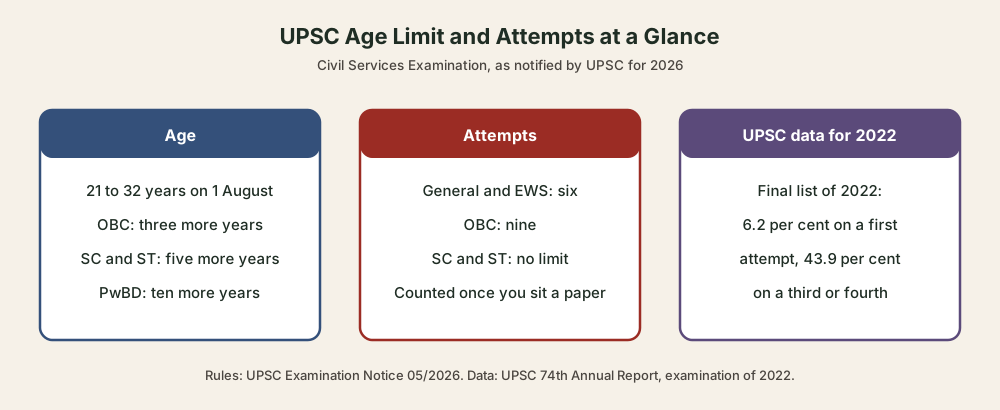
The UPSC age limit for the Civil Services Examination is 21 to 32 years on 1 August of the examination year, relaxed by three years for OBC, five for SC and ST and ten for persons with benchmark disabilities. The number of attempts is six for General and EWS candidates, nine for OBC and unlimited for SC and ST. This guide sets out each rule from the official notice and then uses UPSC's own statistics to show in which attempt, and at what age, candidates reach the final list for the IAS, IPS, IFS and the other services.
UPSC Age Limit: 21 to 32 Years on 1 August
IAS Age Limit: Minimum and Maximum Age Under the 2026 Notice
The UPSC age limit for the Civil Services Examination has two ends. A candidate must have attained the age of 21 years and must not have attained the age of 32 years on 1 August of the examination year. For the 2026 examination, the notice translates this into dates of birth: not earlier than 2 August 1994 and not later than 1 August 2005.
Two points follow from the wording. The upper limit is crossed on the 32nd birthday itself, so a candidate who turns 32 on or before 1 August is over age unless a relaxation applies. The lower limit is a completed age, so a candidate who turns 21 on 2 August has to wait for the next examination.
This limit of 32 is the UPSC age limit for General category candidates, and it applies equally to candidates of the Economically Weaker Sections (EWS). Every relaxation described below is added to this base figure; none of them changes the minimum age of 21. The same limits apply to the IAS age limit, the IPS and the IFS, because all of them are filled from this one examination.
Cut-off Date for 2027 and the Official Examination Calendar
Each annual notice fixes the age with reference to 1 August of that examination year. The notice for 2027 has not been issued yet, so its dates of birth cannot be quoted. UPSC's Programme of Examinations for 2027 does give the schedule for that year.
| Event | Date |
|---|---|
| Notification | 13 January 2027 |
| Last date for applications | 2 February 2027 |
| Preliminary Examination | 23 May 2027 (Sunday) |
| Main Examination begins | 20 August 2027 (Friday), five days |
A candidate planning for 2027 should therefore test eligibility against 1 August 2027 as a working assumption, and confirm it on the day the notice appears. Until then, the 2026 rules set out here are the latest official position.
Category-wise Age Relaxation and Upper Age Limits
UPSC Age Limit for OBC, SC, ST, PwBD and Ex-servicemen
The notice relaxes only the upper age limit, and only for the groups it lists. The last column adds each relaxation to the base limit of 32 and shows the age a candidate must not have attained on 1 August.
| Category | Extra years | Upper age limit |
|---|---|---|
| General and EWS | None | 32 years |
| Other Backward Classes (eligible for reservation) | Up to 3 years | 35 years |
| Scheduled Castes and Scheduled Tribes | Up to 5 years | 37 years |
| Defence Services personnel disabled in operations and released | Up to 3 years | 35 years |
| Ex-servicemen, including ECOs and SSCOs with at least five years of military service | Up to 5 years | 37 years |
| Persons with Benchmark Disabilities (PwBD) | Up to 10 years | 42 years |
The OBC relaxation is available only to candidates who are eligible to avail of reservation as OBC, and the notice requires an OBC (Non-Creamy Layer) certificate in support. The PwBD relaxation covers five groups: blindness and low vision; deaf and hard of hearing; locomotor disability; autism, intellectual disability, specific learning disability and mental illness; and multiple disabilities.
A PwBD candidate who uses the relaxation must still meet the physical and medical standards of the service to be allocated. The notice closes the list with a firm sentence: save as provided, the age limits can in no case be relaxed.
Cumulative Relaxation for Two Categories
A candidate can fall in two listed groups at once. The notice allows cumulative age relaxation to an SC, ST or OBC candidate who is also an ex-serviceman or a person with benchmark disability. The two relaxations are then added together.
| Candidate | Years added | Upper age limit |
|---|---|---|
| OBC and PwBD | 3 years and 10 years | 45 years |
| SC or ST and PwBD | 5 years and 10 years | 47 years |
| OBC and ex-serviceman | 3 years and 5 years | 40 years |
| SC or ST and ex-serviceman | 5 years and 5 years | 42 years |
The cumulative rule is written for SC, ST and OBC candidates. A General or EWS candidate with a benchmark disability receives the PwBD relaxation of ten years alone, which gives an upper limit of 42.
To check a date of birth by hand, work out the age on 1 August of the examination year and compare it with the last column of the two tables above. The candidate must have attained 21 and must not have attained the figure shown for the category.
UPSC Age Limit for Female and EWS Candidates
For the UPSC age limit for female candidates the answer is short: the notice lists no separate age limit and no age relaxation for women. A woman candidate's limit is set by her category, exactly as it is for a man: 32 for General and EWS, 35 for OBC, and 37 for SC and ST.
Women candidates do receive a fee exemption. The Preliminary Examination fee is Rs 100 and the further fee for the Main Examination is Rs 200; women, SC, ST and PwBD candidates are exempt from both. The EWS category carries a reservation in vacancies, but the notice gives it neither extra years nor extra attempts.
Date of Birth Proof Accepted by UPSC
Matriculation Certificate as Proof and the No-Change Rule
UPSC accepts the date of birth entered in the Matriculation or Secondary School Leaving Certificate, or in an equivalent certificate such as a Higher Secondary certificate or a university's certified extract of matriculates. The certificate is submitted at the time of applying.
The notice rejects other documents by name: horoscopes, affidavits, birth extracts from a municipal corporation and service records are not accepted. A candidate whose Class 10 certificate carries a wrong date has to get it corrected by the board before applying, because UPSC reads only that record.
Once a date of birth is entered in the Universal Registration Profile and the Common Application Form, and recorded by the Commission, no change is allowed later or at any other UPSC examination, on any ground. A careless digit at registration can therefore end a candidature years afterwards, which makes this the first field to verify against the certificate.
Number of Attempts in UPSC by Category
UPSC Attempts Limit for General, EWS, OBC, SC, ST and PwBD
Every eligible candidate is permitted six attempts at the Civil Services Examination. The notice then relaxes the number for some categories, and it keeps every figure subject to Rule 12 of the Civil Services Examination Rules, 2026.
| Category | Number of attempts |
|---|---|
| General (GL) | 6 |
| Economically Weaker Sections (EWS) | 6 |
| Other Backward Classes (OBC) | 9 |
| Scheduled Castes and Scheduled Tribes | Unlimited |
| PwBD belonging to General, EWS or OBC | 9 |
| PwBD belonging to SC or ST | Unlimited |
Attempts and age work together. An SC or ST candidate has no ceiling on attempts, yet the upper age of 37 still ends eligibility. A General candidate has six attempts across as many as eleven examinations between the ages of 21 and 31, and an OBC candidate nine across as many as fourteen. The attempt count is therefore the tighter limit for General, EWS and OBC candidates, and the age limit the only one for SC and ST candidates.
Definition of an Attempt in the Notice
The notice defines an attempt in three notes, and each of them matters for planning.
- Prelims counts: An attempt at the Preliminary Examination is deemed to be an attempt at the Civil Services Examination.
- One paper is enough: A candidate who actually appears in any one paper of the Preliminary Examination is deemed to have made an attempt.
- Later cancellation does not restore it: The fact of appearance counts as an attempt even if the candidature is afterwards disqualified or cancelled.
The definition turns on appearance. The notice does not list the filing of an application as an attempt, and UPSC's own figures show how many applicants stop there: in 2022, 49.5 per cent of those who applied did not sit the Preliminary Examination. A candidate who walks into Paper I and leaves before Paper II has, however, spent one of the six.
UPSC Data on Attempts and Age of Selected Candidates
Attempts Taken by Successful Candidates in 2022
Every figure in this section describes the final list of the Civil Services Examination: the candidates whom UPSC recommends for appointment after the Main Examination and the Personality Test. It is one common list. The notice for 2026 names 23 services that are filled from it: the Indian Administrative Service, the Indian Foreign Service and the Indian Police Service, fifteen Group 'A' services such as the Indian Revenue Service and the Indian Audit and Accounts Service, and five Group 'B' services.
The service a candidate finally receives depends on rank, the preferences entered in the application, the category and the vacancies in each service. The February notice expected about 933 vacancies for 2026, and by the Prelims result in June UPSC put the notified figure at 1,016 vacancies; in 2022, it recommended 1,020 candidates against 1,022 vacancies. The Annual Report counts attempts and ages for this whole list and does not separate them by service, so the percentages below are for selection to the civil services as a whole, not to the IAS alone.
Rules say how many attempts are allowed; they do not say how many are usually needed. UPSC answers that in its Annual Report, which profiles every candidate of the 2022 examination by the number of attempts made. The figures below come from UPSC's 74th Annual Report, Appendix 9.
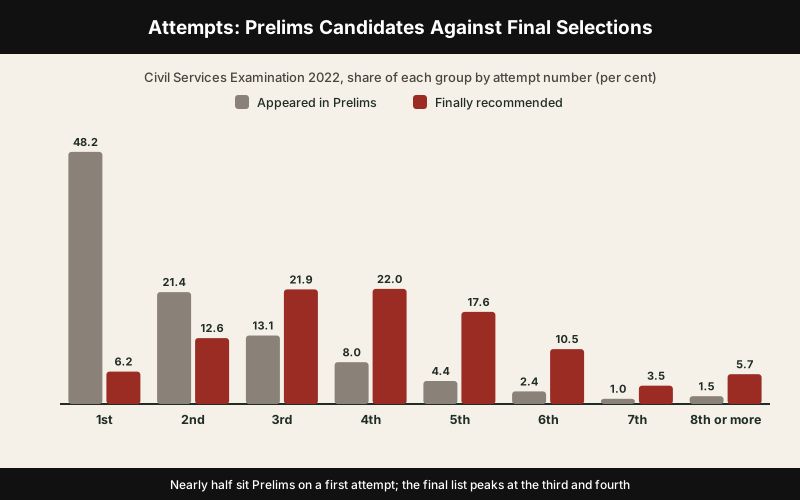
The two sets of bars move in opposite directions. Of the candidates who sat Prelims, 48.2 per cent were on a first attempt, but first-attempt candidates made up only 6.2 per cent of the 1,020 in the final list. The third and fourth attempts together produced 43.9 per cent of the final list, and 40.7 per cent of all selections had come by the third attempt.
| Attempt | Selected | Share of the list |
|---|---|---|
| 1st | 63 | 6.2 per cent |
| 2nd | 129 | 12.6 per cent |
| 3rd | 223 | 21.9 per cent |
| 4th | 224 | 22.0 per cent |
| 5th | 180 | 17.6 per cent |
| 6th | 107 | 10.5 per cent |
| 7th | 36 | 3.5 per cent |
| 8th or more | 58 | 5.7 per cent |
| Total | 1,020 | 100 per cent |
General Category Selections Within Six Attempts
For a General candidate the ceiling is six, so the General figures matter most. Taking men and women together, there were 410 recommended General candidates: 33 in a first attempt, 58 in a second, 126 in a third, 87 in a fourth, 64 in a fifth and 36 in a sixth. The remaining 6 used a seventh or later attempt, which is open only to General candidates with a benchmark disability.
In percentages, the third attempt is the peak at 30.7 per cent, and 52.9 per cent of General selections had been made by the third attempt. Only 8.8 per cent came in the sixth. The figures describe one examination year, not a law, but they do not support the idea that a General candidate typically needs all six attempts.
Age Profile at Prelims and at Final Selection
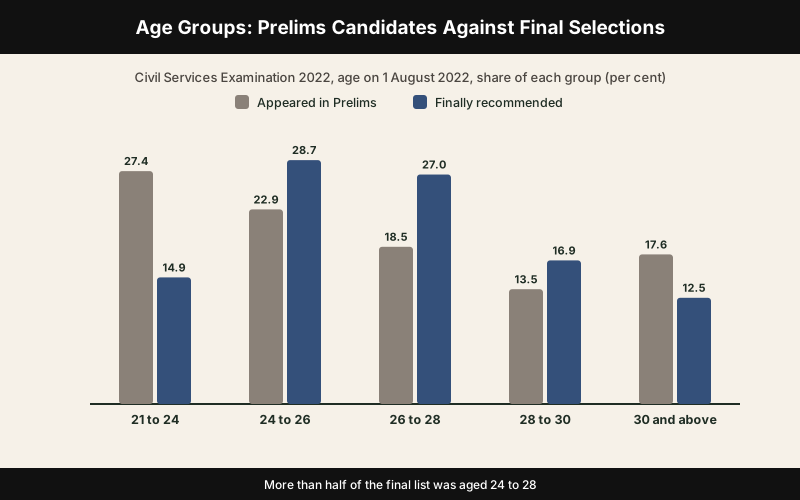
The youngest group, 21 to 24, is the largest at Prelims with 27.4 per cent of candidates, yet it supplies 14.9 per cent of the final list. The groups 24 to 26 and 26 to 28 supply 28.7 and 27.0 per cent, which is more than half of all selections between them. Candidates aged 30 and above account for 12.5 per cent.
Read with the attempts table, the pattern is consistent. The likely reading is that many candidates first sit the examination soon after graduation, and that the selections arrive two to four years later, after the syllabus has been covered and revised more than once. The report also records that women succeeded at a higher rate: 14.8 per cent of women who wrote the Main Examination were recommended, against 6.4 per cent of men.
From Application to Final List in 2022
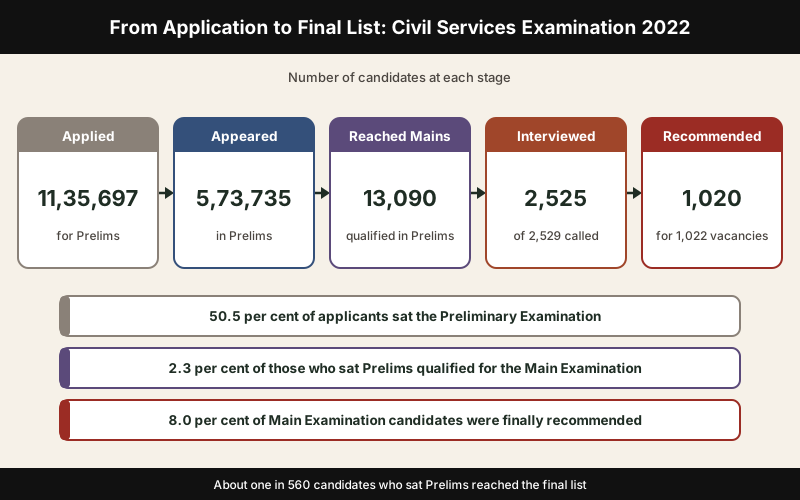
The narrowest gate is the first one. Only 13,090 of the 5,73,735 candidates who sat Prelims, or 2.3 per cent, qualified for the Main Examination, while 8.0 per cent of Main Examination candidates reached the final list and 40.4 per cent of those interviewed were recommended. An attempt is therefore most often lost at the Preliminary stage, which is the stage that rewards broad, accurate coverage of the syllabus.
Planning Attempts From the Rules and the Data
Timing of the First Attempt
Three facts from this page point the same way. An attempt is spent by sitting a single Prelims paper; first-attempt candidates are nearly half the hall but a small part of the final list; and a General candidate has only six. Appearing to see what the paper looks like is therefore an expensive way to learn something that past papers show for free.
A sound rule is to sit the first attempt in the year when the Prelims syllabus has been covered once and revised, and when timed full-length tests are returning scores near the recent qualifying mark. Until then, the application can be skipped, or filed and not used, without the loss of an attempt. This is advice drawn from the figures, not a UPSC rule.
Eligibility Self-check Before Applying
- Age: Work out the age on 1 August of the examination year from the Class 10 certificate, then add the relaxation for the category.
- Category documents: An OBC candidate needs a valid non-creamy layer certificate, and every reserved-category candidate the certificate for that claim, in the format and for the period the notice specifies.
- Attempts used: Count every year in which at least one Prelims paper was written, including years in which the candidature was later cancelled.
- Degree: A degree from a recognised university, or a final-year examination whose result will be out by the time the rules require proof of passing.
- Registration details: Match the name and date of birth in the registration profile with the matriculation certificate before the final submission.
UPSC Eligibility Criteria: Degree, Nationality and Service Restrictions
Graduate Degree and Final-year Students
The minimum qualification is a graduate degree from a university incorporated by an Act of the central or a State legislature, an institution established by an Act of Parliament, a deemed university, or an equivalent qualification. No minimum percentage and no particular subject is prescribed.
Students in the final year of a degree may sit the written examination. A candidate declared qualified for the Personality Test must then produce proof of passing, such as the degree, final mark sheet or provisional certificate, within the time the rules prescribe. Candidates with MBBS or an equivalent degree are admitted provisionally before the internship ends, but must show completion of the internship at the interview stage.
Nationality Conditions for IAS, IFS, IPS and Other Services
For the Indian Administrative Service, the Indian Foreign Service and the Indian Police Service, a candidate must be a citizen of India. For the other services the notice also admits a subject of Nepal or Bhutan, a Tibetan refugee who came to India before 1 January 1962 to settle permanently, and a person of Indian origin who has migrated from specified countries to settle permanently, each with a certificate of eligibility from the Government of India.
Candidates Already Allotted a Service
A serving member of the IAS or the IFS, appointed on the result of an earlier examination, cannot appear again. A candidate already selected or appointed to the IPS cannot opt for, or be allocated to, the IPS again. These restrictions narrow the practical value of the remaining attempts for candidates who have already been placed.
A candidate allocated to the IPS or a Central Service Group 'A' through the 2026 examination may appear in 2027 only with a one-time exemption from joining training, and cannot appear in 2028 or later without resigning from the allocated service. The notice sets out the consequences for seniority and for the earlier allocation in detail, and a selected candidate should read that paragraph in the original.
Common Questions About the UPSC Age Limit and Attempts
What is the IAS age limit?
The same as the UPSC age limit, because the IAS is filled from the Civil Services Examination: 21 to 32 years on 1 August for General and EWS candidates, up to 35 for OBC, 37 for SC and ST and 42 for persons with benchmark disabilities.
Is there a separate UPSC age limit for female candidates?
No. The limits are the same as for men of the same category: 32 for General and EWS, 35 for OBC and 37 for SC and ST, each reckoned on 1 August of the examination year. The only concession the notice gives women as a group is the exemption from the examination fee.
Are attempts counted separately for Prelims and Mains?
No, there is a single count. Each appearance in the Preliminary Examination uses one attempt at the Civil Services Examination as a whole, whether or not the candidate reaches the Main Examination that year. There is no separate allowance of attempts for the Main Examination or the Personality Test.
Does applying without appearing count as an attempt?
No. The notice counts an attempt from actual appearance in any one Prelims paper. An application that is never used is not listed as an attempt. A candidate who is unprepared after applying loses the fee, if one was payable, but not an attempt.
Can I change my category after applying?
Not in the ways that matter. The relaxations in age and attempts follow the category claimed in the application, and the notice makes that claim hard to alter. A request to change from the unreserved category to a reserved one is not entertained, and neither is a change from one reserved category to another, such as OBC to EWS.
Certificates must be held in the prescribed format by the closing date of the application. For the 2026 examination, the OBC non-creamy layer certificate had to rest on income for the three financial years 2022-23 to 2024-25, and OBC status is determined as on the closing date. A candidate should therefore claim a category only when the certificate for it is already in hand.
Official Sources
- Union Public Service Commission: Examination Notice No. 05/2026-CSE, Civil Services Examination 2026
- Union Public Service Commission: 74th Annual Report 2023-24 (Appendix 9, profile of candidates, Civil Services Examination 2022)
- Union Public Service Commission: Programme of Examinations and Recruitment Tests 2027
- Union Public Service Commission: press note of 18 June 2026, result of the Civil Services (Preliminary) Examination 2026
- Department of Personnel and Training: Gazette notifications (the Civil Services Examination Rules are notified here each year)
- Union Public Service Commission: online registration and application portal
- Department of Empowerment of Persons with Disabilities: Rights of Persons with Disabilities Act, 2016, rules and guidelines
- National Commission for Backward Classes: Central List of Other Backward Classes, State-wise
- Department of Ex-servicemen Welfare, Ministry of Defence
- Wikipedia: Civil Services Examination
Editorial Disclaimer
This guide explains the eligibility rules in the official notice for the Civil Services Examination and statistics from the Annual Report of the Commission. The notice and the examination rules published in the Gazette of India are the final authority, and the rules for a later year apply only as the Commission notifies them.