


Overview
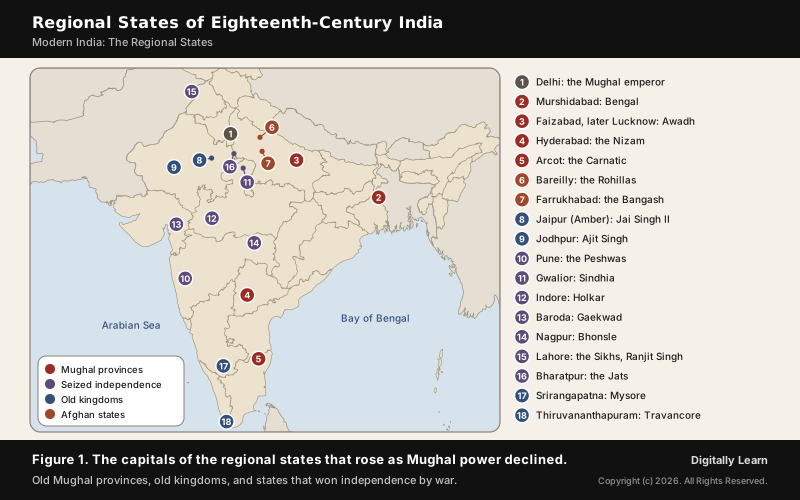
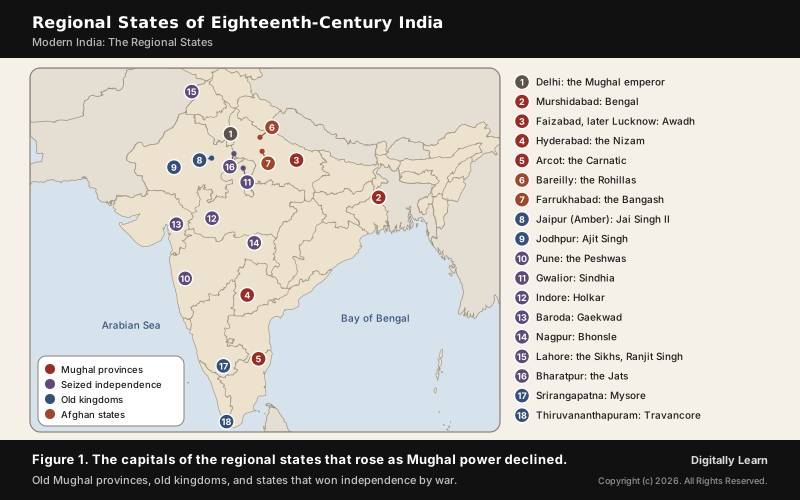
The successor states of the Mughal Empire were the regional kingdoms that grew out of Mughal provinces in the eighteenth century, chiefly Bengal, Awadh and Hyderabad, founded by governors who kept a formal tie to the emperor while ruling on their own. Beside them rose the Rajput kingdoms, the states that won independence by war, those of the Marathas, Sikhs and Jats, and in the south Mysore and Travancore. Together they turned a single empire into a crowd of regional powers.
Rise of Regional States in 18th-Century India at a Glance
Why Regional States Rose as Mughal Power Declined
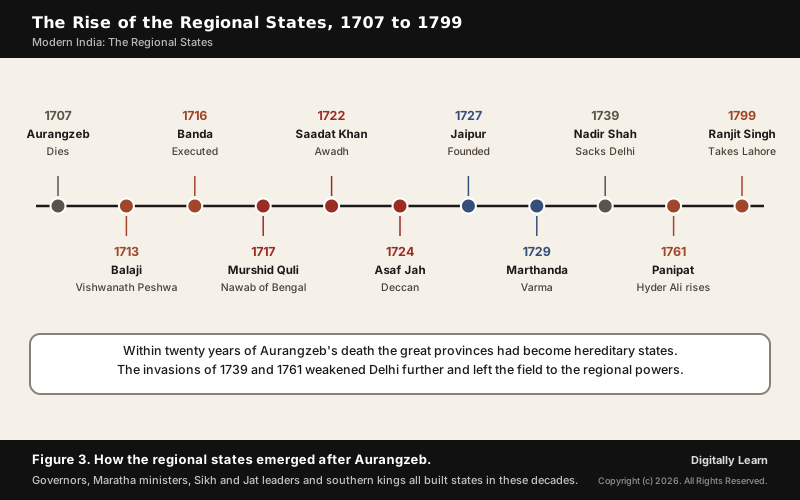
After the death of Aurangzeb in 1707 the Mughal empire did not vanish, but its centre lost its hold. Governors of large provinces (subadars) and great zamindars consolidated their own authority, and through the eighteenth century the empire broke up into a number of independent regional states. Several pressures drove the break-up:
- Faction at court: The nobles split into two groups, the Iranis and the Turanis, and the later emperors became puppets of one or the other. Farrukhsiyar and Alamgir II were assassinated, and Ahmad Shah and Shah Alam II were blinded by their nobles.
- An empty treasury: Nobles could no longer collect the revenue of their jagirs or pay their soldiers, so the army on which the empire rested weakened.
- Invasion: Nadir Shah of Iran sacked Delhi in 1739 and carried off immense wealth, including the Peacock Throne, and the Afghan ruler Ahmad Shah Abdali invaded north India five times between 1748 and 1761.
Three Groups of Regional States: Successor States, Watan Jagirs and Rebel States
The states of the eighteenth century fall into three overlapping groups, the grouping used in the NCERT chapter on eighteenth-century political formations:
- Old Mughal provinces: Awadh, Bengal and Hyderabad. Their rulers were extremely powerful and quite independent but did not break their formal ties with the Mughal emperor. These are the successor states.
- Watan jagirs: States that had enjoyed considerable independence under the Mughals as hereditary holdings, above all the Rajput principalities.
- States that seized independence: Those of the Marathas, the Sikhs and the Jats, won from the Mughals after a long armed struggle.
Two more kinds of state complete the picture. In the south, Mysore and Travancore grew into strong kingdoms of their own, and in the Ganga plain Afghan chiefs founded the Rohilla and Bangash states. The table and map place each one.
| State | Founder or leading ruler | Capital | Group |
|---|---|---|---|
| Bengal | Murshid Quli Khan, Nawab 1717 to 1727 | Murshidabad | Old Mughal province |
| Awadh | Saadat Khan Burhan-ul-Mulk, from 1722 | Faizabad, later Lucknow | Old Mughal province |
| Hyderabad | Nizam-ul-Mulk Asaf Jah, from 1724 | Hyderabad | Old Mughal province |
| Carnatic | Nawabs of Arcot, subah from 1692 | Arcot | Mughal province under the Nizam |
| Amber (Jaipur), Jodhpur | Sawai Jai Singh II, Ajit Singh | Jaipur, Jodhpur | Rajput watan jagirs |
| Maratha empire | The Peshwas, from Balaji Vishwanath (1713) | Pune | Seized independence |
| Sikh misls, then Punjab | Banda Bahadur, the misls, Ranjit Singh | Lahore from 1799 | Seized independence |
| Jat state | Churaman, Suraj Mal | Bharatpur | Seized independence |
| Rohilkhand | Ali Mohammed Khan | Bareilly region | Afghan state |
| Farrukhabad | Muhammad Khan Bangash | Farrukhabad | Afghan state |
| Mysore | The Wodeyars, then Hyder Ali (1761) | Srirangapatna | Southern kingdom |
| Travancore | Marthanda Varma, 1729 to 1758 | Padmanabhapuram, Thiruvananthapuram from 1745 | Southern kingdom |
Successor States of the Mughal Empire: Hyderabad, Awadh and Bengal
Hyderabad: Nizam-ul-Mulk Asaf Jah
One of the most powerful nobles at the court of Farrukhsiyar, Nizam-ul-Mulk Asaf Jah, was first made governor of Awadh and later given charge of the Deccan. He helped the emperor Muhammad Shah remove the Sayyid brothers, the kingmakers of the day, served as grand vizier from 1722 to 1724, and then turned against the court. In 1724 he defeated Mubariz Khan, sent against him on the emperor's secret orders, at the battle of Shakarkheda on 11 October; Muhammad Shah had to recognise him as viceroy of the Deccan, and he became, in effect, the ruler of an independent Hyderabad and founder of the Asaf Jahi line of Nizams.
Asaf Jah brought skilled soldiers and administrators from northern India, appointed mansabdars and granted jagirs. He remained, in name, a servant of the emperor, but he took his decisions without seeking directions from Delhi, and the emperor merely confirmed them. His state fought a constant struggle with the Marathas to the west and with independent Telugu warrior chiefs, the nayakas, and its ambition to control the rich textile-producing Coromandel coast was checked by the British. He died in 1748.
Awadh: Saadat Khan Burhan-ul-Mulk and the Nawabs
Titled Burhan-ul-Mulk, Saadat Khan was appointed subadar of Awadh in 1722 and founded one of the most important states to come out of the Mughal break-up. Awadh was prosperous: it controlled the rich alluvial Ganga plain and the main trade route between north India and Bengal. Saadat Khan held the combined offices of subadari, diwani and faujdari, so he managed the political, financial and military affairs of the province together.
He set out to reduce Mughal influence in Awadh:
- He cut the number of Mughal-appointed jagirdars and the size of jagirs, and put his own loyal servants in vacant posts.
- He had the jagirdars’ accounts checked and the revenue of every district reassessed by the Nawab’s own officials.
- He seized a number of Rajput zamindaris and the fertile lands of the Afghans of Rohilkhand.
- He sold the right to collect tax to the highest bidders, the ijaradars, with local bankers guaranteeing their payments.
The Nawabs first held court at Faizabad; Nawab Asaf-ud-Daula moved the capital to Lucknow in 1775, which is why they are often called the Nawabs of Lucknow.
Bengal: Murshid Quli Khan and Alivardi Khan
Bengal slipped away from Mughal control under Murshid Quli Khan. Aurangzeb sent him to Bengal as diwan around 1700, and he returned in 1710 as naib, deputy to the governor. He soon held all the power of the subadar's office, and in 1717 Farrukhsiyar made him Nawab; he ruled until his death in 1727 from Murshidabad, the city named after him.
Like the rulers of Awadh and Hyderabad, he took charge of the revenue administration. He transferred the Mughal jagirdars to Orissa and ordered a major reassessment of Bengal's revenue, collected in cash and with great strictness. Many zamindars had to borrow from bankers and moneylenders, and those who could not pay sold their lands to larger zamindars. Under Alivardi Khan (1740 to 1756) the banking house of the Jagat Seths became extremely prosperous. His successor, Siraj-ud-Daulah, faced the British at Plassey.
Common Features of the Successor States: Jagirs, Revenue Farming and Bankers
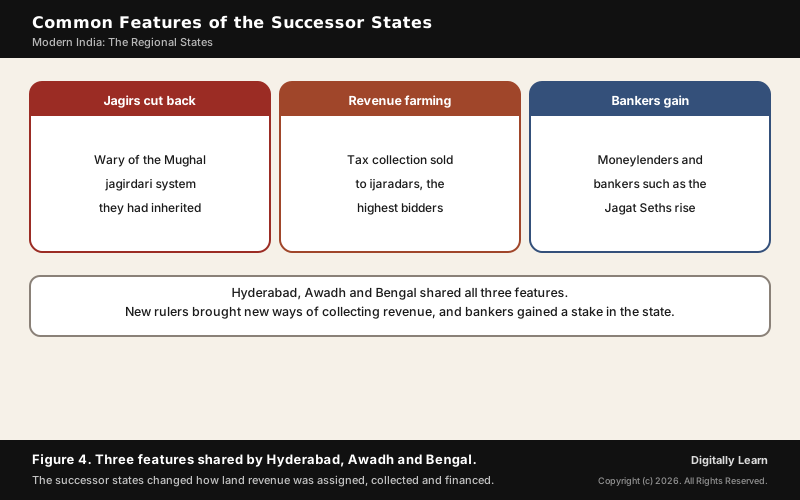
Looked at together, Hyderabad, Awadh and Bengal show three common features:
- Suspicion of the jagirdari system: Though founded by Mughal nobles, they distrusted the jagirdari system they had inherited and cut it back.
- Revenue farming: Instead of relying on state officers, all three contracted with revenue farmers. The practice of ijaradari, which the Mughals had disapproved of, spread all over India in the eighteenth century.
- Bankers and merchants: Rich bankers and merchants lent money to revenue farmers, received land as security and collected taxes through their own agents, gaining a stake in the new political order.
Carnatic, Rohilkhand and Farrukhabad: Other States of the Mughal Break-Up
Smaller states also grew out of the old empire:
- The Carnatic (Arcot): Aurangzeb made Zulfiqar Khan the first subahdar of the Carnatic, with his seat at Arcot, in 1692. As Mughal power waned the subah became an independent nawabi south of the Krishna, whose ruler Saadatullah Khan moved the court from Gingee to Arcot. It stayed nominally under the Nizam of Hyderabad, but it was older than Hyderabad State and did not grow out of it.
- Rohilkhand: Rohilla chiefs, Afghans from the Roh region, settled in Katehr in the 1720s, the first of them Ali Mohammed Khan, and the land came to be called Rohilkhand. It was carved from Mughal territory, not from lands of Ahmad Shah Durrani, though the Rohilla chief Najib-ud-Daula later joined Abdali and helped him win at Panipat in 1761.
- Farrukhabad: Muhammad Khan Bangash, a Mughal commander, became the first Nawab of Farrukhabad on the jagir he was granted.
Rajput Watan Jagirs: Amber and Jodhpur
Sawai Jai Singh of Amber and Ajit Singh of Jodhpur
Many Rajput kings, especially those of Amber and Jodhpur, had served the Mughals with distinction and in return enjoyed considerable autonomy in their watan jagirs, their hereditary homelands. In the eighteenth century they tried to extend their control over neighbouring lands:
- Governorships: Raja Ajit Singh of Jodhpur held the governorship of Gujarat and Sawai Raja Jai Singh of Amber that of Malwa; the emperor Jahandar Shah renewed both offices in 1713.
- Territory: Nagaur was annexed to Jodhpur, and Amber seized large parts of Bundi.
- Jaipur: Jai Singh founded a new walled capital at Jaipur in 1727, was made subadar of Agra in 1722, and built the Jantar Mantar observatories.
Their expansion was checked from the 1740s, when Maratha campaigns into Rajasthan put severe pressure on these principalities.
States That Seized Independence: Marathas, Sikhs and Jats
The Marathas under the Peshwas
The Maratha kingdom rose out of sustained opposition to Mughal rule. Shivaji (1627 to 1680) had built a stable kingdom with the support of powerful warrior families, the deshmukhs. In the eighteenth century effective power passed to a family of Chitpavan Brahmanas who served Shivaji's successors as Peshwa, the principal minister, with Pune as their capital:
- Balaji Vishwanath (1713): Appointed Peshwa by Shahu, he secured Mughal recognition of Shahu as Shivaji’s rightful heir.
- Baji Rao I (1720): His appointment made the office hereditary. He defeated the Nizam at Palkhed, raided Delhi in 1737 and won Malwa after the battle of Bhopal the same year.
- Expansion: Malwa and Gujarat were taken by the 1720s; by the 1730s the Maratha king was accepted as overlord of the Deccan with the right to levy chauth and sardeshmukhi; after 1737 Maratha power reached Rajasthan, the Punjab, Bengal, Orissa and the south as tribute-paying lands.
- A confederacy: The great Maratha chiefs, Sindhia of Gwalior, Holkar of Indore, Gaekwad of Baroda and Bhonsle of Nagpur, built powerful armies and grew more independent of the Peshwa.
Expansion came at a price. The campaigns made other rulers hostile, and they did not support the Marathas at the third battle of Panipat in 1761. Yet Maratha rule also brought order: revenue demands were fitted to local conditions, agriculture and trade revived, and Ujjain and Indore grew into large commercial and cultural centres.
The Sikhs: Banda Bahadur, the Misls and Ranjit Singh
The organisation of the Sikhs into a political community in the seventeenth century helped them build a state in the Punjab. After Guru Gobind Singh's death in 1708 the Khalsa rose against Mughal authority under Banda Bahadur, whom the Guru had met at Nanded that year. They struck coins in the names of Guru Nanak and Guru Gobind Singh and set up their own administration between the Sutlej and the Jamuna, until Banda was captured in 1715 and executed in 1716.
- Jathas and misls: The Sikhs organised themselves in bands called jathas and, from 1748, in misls, a confederacy of twelve.
- Dal Khalsa and gurmatas: Their combined army was the dal khalsa; the whole body met at Amritsar at Baisakhi and Diwali to pass collective resolutions, the gurmatas.
- Rakhi: Protection for cultivators in return for a tax of 20 per cent of the produce.
- Sovereignty: They resisted the Mughal governors and then Ahmad Shah Abdali, and struck their own coin again in 1765.
By the late eighteenth century Sikh territory stretched from the Indus to the Jamuna under different rulers. Maharaja Ranjit Singh reunited them and made Lahore his capital in 1799.
The Jats: Churaman and Suraj Mal of Bharatpur
The Jats were prosperous agriculturists who consolidated their power in the late seventeenth and eighteenth centuries. Under Churaman (died 1721) they took control of lands west of Delhi, built a fortified base at Bharatpur, and came to dominate the region between Delhi and Agra, for a while acting as the virtual custodians of Agra. Towns such as Panipat and Ballabhgarh became trading centres in their lands.
Under Suraj Mal (1707 to 1763) Bharatpur became a strong state; he built the Lohagarh fort at Bharatpur, and when Nadir Shah sacked Delhi in 1739 many of the city's notables took refuge there. His son Jawahir Singh had 30,000 troops of his own and hired 20,000 Maratha and 15,000 Sikh troops to fight the Mughals. At Dig the Jats built an elaborate garden palace combining the styles of Amber and Agra.
Southern Kingdoms: Mysore and Travancore
Mysore under the Wodeyars and Hyder Ali
The kingdom of Mysore, ruled by the Wodeyars, began as a vassal of the Vijayanagara empire and asserted itself as Vijayanagara declined. Raja Wodeyar I wrested Srirangapatna from the Vijayanagara governor, with the tacit approval of Venkatapati Raya (Venkata II), who then ruled the diminished empire from Chandragiri.
In the eighteenth century real power passed to Hyder Ali, a soldier who rose to be dalavayi, commander-in-chief, under Krishnaraja Wodeyar II and by 1761 was the de facto ruler of Mysore. His son Tipu Sultan ruled from 1782 until he was killed in 1799. Both fought the British.
Travancore under Marthanda Varma
In the far south, Marthanda Varma (ruled 1729 to 1758) turned the state of Venadu into the kingdom of Travancore. He is best known for defeating the Dutch East India Company at the battle of Colachel in 1741. He broke the power of the old Nair nobility, the Ettuveetil Pillamar, and made trade in pepper and other goods a royal monopoly, which paid for his army. In 1745 he moved his capital from Padmanabhapuram to Thiruvananthapuram, where he built the Sri Padmanabhaswamy temple. His successor Rama Varma, known as Dharma Raja, ruled until 1798.
A Fragmented Polity on the Eve of British Conquest
Why the Regional States Could Not Stop the British
By the middle of the eighteenth century India was, in the words of a later Mains question, beset with the spectre of a fragmented polity. The regional states were often vigorous: revenue was reorganised, trade revived in Maratha lands, Jaipur was built, and Ujjain, Indore and Poona prospered. But their strengths did not add up to a common defence:
- Rivalry: Hyderabad fought the Marathas, the Marathas made enemies across the north, and no power would stand with the Marathas at Panipat in 1761.
- Divided loyalty: The successor states kept a formal tie to a powerless emperor, so there was no recognised centre to rally around.
- Dependence on bankers and revenue farmers: The same arrangements that paid for their armies gave merchants and bankers, such as the Jagat Seths, interests of their own.
- External blows: Nadir Shah in 1739 and Abdali between 1748 and 1761 drained Delhi and the Punjab.
Into this crowd of rival powers came the English East India Company, which could deal with each state in turn. The Carnatic wars and Plassey, and the wars with Mysore and the Marathas, show how.
Regional States of the 18th Century in UPSC Previous Year Questions
What UPSC Has Asked About the Eighteenth-Century States
UPSC's objective questions on this period test origins and founders: which state grew out of which, who led the Sikhs and the Marathas, and who ruled Vijayanagara when Mysore rose. The Mains question asks for an overall picture of the fragmented polity. The common trap is a wrong origin: a state said to grow out of a neighbour it was older than, or out of an invader's lands.
| Year | What the question asked | The point being tested |
|---|---|---|
| 2000 | Who streamlined the Maratha administration after Sambhaji | Balaji Vishwanath |
| 2004 | Statements on Banda Bahadur and the Sikh Gurus | Banda was made leader by Guru Gobind Singh |
| 2006 | Who ruled Vijayanagara when Raja Wodeyar founded Mysore | Venkata II |
| 2021 | Origins of Arcot, Mysore and Rohilkhand | Only Mysore emerged out of Vijayanagara |
Previous Year UPSC-CSE Questions
Previous Year UPSC-CSE Questions By the end you will be able to draft model answers for the following UPSC questions. Each question carries a collapsible framework showing how to approach it in the exam.
- UPSC Mains 2017 GS-IClarify how mid-eighteenth century India was beset with the spectre of a fragmented polity.
Answer outline: how to structure the answer
What the question asks, the main arguments, relevant examples and the direction of the conclusion. This is not a full model answer.
Introduction: Open with the dissolution of Mughal central authority into many regional powers.
Body (sub-themes to develop):
- Collapse of the centre: court factions, empty treasury, Nadir Shah (1739) and Abdali (1748 to 1761).
- Successor states (Bengal, Awadh, Hyderabad): independent in fact, loyal in name.
- Rajput watan jagirs and the states that seized independence (Marathas, Sikhs, Jats); Mysore and Travancore.
- Rivalry and no common centre: Marathas isolated at Panipat, Hyderabad against the Marathas, bankers with their own interests.
Conclusion: Conclude that a polycentric but divided India lay open to a determined external power.
- UPSC Prelims 2000 Prelims-GSWho among the following streamlined the Maratha administration after Sambhaji?
How to approach this Prelims question
Approach: Ask who first made the Peshwa's office the centre of Maratha government.
Trap to watch: Raja Ram was Shivaji's son and king, not the reforming minister.
Key facts to recall:
- (a) Raja Ram: wrong. The Maratha administration was streamlined by the Peshwa Balaji Vishwanath, not by Raja Ram.
- (b) Balaji Viswanath: right. He became Peshwa in 1713, secured recognition of Shahu and put the administration in order.
- (c) Ganga Bai: wrong. She was not the one who streamlined the Maratha administration; Balaji Vishwanath was.
- (d) Nanaji Deshmukh: wrong. The administration after Sambhaji was streamlined by Balaji Vishwanath, not by Nanaji Deshmukh.
Answer signal: Balaji Vishwanath streamlined the administration, so the answer is option (b).
- UPSC Prelims 2004 Prelims-GSConsider the following statements about Sikh Gurus:
- Banda Bahadur was appointed as the military leader of the Sikhs by Guru Tegh Bahadur.
- Guru Arjun Dev became the Sikh Guru after Guru Ram Das.
- Guru Arjun Dev gave to Sikhs their own script – Guru mukhi.
Which of the statements given above is/are correct?
How to approach this Prelims question
Approach: Check each statement against the order of the Gurus. Statement 1 is wrong, statement 2 is right, and statement 3 is open to doubt, so look for the option that drops 1 and keeps 2.
Trap to watch: Banda Bahadur was appointed by Guru Gobind Singh, not Guru Tegh Bahadur.
Key facts to recall:
- (a) 1 only: wrong. Statement 1 is wrong: Guru Gobind Singh, not Guru Tegh Bahadur, made Banda Bahadur the military leader, after they met at Nanded in 1708.
- (b) 2 and 3: right by UPSC's answer key. Guru Arjun Dev did follow Guru Ram Das. Statement 3 is in doubt: NCERT says Guru Angad wrote in the new Gurmukhi script, while Guru Arjun compiled the Gurus' compositions in 1604; the key reads the script as Guru Arjun's gift.
- (c) 1 and 3: wrong. Statement 1 is wrong.
- (d) 1 and 2: wrong. Statement 1 is wrong.
Answer signal: Answer in doubt on statement 3, but no option reads '2 only', so option (b), UPSC's key, is still the only one that drops the wrong statement 1 and keeps statement 2.
- UPSC Prelims 2006 Prelims-GSWhen Raja Wodeyar founded the kingdom of Mysore, who was the ruler of the Vijayanagar Empire?
How to approach this Prelims question
Approach: Recall the late Vijayanagara ruler at Chandragiri.
Trap to watch: Sadasiva and Tirumala ruled earlier, around and after Talikota (1565).
Key facts to recall:
- (a) Sadasiva: wrong. Raja Wodeyar acted with the approval of Venkatapati Raya, not Sadasiva.
- (b) Tirumala: wrong. Raja Wodeyar acted with the approval of Venkatapati Raya, not Tirumala.
- (c) Ranga II: wrong. Raja Wodeyar acted with the approval of Venkatapati Raya, not Ranga II.
- (d) Venkata II: right. Raja Wodeyar took Srirangapatna with the tacit approval of Venkatapati Raya, that is Venkata II.
Answer signal: Venkata II ruled Vijayanagara then, so the answer is option (d).
- UPSC Prelims 2021 Prelims-GSWith reference to Indian history, which of the following statements is/are correct?
- The Nizamat of Arcot emerged out of Hyderabad State.
- The Mysore Kingdom emerged out of Vijayanagara Empire.
- Rohilkhand Kingdom was formed out of the territories occupied by Ahmad Shah Durrani.
Select the correct answer using the code given below.
How to approach this Prelims question
Approach: Trace each state to the power it grew out of.
Trap to watch: The Carnatic subah (1692) is older than Hyderabad State (1724); Rohilkhand was carved from Mughal lands.
Key facts to recall:
- (a) 1 and 2: wrong. Statement 1 is wrong: Arcot was the Carnatic subah's seat from 1692, not an offshoot of Hyderabad State.
- (b) 2 only: right. The Mysore kingdom began as a vassal of the Vijayanagara empire.
- (c) 2 and 3: wrong. Statement 3 is wrong: the Rohillas settled Katehr in the 1720s, not in lands taken by Ahmad Shah Durrani.
- (d) 3 only: wrong. Statement 3 is wrong.
Answer signal: Only the Mysore statement is correct, so the answer is option (b).
Sources
- NCERT: Our Pasts II (Class VII), Eighteenth-Century Political Formations
- District Rangareddy (Government of Telangana): History
- District Thiruvananthapuram (Government of Kerala): History
- District Lucknow (Government of Uttar Pradesh): History
- Wikipedia: Murshid Quli Khan
- Wikipedia: Nawabs of Bengal and Murshidabad
- Wikipedia: Alivardi Khan
- Wikipedia: Awadh
- Wikipedia: Saadat Ali Khan I
- Wikipedia: Asaf Jah I
- Wikipedia: Hyderabad State
- Wikipedia: Nawab of the Carnatic
- Wikipedia: Rohilla
- Wikipedia: Najib ad-Dawlah
- Wikipedia: Muhammad Khan Bangash
- Wikipedia: Sawai Jai Singh II
- Wikipedia: Maratha Empire
- Wikipedia: Peshwa
- Wikipedia: Baji Rao I
- Wikipedia: Sikh Confederacy
- Wikipedia: Banda Singh Bahadur
- Wikipedia: Ranjit Singh
- Wikipedia: Churaman
- Wikipedia: Suraj Mal
- Wikipedia: Kingdom of Mysore
- Wikipedia: Hyder Ali
- Wikipedia: Tipu Sultan
- Wikipedia: Marthanda Varma
- Wikipedia: Kingdom of Travancore
- UPSC: Civil Services Examination question papers
Editorial Disclaimer
This article is prepared for UPSC examination preparation. Verify key facts and interpretations against standard reference histories before relying on them.